Law and Legislation Committee Special Meeting – October 3, 2023
STREAMING COPY IN PREPARATION — RECORDING AVAILABLE FROM THE ORIGINAL SOURCE
Law and Legislation Committee Special Meeting – October 3, 2023
The Law and Legislation Committee of the Sacramento City Council met in a special session on Tuesday, October 3, 2023, at 11:31 a.m. in the City Hall Council Chamber (915 I Street, Sacramento, CA 95814). The meeting, chaired by Councilmember Katie Valenzuela (District 4) and attended by Councilmembers Lisa Kaplan (District 1), Eric Guerra (District 6), and Rick Jennings II (District 7), addressed six agenda items. Key topics included modernization of the Business Operations Tax (BOT), an interim ordinance on commercial truck usage in North Sacramento, a digital kiosk policy, and an update on the audit of the Sacramento Community Police Review Commission (SCPRC). The meeting adjourned at 1:55 p.m.
Consent Calendar
- Motion by Councilmember Kaplan, seconded by Councilmember Guerra, adopted unanimously (4-0) with a voice vote, approving:
- The Law and Legislation Committee meeting minutes of August 15, 2023 and September 5, 2023 (File ID: 2023-01270).
- The Law and Legislation Log (File ID: 2022-02190).
- Councilmember Guerra requested that contract lobbyists provide a legislative wrap-up at the November hearing; Councilmember Jennings noted his absence on August 15, 2023, and asked that the minutes reflect that.
Public Comments & Testimony
- Item 3 (BOT): One public comment was received. Douglas Nelson, representing a local business and property owner, expressed concerns that increasing the business tax would unfairly penalize compliant businesses while unpermitted land uses (e.g., trucking operations on gravel lots) circumvent the system. He urged the city to enforce existing land-use regulations rather than raise taxes on responsible businesses.
- Item 4 (Commercial Truck Ordinance): Five public comments were received, all but one from business owners or attorneys:
- Nick Abdiscontre (attorney for Jensen Enterprises) and Ryan Hooper and Brian Manning (representing property owners) requested additional time for stakeholder outreach, arguing that the ordinance was not adequately publicized and would devalue property without addressing underlying environmental justice concerns. Brian Manning also raised potential Equal Protection Clause issues, noting the ordinance applies only to North Sacramento.
- Todd Sperber, a property owner, stated he had not received formal notice and requested more time to analyze the ordinance's impact.
- Keon Bliss, a resident of District 4 and SCPRC vice chair, spoke in support of the ordinance, arguing that residents in industrial areas lack resources to participate in public process and that businesses' legal challenges should not overshadow community health concerns.
- Sheridan Evans (Buzz Olds Construction) echoed concerns about insufficient financial impact analysis and the length and cost of conditional use permits (CUPs).
- Item 6 (SCPRC Audit): Two public comments were received:
- Keon Bliss, speaking as SCPRC vice chair, read a letter from the commission's chair and vice chair, Graciela Castillo-Kings and Keon Bliss, supporting the city auditor's findings and requesting clear delineation of roles, dedicated staff, and a pathway for recommendations to be heard. They highlighted that 146 of 147 SCPRC recommendations since 2018 remain unaddressed.
- Chief Bay, a community member, alleged racial profiling by the Sacramento Police Department and expressed frustration with lack of accountability, claiming a recent incident of ID confiscation.
Discussion Items
Item 3: Business Operations Tax (BOT) Modernization (File ID: 2023-01252)
- Staff Presentation: Peter Coletto (Finance Director) presented options to modernize the BOT. The current tax, established in 1975 and last updated in 1991, generates approximately $9 million annually from non-cannabis businesses. The tax has a regressive structure, with a $5,000 maximum cap, resulting in large businesses paying a smaller effective rate than small ones. Three options were presented:
- Option 1: Inflation adjustment only, raising the minimum threshold from $10,000 to $22,000, the cap to $11,405, and generating approximately $3 million in additional revenue.
- Option 2: Increase the rate from 0.04% to 0.06% and remove the cap, generating approximately $17 million in additional revenue, with the highest impact on businesses grossing over $100 million (only 37 firms).
- Option 3 (Staff Recommendation): Raise the threshold to $50,000 (minimum payment $50), increase the cap to $150,000, and generate approximately $6.5 million in additional revenue, protecting small and medium-sized businesses.
- Committee Discussion: Councilmember Kaplan favored option 3 but raised concerns about the cap increase to $150,000 and the impact on large businesses. Councilmember Guerra moved to support option 3**, with a provision to phase in the cap. He also requested analysis of the impact on minority grocers and collaboration with economic development. Chair Valenzuela suggested raising the threshold to $100,000 and creating a separate rate for grocery stores. The committee directed staff to explore these amendments and return with a refined proposal.
- Public Comment: One speaker (Douglas Nelson) expressed opposition to increasing taxes on compliant businesses, advocating for enforcement of existing land-use rules instead.
- Vote: Motion by Councilmember Guerra, seconded by Councilmember Kaplan, passed unanimously (4-0).
Item 4: Interim Ordinance – Commercial Truck Usage in North Sacramento (File ID: 2023-01180)
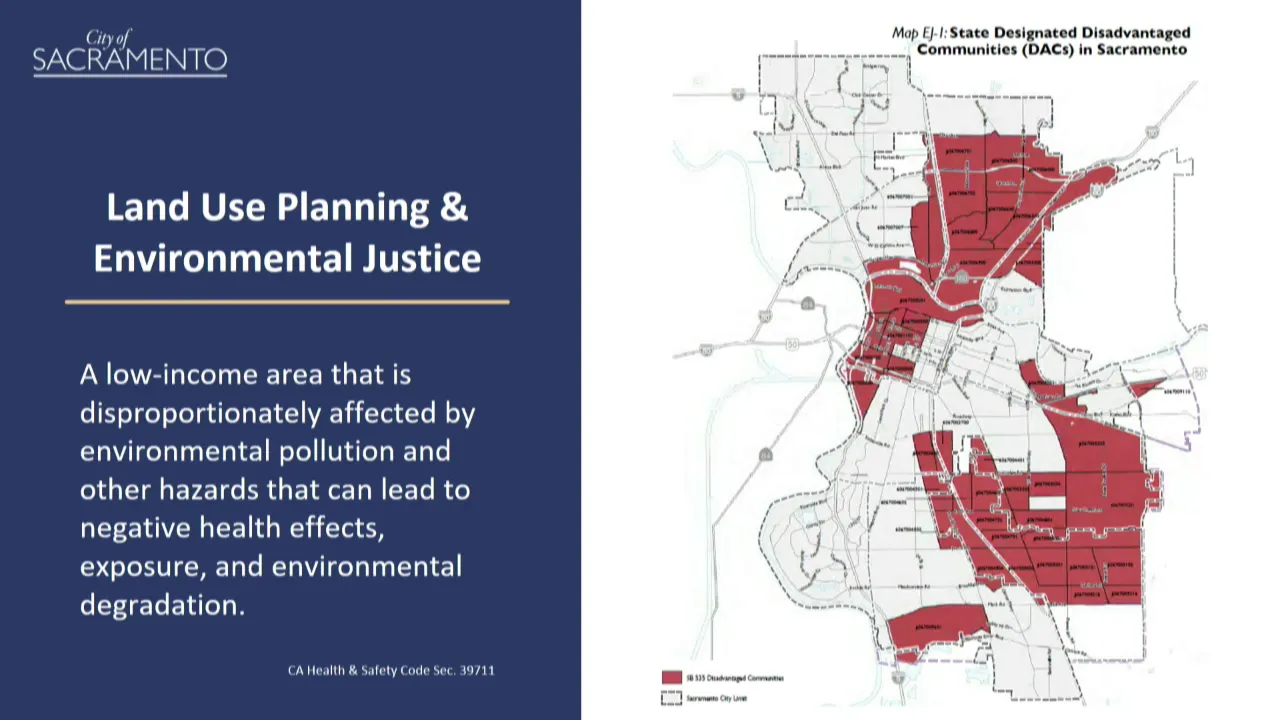
- Staff Presentation: Kevin Colin (Zoning Administrator) described an interim ordinance that would require a conditional use permit (CUP) for certain commercial truck-related uses (e.g., truck parking, contractor storage yards, warehouses) in industrial zones (M1, M1S, M2, MT) in North Sacramento, within a defined geographic area (north of Arden Way, south of Steelhead Creek) and within 1,000 feet of sensitive uses (homes, schools, etc.). The ordinance aimed to address environmental justice and land-use compatibility issues.
- Committee Discussion: Multiple members noted the necessity of a balance between protecting residents and not overburdening existing businesses. Concerns were raised about notification (standard mail, with 20 calls received out of 1,022 notices), the potential for property devaluation, and the need for a sunset clause. Councilmember Kaplan proposed narrowing the ordinance and holding stakeholder meetings before forwarding to City Council. Councilmember Guerra and Vice Chair Jennings supported a pilot approach with more dialogue. Chair Valenzuela emphasized the importance of community input, and the need for a privacy/surveillance policy if cameras are allowed.
- Vote: Motion by Councilmember Kaplan, seconded by Chair Valenzuela, passed unanimously (4-0), directing staff to conduct stakeholder outreach with Councilmembers Kaplan and Loloee (District 2) and to bring a revised draft to City Council.
Item 5: Digital Kiosk Policy (File ID: 2023-01171)
- Staff Presentation: Jamie Mosler (Associate Planner) presented the findings from community outreach (March 2023) and a proposed ordinance and resolution to permit digital kiosks in the public right-of-way. The ordinance would define digital kiosks, allow them on public property with city agreement, and permit advertising as a subordinate use. The resolution would guide the future procurement process, emphasizing multilingual content, accessibility, maintenance responsibility by the provider, and further outreach when locations are selected.
- Committee Discussion: Councilmember Guerra moved to forward the ordinance and resolution to City Council with amendments: (1) making cameras permissive (rather than prohibited) subject to a city-manager-approved privacy/surveillance policy; (2) adding language allowing for security cameras; (3) including considerations for electric vehicle charging infrastructure. Councilmember Kaplan and Vice Chair Jennings supported the amendments, with Councilmember Kaplan noting the importance of privacy protections and Councilmember Jennings supporting cameras for crime prevention. Councilmember Valenzuela expressed concern about privacy but supported the motion with adequate oversight.
- Vote: Motion by Councilmember Guerra, seconded by Chair Valenzuela, passed unanimously (4-0).
Item 6: Update on Audit of Sacramento Community Police Review Commission (File ID: 2023-00919)
- Staff Presentation: City Auditor Jorge Oseguera and Principal Policy Analyst Kevin Christensen presented an update on the 2021 audit of the SCPRC. The audit found three main findings, including unclear roles and responsibilities and insufficient staffing. They noted that the commission currently receives no dedicated functional support, and recommended that the City Council determine staffing and funding. The auditor's office will continue follow-up every six months.
- Committee Discussion: The committee discussed the need to clarify the commission's role, provide adequate staff, and strengthen the recommendation process. Chair Valenzuela proposed that the commission have a dedicated staff position and that the police department be required to consult with and attend commission meetings. Councilmember Kaplan noted that this item was for discussion only and emphasized consistency across all boards and commissions. Vice Chair Jennings recommended a joint workshop between the City Council and the SCPRC to build trust. Councilmember Guerra recalled prior commitments to staff OPSA and have police department representatives attend meetings.
- Action: The committee received and filed the report by consensus. No formal motion was made, but Chair Valenzuela directed staff to work on bringing draft code amendments to a future meeting.
Key Outcomes
- BOT Modernization: The committee unanimously directed staff to draft a ballot measure for the March 2024 election, incorporating a threshold increase (likely to at least $50,000, with consideration of $100,000), a cap increase to potentially $150,000, a phase-in option, a potential separate rate for grocery stores, and a recommendation for a 0.06% rate (option 2) or other modifications. The motion included a request for staff to return to the committee with a revised proposal before the October 31 (or November) City Council deadline.
- Commercial Truck Ordinance: The committee unanimously directed staff to continue stakeholder outreach and bring a revised draft that narrows the scope (likely focusing on areas with residential uses), includes a sunset provision, and applies lessons learned as a pilot, with eventual citywide consideration. The revised ordinance is expected to be brought back to City Council after refining details.
- Digital Kiosk Policy: The committee unanimously voted to forward the ordinance and resolution to City Council with amendments: making cameras permissive under a privacy policy, adding language for security cameras, and considering EV charging infrastructure.
- SCPRC Audit: The report was received and filed. The committee agreed to consider a future joint workshop with the SCPRC and to explore code amendments to clarify roles, staffing, and recommendation timelines, with an emphasis on consistency across all boards and commissions.
Meeting Transcript
And Chair Staff is good. All right. Welcome to the City of Sacramento City Council's Law and Legislation Committee meeting. Will the clerk please call the roll to establish a quorum? Thank you, Chair. Councilmember Gare? Here. Councilmember Jennings. Here. Councilmember Kaplan. Yeah. Chair Balance Willie. I am here. And Councilmember Kaplan, will you lead us in the land acknowledgement and pledge of allegiance? Absolutely. Everyone, please rise. Please rise for the opening acknowledgments in honor of Sacramento's indigenous people and tribal lands. To the original people of this land, the Nissanon people, the Southern Maidu, the Valley and Plains Maywalk, the Putwin Winton people, and the people of the Wilton Rancheria, Sacramento's only federally recognized tribe. May we acknowledge and honor the Native people who came before us and still walk beside us today on these ancestral lands by choosing to gather together today in the active practice of acknowledgement and appreciation for Sacramento's indigenous people's history, contributions, and lives. Thank you. Please stay standing for the pledge. Pledge. I pledge allegiance to the flag of the United States of America. And to free public forces. One nation under God, indivisible with liberty and justice for all. Thank you, everyone. Well, we are just going to keep trying to break records for the longest law and ledge agendas ever in the history of this council. So I hope folks will bear with us and take breaks when they need to. To start us off, uh first I want to make sure members of the public know that there are slips in the back. If you'd like to register to get public comment, you can return them to the clerk up here in the front of the room. And with that, we will start with our consent calendar items one and two. Do any of my colleagues have questions or comments on the consent? Move consent. Move it. And seconded. Do we have any public comment, Madam Clerk? We have no public comment. Thank you. I do uh have one request, madam chair. Um, and this is for our staff that after the uh conclusion of all actions from the governor, if we could have our um contract lobbyists come in and give a you know a wrap-up, legislative wrap up when appropriate in the November hearing. That would be great. Thank you. All right, um, hearing no other comment. Oh, sorry, go ahead, vice chair. Yeah, I just want to uh I want to support the consent calendar, but I want the record to show that I was absent on the 15th of uh of the month of the previous meeting. Okay. Is that an amendment to the minutes then? Yes. Okay, awesome. Uh I see the clerk taking studious notes over here, so thank you, Vice Chair.
openpublica.com