Sacramento Law and Legislation Committee Meeting - October 17, 2023
STREAMING COPY IN PREPARATION — RECORDING AVAILABLE FROM THE ORIGINAL SOURCE
Sacramento Law and Legislation Committee Meeting - October 17, 2023
The Law and Legislation Committee of the Sacramento City Council met on October 17, 2023, at 1:04 PM in the City Hall Council Chamber. The meeting was called to order by Chair Katie Valenzuela and adjourned at 2:38 PM. Members present included Eric Guerra (District 6), Rick Jennings (District 7), Lisa Kaplan (District 1), and Chair Valenzuela (District 4). The committee reviewed two consent items and two discussion items, including a proposed ordinance on Community Benefits Agreements and amendments to solid waste management codes.
Consent Calendar
- Item 1 – Law and Legislation Log (File ID 2022-02191): Approved by unanimous motion. The log tracks city legislative activities.
- Item 2 – Legislative Advocacy Correspondence (File ID 2023-01065): Received and filed by unanimous motion. This item documents city advocacy positions.
Public Comments & Testimony
- Tamika LaCluse (Vice President, Sacramento Investment Without Displacement – SIWD): Expressed strong support for a robust Community Benefits Agreement (CBA) ordinance, emphasizing that the current $10 million threshold is too high and that the ordinance must give residents a direct role in negotiations and enforcement. She urged the committee to forward the ordinance to the full City Council.
- Michelle Willard (Chief Public Affairs Officer, Greater Sacramento Economic Council): Opposed the CBA ordinance, stating it would reduce investment and job growth, particularly harming low-income and underserved communities. She cited national concerns that such agreements drive up construction costs and limit competition.
- Liz Williams (Downtown Sacramento Partnership): Opposed the ordinance as written, requesting an exemption for the central city and infill development. She warned that the policy could negatively impact transformative projects like the Rail Yards.
- Chris Noram (North State Building Industry Association): Expressed concerns about unclear language, particularly regarding the potential capture of routine housing projects and definitions of affordable housing. He requested further clarification before the ordinance proceeds to full council.
- Rashid Sadiq (SIWD member): Urged the committee to be bold and prioritize the needs of vulnerable residents over developer interests, stating that a CBA would lift all communities.
- Andrea Cow (Sacramento Asian Pacific Chamber of Commerce): Supported the CBA but requested inclusion of the Small Business Utilization Program (SBUC) to ensure local and minority-owned businesses can participate in city projects.
Discussion Items
Item 3 – Ordinance Adding Chapter 3.156: Community Benefits Agreements (File ID 2023-00557)
Staff presented a revised draft ordinance, required by the 2021 Aggie Square settlement agreement with SIWD. The ordinance would mandate a CBA for development projects receiving $10 million or more in city subsidies (consistent with Government Code 53083). Required elements include prevailing wage, local hire, and third-party beneficiary enforcement. Optional elements include small business support, anti-displacement, affordable housing, and transportation. Staff incorporated feedback from the April 2023 law and legislation meeting, adding a purpose section, adjusting the definition of affordable rent, clarifying bond exclusions, and specifying that the city manager’s policies include community input processes.
Committee discussion focused on several concerns raised by Vice Chair Jennings and others:
- Subsidy definition: The city attorney confirmed the definition aligns with the settlement agreement and cannot be narrowed without violating the agreement.
- $10 million threshold: Staff noted that only a few major projects (e.g., Golden One Center, Aggie Square) have exceeded this threshold historically. Councilmember Kaplan suggested the threshold should be adjusted annually for inflation every 24 months (starting in 2026) rather than the proposed 60 months.
- Housing exemptions: Councilmembers Kaplan and Guerra requested that standalone housing projects and master-planned communities be explicitly excluded to avoid conflicts with state housing law (SB 330) and to not hinder housing production. Chair Valenzuela noted that the city rarely provides $10 million subsidies to non-affordable housing projects.
- Third-party beneficiary: The city attorney explained that the settlement agreement requires the ordinance to include community enforcement through a third-party beneficiary, but the council may ultimately choose not to include it.
- Pipeline projects: Vice Mayor Guerra asked staff to define pipeline projects (e.g., Rail Yards, Innovation Park) and consider exemptions for fragile, long-term projects.
After extensive discussion, the committee voted unanimously to forward the ordinance to the full City Council, with the recommendation that it be considered in a workshop format to allow for robust debate. The motion also directed staff to:
- Clarify the definition of pipeline projects and potential exemptions.
- Provide an estimate of implementation costs.
- Consider adjusting the inflation trigger to 24 months.
Item 4 – Ordinance Amending Solid Waste Management Codes (File ID 2023-01287)
Staff presented updates to five chapters of the city code to comply with SB 1383 (short-lived climate pollutants) and to reflect the 2019 dissolution of the Sacramento Solid Waste Authority. Key changes include:
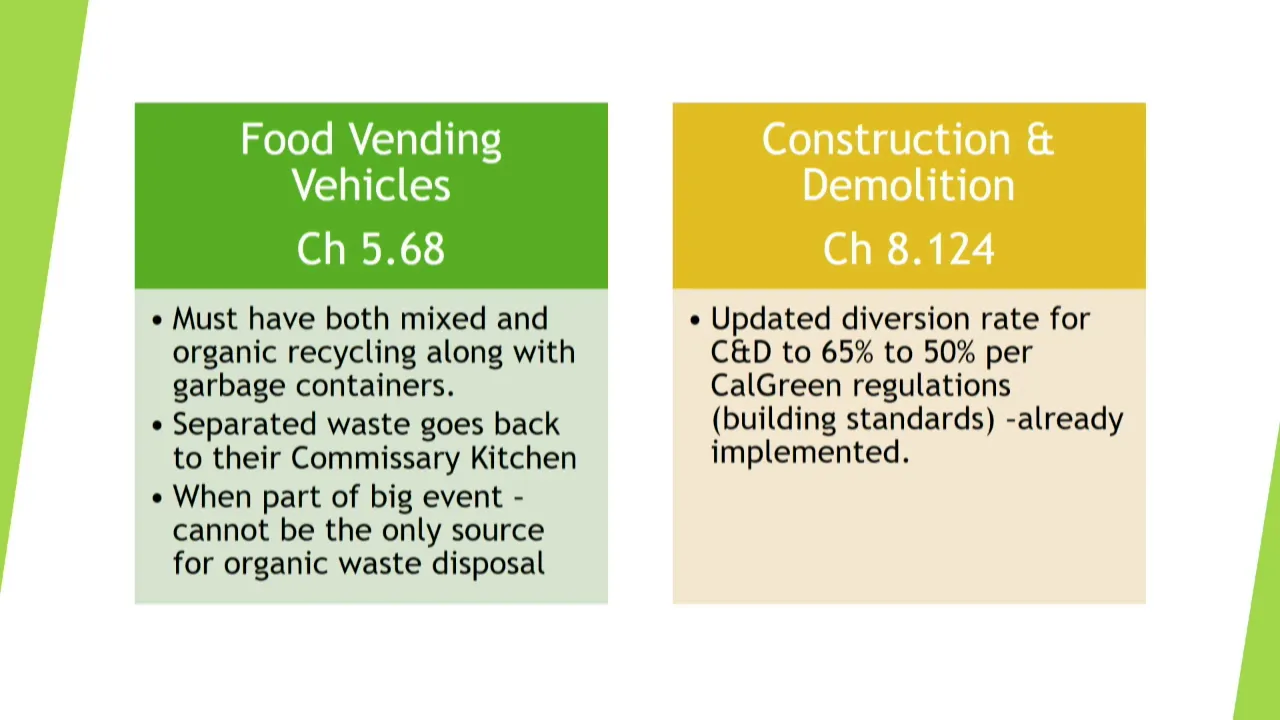
- Requiring food waste recycling at food trucks and special events.
- Increasing construction diversion rates from 50% to 65% (per CalGreen).
- Mandating waste plans for events with 500+ attendees and post-event reports for events with 2,000+ attendees.
- Codifying residential junk pickup appointment times and container storage rules.
- Updating commercial waste regulations, including customer service standards and franchise fee uses (now allowed for landfill maintenance at Sutter Landing Park and illegal dumping mitigation).
No public comments were received. Committee members discussed franchise fee allocation, the need for a coordinated approach to special events, and future opportunities for renewable energy from waste (e.g., hydrogen). Councilmember Kaplan urged a thoughtful rollout of food recovery requirements for tier-two generators. The committee voted unanimously to forward the ordinance to the City Council, with direction to further explore franchise fee use and SB 1383 implementation strategies.
Key Outcomes
- Consent Calendar (Items 1 & 2): Approved unanimously.
- Item 3 – Community Benefits Agreements: Motion to forward to City Council for a workshop passed unanimously (4-0). Staff was directed to refine definitions, assess costs, and consider inflation adjustments.
- Item 4 – Solid Waste Code Amendments: Motion to forward to City Council with additional staff direction on franchise fees and SB 1383 goals passed unanimously (4-0).
- Adjournment: The meeting adjourned at 2:38 PM.
Meeting Transcript
Okay. I'd like to call this meeting of the Sacramento City Council's Law and Legislation Committee to order. Will the clerk please call the role to establish a quorum? Thank you, Chair. Member Guerrero. Here. Councilmember Jennings? Councilmember Kaplan? Yeah. Chair Bellswell. I'm here. Vice Chair Jennings, would you please lead us in the land acknowledgement and pledge of allegiance? Be my pleasure. Would you please rise for the opening opening acknowledgments in honor of Sacramento's indigenous peoples and tribal lands? To the original people of this land, the Nision people, the Southern Maidu, the Valley and Plains Miwok, the Patwin Whiton peoples, and the peoples of the Wilton Rancheria, Sacramento's only federally recognized tribe. May we acknowledge and honor the Native people who came before us and still walk beside us today on these ancestral lands by choosing to gather together today in active practice of acknowledgement and appreciation for Sacramento's indigenous peoples' history, contribution, and lives. Please join me in the Pledge of Allegiance. I pledge allegiance to the flag of the United States of America and to the Republic for which it stands. One nation under God, indivisible, with liberty and justice for all. Thank you. Thank you, Vice Chair. And welcome everybody to the members of the public. As a quick housekeeping item as a reminder, if you'd like to make public comment on any items on today's agenda, there are comment slips in the back of the room, and you could submit them up here to the front to the clerk's table so that you can be registered. Um diving into our agenda, we have two items on consent. Do any of my colleagues have questions or comments about the consent items? Moved and seconded. All in favor, please say aye. Aye. Any opposed or abstentions? That passes unanimously. Thank you. Now on to our first of two discussion items, item three, an ordinance related to community benefits agreement. Welcome Leslie up to give the staff presentation of this long-awaited item. Yes. Good afternoon, Councilmember Valence Whalen, members of the Law and Ledge Committee. My name's Leslie Fritschie of your Office of Innovation and Economic Development. And I'm returning to you today with a revised draft community benefits agreement ordinance. The ICE Square Settlement Agreement with Sacramento Investment Without Displacement, approved in April 2021, requires city staff to work with SIWD to bring forward to council for consideration an ordinance requiring a community benefits agreement for certain development projects receiving city economic subsidies. This timeline shows the steps we have taken since that approval in spring of 2021, including regular meetings with SIWD, presentation of a framework to law and ledge in March of 2022, presentations to our investment committee several times, and outreach to the business community. We return to this body in April of this year with a draft ordinance. The next few slides show what are the key elements of that ordinance. What it requires is that when the city is providing 10 million dollars of city investment or subsidy for significant development projects, that would require a community benefits agreement to be drafted. The definition of the subsidy is consistent with government code 53083 as referenced in the IG Square Settlement Agreement. Basically, it says that the expenditure of public funds or loss of revenue to the city, such as grants, loans, or fee waivers, would constitute that subsidy. The elements of the ordinance said that all CBAs require compliance with prevailing wage laws, local hire provisions, and designated third-party beneficiaries. Those are elements that could not be required if the CBA was triggered or CBA requirement was triggered. Then there are other elements that need to be considered for a CBA. There are small and local business support, anti-displacement strategies, affordable housing, transportation projects or initiatives, and then there could be some unique project-specific benefits that council feels are necessary for a particular project. The ordinance says that council may approve a CBA with some, none, or all of the benefits listed above, other than those three that I mentioned earlier that are required for all. And those community input process would occur when developing the terms of the CBA and also evaluating the performance of the CBA.
openpublica.com