Law and Legislation Committee Special Meeting – November 28, 2023
STREAMING COPY IN PREPARATION — RECORDING AVAILABLE FROM THE ORIGINAL SOURCE
Law and Legislation Committee Special Meeting – November 28, 2023
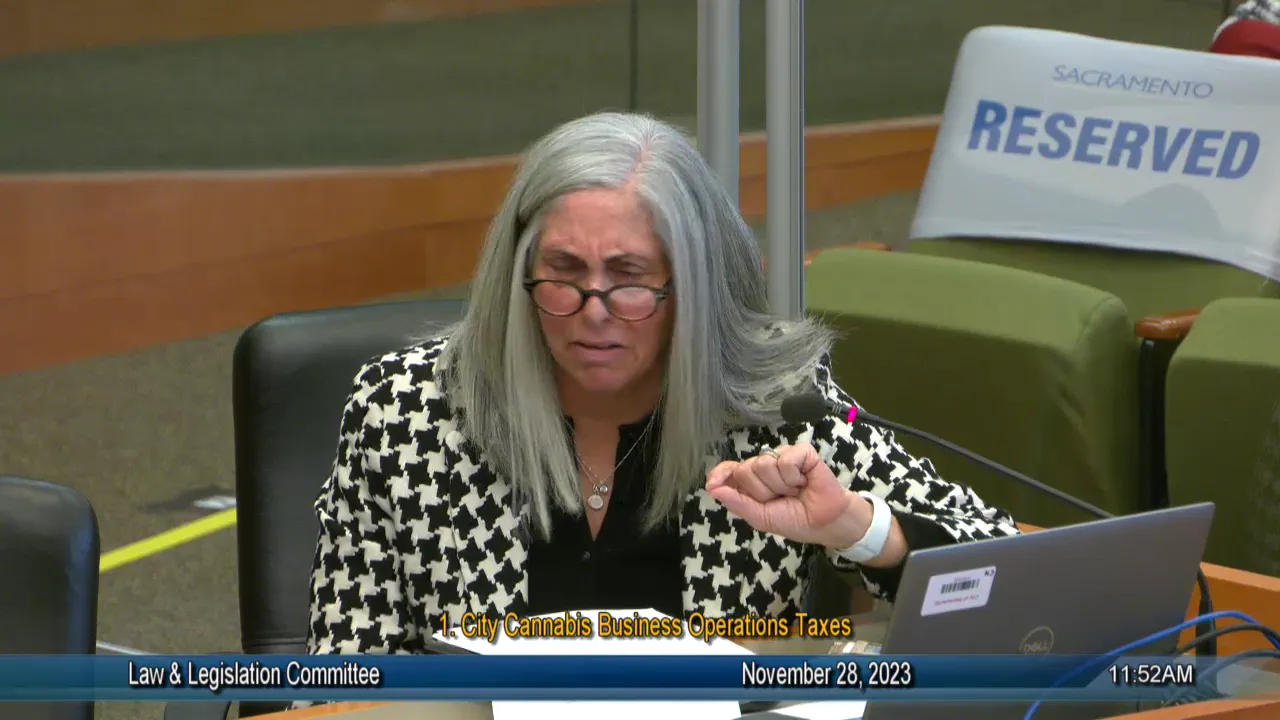
The Law and Legislation Committee held a special meeting on November 28, 2023, from 10:02 a.m. to 12:14 p.m. to discuss the City's Cannabis Business Operation Tax (CBOT). The committee reviewed a staff report providing information on state and municipal cannabis taxation, modeling of potential tax reductions, and heard extensive public testimony before agreeing to form a stakeholder task force and bring a proposed ordinance back in March 2024.
Public Comments & Testimony
- Children's Fund Advocates (e.g., Merrill Starr, Allegra Taylor, Estrella Ortiga, Edgar Romo, Megan Bueno, Jaleel Baker, Peter Falau, Mandeep): Expressed strong support for maintaining the 4% CBOT, arguing that the Sacramento Children's Fund (Measure L) relies on this revenue and that reducing taxes would harm youth programs. Several noted that voters approved Measure L and that the fund has not yet been implemented.
- Industry Representatives and Equity Operators (e.g., Khalil Ferguson, Rachel Brown, Satinder Core, Rachel Bartas, Kimberly Cargyle, Tyler Bergman, Debbie Blurton, Joe Devlin, Mindy Galloway, Justin Jacinto, Javier Hernandez, Rhonda Ernest, Mike Snell, Steve Squaliga, Jay Johnson): Argued that the current 4% CBOT, compounded with state taxes, creates an effective tax rate of over 20%, driving legal businesses toward failure and unable to compete with the illicit market. Many noted that cannabis businesses are taxed 100 times more than other businesses and that the industry is struggling, with closures and lack of profitability. They called for tax reductions, especially for testing and distribution (where the tax is effectively doubled), a flat 1–2% rate, and zero percent for social equity companies. Several emphasized that if businesses close, the Children's Fund will lose revenue entirely.
- Community Organizer (Hazel Watson): Supported keeping the tax for youth funding.
- Youth Representative (Lozan Miranda-Brightman): Opposed tax cuts, urging the committee to honor commitments to future generations.
Discussion Items
- Staff Presentation (Davina Smith, Cannabis Program Manager): Presented data showing Sacramento's 4% CBOT is competitive regionally, business closure rates are below national average (below 48%), and current-year CBOT revenue is about $230,000 higher than last year (approximately $21-22 million projected). Staff provided modeling: a 2% across-the-board reduction plus zero for testing/distribution would reduce revenue by about $14 million; a 1% cut would reduce by $5.6 million. Staff noted no evidence of oversaturation, as Sacramento is a regional supplier. They highlighted examples from other cities (Long Beach, San Diego, Coachella Valley, Palm Springs, San Francisco) that reduced taxes or enacted moratoriums but lack data on effectiveness.
- Chair Katie Valenzuela: Framed the discussion as whether the current tax rate is appropriate for a sustainable legal industry. She supported eliminating the tax on distribution and testing (calling it a double tax) and reducing the rate to 2% across other sectors. She stressed that inaction could also reduce revenue if businesses fail, and that the children's fund depends on a healthy cannabis industry.
- Vice Mayor Eric Guerra: Opposed any reduction of the 4% tax, arguing that reducing local taxes lets the state off the hook and could lead to a race to the bottom. He supported a narrow focus on testing and distribution, possible tax relief for core program participants, and convening a task force. He also urged the city to refund overpayments by businesses.
- Councilmember Lisa Kaplan: Emphasized finding a balance between business survival and children's fund revenue. She supported an immediate reduction to zero for medical cannabis (calling it a tax on medicine), elimination of the tax on distribution and testing, and a temporary across-the-board reduction to 2% as a reprieve. She also proposed a task force to develop longer-term solutions and suggested a moratorium on new permits (except core) to assess market saturation.
- Vice Chair Rick Jennings: Expressed concern that staff data and public testimony conflict, and advocated for a task force to better understand the industry's needs. He supported a stakeholder process but did not support immediate tax reduction or a moratorium.
Key Outcomes
- Task Force: The committee directed Chair Valenzuela and Councilmember Kaplan to convene a stakeholder task force with industry, youth advocates, and community representatives to discuss possible adjustments to the CBOT. The task force will aim to produce recommendations by March 2024.
- Ordinance by March 2024: The committee committed to bringing a proposed ordinance (or resolution) to a vote in March 2024, after the task force process. This will coincide with the expected outcome of a citywide business operations tax reform measure on the March 2024 ballot.
- Medical Cannabis Exemption: The committee expressed consensus to fully exempt medical cannabis from the CBOT, but this will be incorporated into the March ordinance rather than acted on immediately.
- No Moratorium: The committee did not approve a moratorium on new permits or tax collection, though Councilmember Kaplan raised the idea; it was not supported by the majority.
- Oversight: Vice Mayor Guerra requested that the city address overpayments by cannabis businesses; this was noted for staff follow-up.
- Next Steps: Staff will prepare analysis for the task force and the March meeting. The committee will hold additional meetings as needed.
Meeting Transcript
To call this meeting of the law and legislation committee to order order. Will the clerk please call a roll to establish a quorum? Thank you, Chair. Councilmember Gera. Councilmember James? Kaplan? Here, Chair of Alan Zwilla. I am here. Vice Chair Jennings, since I saw you get your card out, would you like to lead us in the land acknowledgement and pledge of allegiance? Those who are available to stand, would you please stand? As we do the land acknowledgement. Go ahead. Okay. This is in honor of Sacramento's Indigenous People's Tribe people and Tribal Lands to the original people of this land, the Nision people, the Southern Madhu, the Bally and Plains, the Miwok, and Patwin Patwinwenton peoples and the peoples of the Wilton Rancheria, Sacramento's only federally recognized tribe. May we acknowledge and honor the Native people who come before us, who came before us and still walk beside us today on these ancestral lands by choosing to gather together in the active practice of acknowledgement and appreciation for Sacramento's Indigenous People's History, contribution, and lives. Please join me in the Pledge of Allegiance. I pledge allegiance to the flag of the United States of America and to the Republic for which it stands one nation under God, indivisible, with liberty and justice for all. Thank you. And I'll note for those watching online that the vice mayor has joined us. Good morning. So we have one item on our discussion calendar today, which is the city cannabis business operations tax. So while staff comes up to prepare the presentation, I just want to start with the brief framing comments, if I might take the liberty as chairs, you get ready. Um, just to say that I appreciate all of the emails that we've all received over these last couple of days about the business tax in this space. And I just want to say that today's discussion is about whether or not we are charging the appropriate tax rate for sustainable legal industry. Um that's the conversation today. And I appreciate that tax revenue is tied to a lot of really important things, of which I know I personally can speak for myself support. But right now we charge cannabis 100 times what we charge any other business in the city of Sacramento, and they are charged double what alcohol is charged at the state level. And so we have heard very clearly that we need to talk about whether or not this rate is strong enough as the right rate to support the legal market, because without a strong legal market, we will continue to see the illicit market thrive in Sacramento, and that is unacceptable on many, many fronts. And what is happening right now is the legal market is unable to adequately compete. And so that is the point of our conversation today. I just want to frame in this way so that as people are coming up for public comment, I just want to make sure that we know that we the goal here today is to really talk about whether or not as a policy decision the tax rate for cannabis is appropriate or needs to be adjusted. And I will remind folks from our last conversation that one where we left this is that you know we urgently need the federal and state government to take some action here. Um we desperately need the federal and state government to take some action here. This is part of why the cannabis industry is particularly impacted by the current regulatory environment. And if at any point they do, we at the local level can decide to change again. Um we have that flexibility within the four percent to say, hey, we're gonna change it one way, now we're gonna bring it back if we so to choose. So we're not locking ourselves in here today to a ballot measure process or anything. We're just talking about does it make sense to make an adjustment? And if the state or federal government make changes, we can change again at the local level. We have that flexibility, and so just want to continue to bang that drum and kind of tee us up where we left off at our last conversation, which is where we are starting the conversation today with the assessment that staff is bringing us. So go ahead, Davina. Um Program Manager for the Office of Program Office of Cannabis Management here in Sacramento. Um I also want to let people know um, you know, I'm a regulator, tax is not my normal place where I live. Uh so I didn't want to let the committee know that the director of finance can be available uh to answer any questions if if so desired. So I think in any discussion of cannabis in California, as the chair and to uh said it is important to talk about the statewide cannabis taxes. Um Prop 64, which was the ballot measure that looked at um having both adult use and medicinal cannabis along with regulatory programs throughout the state, established two state taxes. One was a 15% excise tax, that excise tax would be floating and kind of change every year, adjust every year. And then there was a cultivation tax on harvested cannabis as well. AB 195, which was passed at the end of June in 2022, that was part of a budget bill that did eliminate the cultivation tax and it froze the excise tax tax for three fiscal years. So we all know that sales are down in general, statewide.
openpublica.com