Law and Legislation Committee Special Meeting – December 5, 2023
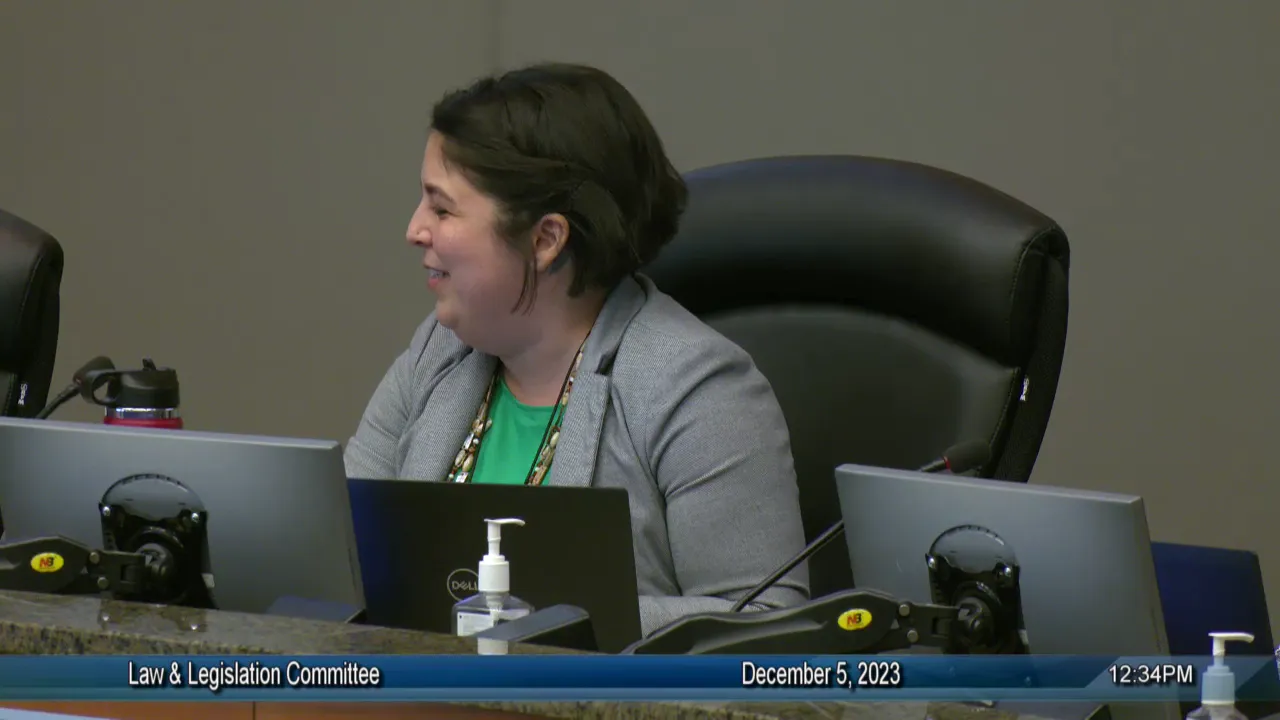
STREAMING COPY IN PREPARATION — RECORDING AVAILABLE FROM THE ORIGINAL SOURCE
Law and Legislation Committee Special Meeting – December 5, 2023
The Law and Legislation Committee of the City of Sacramento held a special meeting on December 5, 2023, from 11:00 a.m. to 1:00 p.m. in the City Hall Council Chamber. The committee considered a vacancy tax proposal, approved the city's legislative platform, reviewed the 2024 planning and zoning work program, and received an update on the Sacramento Forward policy package. All votes were unanimous (4-0).
Consent Calendar
- Approved the Law and Legislation Committee meeting minutes from September 19, October 3, and October 17, 2023.
- Approved the Law and Legislation Log.
Public Comments & Testimony
Item 3 – Vacancy Tax Proposal:
- Jack Blatner (Sacramento Metro Chamber) recognized the problem of vacant land but urged the city to use both “sticks and carrots,” such as incentives for developing or renting vacant land and rent relief for small businesses.
- Robert Coplin expressed support, saying the tax should have been implemented years ago, and suggested revenue be used to help property owners renovate or promote Sacramento.
- Jonathan Cook (Sacramento Housing Alliance) urged the committee to vote yes on staff-recommended Option B to preserve and build additional affordable housing.
- Matt McDonald (California Apartment Association) spoke in opposition, arguing that the tax would chill business investment, that the city has not distinguished dormant parcels from developed ones, and that the city is already adding multiple new taxes and fees. He urged rejection of the proposal.
- Aaron Teague (Sacramento Association of Realtors) noted that the main issue is vacant lots, not buildings, and suggested using code enforcement and the existing vacant lot program rather than a new tax. He requested that his organization be part of the conversation.
- Keon Bliss expressed strong support for the proposal, stating that vacant lots could be used for housing and that the city should have acted sooner. He reminded committee members of campaign contributions from groups opposing the measure.
Item 7 – Sacramento Forward Policy Package Stakeholder Process:
- Vance Gerard (Construction Employers Association) thanked the committee for engaging stakeholders and requested that the labor standards ordinance be considered alongside the full Sacramento Forward package. He asked for a thorough fiscal analysis of the cost impact on projects.
- Trevor Newquist (Construction Employers Association) stated that the proposed labor standards mirror what union contractors already provide (fair wages, health care, apprenticeships) and that they lose work to bad contractors who commit wage theft and tax fraud. He argued developers receiving subsidies should be required to use compliant contractors.
- Neil Dan Charles (NorCal Carpenters Union) emphasized that if taxpayer dollars fund housing, workers building it should earn a livable wage to prevent homelessness. He noted that many construction workers are underpaid and that the city has an opportunity to save lives by supporting this ordinance.
- Lindsay Sakasis (Carpenters Union Local 46) shared her personal story as a single mother who moved from government assistance to a union carpenter career with benefits. She stressed the importance of providing jobs so apprentices can stay in the program.
- David Perez (union carpenter) highlighted the value of apprenticeship training, a living wage, and health insurance. He noted that non-union contractors often use out-of-state workers and undercut wages, and urged the city to support local workers.
- Alyssa Lee (District 4 resident) supported the ordinance, noting that the false choice between affordable housing and fair labor can be avoided by reducing other development costs, such as parking minimums.
- Fred Latou (Sheet Metal Workers Local 104) spoke in support, citing the need for more developers willing to pay prevailing wages and provide health care. He noted that low-road contractors create unsafe job sites and few career opportunities.
Discussion Items
Item 3 – Vacancy Tax Proposal: Staff presented three options: Option A (tax entirely vacant parcels only), Option B (add entirely vacant commercial and mixed-use buildings), and Option C (add vacant individual units). Key data: 3,600+ privately owned vacant lots and 451 vacant buildings identified using water consumption data. Exemptions could include active construction, non-profit ownership, or site activation. Revenue could fund affordable housing, code enforcement, or infrastructure. A tax could be graduated by parcel size, with an illustrative range of $3,000–$10,000 per property. A special tax would require two-thirds voter approval. The proposed timeline aimed for a November 2024 ballot measure.
Committee members discussed the problem being solved, the need to distinguish between good and bad actors, and the importance of not penalizing property owners who are actively trying to develop or who face barriers such as contamination or high interest rates. Vice Mayor Guerra expressed support only for Option A and only for priority areas, stressing that a tax on storefronts or residential units could be counterproductive. Councilmember Kaplan asked for polling to gauge voter support before committing staff time, and requested an impact analysis of other cities' experiences. Chair Valenzuela supported keeping Option B (100% vacant buildings) in the conversation. The city attorney confirmed that polling prior to placing a measure on the ballot is permissible.
Item 4 – Review and Approval of City’s State and Federal Legislative Platform: Staff presented the 2024 draft legislative platform, which guides advocacy and pre-approves positions on issues within the city's sphere of influence. State lobbyists Ross Buckley and McKinley Thompson Morley provided an oral report on the 2023 legislative year, including new members, leadership changes, the state budget deficit ($58 billion over three years), and key issues such as housing, homelessness, public safety, and cannabis policy. Vice Mayor Guerra highlighted the need for continued advocacy on cannabis tax reform, sideshow legislation, and childcare-friendly housing tax credits. Councilmember Kaplan requested an annual report from lobbyists to show accountability and return on investment, and called for more specificity in the platform regarding equal rights for women and LGBTQ+ communities.
Item 5 – 2024 Planning and Zoning Work Program: Planning Director Greg Sandlund presented the work program, which includes key accomplishments (public review draft of the 2040 General Plan and Climate Action Plan, ADU permit-ready plans, parking reform, river district plan update) and upcoming initiatives (inclusionary housing ordinance, special needs housing, missing middle housing study, Stockton Boulevard specific plan, citywide rezones, and climate policy updates). The committee unanimously forwarded the work program to the full City Council.
Item 6 – Continued to January 16, 2024: The item on a proposal to prohibit daytime camping citywide was continued to the January 16, 2024 meeting.
Item 7 – Sacramento Forward Policy Package Stakeholder Process: Chair Valenzuela presented an overview of the proposed labor standards ordinance, which would apply to projects receiving a public subsidy over a certain threshold (e.g., over 10,000 sq ft or 10 units). Requirements would include prevailing wage, apprenticeships, health care expenditures, a local hire goal (30% of hours by Sacramento County residents), and record-keeping. Enforcement could include withholding permits. The ordinance would be waived for contractors with a union agreement. The chair noted that the state housing agency (HCD) had expressed surprise that the city does not already have such requirements.
Committee members expressed support for continuing stakeholder engagement. Vice Mayor Guerra emphasized the importance of local hire and apprenticeship programs, and cautioned against policies that might deter development. Councilmember Kaplan requested a city-led stakeholder process, an economic impact analysis, and legal review to ensure compatibility with state law and other city ordinances. Chair Valenzuela directed staff to work with the city attorney and stakeholders to refine a draft ordinance and return to the committee.
Key Outcomes
- Item 3 (Vacancy Tax): Passed a motion (4-0) directing staff to first conduct polling on voter support for the vacancy tax options, then conduct stakeholder outreach, and return to the committee with a revised timeline. Staff was also asked to provide examples from other cities (including outside California) with longer implementation histories and impact data.
- Item 4 (Legislative Platform): Passed a motion (4-0) approving the 2024 State and Federal Legislative Platform and forwarding it to the City Council for final approval. The committee also requested that lobbyists provide an annual report on positions taken and funding secured.
- Item 5 (Planning and Zoning Work Program): Passed a motion (4-0) to forward the 2024 work program to the City Council with positive recommendations.
- Item 6: Continued to January 16, 2024.
- Item 7 (Sacramento Forward): The committee gave direction to staff to continue the stakeholder process, work with the city attorney’s office on a draft ordinance, and bring back a report that includes an economic impact analysis and legal review. No formal vote was taken; the item was a discussion and direction item.
Meeting Transcript
Good morning. Welcome to the City of Sacramento's Law and Legislation Committee. I call this meeting to order. Madam Clerk, will you please call the role to establish a quorum? Thank you, Chair. Councilmember Kaplan. Here. Councilmember Gere? Here. Councilmember Jennings. Chair Valenswell? I'm here. Councilmember Kaplan, will you lead us in the land acknowledgement and pledge of allegiance? Please rise for the opening acknowledgments in honor of Sacramento's indigenous people and tribal lands. To the original people of this land, the Nissanon people, the Southern Maidu, the Valley and Plains Miwok, the Putwin Wintoon people, and the people of the Wilton Rancheria, Sacramento's only federally recognized tribe. May we acknowledge and honor the Native people who came before us and still walk beside us today on these ancestral lands by choosing today to gather by choosing to gather today in the active practice of acknowledgement and appreciation for Sacramento's indigenous people's history, contributions, and lives. Please remain standing. Pledge. I pledge allegiance to the flag of the United States of America. And to the Republic for which it stands. Thank you, Councilmember. Well, we have quite a packed agenda today. We are going to be stricter than I normally am that if you don't turn in your comment card when the item begins, we might not get to you because we do have a lot of things to get to. So if you're interested in making public comment, there are slips in the back and here at the front that you can churn in to get on our list. So, and to just also for folks who might be watching are here for item six. Just want to publicly state that that item has been continued to January 16th. So if you are here for that item, apologize for the inconvenience and please come back to us in January. So with that, we will start with the consent calendar with an editorial note that item two is super wonky. It was formatted by someone who is new to the job, and it will be back in the format that we are familiar with it. Come our next meeting. Because I was like, why are there items for 2018 in here? I don't understand. So with that note, does anybody have any questions or comments about items on the consent calendar? Move approval. It's moved and seconded. All in favor, please say aye. Aye. Aye. Any opposed? Abstentions. Measure carries unanimously. Thank you all. Now jumping right into item three, our vacancy tax proposal presentation from staff. Welcome, Greta. Please be in. Good afternoon, Chair. Okay. Today we're requesting that the committee receive a report on options for a potential vacancy tax and pass a motion directing staff to conduct outreach on one of the recommended options and return to law and legislation committee with a draft ballot measure for consideration. This presentation is a follow-up to our initial discussion at the March 7th, 2023 law and legislation meeting. At our March meeting, we reviewed the following information.
openpublica.com