Law and Legislation Committee Meeting – May 21, 2024: Omnibus Ordinance and Cannabis Update
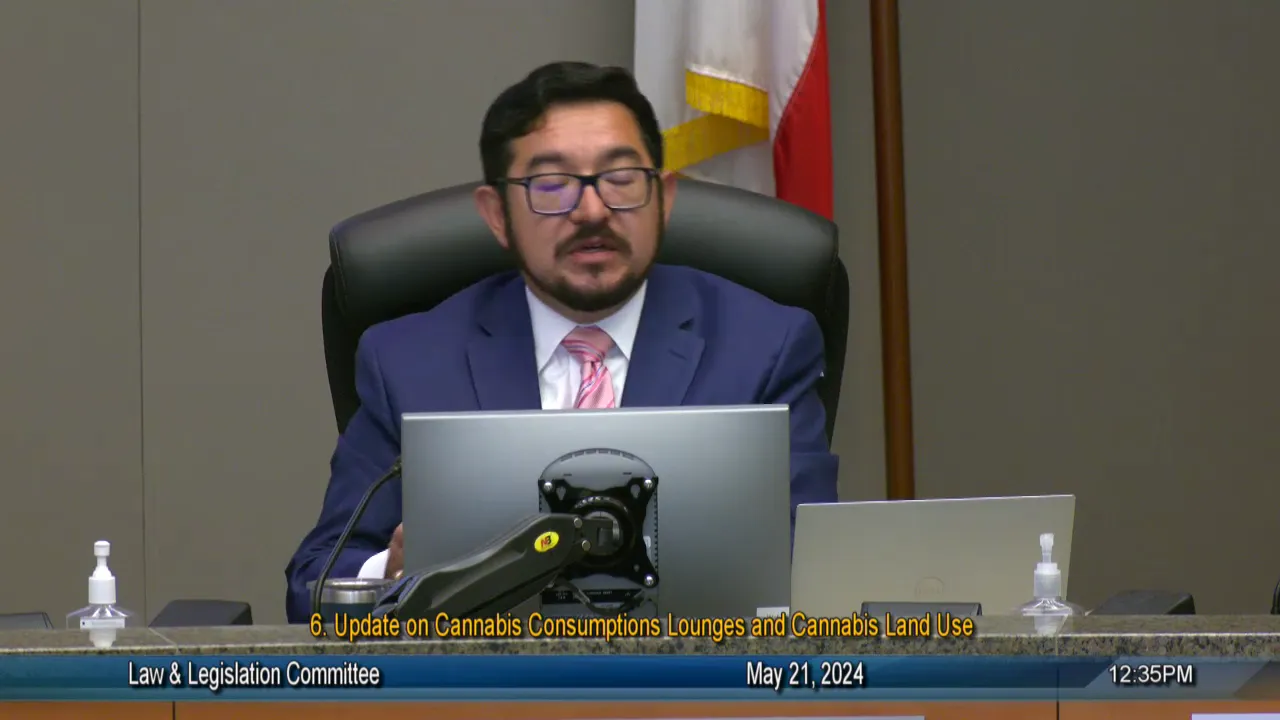
STREAMING COPY IN PREPARATION — RECORDING AVAILABLE FROM THE ORIGINAL SOURCE
Law and Legislation Committee Meeting – May 21, 2024
The Law and Legislation Committee met on Tuesday, May 21, 2024, from 11:00 a.m. to 1:02 p.m. at City Hall, 915 I Street. The committee approved the consent calendar, forwarded a consolidated Title 17 omnibus ordinance to the City Council, and received an update on cannabis consumption lounges and land-use regulations. Members also provided direction to staff on the cannabis pilot program.
Consent Calendar
- Minutes (April 2, 2024) – Approved unanimously.
- Law and Legislation Log – Approved unanimously.
- Legislative Advocacy Correspondence – Received and filed.
- Ordinance Amending Lobbyist Regulations (Chapter 2.15) – Reviewed and forwarded to City Council for adoption unanimously. Public commenter Mac Worthy expressed concerns about lobbyist connections and equity in communications.
Public Comments & Testimony
- Item 4 – Lobbyist Ordinance: Mac Worthy questioned the relationship between city officials and lobbyists, urging transparency.
- Item 5 – Title 17 Omnibus Ordinance: Mac Worthy discussed property reclassification and the lack of community education on land-use changes, suggesting that residents are not informed about depreciation and zoning impacts.
- Item 6 – Cannabis Consumption Lounges Update: Sixteen speakers addressed the committee. Positions included:
- Debbie Blurten (All About Wellness) opposed the five‑year restriction on type two permits for original dispensaries, arguing they should be included from the start.
- Maisha Bahadi (Crystal Nuggs) supported lounges, noted social equity priorities, and warned that overly stringent regulations would harm small businesses.
- Jay Johnson (Trees and Knowledge) urged removal of sensitive‑use buffers and green zones, stating these hinder the legal market and benefit the black market.
- Isaac Altamarino argued that the state does not prohibit off‑site consumption and requested a pilot for events outside CalExpo.
- Eric Henry called for off‑site consumption permits, noting no safe place exists in the city.
- Diana Huen (Humble Root) asked that delivery‑only core businesses be included in the pilot.
- Christine Trimble and William Trimble requested a safe consumption space, citing medical needs.
- Natalie Shepherd (AFG Solutions) provided revenue loss estimates: $45,000 lost per event (700 attendees × $65 ticket) and $4.68 million annually in uncollected taxes, urging immediate action.
- Rashida Mitchell (Buddha Cannabis Delivery) emphasized that consumption will happen regardless; regulation ensures safety and tax revenue.
- Ignacio (Organic Design Media) noted that existing “unofficial” pilots already meet many proposed requirements, with 180+ events and no injuries.
- Kyle Nase opposed limiting type two permits to core businesses for five years, citing fairness.
- Mindy Galloway (Camille Shared Manufacturing) supported on‑site consumption for community healing and education.
- Elsa Romo (core business owner) requested inclusion of delivery services in the pilot.
- Carlos Megania (High Power) asked for minimal barriers and emphasized cannabis as medicine.
- Public Comments – Matters Not on the Agenda: Four speakers addressed other topics:
- Mac Worthy raised concerns about court proceedings and policing in poor neighborhoods.
- Raysa Roque read a DCC email clarifying that the state does not regulate consumption lounges; that authority rests entirely with local jurisdictions.
- Kevin McCarty urged that all storefront dispensaries be allowed to apply for lounge permits, not just core operators.
- Myra Altamarino expressed frustration that off‑site consumption was not advanced, claiming economic harm to her family.
Discussion Items
Item 5 – Title 17 Omnibus Ordinance (M23‑002)
- Kevin Colin (Zoning Administrator) presented the ordinance, which amends Titles 15, 17, and 18 to achieve state‑law consistency (SB 897, AB 2221, housing/commercial zones), streamline regulations (e.g., digital signs for large entertainment venues based on 2,000‑person capacity), and perform administrative cleanup.
- The Planning and Design Commission voted unanimously to forward the ordinance on April 11, 2024.
- A supplemental amendment removes the two‑person limit on home occupation permits and eliminates minimum parking requirements per the 2040 General Plan.
- The committee voted 4‑0 to forward the ordinance to City Council with the supplemental included.
Item 6 – Update on Cannabis Consumption Lounges and Cannabis Land Use
- Davina Smith (Office of Cannabis Management) outlined two permit types:
- Type One: Ingestible products only (no ventilation required); available to all storefront retailers.
- Type Two: Inhalable and ingestible products (requires negative‑pressure ventilation costing $150,000–$250,000); proposed to be limited to majority core‑owned businesses for the first five years, then opened to all.
- Kirk Skierski (Senior Planner) reported that 55% of existing dispensaries are within 0.5 miles of a major transit stop. Sensitive‑use buffers and zoning constraints reduce available land significantly—for example, in CD‑1 zones a large share of parcels fall within at least one buffer.
- Conditional use permit costs range from $7,000 (Zoning Administrator, 130–220 days) to $14,000 (Planning Commission, 220–260 days). Approximately 80% of current storefront dispensaries are within a sensitive‑use buffer.
- Staff recommended pursuing the cannabis study and the consumption lounge pilot concurrently, with community engagement in summer 2024 and a legislative package by late 2024.
- Councilmember Guerra expressed strong opposition to type two permits, citing 40 years of public‑health efforts against secondhand smoke and noting no safe level of exposure exists. He suggested that even type one should be carefully evaluated given existing non‑conforming uses.
- Councilmember Jennings questioned the five‑year core‑only period and emphasized the need for safe consumption spaces to avoid driving business to the black market.
- Chair Valenzuela directed staff to accelerate the timeline, bringing recommendations by September 2024 (rather than late 2024), to allow hearings in November before new council members take office. She also urged that:
- Type two permits be available to all storefront dispensaries, not just core businesses.
- The transit‑proximity requirement be flexible: dispensaries outside the designated transit bubbles could still qualify if they provide alternative transportation accommodations (e.g., ride‑share vouchers).
Key Outcomes
- Consent Calendar: Approved unanimously (4‑0).
- Item 5 (Omnibus Ordinance): Motion to forward to City Council with the supplemental amendment passed 4‑0.
- Item 6 (Cannabis Consumption Lounges): Received and filed. Staff directed to:
- Return with a revised draft ordinance by September 2024.
- Explore allowing type two permits for all storefront dispensaries, not limited to core-owned businesses.
- Allow dispensaries outside designated transit areas to participate if they provide equivalent transportation safety measures.
- Conduct community engagement on the cannabis study and consumption lounge pilot concurrently this summer.
- No formal vote on item 6 was required; the direction was advisory.
Meeting Transcript
Good morning. I'd like to call a city of Sacramento's law and legislation committee meeting to order. Well, a quick please call the roll to establish a quorum. Thank you, Chair. Councilmember Garrett. Here. Councilmember Jennings? Here. Councilmember Maple? Here. Chair of Ellen's Well. I'm here. All right. Um, who would like to lead the land acknowledgement and pledge of allegiance? Who's most ready? All right, Vice Mayor, thank you. Please stand if you are able. Please rise for the opening acknowledgments in honor of Sacramento's indigenous people and tribal lands. To the original people of this land, the Nissanon people, the Southern Maidu, Ellian Plains, Niwok, Putwin Wintoon peoples, and the people of the Wilton Rancheryette. Sacramento is only federally recognized tribe. May we acknowledge and honor the native people who came before us and still walk beside us today on these ancestral lands by choosing to gather today in the active practice of acknowledgement and appreciation for Sacramento's indigenous peoples' histories, contributions, and lives. So remain standing. Salute and pledge. And pledge allegiance to the flag of the United States of America and to the Republic for which it stands. One nation under God, indivisible liberty justice for all. Thank you, Vice Mayor. I've almost got that memorized. I'm going to start challenging my colleagues who can do it without looking. All right. Moving right along to the business. We have four items on consent today. Do any of my colleagues wish to pull an item or have any questions or comments? Oh, go ahead, Council Merg. Um, I'll go ahead and move consent, but um, there was um I saw a I think it was a um uh Senator Ben Allen uh bill on a speed safety pilot program in Santa Monica, and I just wanted to know um if uh what our engagement was and uh and don't need an answer right now, but I'd like to get a report back on that because anything we can do on the speeding issue. Um like to make sure that we're part of it if we can, not just Santa Monica. Yeah, thanks. Well, this is district, so he's got some preference, but we'll see if we can get ourselves in there. Okay, ask Consuelo to follow up with you on that. Any other comments or questions? All right, moved and seconded, and we have one public comment, Madam Clerk. We have one speaker for this comment. Macworthy for item number four in consent. Oh, you all are doing this morning. Mainly what I'm concerned about, the lobbies. Now, isn't somebody on a city council connected with the Lake California City? Lake of California City is a lobbyist. Meet with them and involve in the lobbying over there. Now I was in that building for 28 years. I know who they lobby it. Some good people still over there.
openpublica.com