Sacramento Planning and Design Commission Meeting: CAP, Housing Element, Ad Hoc Recommendations (August 13, 2020)
STREAMING COPY IN PREPARATION — RECORDING AVAILABLE FROM THE ORIGINAL SOURCE
Sacramento Planning and Design Commission Meeting – August 13, 2020
The Sacramento Planning and Design Commission met remotely by teleconference on Thursday, August 13, 2020, at 5:30 p.m. because of the COVID-19 local emergency. Commissioners Burke and Hernandez were absent; Commissioner Farrell joined later in the meeting. The Commission approved the consent calendar, received staff reports on the Climate Action Plan and Housing Element update, and approved a motion forwarding the Ad Hoc Committee’s recommendations on the Commission’s purpose, composition, and policy prioritization to the City Council.
Consent Calendar
- Moved, seconded, and approved the July 23, 2020 meeting minutes (Pluckebaum/Macias Reed); vote 8:0:2; Burke, Hernandez, and Farrell were absent.
- Received and filed the Director’s Report. The report noted that the City Council approved a ministerial infill housing ordinance on July 28 and previewed upcoming agenda items, including a Folsom Boulevard special planning district and General Plan workshops.
Public Comments & Testimony
- Ansel Lundberg (co-chair, Health Sacramento) supported the CAP’s land-use measure E4 focusing growth in transit-priority/infill areas, investment in active transportation and transit, and environmental justice; he suggested using SACOG’s GHG modeling.
- Erica De York (Sacramento Metropolitan Chamber of Commerce) said the Chamber’s input to the Mayor’s Climate Commission was not reflected in the CAP staff report. She opposed an unrestricted all-electric new construction ordinance by 2023, citing grid capacity, technology gaps (especially electric hot water heating), and costs that could make infill housing unaffordable, push development outside the city, and increase emissions through longer commutes. She asked for cost-benefit analysis, feasibility protections, and fair warning for projects already in the pipeline.
- EComments received before and during the meeting included concerns that the Mayor’s Climate Commission report and its business/community input were not clearly incorporated into the CAP materials.
- Anthony Lundberg (Housing Sacramento) spoke on the Ad Hoc item, supporting the streamlining reform direction and the policy priorities outlined by the Ad Hoc Committee, including eliminating R1 zoning and parking minimums.
Discussion Items
Sacramento Climate Action Plan Update
Staff presented preliminary draft measures to reduce community greenhouse gas (GHG) emissions to 40% below 1990 levels by 2030 and achieve carbon neutrality by 2045. Sacramento’s 2016 emissions were about 3.5 million metric tons of carbon dioxide equivalent; transportation accounts for 57%, buildings 37%, waste 5%, and water/wastewater 1%. Sacramento is already below its 2020 target. Staff proposed a linear per-capita path to carbon neutrality, requiring an additional reduction of 683,271 metric tons of CO2e by 2030. Key measures include all-electric new construction (E1), phased electrification of existing buildings (E2), transit and active transportation improvements (TR1/TR2), electric vehicle transition (TR3), food-waste diversion, and increasing the urban tree canopy from 19% to 30%. Staff reported TR3 would provide 42% of GHG reductions, TR2 18%, E1 8%, food-waste diversion 8%, and tree canopy 6%.
Commissioners raised the need for cost estimates and transparent prioritization; staff said Bay Area Economics is preparing a funding/financing plan and cost estimates will accompany each measure in future drafts. Commissioner Pluckebaum asked about water heater and EV technology; consultant Matt Maddox said commercial electric water heaters are developing and expected to be standard by 2026, with efficient operating costs. Commissioner Ogilvie requested a summary “crosswalk” between the CAP and the Mayor’s Climate Commission report; staff said one could be brought back after the Mayor’s Climate Commission report goes to City Council on August 25. She also raised equity concerns about point-of-sale enforcement, SMUD retrofit programs, youth engagement, tree canopy targets, bicycle mode share, and barriers to biking. Commissioner Wang Connelly questioned the CAP’s emphasis on EVs (30% of vehicles) over active transportation and transit; staff and consultants explained the CAP must be legally defensible and cannot separately quantify land-use changes due to double counting, and that the EV target is consistent with the Mayor’s Commission’s 75% new-registration goal when measured the same way. Commissioner Kaufman said the pandemic may reduce public support for transit and density, calling for an education campaign and transparent cost/priority criteria. Commissioner Macias Reed asked for side-by-side CAP/MCC comparisons, cost and feasibility data, commercial corridor tree incentives, and consumer EV costs. Commissioner Lindsay described North Natomas as a “transportation desert” and urged stronger coordination with RT and regional growth decisions. Several commissioners opposed mandatory point-of-sale permit inspections, calling them costly and inequitable; staff said enforcement would be at least 10 years out and open to alternatives. The item was received and filed.
Sacramento’s Housing Strategy (2021-2029 Housing Element Update)
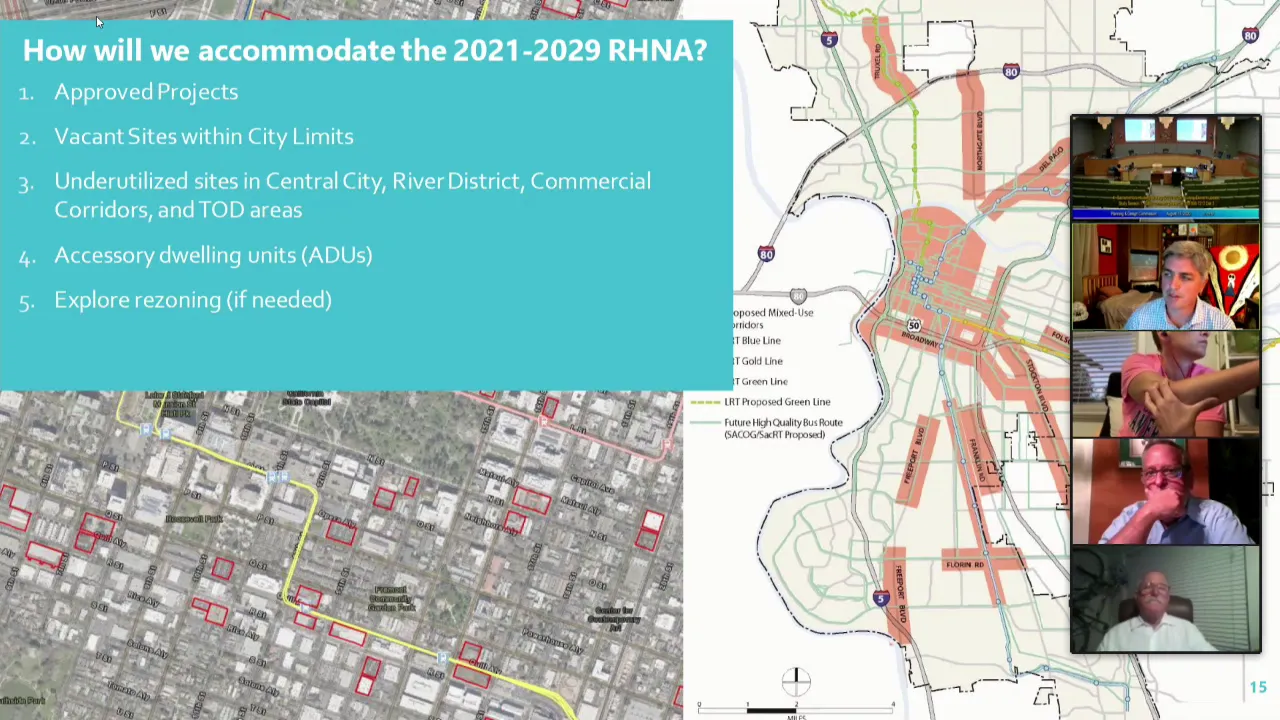
Staff presented a study session on the eight-year Housing Element, which is state-mandated and due May 15, 2021, with a 120-day grace period. The City of Sacramento’s share of the regional housing needs allocation (RHNA) is 45,580 units, 29% of the regional total and an 89% increase over the previous cycle’s approximately 24,000 units. Staff plan to accommodate the allocation through pipeline projects, vacant and underutilized sites, commercial corridors and transit-oriented development areas, higher ADU projections, and potential rezoning; they will also complete a fair housing assessment under AB 686, analyze governmental and non-governmental constraints, and review current programs. Outreach includes internal and external housing working groups, focus groups on anti-displacement and affordable housing requirements, and upcoming community plan area workshops.
Commissioner Kaufman urged building-department streamlining or self-certification, manufactured and 3D-printed housing, and Portland-style residential infill rules allowing up to four homes per lot (six for price-regulated projects). Commissioner Ogilvie asked for housing opportunity maps that include historically redlined neighborhoods, workforce development to reduce ADU costs, and more diverse site locations. Commissioner Macias Reed highlighted building department inconsistencies and called for rethinking R1 zoning near commercial corridors. Commissioner Wang Connelly recommended corridor rezoning, density and affordable housing bonuses, and removing minimum parking requirements. Commissioner Pluckebaum noted the potential conflict between inclusionary housing/anti-displacement goals and housing production/affordability. Greg Sandlund reported ADU permits are coming in at about five to six per week. The item was received and filed.
Ad Hoc Committee Recommendations on Commission Purpose, Composition, and Policy Prioritization
Staff reported on the Ad Hoc Committee (Commissioners Ogilvie, Macias Reed, Kaufman, Farrell, Hernandez, and Yee; seven meetings from April 3 to June 23, 2020). The committee’s recommendations included: (1) keep the Design Advisory Group informal for one year so design professionals can provide early, candid comments before Brown Act requirements would apply; (2) amend City Code Title 2 to require new council/mayor-nominated commissioners to have “formal training or demonstrated experience” in at least one of a list of qualifications; and (3) establish an annual policy-prioritization work plan process informing City Council adoption of the planning work program.
Commissioners discussed the trade-offs of three commission composition options (13 members, 9 district-based members, or 5–7 expert members). Commissioner Farrell worried about exclusivity; Commissioner Kaufman responded that the qualifications do not require degrees or licenses and could include community experience. Vice Chair Pluckebaum suggested retaining 13 members but allowing action by a majority of those present rather than a majority of the full commission. Chair Covill, speaking from experience as a realtor, opposed mandatory point-of-sale permit inspections. Public commenter Anthony Lundberg supported the reform direction.
The Commission approved a motion (Kaufman/Yee), 9:0:2, with Burke and Hernandez absent, forwarding the Ad Hoc Committee recommendations to City Council with amendments: add “neighborhood development, economics, and social equity issues” to the commissioner qualification list; retain the 13-member commission structure; and recommend that commission actions require a majority of members present rather than seven votes.
Key Outcomes
- Consent calendar approved: minutes of July 23, 2020 (8:0:2) and Director’s Report received and filed.
- Climate Action Plan update received and filed; staff will return with a crosswalk to the Mayor’s Climate Commission report, cost/financing details, and further refinements.
- Housing Element study session received and filed; no formal action.
- Ad Hoc Committee recommendation approved 9:0:2 and referred to City Council with amendments on qualifications, commission size, and vote threshold.
- No public comments were received for matters not on the agenda; the meeting adjourned after member comments.
Meeting Transcript
You're pretty quiet, Sasha. There we go. Hear me. I can. Can you hear me better now? Better. Good. Okay. We'll go ahead and um. Okay. Doug, if you like, we can get started in one minute. Very good. Like 5 30 to me. Okay. Yeah, we can get started. Well, good evening, everybody. Welcome to the city of Sacramento, August 13th, 2020, Planning and Design Commission. Before we get started, a few housekeeping items. If all staff, commissioners, and applicants could keep themselves muted until we uh uh till you speak. That would be great. In regards to the public, in addition to your e-comments, you have the option to phone in during the public comment period. Uh Stacia will share her screen now to display both of those options for you. Comments that were submitted through email or e-comments before 5 p.m. today have been received by staff and available for commissioners to review. You can give an e-comment during the hearing, and those comments along with all comments received after 5 p.m. today will be pulled up and we will review, take a moment to review them. Uh with that, let's move on. And what do you think? Roll call. Okay. Commissioner Wang Connolly. Here. Commissioner Messius Reed. Here. Commissioner Hernandez. Commissioner Kaufman. Here. Commissioner Lenzi. Here. Commissioner Farrell. Commissioner Ogilvie. Here. Commissioner Yi. Here. Vice Chair Pluckenbaum. Here. Chair Coville. Here. You have a quorum. Very good.
openpublica.com