Sacramento Planning and Design Commission Meeting - August 24, 2023
STREAMING COPY IN PREPARATION — RECORDING AVAILABLE FROM THE ORIGINAL SOURCE
Sacramento Planning and Design Commission Meeting - August 24, 2023
The Planning and Design Commission of Sacramento, California met on Thursday, August 24, 2023, from 5:33 p.m. to 8:49 p.m. at City Hall Complex, 915 I Street. The Commission approved the consent calendar and a conditional use permit, and held two discussion workshops on the Mixed Income Housing Ordinance and the Draft Existing Building Electrification Strategy. All members attended, with Commissioners Xiong, Yeung, and Andrade absent throughout; Commissioner Boyd and Buckley arrived later during the meeting.
Consent Calendar
- Approval of Planning and Design Commission Minutes of July 27, 2023 (File ID: 2022-02428): Passed unanimously by one motion. Motion by Commissioner Macias Reed, second by Commissioner Kadin. Yes: Chase, Lamas, Kadin, Macias Reed, Wallace, Thompson, Hernandez. Absent: Xiong, Buckley, Yeung, Boyd, Andrade.
Public Comments & Testimony
- Item 2 (Good Bottle): No public speakers appeared in person or online. The Chair noted 19 e-comments in support (an initial 18, plus one received at 5:21 p.m. that day), one letter of support, and one letter of opposition.
- Item 3 (Mixed Income Housing Ordinance): Two public speakers. Chris Noram (North State Building Industry Association) expressed opposition to increasing affordable housing requirements, citing the industry's analysis projecting a 6% increase in home prices, 8% increase in rents, 5% reduction in housing production, and a loss of about 1,700 market-rate units over ten years. He supported fee-based approaches, flexibility, and broader funding sources. Annie Keyes (Downtown Sacramento Partnership) urged caution, noting a 91% reduction in multifamily housing construction starts in downtown Sacramento over the past six months and the importance of not constraining supply.
- Item 4 (Existing Building Electrification Strategy): No public speakers during the hearing; two e-comments were received (one neutral, one supportive). During the later "Matters Not on the Agenda" period, Rosie Akubal with 350 Sacramento commented that electrification costs should be viewed as incremental costs above standard appliance replacement, noting rebates can offset the difference.
Mixed Income Housing Ordinance Review Workshop
Staff (Greta Soos, Associate Planner, and David Dozima of Kaiser Marston Associates) presented the draft report and feasibility analysis. Key findings included:
- The 2000-2015 inclusionary ordinance produced 1,557 required affordable units (or 1,985 units including excess), averaging 104-132 units per year.
- The current housing impact fee program generated $6.6 million through 2021; SHRA committed $4.7 million to three projects with 449 affordable units, 27 of which are attributed to the fee program.
- Feasibility analysis of prototypical projects found that under current market conditions, almost all projects are infeasible, even without new ordinance requirements. Under prior more favorable market conditions, some fee levels could be supported, e.g., $10-$20 per square foot in certain areas, and removal of the $0 rate for high-density rental projects.
- Draft policy objectives include increasing affordable housing production, meeting RHNA goals, ensuring long-term affordability, affirmatively furthering fair housing, anti-displacement, creating mixed-income communities, and not constraining housing production.
- Potential ordinance options: citywide per-square-foot impact fee, citywide on-site percentage with lower or higher in-lieu fees, varying requirements by submarket, and requiring on-site units in higher opportunity areas.
Commissioners asked questions and provided comments:
- Commissioner Kadin confirmed that under current market conditions, medium- and higher-density multifamily projects are not feasible anywhere in the city, even without ordinance changes. He later expressed full support for the policy objectives and increased affordable housing funding, but viewed inclusionary zoning as a tax on new housing. He preferred options with in-lieu fees and flexibility, recommended a minimum threshold of 10 or more units (citing Portland's 20-unit threshold), and supported phasing in new fees.
- Commissioner Lamas asked about enforcement of affordable unit obligations; Christine Wikert (Director of Development Finance, SHRA) explained that developers cannot pull more than 50-75% of market-rate permits before constructing required affordable units.
- Commissioner Buckley asked about investor return assumptions. David Dozima explained: 10% of sales price for for-sale projects; 6.5% return on cost for rentals under current market conditions, and 6.05% under prior market conditions, based on cap rates plus a risk premium.
- Commissioner Boyd questioned the absence of construction cost projections and the logic of in-lieu fees vs. on-site units. Staff clarified that a lower in-lieu fee would likely lead developers to pay fees rather than build on-site, while a higher fee would encourage on-site production.
- Commissioner Macias Reed asked for comparison data on subsidy costs per affordable unit; Wikert offered to provide current gap financing figures and noted a homeless project costs about $500,000 per unit, but workforce housing would be less.
- Commissioner Chase suggested seeking feedback from developers who built inclusionary projects in the past (e.g., Regis Homes, Soteries/SSK), and asked about whether high in-lieu fees might push development to other jurisdictions.
- Commissioner Buckley cautioned against letting the feasibility study override the policy values, emphasizing anti-displacement and community benefits.
- Commissioner Thompson asked about research on LA-based projects (Angie Brooks and Bricks/Scarpa) and non-cost incentives such as faster permitting; staff said they had not studied LA in depth and noted the city already provides shorter permitting timelines for affordable housing.
No vote was taken. Public comments are due September 8, 2023; staff will return in October with preliminary recommendations.
Draft Existing Building Electrification Strategy
Staff (Laura Tuller, Associate Planner) presented the public review draft. Key points:
- The city aims for carbon neutrality by 2045; 37% of citywide greenhouse gas emissions come from buildings. SMUD plans zero-carbon electricity by 2030.
- Modeling shows 100% of single-family homes would see immediate on-bill savings with full electrification: median $680/year for homes without solar, $1,500/year with solar.
- The strategy proposes a flexible approach for residential: electrification at time of appliance replacement, with several EPCA-compliant ordinance pathways. For commercial: energy benchmarking and performance standards for large buildings, plus a possible requirement to replace rooftop packaged HVAC units with heat pumps.
- The Ninth Circuit's decision in California Restaurant Association v. Berkeley affects new building electrification ordinances and may limit certain existing-building mandates; staff is waiting on the possibility of an en banc rehearing.
- Near-term pilots include electrification of low-income homes in the Stockton Boulevard area (two full home retrofits with solar and battery, plus 20+ heat pumps) and a $1 million ARPA-funded small business electrification grant program on Northgate Boulevard.
Commissioners commented and asked questions:
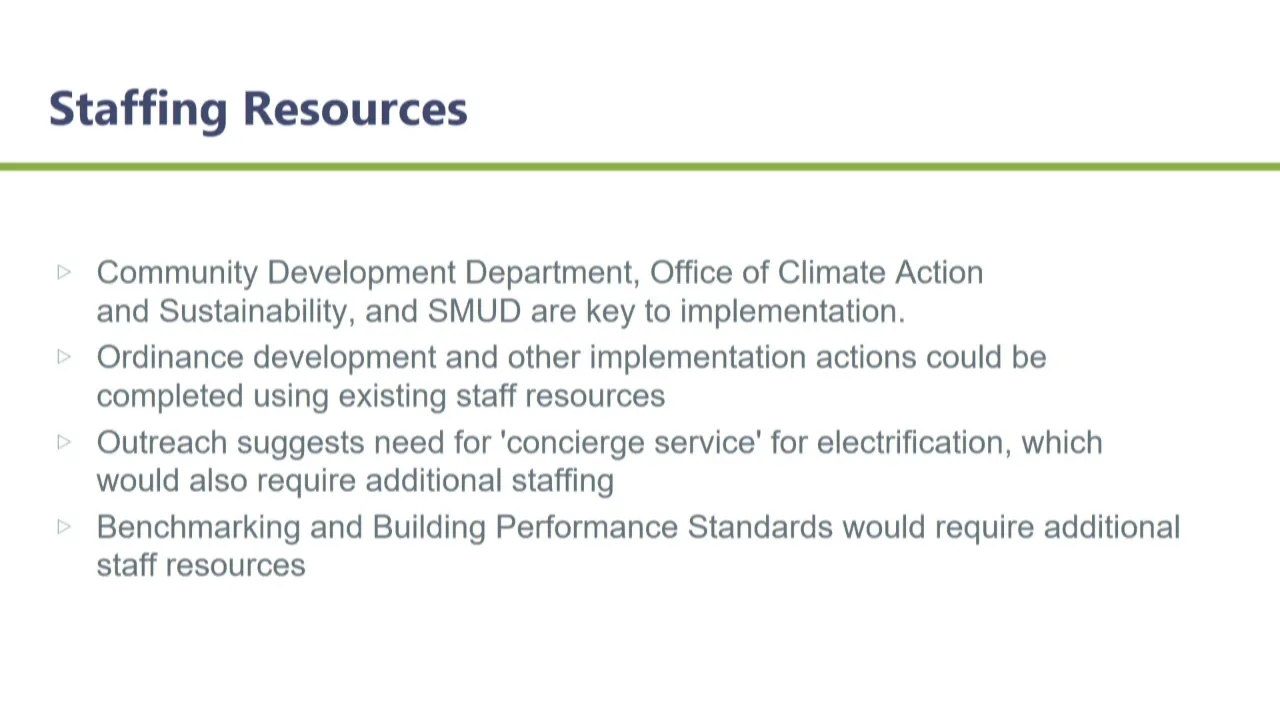
- Commissioner Macias Reed expressed strong support for electrification goals but raised concerns about costs to homeowners, permitting burdens, and staff capacity. She shared examples from her work with PBIDs and small businesses and urged the city not to create onerous processes.
- Commissioner Kadin asked about the legal scope of the Berkeley case; City Attorney Jeff Heron explained that EPCA preemption applies to new buildings and the state is also preempted, limiting the city's options.
- Commissioner Lamas asked about the benchmarking program; staff clarified it would apply to large commercial buildings (e.g., 50,000+ sq ft), not single-family homes, and would likely use ENERGY STAR Portfolio Manager.
- Vice Chair Wallace asked SMUD about grid capacity for both building and transportation electrification. Steve Johns (SMUD) described 5- and 10-year transmission and distribution planning, managed charging, and integrated forecasts to accommodate load growth.
- Commissioner Thompson asked how low-income families would get support if they wait until appliances fail late in the transition; staff acknowledged uncertainty but pointed to Inflation Reduction Act funding, evolving technology, and adaptive management of the strategy.
- Chair Hernandez expressed personal concern about up-front costs (e.g., heat pumps), cultural preferences for gas stoves, and the total impact on household budgets. She requested a clearer cost chart. Commissioner Chase noted heat pump replacement costs may be comparable to standard AC-plus-furnace replacement.
- Commissioner Boyd suggested the presentation include total full-home electrification costs.
No vote was taken. The strategy will undergo a three-month public review, with public input accepted via the Conveyo platform or email, and is expected to go to City Council in 2024 after the General Plan and Climate Action Plan adoption.
Key Outcomes
- Consent Calendar: Approved the July 27, 2023 Planning and Design Commission minutes (unanimous on those present).
- Good Bottle (P23-009): Approved the CEQA exemption (Class 15301, Existing Facilities) and Conditional Use Permit for off-premises alcoholic beverage sales at 2527 J Street (1,750 sq ft storefront). Motion by Vice Chair Wallace, second by Commissioner Macias Reed. Yes: Chase, Lamas, Kadin, Macias Reed, Wallace, Thompson, Hernandez. Abstain: Buckley and Boyd (arrived after hearing completed). Absent: Xiong, Yeung, Andrade.
- Mixed Income Housing Ordinance Review Workshop: Received staff presentation and public comments; commissioners provided feedback. Next steps: public comments due September 8, 2023; preliminary recommendations to be presented in October 2023.
- Draft Existing Building Electrification Strategy: Received staff presentation and public comments; commissioners provided feedback. The public review period continues; final strategy will be brought to City Council in 2024.
Meeting Transcript
The 30-second speakens. Thank you. 30 seconds has begun. Clerk staff is ready when you are. All right, we're calling the meeting to order. Um good evening, everyone. Uh, this is the City of Sacramento Planning and Design Commission meeting. Today's Thursday, August 24th. The time is 5 33 p.m. Clerk, will you please call the roll to establish a quorum? Thank you, Chair. Commissioners, please unmute. Commissioner Jean. Absent. Commissioner Chase. Here. Commissioner Lamas? Here. Commissioner Buckley. Commissioner Caden. Here. Commissioner Macius Reed. Here. Commissioner Young. Absent. Vice Chair Wallace. Here. Commissioner Boyd. Absent. Commissioner Andrabe. Absent. Commissioner Thompson. Here. And Chair Hernandez. Here. Thank you. We have quorum. Thank you very much. I would like to remind members of the public and in the chambers that if you would like to speak on an agenda item, please turn in a speaker slip when that item begins. For members of the public who wish to join virtually, please refer to the agenda for the Zoom link. Once you've joined the meeting and wish to speak, raise your hand to provide public comment when we open the public comment period for your desired item. If you're online, click on raise hand at the bottom of your screen. In the mobile app, you can raise your hand by tapping the raise hand option in the more tab. And if you're calling in by telephone, raise your hand by dialing star nine. Then to unmute or mute yourself, dial star six. Speakers will be called upon by the last four digits of their phone number. You will have three minutes to make your comments. After the first speaker, we will no longer accept speaker slips, and the raise hand feature in Zoom will be disabled. We'll now move on to the land acknowledgement. Please rise for the opening acknowledgments in honor of Sacramento's indigenous people and tribal lands.
openpublica.com