Planning and Design Commission Special Meeting: 2040 General Plan and CAAP Revisions – November 29, 2023
STREAMING COPY IN PREPARATION — RECORDING AVAILABLE FROM THE ORIGINAL SOURCE
Planning and Design Commission Special Meeting: 2040 General Plan and CAAP Revisions – November 29, 2023
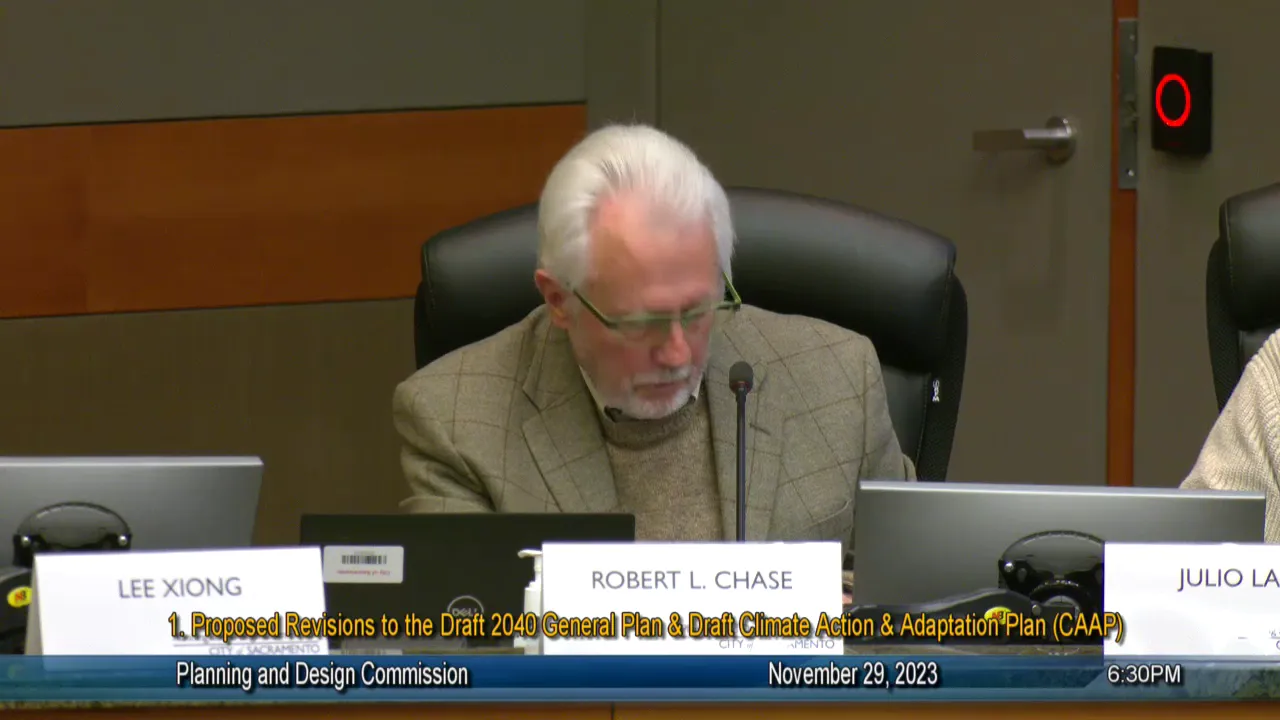
The Sacramento Planning and Design Commission held a special meeting on Wednesday, November 29, 2023, from 5:30 p.m. to 6:55 p.m. to review and comment on proposed red-line revisions to the Draft 2040 General Plan and the Draft Climate Action & Adaptation Plan (CAAP). Staff presented notable changes, including increased floor area ratios (FAR) near transit, elimination of parking minimums, new policies on biological resource protection, and updates to the climate plan. The commission heard public testimony and provided feedback for staff to incorporate before final adoption hearings in early 2024.
Public Comments & Testimony
- Elisa Lee (Strong Towns, District 4) expressed strong support for the revisions, particularly the elimination of parking minimums, increased FAR near transit, and safe routes to school. She urged further VMT reduction as a key indicator, upzoning around transit corridors, and transparent, timely updates to roadway design standards.
- Troy (District 4) supported the revisions and requested the inclusion of "sticks" such as reducing roadway capacity and de-paving to complement the carrots for transit and active transportation. He also suggested incentivizing de-paving to address heat island and flood mitigation.
- Dan (District 4) supported the direction of the revisions, praising the expansion of TOD zones from a quarter-mile to a half-mile. He highlighted the importance of tree canopy expansion, especially in low-income neighborhoods, and requested cross-references in the general plan text for tree-related policies. He also noted that upcoming parking management and street design standards are critical to the plan's success.
Discussion Items
- Staff Presentation: Remi Mendoza and Vic Randall presented the red-line revisions, which included:
- Land Use Policy 4.1: Increasing the transit-supportive development radius from ¼ mile to ½ mile and raising the maximum FAR from 1.0 to 2.0 for parcels within that distance (approximately 17,000 parcels).
- Policy 3.1: A sliding-scale FAR to encourage smaller, more attainable units.
- New policies: Elimination of parking minimums (LUP 4.13), support for vacant parcel development (LUP 4.14), design guidelines for light-industrial/residential compatibility (LUP 4.16), reconnecting communities (LUP 6.12), setbacks from rivers/creeks (LUP 8.15), a local affordable housing bonus program (LUP A.3), and future high-frequency transit route evaluation (LUP A.6).
- Reintroduction of 11 biological resource protection policies from the 2035 General Plan.
- CAAP revisions: Adjustments to building electrification measures (E2, E3) due to a Ninth Circuit ruling, new actions for e-bike adoption, safe routes to school, curbside charging, and heat mitigation strategies.
- Park service level standard changed to 8.5 acres per 1,000 residents.
- Community plan updates: temporary alley closures in Central City, engagement north of I-80 in North Sacramento, and street improvement prioritization.
- Commissioner Questions and Comments:
- Macias Reed: Praised the community engagement and the reconnecting communities policy. Emphasized the need for long-term maintenance funding for tree canopy in underserved areas and supported the community-led planning grant program. Asked about performance measures; staff responded that annual reports to council will track indicators like mode share, VMT, EV adoption, tree canopy in disadvantaged communities, healthy food access, park equity, infill development, and housing cost burden.
- Kadin: Commended the council’s action to increase FAR. Questioned small parcels near the 48th Street light rail station that still showed FAR 1.0—staff will review GIS methodology. Asked about the local bonus program for projects under five units; staff explained it will incentivize affordable housing through FAR deviations or other concessions. Asked about the definition of transit in LUP 4.1 (existing/planned rail vs. existing high-frequency bus). Kadin urged including planned BRT routes and strengthening the commitment in LUP A.6 from "reevaluate" to an automatic trigger. Asked about interim zoning consistency (LUP 3.11) and learned that zoning code updates are needed before processing missing middle applications.
- Chase: Asked about the definition of "small lot" in LUP 3.3—staff clarified that up to 2,000 sq. ft. of net building area is allowed on small lots. Supported including BRT in transit definitions. Questioned the heat-resilient design language (ERC A.8) about reflective building materials; staff noted it came from design review. Emphasized the need to prioritize sidewalk improvements in North Sacramento, especially near schools. Requested policies to encourage retaining existing trees on development sites and to tie tree removal to building permit issuance to preserve canopy. Asked about the urban center concept on the land use map near I-80/Swanson; staff identified it as the Swanson Station Transit Village Plan area.
- Lamas: Confirmed that staff received a late letter from ECOS (Environmental Council of Sacramento) regarding the Natomas Basin habitat conservation plan; staff incorporated responses and will present the final EIR before the January 25 hearing. Suggested flag programs for safe routes to school.
- Yeung: Asked about Vision Zero top-five corridors, specifically Florin Road. Transportation Planning Manager Jennifer Donlin Wyatt explained the city’s Vision Zero plan, data-driven prioritization of corridors (Florin Road is one), and funded improvements (tightening lanes, safer crossings). Yeung encouraged using TOD and IIG funding for safety improvements.
- Chair Hernandez: Asked about the Campus Commons neighborhood; staff confirmed that the general plan maintains consistency with the 2035 plan and that the pending 707 Campus Commons project will come to the commission as an appeal. The chair also noted the city’s strong tree canopy emphasis and asked about pedestrian scrambles; staff noted they are under consideration at high-traffic locations.
Key Outcomes
- The commission completed its review and provided oral and written comments on the proposed revisions to the Draft 2040 General Plan and the Draft Climate Action & Adaptation Plan.
- Staff will incorporate the commission’s feedback and finalize the documents for adoption hearings: January 25, 2024 (Planning and Design Commission) and February 27, 2024 (City Council).
- No formal vote was taken; the item was for review and comment only.
Meeting Transcript
Chair, staff is ready when you are. Thank you very much, Heather. Uh, let's uh good evening, everybody. Let's call this special meeting of the City of Sacramento Planning and Design Commission to order. Today's Thursday, November 29th, 2023. The time is 5 30 p.m. Clerk, will you please call the role to establish a quorum? Thank you, Chair. Commissioners, please unmute. Commissioner Andrade. Here. Commissioner Boyd. Absent. Commissioner Buckley. Absolutely. Is absent. Commissioner Chase. Here. Commissioner Caden. Commissioner Lamis. Absolutely. Commissioner Macius Reed. Here. Commissioner Thompson. Here. Commissioner Wallace. Here. Commissioner Zhang. Here. Commissioner Young. Here. And Chair Hernandez. Here. Thank you. We have quorum. Thank you very much. For members of the public, I'd like to remind everyone that if you would like to speak on an item today, please turn in a speaker slip. You can find them at the end of the room or over here with the clerk's office. Everyone will have three minutes to speak and make their comments. So with that, we'll now move on to the land acknowledgement. Please rise for the opening acknowledgments in honor of Sacramento's indigenous people and tribal lands. To the original people of this land, the Nissanon people, the Southern Maidu, Valley and Plains Miwok, Petwin Dwintom peoples, and the people of Wilton Rancheria, Sacramento's only federally recognized tribe. May we acknowledge and honor the Native people who came before us and still walk beside us today on these ancestral lands by choosing to gather today in the active practice of acknowledgement and appreciation for Sacramento's indigenous peoples history, contributions, and lives. Thank you very much. Please remain standing for the Pledge of Allegiance. I pledge allegiance to the flag of the United States of America and to the Republic for which it stands. One nation under God, indivisible with liberty and justice for all. Thank you all. Maybe seated. So we'll move straight on into the discussion calendar.
openpublica.com