Sacramento Preservation Commission Meeting Summary - June 20, 2018
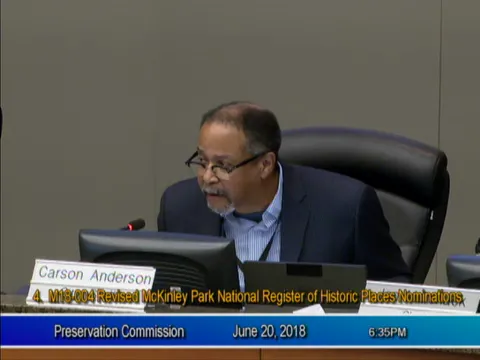
STREAMING COPY IN PREPARATION — RECORDING AVAILABLE FROM THE ORIGINAL SOURCE
Sacramento Preservation Commission Meeting Summary - June 20, 2018
The Preservation Commission of the City of Sacramento met on Wednesday, June 20, 2018, at 1:30 PM in the City Hall Council Chamber (915 I Street, 1st Floor). The meeting covered five agenda items: approval of prior meeting minutes, public comments on cemetery rose garden maintenance, a program to prepare historic district plans, a revised National Register nomination for McKinley Park, and a public hearing on amendments to the Mills Act ordinance. The commission unanimously approved the minutes and forwarded the Mills Act ordinance to City Council with amendments, while offering review and comment on the historic district plans program and the McKinley Park nomination.
Consent Calendar
- Approved the minutes of the April 18, 2018 meeting by unanimous vote. Commissioner Miller seconded the motion; no discussion or opposition was noted.
Public Comments & Testimony
- Anita Clevenger (volunteer curator at the Historic Rose Garden, Sacramento Historic City Cemetery; member of the Technical Advisory Committee) reported that park staff had been pruning and removing plants in the cemetery despite a moratorium on moving or removing roses and structures. She described severe damage to a 100+-year-old tea rose (the 'Joss Plot T') and poor pruning practices in Hamilton Square Perennial Plant Garden. She noted that Acting Parks Director Shannon Brown had committed to a moratorium on further pruning until the next TAC meeting on July 11, and requested that the commission agendize a report on the status of cemetery pruning for its July meeting.
- Margaret Buss expressed alarm about the rose garden damage, comparing it to replacing windows in a historic building without a management plan. She called the actions 'an act of bad faith' given the strong public support and international fame of the cemetery, and urged the commission to convey concerns to city management.
- Fritz Heilbron (longtime Sacramento resident, 67 years old) thanked the commission for its help with the Heilbron House preservation issue. He spoke about roses at his family plot in the cemetery, believed to have been planted by his great-grandmother, and asked that pruning be delayed until the proper season and that volunteers be allowed to perform the work with care.
- Margaret Buss (on Item 3) raised concerns about the R Street corridor survey, noting that consultants for the Downtown Specific Plan were told not to find anything new and that some properties were in question.
- William Burg (on Item 3) commented on the R Street corridor survey, stating that the Central City Specific Plan used a restricted threshold of eligibility (only properties directly associated with railroad or agriculture), which excluded important industrial resources. He recommended including the full industrial context of the corridor.
- William Burg (on Item 5, Mills Act) expressed support from Preservation Sacramento for the readoption of the Mills Act, noting the program is 'a long time coming' and that the organization would help spread the word once the program is active.
Discussion Items
Item 3: Program to Prepare Historic District Plans
- Director Carson Anderson introduced the program, authorized by Sacramento City Code Section 17.604.300, with a budget of $250,000 to prepare historic district plans for 29 of the city's 32 historic districts. The plans will include district-specific historic context statements, identification of contributing vs. non-contributing resources, and design standards.
- Melissa Gaudreau, consultant from Page & Turnbull, outlined the approach: a common 'front end' covering citywide context and themes, followed by individual chapters for each district. Field surveys will include property-by-property surveys for 19 districts, reconnaissance-level surveys for 6 districts, and review/photograph-only for several districts. Three districts (cemetery, city college, and central shops) are exempt.
- Associate Planner Sean de Courcy described public outreach efforts, including meetings with Preservation Sacramento, Midtown Association, South Park/Southside Park Neighborhood Association, Midtown Neighborhood Association, and Boulevard Park Neighborhood Association. A website (cityofsacramento.org/hdp) will post drafts and collect comments. Approximately 2,000 people are already on the preservation email list.
- Commissioner Whitelamb asked about spatial relationships as character-defining features; the consultant confirmed that field surveys would capture spatial and contextual issues for the design standards.
- Commissioner Bounds expressed concern about including urban design and landscape character in the plans, noting differences between districts like Midtown and South Land Park.
- Chair Marshak noted that Boulevard Park had been moved into the property-by-property survey category, which she appreciated given the nearly 200 properties outside the National Register District.
- The commission's attorney clarified that under the Brown Act, a majority of commissioners cannot attend city-hosted public workshops without it constituting an unagendized meeting; coordination through Carson Anderson on a first-come, first-serve basis was suggested.
- Chair Marshak discussed how older designations (priority essential, supportive, retrievable, non-supportive) would map to current contributing/non-contributing language, with refinements based on field surveys.
- The project is scheduled to wrap up at the end of April 2019.
Item 4: Revised McKinley Park National Register of Historic Places Nomination (M18-004)
- Director Anderson presented the revised nomination, which was a follow-up to a March 21, 2018 commission discussion. The revision expanded the narrative supporting significance but still has issues: ambiguity about contributing vs. non-contributing resources, gaps in integrity discussion, and inclusion of elements later than the proposed period of significance (1958), such as a 1980s garden at the Ivo Gard Shepherd Center.
- No representative from city parks attended; William Berg from the State Office of Historic Preservation was present.
- Commissioner Whitelamb asked whether Carson could solicit comments from absent commissioners (Moffat and another); legal counsel stated that Carson cannot serve as an intermediary to facilitate a Brown Act violation.
- The timeline is urgent: comments are needed before the State Historical Resources Commission meeting in the first week of August. The commission's next meeting is in the fourth week of July.
- Commissioners expressed general support for the nomination's merit (Commissioners Bounds, Miller, Whitelamb, and Marshak all agreed it should be listed), but supported staff's comments on the flaws. Chair Marshak also noted that the nomination's level of significance (statewide) lacked justification; it appeared more local or national.
- No formal motion was required; the chair indicated that individual comments and staff's identified flaws would be conveyed to the State Historic Preservation Office.
Item 5: Public Hearing - Ordinance Amending Section 17.604.720 (Mills Act)
- Director Anderson explained the Mills Act, a California state law allowing local governments to enter into property tax reduction agreements with owners of historic properties in exchange for maintenance/restoration. The City authorized the program in 2000, but only one contract (the Senator Hotel) remains active.
- Associate Planner Sean de Courcy detailed the proposed ordinance amendment, which would allow the city to cap contracts at 12 per year and establish an application fee. The City Council Law and Legislation Committee reviewed the item on June 12 and passed a motion consistent with staff's recommendation.
- Commissioner Bounds asked about the Senator Hotel's status; staff noted they have requested a 10-year work plan and the physical contract, which they have been unable to locate; next step is to request it from the City Clerk's office.
- Commissioner Whitelamb asked about the timeline; target date for City Council consideration is the first Tuesday in August (around August 9), with the ordinance effective 30 days after passage. Outreach materials and a web page are already in development.
- Chair Marshak proposed amendments to the ordinance: (1) add language to the financial analysis emphasizing the economic benefit of maintenance and rehab of historic resources; (2) add 'when factoring in property tax savings provided through a Mills Act contract' at the beginning of section D2; and (3) change 'and' to 'or' in the phrases 'restoration and rehabilitation' in sections D2 and D3, consistent with Secretary of the Interior standards.
- Commissioner Bounds noted discrepancies in the supplemental material: the definition of single-family housing differed between exhibits (4 units or less vs. 5 units or less), and the proposed fee appeared as both $152 and $135. Staff confirmed the intent is 4 units or less and a $135 fee.
Key Outcomes
- Approved the April 18, 2018 meeting minutes unanimously.
- Forwarded the Mills Act ordinance amendment to the City Council for adoption with amendments (including those proposed by Chair Marshak and corrections noted by Commissioner Bounds). The motion passed unanimously (4-0): Commissioners Bounds, Miller, Whitelamb, and Chair Marshak all voted yes.
- The commission provided review and comment on the Historic District Plans program, with no formal vote; comments focused on including spatial relationships, landscape character, and addressing R Street survey limitations.
- The commission provided review and comment on the McKinley Park National Register nomination, supporting the listing but conveying concerns about contributing/non-contributing analysis and integrity gaps to the State Historic Preservation Office.
- Director Anderson reported that a $200,000 one-time infusion into the Historic Places Grants Program is being considered by City Council; he will report back at the next meeting.
Director's Report Highlights
- California Preservation Foundation Annual Conference (May 17-20) drew approximately 300-350 attendees; next year's conference is in Palm Springs, and the 2020 conference is slated for Sacramento.
- New senior planner Carlo Felix began work on June 18; new preservation intern Catherine Kanipa started June 20.
- Openings remain on the Preservation Commission (licensed contractor) and the Sacramento Heritage Board.
- No new updates on the Johnny Moss Federal Building or the Gordon Shaber Superior Courthouse.
- Staff is working with Sacramento Modern on advancing mid-century modern nominations; individual property nominations are underway for some owners on 38th Street who supported district designation.
Member Comments
- The commission requested that the July agenda include a report on the cemetery rose garden pruning status, following the July 11 TAC meeting.
- Commissioner Bounds noted that the July 10 issue of the New York Times travel section (36 Hours in Sacramento) referenced several historic districts.
- Chair Marshak requested that documents be converted to PDF electronically rather than scanned where possible, to facilitate electronic review and comments.
Meeting Transcript
The June twentieth, twenty eighteen meeting of the City of Sacramento's Preservation Commission is called to order. Before we start, I'll review our procedures. Copies of the agenda for tonight's meeting are in the kiosk outside the door. Commission will refer to each of the items according to the order provided on the agenda, and there are no changes to the agenda. Followed by questions of the commission, and then opportunity for public comments before the commission actually takes any action. And there's normally a three-minute public comment limit. So if you'd like to speak on an item not on our agenda, please fill out the speaker form and list item two as your preferred item. At this time, I ask that you please turn off all cell phones and pagers. Anything else that makes noise. Well, which of you would like to be the seconder? All right. Commissioner Miller with the seconder. Um and any discussion on the uh on the motion. Being none, let's take a vote. All in favor. Aye. Aye. Any opposed? Any abstentions. Okay, the minutes are approved. Our next item public comments matter is not on the agenda. We do have speaker slips apparently. Okay, we have two speaker slips. Um first one is Anita Cleavinger or Clavinger. I never know how to please correct me. But whatever. I now I do want to show a couple pictures, and I want to be sure these will project. I hold on, okay, perfect. Okay. Wasn't expecting a presentation. Yeah. Okay. Uh good evening. I'm Anita Clevinger. I volunteer as the curator at the Historic Rose Guard in the Sacramento Historic City Cemetery. I'm a member of the technical advisory committee, which city staff proposed forming two years ago, making a commitment to this commission to develop revised horticultural guidelines in an open and transparent process. There have been two TAC meetings. The first was September of last year. Guidelines have not been on the agenda. While the moratorium on moving and removing roses and structures has remained in place. About six months ago, park staff began moving through the cemetery, limbing up, cutting back, and removing plants. One of the plants badly damaged in this process is an old tea rose that we believe was planted more than 100 years ago. We call it the Joss Plot T because that's the pot it's next to. Lynette Strangsted and her graveyard preservation primer states, much graveyard vegetation is historic and important in its own right. It should be retained. I had documented my concerns about this rose to city staff before when they said it was too close to the head stones and had to be moved or removed. And I I thought that we were okay, but to no avail. But this shows how lush and beautiful it was in November of 2013, and now it's just a single diseased cane in its place. Three weeks ago, staff brutally and inexpertly pruned and thinned roses in Hamilton Square Perennial Plant Garden at the wrong time of year. You don't do that in July.
openpublica.com