Preservation Director Special Meeting on Historic District Plans - October 30, 2019
STREAMING COPY IN PREPARATION — RECORDING AVAILABLE FROM THE ORIGINAL SOURCE
Preservation Director Special Meeting on Historic District Plans - October 30, 2019
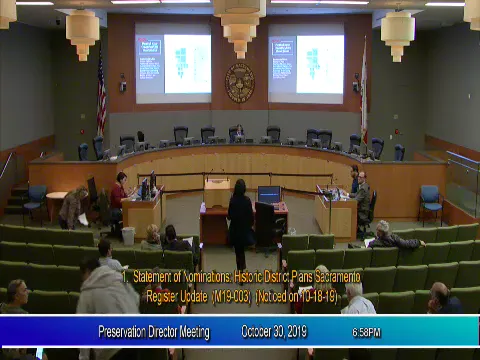
On October 30, 2019, the Sacramento Preservation Director held a special public hearing to review the Statement of Nomination for updating the Sacramento Register of Historic and Cultural Resources as part of the Historic District Plans project. The meeting covered 27 historic districts, proposing boundary revisions, designation of contributing and non-contributing resources, and deletion of two districts (12th Street Commercial and Memorial Auditorium). Staff presented an overview of the process, incentives (Mills Act, grants), and the three-step review approach. Public comments were received on multiple districts. The director will forward a recommendation to the Preservation Commission on November 20, 2019, with further review by the Planning and Design Commission and final action by City Council in December 2019.
Public Comments & Testimony
- Michael Malinowski (architect, representing Michael Fond) objected to listing 1219 17th Street as a contributing resource, citing poor integrity and infeasibility for mixed-use development. He also raised concerns about 2612 J Street and 520 S Street.
- James Fitzpatrick confirmed that 1706 P Street and 1611 17th Street are contributing resources.
- Lily Mohanna (representing Mohanna Development) requested that 904 J Street be designated non-contributing due to heavy alterations and difficulty of future development.
- Matthew Piner (architect) noted confusion over parcel vs. address designation at 904 J Street/1009 9th Street and the building's deteriorated condition.
- Jenny Hilderbrand asked about the grant program and confirmed that 900 J Street is a city landmark.
- Joe Maloney objected to 1412 F Street being listed as contributing, arguing it lacks integrity and does not match district characteristics. He also questioned the benefits of the Mills Act.
- Clea Bertakis (owner of 1115 T Street) petitioned for non-contributing status, describing the property as a "stucco box" with no significant features.
- John Lucas (representing Greg McRae, 422 U Street) objected to listing due to a pending dispute over heat pump condensers and insufficient notice.
- Margot Parks (South Side Park owner) questioned restrictions on new construction and their impact on housing supply, and opposed the designations as a policy.
- Steven Cvitanov (owner of 2318 H Street) expressed concern about late notice, the rushed timeline to meet SB 330 implications, and the impact on development potential.
- Rhonda Pope-Flores (owner of 1412 20th Street) recommended incorporating an economic analysis and tribal cultural resources into the process.
- Evelyn Fallon requested that the consultant (Page & Turnbull) be present at public meetings to hear feedback.
Discussion Items
- Staff Presentation: Sean deCourcy and Director Anderson outlined the project background, public outreach, CEQA determination (no additional significant effects), and the permitting process. They explained that many districts from the 1980s lacked contributing/non-contributing lists, and the update aims to streamline review.
- District-by-District Review: Each of the 27 districts was presented with proposed changes. Most had no speakers; some received objections or questions. Key districts with public comments included:
- Alkali Flat North: A speaker questioned 1111 D Street (1995 building) as contributing; staff will re-examine.
- Boulevard Park: A non-contributing property owner (2220 C Street) asked about benefits; staff clarified that non-contributing status may simplify review.
- Cathedral Square: John Fairbanks questioned the inclusion of "masks and animal figure heads" as character-defining features; staff will review.
- East End (Capitol Avenue): Michael Malinowski objected to 1219 17th Street; James Fitzpatrick confirmed 1611 17th Street as contributing.
- Merchant Street: A speaker (88-year-old) requested that 923 7th Street be changed to non-contributing due to extensive alterations.
- Memorial Auditorium: Deletion recommended; no objections.
- Plaza Park (Cesar Chavez): Lily Mohanna and Matthew Piner raised concerns about 904 J Street; Jenny Hilderbrand asked about landmark status.
- Poverty Ridge: Leon Corcos objected to 1921 21st Street (1940s stucco duplex) being listed as contributing, citing cost and incompatibility.
- South Side: Clea Bertakis, John Lucas, Margot Parks, and others objected to contributing status for their properties, citing lack of integrity, housing supply concerns, and insufficient notice.
- General Public Comments: Several speakers highlighted the rushed timeline, lack of consultant presence, economic impacts, and the need for alignment with state housing laws.
Key Outcomes
- The Preservation Director will forward a Statement of Nomination to the Preservation Commission for each district, incorporating the recommendations presented and noting public comments that require further research.
- Staff will review objections to specific property designations (e.g., 1111 D Street, 1219 17th Street, 904 J Street, 923 7th Street, 1412 F Street, 1115 T Street, 422 U Street, 1921 21st Street, 2318 H Street) and update the record before the Preservation Commission hearing.
- The Preservation Commission public hearing is scheduled for November 20, 2019. The Planning and Design Commission will also consider code revisions for non-contributing resources. Final action by City Council is expected in December 2019.
- CEQA determination: The project is within the scope of the Master EIR for the 2035 General Plan, with no additional significant effects.
Meeting Transcript
Thank you for your attendance tonight. This is a one step in a rather long process that began in the summer of 2018 when the city brought on board its preservation consultant Paige and Turnbull, who worked very closely with city staff to develop what we're calling the historic district plans. Some of you have had a chance to go to the city's website. If you have not done so already, I would encourage you to do so. There is a lot of information there. It's www.city of sacramento.org, and then there's the forward slash and the word HDP for historic district plans, and most of the information that you will need to understand how your property's been classified or understand the overall process will be explained by going to the website. So we are kind of in the later stages of a process. This will go all the way up to the city council level in the City of Sacramento. Our ordinance, our preservation ordinance requires the final action of City Council to change items, add things to the Sacramento Register of Historic and Cultural Resources. There will be a meeting of the Preservation Commission on November the 20th. And that will be a public hearing, sort of a little bit like the format we have tonight, where they were they're going to make a formal recommendation both to the Planning and Design Commission and to City Council about the historic district plans. So there's an opportunity yet to hear further slight refinements to what you have before you tonight and to share your thoughts and opinions. And Jose Quintania, who is one of our assistant planners in current planning, who will be assisting him in providing information to you and to me during the course of this public hearing. So I'm going to just give you a quick overview of the why and wherefore of this meeting tonight. Sean de Coursey is going to give you a bit more detail, is going to show you a PowerPoint presentation that'll go through the things that I'm saying in a bit more detail. So having said that. So we're talking about historic districts that were previously created by the city, a majority of them, a large majority of them back in the 1980s, more than 30 years ago. Our practices today, based on our current code, are to develop what we call historic district plans for each of those historic districts. Only the more recently created historic districts actually have plans of this sort. The earlier ones that the city established back in the 1980s and 1990s do not have this level of detail. They don't have a list of what we call contributing and non-contributing resources. They are simply delineations on a map of the historic district boundaries and a list of all the properties. We don't have discussion of character-defining elements in each of those historic districts. We don't have historic context statements, which explain the development history and the design patterns that you see present in each of the districts. Explain what we're recommending, and then at the end of staff's discussion of each district, there will be an opportunity for you to come up to the podium and to share a three-minute comment or question with us that we can get back to you on. I think I covered the basic points here. So with that, I'm going to turn things over to Sean DeCourcy. Thank you, Director Anderson. I'm pleased to present the Sacramento Register update as part of the historic district plans project. Again, my name is Sean DeCoursi, Associate Preservation Planner with the City of Sacramento's Community Development Department. To give you a little more background about this project, the city's developed historic district plans for 27 of its 32 historic districts. They contracted with the historic architecture firm Page and Turnbull, who are based out of San Francisco but have offices in Los Angeles and here in the Boulevard Park neighborhood of Sacramento. Page and Turnbull specializes in historic preservation planning and projects involving historic buildings. This public outreach involved meetings with neighborhood associations, professional organizations, business groups. We also formed a technical advisory committee to look at the design guidelines and standards and help us refine that portion of the document. We had public meetings and several meetings at the preservation commission and planning and design commission to review various drafts of the document. The design standards and criteria that came out of this public outreach and the consultants' work is largely based on establishing contributing and non-contributing status within the historic district, a commonly used preservation tool. We provided property owners notification to every property owner in each district subject to change, whether that their property was subject to changes or not. I'll get into a little more detail about whether the properties are subject to change, but several districts included in the plans have boundary revisions only, and the status of contributing and non-contributing properties would not change as a result of the historic district plans and Sacramento Register update. That said, some notices went out with incorrect status information, and we've provided correction notices to any property owner who whose status was incorrect on the original notice. We're confident that the notice prior to the preservation commission meeting will include the correct property status as well as any changes to historic property status and recommendations that result from tonight's public hearing. As Director Anderson mentioned, 23 of the historic districts that were listed on the Sacramento Register in the 1980s, first surveyed in the 1970s, were more akin to overlay zones or zoning districts. They did not include identification of individual contributors and non-contributors. Those properties are shown in this map in blue. And all properties within these historic districts are treated the same. And I'll go over our permitting process and our site plan design review process in more detail in a moment. But anyone within one of these areas comes in for a it's for a requested change to their property and would be routed through the same the same review process. Identifying contributors and non-contributors gives the city the opportunity to streamline development on non-contributing parcels while focusing their efforts on contributing parcels and identifying which of those parcels are truly significant to the districts. For the other districts, there is uh shown here in orange or yellow. Those resources are already listed on the Sacramento Register as contributing and non-contributing, and the documentation is fairly recent, as late as 2004 and early as 2014.
openpublica.com