Utilities Rate Advisory Commission Solid Waste Rate Hearing, February 6, 2013
STREAMING COPY IN PREPARATION — RECORDING AVAILABLE FROM THE ORIGINAL SOURCE
Utilities Rate Advisory Commission – February 6, 2013
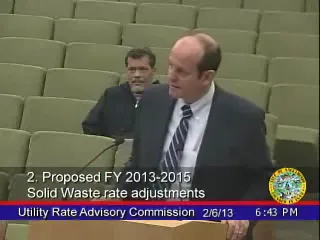
The Sacramento Utilities Rate Advisory Commission met on Wednesday, February 6, 2013, at New City Hall, 915 I Street, Council Chamber. The agenda listed a 5:30 p.m. start; the minutes record the meeting was called to order at 5:35 p.m. and adjourned at 7:45 p.m. Six commissioners were present (Christopher Butcher, Kevin Schubert, Steven Archibald, Karen McBride, Scott Brown, Carolyn Veal-Hunter); Chair Douglas Brown was absent. The main business was a Proposition 218 public hearing on the proposed Fiscal Years 2013–2015 Solid Waste rate adjustments and a recommendation to the City Council.
Consent Calendar
- The Commission unanimously approved the minutes of the November 28, 2012 meeting. Motion by Kevin Schubert, seconded by Scott Brown; 6 yes, 0 no, with Douglas Brown absent.
Public Hearing: Proposed FY 2013–2015 Solid Waste Rate Adjustments
- Integrated Solid Waste Manager Steve Harriman presented the proposal. He explained that rates are not being increased; instead, the definitions of what each rate funds are being changed.
- Monthly garbage collection remains weekly at $21.49 and will now also fund the appointment-based neighborhood cleanup program (suspended since 2010), offered February through October.
- Recycling would change from weekly to every-other-week starting July 1, 2013, while the monthly recycling rate remains unchanged. The City would establish a new rate of $1.76 for a second recycling can; an extra yard waste can would drop from $5.70 to $3.34; and collections over the neighborhood cleanup program’s 5-cubic-yard limit would cost $28.60 for up to an additional 5 cubic yards.
- The changes implement the Solid Waste Business Plan approved by the City Council in December 2012. Voters passed Measure T on November 6, 2012, repealing the 1977 Measure A that had prohibited required containerized green waste collection.
- A Proposition 218 notice was mailed December 21, 2012. Staff reported 13 written protests at the time the staff report was prepared and 27 written protests as of the meeting. About 147,000 notices were mailed.
- FCS Group consultant Angie Sanchez described the new rate model. She said industry reserve targets are 60–90 days of operating cash and that bond coverage should be at least 1.30, with 1.50–2.0 preferable for future borrowing. Rates are planned to remain flat through July 1, 2015, after which the model would inform future rate scenarios.
Public Comments & Testimony
- Marian Ender: expressed opposition to eliminating the loose-in-the-street (claw) yard waste collection system. She suggested considering every-other-week pickup to save money and raised concerns about container durability.
- Steven Bourasa (also transcribed as Barasa): opposed the switch to bi-weekly recycling, saying it conflicts with Sacramento’s green goals. He supported continued weekly recycling, described himself as a frequent recycler, and asked about street sweeping frequency.
Commission Deliberations
- Commissioner Steven Archibald moved to divide the question and vote separately on each of the six rate components. The motion was seconded by Carolyn Veal-Hunter and passed 4–2 (Schubert, Archibald, Scott Brown, Veal-Hunter yes; Butcher, McBride no).
- A substitute motion by Scott Brown to vote on all rates as one package failed for lack of a second.
- Senior Deputy City Attorney Janeth San Pedro advised that under the City ordinance, the Commission’s role is limited to reviewing rates and making recommendations on staff’s proposal; it cannot recommend changes to the service levels already approved by the City Council. She stated the Council could still consider service-level questions when the rates are presented.
- Several commissioners expressed concern that they lacked detailed cost and revenue information to judge whether rates matched expenses, particularly for recycling. Commissioner Archibald called the weekly-to-bi-weekly recycling change a doubling of the rate because the same price buys half the service. Staff responded that weekly recycling costs over $1 million more per year but generates only about $60,000 more revenue than bi-weekly, and that recycling has historically been undercharged. Staff also acknowledged that the current structure overcharges for garbage and undercharges for recycling.
Key Outcomes
The Commission voted separately on each proposed rate component:
- Monthly garbage rate ($21.49, including neighborhood cleanup): passed 4–2.
- Monthly yard waste rate ($10.35): failed 3–2–1, with one abstention; because only 3 of 6 present commissioners voted yes, the motion failed.
- Monthly recycling rate (unchanged rate with bi-weekly service): failed 1–5.
- Extra recycling can rate ($1.76): failed 2–2–2. There was some confusion about the proposed amount; staff confirmed the correct rate in the Prop 218 notice was $1.76.
- Extra yard waste can rate ($3.34, down from $5.70): failed 1–2–3.
- Neighborhood cleanup overage charge ($28.60 for more than 5 cubic yards): passed. Minutes record the vote as 5–1, with Commissioner Butcher opposed; the raw transcript appears to show unanimous approval, a discrepancy noted for the record.
- Staff said they would convey to the City Council that the Commission did not recommend approval for the four failed items. The Council hearing was tentatively scheduled for March 12, 2013, with a possible move to April 2, 2013.
- No comments were received under Public Comments—Matters Not on the Agenda. The meeting adjourned at 7:45 p.m.
Meeting Transcript
For the record, I'm Steve Harriman. I'm the integrated waste general manager for the City of Sacramento. We're here tonight to have a public hearing for the 2013 service and rate changes for the recycling and solid waste division. And I'm going to give it one second here so we can go to the next slide. So just by way of a quick summary, we've presented this this slide particular to the commission several times. This is a summary of our business plan that was put forth and was adopted by council in December of this year. And just very quickly, garbage collection is currently weekly and it will continue as a weekly collection. Starting on July 1 of this year, recyclables will go from weekly to every other week. On our yard waste system, we currently have a hybrid where 103,000 customers have a container and pay a lower rate. All customers will have a container for weekly yard waste collection. And citywide loosen the street pickup will take place on November, December, and January annually. We're going to bring back the appointment-based neighborhood cleanup program, which was suspended in about 2010. And that's for the collection of large items like furniture and appliances and large quantities of yard waste that won't fit into the CAN. That will be an appointment-based system and will be offered from February through October annually. Between March and June of 2012, we did a significant amount of community outreach with the business plan, including a presentation to the Rate Advisory Commission. On June 26th, we went back to council and the council approved uh placing measure T on the ballot. And you will recall that measure T was uh to repeal Measure A, which was uh voted in in 1977, and basically said that the City Council could not require residents to use a container for the collection of green waste. Uh and for the business plan to proceed, we needed to repeal measure A. So in June, the council approved uh putting Measure T on the November ballot. Uh measure T was successful, it passed on uh November 6th of 2012. And then we went um subsequently back to council and they approved the implementation plan uh for the business plan. Uh there's a typo on the next line here, uh February 6, 2013, not February 6, 2012. We are here uh for the public hearing. Um let me just note also I skipped over it. The uh the Prop 218 notice was sent out to uh residents on December 21st, I want to say, uh, that shows the proposed changes as part of the implementation of the business plan. And that notice uh lists tonight as the public hearing. So that's why we're here. Uh on March 12th, then uh the proposed new rates will be presented to the city council for approval, and then uh the programs and the new rates for additional services will go into effect on July 1 of this year. So this is a just kind of a quick summary of the rates, and and this this process is a little bit different because we're not actually raising rates. What we are doing here is we are changing the definition of what each of these uh line items is funding. And uh so that requires a uh a public review process. So for example, the garbage rate uh includes weekly trash collection, and with this change, it will also include the neighborhood cleanup program from February February through October. So that program is being added to the garbage rate. Uh the recycling rate is currently funds a weekly program. The recycling rate will now fund and every other week program. And the yard waste rate uh uh is will fund the weekly containerized pickup plus the three months of the loosened street November, December, and January. So really we're just we're just changing the definition of what each of those light items pay for. And our you know, one of our primary goals here in this process is just to more closely align revenue and expense uh in our enterprise. And I I uh apologize for this slide. I know it's small and we showed it last time, but let me uh go through it. This is basically uh a table that was included in the Prop 218 notice, and uh you'll see on the right side of the table here, it shows the current monthly rate and then the proposed monthly rate, and then in the column that says program changes, uh it just lists how those definitions are changing. So, you know, just for example, the weekly garbage collection, the rate is staying at $21.49. However, we're adding the appointment-based neighborhood cleanup. I will point out that on the bottom part of the chart there, um we are uh uh lowering the rate for an extra recycling can. Okay, so that's going from uh uh I'm sorry, we didn't actually have a rate for an extra recycle can before. We charged the extra and a second recycle can was charged at the first can rate. So we're establishing uh a rate of $1.76 for a second recycling container. Uh for the yard waste program, um we're actually lowering the rate for the uh second container from $5.70 to $3.34. And then finally, we're establishing a rate for the neighborhood cleanup program uh if people put out excess material. So there is a five cubic yard limit in the neighborhood cleanup program.
openpublica.com