Utilities Rate Advisory Commission Meeting - February 25, 2015
STREAMING COPY IN PREPARATION — RECORDING AVAILABLE FROM THE ORIGINAL SOURCE
Utilities Rate Advisory Commission Meeting - February 25, 2015
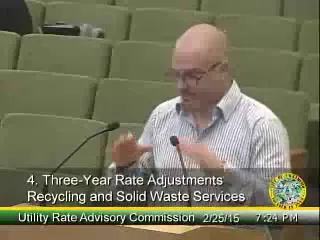
The Utilities Rate Advisory Commission met on Wednesday, February 25, 2015, in Council Chambers at Sacramento City Hall, 915 I Street, with open session scheduled for 5:30 p.m. The Commission approved the February 11 minutes, elected new leadership, received the Department of Utilities quarterly Accountability Plan update, and closed the continued public hearing on proposed three-year recycling and solid waste rate adjustments. After considering alternatives, the Commission voted to recommend the staff proposal of 3% FY2016, 2% FY2017, and 2% FY2018 rate increases with a 90-day reserve.
Consent Calendar
- Approved the minutes of the February 11, 2015, meeting by motion.
Public Comments & Testimony
- Member of the public Joshua Foster expressed frustration that residents who heavily recycle and compost receive no economic benefit for using less garbage service. He asked whether customers can opt out of services or receive a credit. Staff responded that variable can sizes provide some rate choice, city code requires a minimum 32-gallon weekly garbage service for health and safety, and weight-based billing has been explored but presents practical issues.
Department of Utilities Accountability Plan Update
- Dan Cherry, presenting for interim director Bill Busath, reported on quarterly accountability measures. As of February 2, 2015, the water bond fund had spent $108 million of $239.5 million, and the wastewater bond fund had spent $13.8 million of $30 million. Bond-funded work includes about 33 water projects (9 complete, 6 in construction) targeted for completion by March 2016, and about 58 wastewater projects (10 complete, 7 in construction) targeted by June 2016.
- The Department remains under Stage 2 water shortage restrictions with a 20% conservation target. In 2014, citywide conservation averaged 19%, with 19% residential and 13% commercial/industrial savings. About 19,000 water misuse calls were received last year.
- City Council approved the accelerated water meter program the previous evening: approximately 38,800 front-yard and 12,400 backyard meters at an estimated cost of about $250 million, aiming for 100% metering by 2020 and about 90% metering within three years.
- The new utility bill format, effective February 23, 2015, includes a 13-month water usage histogram.
- Commissioner Archambold disclosed that he had testified on the meter plan before City Council as an individual, not on behalf of the Commission. The Commission received and filed the report.
Public Hearing: Proposed Three-Year Recycling and Solid Waste Rate Adjustments
- The Commission continued the public hearing begun the previous week. Staff recommended three-year rate adjustments of 3% in FY2016, 2% in FY2017, and 2% in FY2018 on a weighted-average basis, while maintaining a reserve equal to 90 days of operating costs (about $15.5 million). For residential customers, monthly rates would rise from $30.22 to $32.34 for 32-gallon service, $34.48 to $36.89 for 64-gallon service, and $38.31 to $40.99 for 96-gallon service over the three years.
- Steve Harriman, Integrated Waste General Manager, reviewed cost drivers including disposal tip fees, fuel, Local 39 labor contract escalations, and landfill regulatory compliance. He cited efficiencies achieved since 2010 including exiting commercial waste service, biweekly recycling, a mandatory containerized yard waste program, complete rerouting, fleet replacement, and safety programs. Reported improvements include a 60% reduction in workers' compensation claims from FY12 to FY14, collision reductions from 50 in FY13 to 29 in FY14, and recycling contamination down from nearly 32% to under 20%.
- David Levine, Business Planning Manager, described rate model assumptions: 3% annual labor escalation, 2.75% CPI (using the San Francisco-Oakland-San Jose index), 5.8% disposal escalation, 5% fuel escalation, and 2% development growth. He noted that a 1% rate reduction equals about $600,000 in cuts.
- Alternative reserve scenarios were presented: a 75-day reserve ($12.7 million) would lower the package to about 2% per year; a 60-day reserve ($10.2 million) would yield about 1.5%/1%/1%; a 45-day reserve ($7.6 million) would allow 0% in FY16 and FY17 with 1.21% in FY18; and a 30-day reserve ($5.1 million) would require no rate increase over the three-year period but was not advised.
- The Commission heard responses to written commissioner questions, including on the 11% voter-approved general fund tax (Measure I), the disposal contract's 117,000-ton "put or pay" minimum, recycling commodity pricing and contamination, the $50,000 cost of Prop 218 notices, and fleet replacement timing.
Key Outcomes
- The February 11, 2015, minutes were approved.
- Carolyn Bill Hunter was elected Chair and Kevin Schubert was elected Vice Chair.
- The Department of Utilities Accountability Plan update was received and filed.
- The public hearing was closed.
- Commissioner Horner moved to approve the staff proposal of 3%/2%/2% with a 90-day reserve; the motion was seconded by Commissioner Butcher.
- A substitute motion to instead use the 75-day reserve option failed.
- A later substitute motion to approve only the first two years of rate increases also failed.
- The original motion approving the 3%/2%/2% rate adjustments with a 90-day reserve passed. The transcript records yes votes from Commissioners Butcher, Horner, and Hunter and no votes from Commissioners Schubert and Archambold; Commissioner Bering's vote is not clearly captured in the transcript.
- A subsequent motion to send an advisory notice to the City Council requesting consideration of rebating a portion of the 11% utility general fund tax or surplus revenue to ratepayers was made and seconded, but was withdrawn after Commissioner Horner expressed concern that this might not be the best use of city surplus funds.
Meeting Transcript
Oh okay. Okay, we're gonna call the meeting to order. Wednesday, February twenty-fifth meeting. First item we'll do is a roll call. April Butcher. Here. Kevin Schubert. Here. Stephen Archambold. Here. Timothy Horner. Here. Brian B. Ering. Carolyn Bill Hunter. Here. You have a quorum. You have before you the minutes from the February eleventh meeting. Everyone take a moment to review the minutes. We'd be we could entertain a motion to approve those if you see fit. I move to approve the minutes. Second. All those in favor? April Butcher? Yes. Kevin Schubert? Stephen Archibald? Timothy Horner? Yes. Brian Bear. Carolynville Hunter. Yes. Motion passes. We'd like to bring that up for discussion. Our former chair was Doug Brown, who has um exited off of the commission. So we have um the chair position open. Um and uh now's the time to discuss if anyone has an interest in either taking on the uh chair role or the vice chair role. Uh and uh making those selections this evening, so then as we move forward through the calendar, we have the folks who will be running our meetings for this next year. Yes, thanks. I'd like to nominate Carolyn for the uh chair position. I should be specific here. Whenever you're ready to? Whenever you're ready to act, uh whether you do them separately or together, you I you should do it by motion, I think. Our question was whether we need to put that. Uh if someone makes a motion, yeah. I'm not sure if that was actually a motion or uh you did say move, I think. So let's see. I will make I will make that a motion then. If it was not before, I would move to nominate Carolyn Beal Hunter as the uh chair of the URE. Okay.
openpublica.com