Utilities Rate Advisory Commission Meeting - August 26, 2015
STREAMING COPY IN PREPARATION — RECORDING AVAILABLE FROM THE ORIGINAL SOURCE
Utilities Rate Advisory Commission Meeting - August 26, 2015
The Utilities Rate Advisory Commission (URAC) met on Wednesday, August 26, 2015, at 5:30 p.m. in the Council Chambers at 915 I Street, Sacramento. The meeting covered updates on the Department of Utilities' accountability plan, financial status, and rate development planning. Commissioners discussed water conservation achievements, the accelerated meter program, and the upcoming rate adjustment process. The meeting also recognized Commissioner Steven Archibald for his service since the commission's inception in 2008.
Consent Calendar
- Approval of Minutes for May 27, 2015: Approved unanimously (4-0, with Commissioners Kevin Schubert and April Butcher absent).
Discussion Items
- Department of Utilities Accountability Plan Update: Bill Busath, Utilities Director, reported on community outreach, meter construction (one of the most intense periods), bond expenditures (bonds sold March 2013 requiring 85% spend by March 2016), and drought conservation. Conservation achievements: 34% reduction in June, 35% in July, on track for 32-33% in August, cumulatively meeting the governor's 28% mandate. The My Water customer web portal was launched for the first 11,000 customers. Commissioner Archibald commended the portal's rollout.
- Department of Utilities Financial Update: Susan Goodison, Business Services Manager, presented the FY2015/16 adopted budget. No rate increases were included; revenues assumed 20% conservation (each 10% conservation reduces water fund revenue by $3 million). A $2.3 million augmentation was approved for 13.5 new FTEs, primarily for the accelerated meter program and conservation efforts. The water fund's beginning balance was approximately $41 million, with a planned $16.6 million use for capital improvements, leaving an ending balance of $24.4 million (138 days of working capital, above the 120-day guideline). Commissioner Archibald discussed pay-as-you-go capital funding variability.
- Department of Utilities Utility Rate Development Planning Update: Goodison outlined the rate development process (data collection, cost drivers, financial plan) and proposed timeline: Proposition 218 notice mailed in November 2015, public hearing at URAC in January 2016, City Council consideration in spring 2016 for FY2017 rates. A four-year rate increase for water and wastewater is under consideration (storm drainage, unchanged since 1996, would require voter approval). Staff clarified they are not currently proposing tiered rates due to uncertainty from the San Juan Capistrano ruling and the city being only 55% metered; target is to be 90% metered by end of FY2018 before introducing tiers. Commissioners requested a revisit of rate structure options at the September 9 workshop.
Key Outcomes
- Consent calendar approved (Item 1).
- All discussion items (Items 2-4) received and filed.
- Staff committed to providing additional information on tiered rate structures and the impact of the San Juan Capistrano ruling at the next meeting (September 9, 2015).
- The next workshop (September 9) will cover water and wastewater system overview and capital needs, not specific financial proposals.
- Commissioner Steven Archibald was recognized for his service; he attended his last meeting.
Meeting Transcript
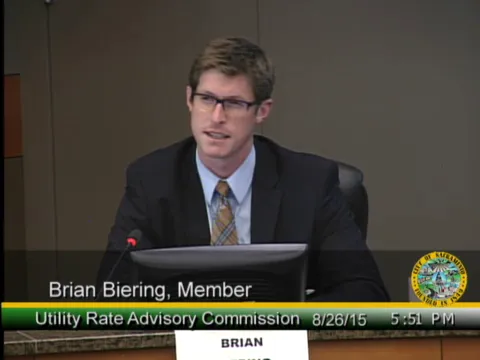
Kevin Schubert. Timothy Horner. Here. Here. We have a quorum. I'm going to make a real quick announcement. It's actually a facility announcement. We've learned the water's going to be turned off in the building from seven until eight this evening. So around six forty-five, we'll do a quick time check, see where we are, and we might take a five-minute uh break to take care of anything regarding water while they've shut it down. So we just learned that this evening, so thanks. The May twenty-seventh, two thousand fifteen minutes, which are attached to your agenda. If you could take a moment to review those I'd be happy to entertain a motion on those. Um first of all, you've got the report, and so I'm just gonna highlight uh a few things in the uh in the accountability report. Um we continue to do robust community outreach with our capital program, including um our mailers, our signs, our community meetings. We have um ramped up our construction in the in the past few months. Um we have quite a few meter projects that are either out to bid or in construction right now. And um, it's actually one of the most intense meter construction times that we've that we've ever had in the in the meter program so far. And it's gonna be a nice uh it's a nice little test for us because when we get into the meter acceleration program or the accelerated meter installation program, we're going to be uh installing meters at at even a more intense rate uh than what we are right now. Um one of the things that we're doing in conjunction with this little mini uh boom that we have in in construction right now is is that we've hired a consultant to help us to manage our community outreach. Um HDR and they are already uh have helped us greatly uh with some community meetings and uh and uh communications with the with the with the um with the community. Um so and we're learning some lessons from that going into the accelerated meter program. Uh they're gonna greatly benefit us as we go into that program. Um we also have the water works website, which is uh we continue to uh keep updated that gives um the community information about the projects and uh the status of them. We may have had a little bit of lapse in that um uh website and we are in the process of uh of making sure that that website is updated. Um as far as the bond expenditures, um well, and just one more point on community engagement. We've also we're also in the process of bringing on a uh uh an outreach firm to help us with our outreach on the on our rate um adjustment uh plan and strategy as we move forward with that. We're gonna be touching lightly on that tonight. Whatever we say in regard to rate planning and and rate adjustment proposals is very draft tonight because we're meeting with the city manager on Monday to lay out for him what we're proposing and to get his input and and buy off on that. Um as far as our capital program in your packet, you have these two tables, and really all these tables say, you know, this is what we expected to do, and this is what we're on track to do. And you can see that other than you know, some differences, for instance, on the first chart, you'll see that we plan the the water treatment plant. Looks like it's gonna cost us less than we anticipated, which is good news, and that we've had some extra money to spend on our groundwater wells uh well rehab. Uh you can see that other than that, our expenditures are about what we anticipated. Um also on the wastewater, same thing that we're we're spending a little bit more money on our uh rehab, CSS rehab and permit compliance, and and what what the dynamic there is is that we're doing a little bit more work than we anticipated in that in that area, and we're so we're spending a little bit less money in some of those and some of those other areas. Um we also want to um you also have uh in your packet that the dashboards that give you an indication of where we are in our capital and in delivering our capital uh program. A reminder that we purchased bonds for the waste uh for the water capital program in uh March of 2012, and so we need to have those funds largely spent by March of 2015. Of uh I'm sorry, we sold them in in March of 2013, and so we need to have those largely spent by March of 2016, and we're on track uh you know to do that. our capital uh program a reminder that um we purchased bonds for the waste uh for the water capital program in uh march of 2012 and so we need to have those funds largely spent by march of 2015 of uh I'm sorry we sold them in in March of 2013 and so we need to have those largely spent by March of 2016 and we're on track uh you know to do that um so if obviously I'll I'll answer any questions that anybody has about that uh either now or after my uh my presentation so you have both the water and wastewater uh dashboards in your in your packets that were delivered to you by way of the director's report um I want to first introduce um Dan Sherry and Susan Goodison last time we met uh well I'm not sure what the status was last time we met but I know I'm pretty sure Dan was an interim uh manager of the engineering services division and I can't remember where we were with Susan but those are full-fledged managers now of uh the integrated planning and business services division that's Susan Goodison and uh Dan Sherry is the engineering and water resources division you have a you had a very nice bio in your in your packet um and I hope that you read that all I want to say is I'm just very grateful for the division managers that I have our executive management team is is very strong I'm not sure how doable my job would be without a very strong uh executive management team Dan Sherry is one of the best administrators and managers that I've ever worked with he's a clear thinking you know decisive individual and I just really appreciate being able to work with him and Susan is a very dedicated and very knowledgeable manager also and I'm I'm I just want to express my gratitude at being able to work with good people we've had Mike Malone on board for a long time he has a very challenging job working with about over 300 he has the largest um division in our department and does a great job managing the you know the field the uh operations and and and maintenance division um I the last thing that I want to do is give a a conservation update um the first thing that I want to do is um uh board member uh or uh uh this is a commission commission member butcher requested that in in addition to our very robust um enforcement program that we also try to do some you know some positive things and I know uh I don't think uh Rhea uh Saran is here but we we did our first drought champion highlight um about a month ago and we intend to keep doing uh about one of those a month where we highlight somebody so that we can offset uh the thousands of uh NOVs that we're issuing uh we also want to highlight people that are are doing a good job uh with the with the uh with their with their uh water conservation um this wasn't in your package but uh what this shows is that we are doing a good job in our water conservation um the uh the governor's mandate for 28 percent um conservation started the clock started ticking for that in june uh june first um you can see the the red lines there are what we uh what the demand was in 2013 the the blue line is the um 28 percent uh benchmark and then the green line is where we are or where we have been you can see that we did a great job in June we did a great job in July and we're on on pace to do a very good job in in August also this is where we are we've you can see these lines it's a little bit hard to read but not too hard to read you can see the purple line on the bottom is our um June to present so that's what we're averaging since the beginning of June and you can see we're at a uh almost 34 percent uh average um we had a 34 percent average in uh june we did 35 percent in july and we're on track to do about 32 to 33 percent in in august um we knew that we'd have to do well in these um hot months uh because when we get to the cooler months it's gonna be hard to get 28 percent um because of the the because of the lack of irrigation that goes on in those in those months and that's where we get the bulk of our savings so we feel pretty good about what we're doing and we we're on track to to meet the you know the governor's 28 percent man uh goal and mandate for conservation if i may interrupt you um commission Um we knew that we'd have to do well in these um hot months because when we get to the cooler months, it's gonna be hard to get 28 percent because of the the because of the lack of irrigation that goes on in those in those months, and that's where we get the bulk of our savings. So we feel pretty good about what we're doing, and we we're on track to to meet the you know the governor's 28 percent man uh goal and mandate for conservation. If I may interrupt you, um Commissioner Baring has a question. Thank you. Um I actually have a few questions um from uh the agenda packet. Um I guess since we're we're on the issue of the drought, I'll start there. Um when you're measuring our achievement of the you know the uh reduction requirements, is it cumulative such that you know we could kind of bank the savings that we've had over the last few months going forward, or is it a month to month determination such that if we're we miss it in any single month, we would be automatically moved to a stage three? No, it's it is cumulative. And um we have a council report, uh a placeholder for a council report in case we need to go to stage three. But given where we are and how well we're doing, we haven't seen a need to do that. We we mapped out what we thought that we'd need to do in these dry months, and um it was about 33 percent average that we that we needed to get in these I'm I'm sorry, in the hot dry months of uh of summer, June, July, August, September. And we're we're on track because we know that as I mentioned in the October, November, December, January, February, we're probably gonna be below 28 percent in those months. Um so yes, it's cumulative.
openpublica.com