Utilities Rate Advisory Commission Meeting - May 25, 2016: Financial Updates and Drainage Fund Discussion
STREAMING COPY IN PREPARATION — RECORDING AVAILABLE FROM THE ORIGINAL SOURCE
Utilities Rate Advisory Commission Meeting - May 25, 2016: Financial Updates and Drainage Fund Discussion
The Sacramento Utilities Rate Advisory Commission (URAC) met on Wednesday, May 25, 2016, at 5:30 p.m. in the City Hall Council Chambers. The meeting focused on the Department of Utilities' financial update for fiscal years 2015-16 and 2016-17, including projections for the water, wastewater, and storm drainage funds. Commissioners also discussed the structural deficit in the drainage fund, the planned expansion of the utility rate assistance program, and the need for future rate adjustments for storm drainage. No public comments were made.
Consent Calendar
- Approval of Minutes for April 27, 2016: The commission approved the minutes unanimously. (Motion by April Butcher, second by Brian Biering; all commissioners present voted yes.)
Discussion Items
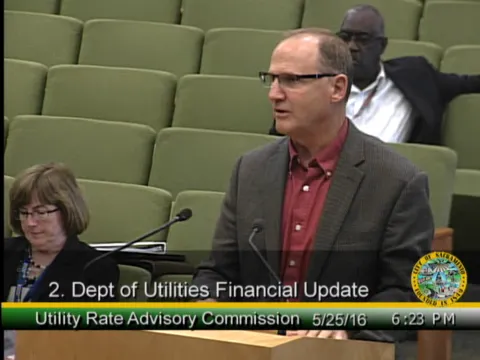
- Department of Utilities Financial Update: Susan Goodison, Business Services Manager, presented a high-level update on the department's financial position. Key points included:
- FY16 Projections: Based on actual revenues and expenditures through March 31, 2016, the department expects revenues to exceed budgeted amounts across all three funds (water, wastewater, drainage) and expenditures to be lower than budgeted.
- For the water fund, budgeted revenues assumed a 20% conservation level, but the state mandated 28% conservation. A mid-year adjustment reduced budgeted user fees by $1.3 million. However, total revenues are now projected to be $1.7 million over budget, driven by increased development activity (e.g., tap fees, water flow test fees) and one-time items (sale of McAuliffe Field, a settlement with a manufacturing firm).
- For the drainage fund, a restructuring of non-residential vacant lot fees (retroactive to January 1, 2015) is expected to reduce revenues by $771,000, but overall revenues are projected to be $800,000 over budget due to ongoing efforts to bill previously unentered parcels. Expenditures are tracking $1.4 million under budget, allowing the fund to avoid drawing on its balance for operating expenses in FY16.
- FY17 Budget Preview: The proposed budget incorporates the rate adjustments for water and wastewater approved by City Council (effective July 1, 2016), which will add $9.1 million in water revenues and $2.7 million in wastewater revenues. The budget assumes a 25% conservation level for water. For storm drainage, the department has set a guideline to align operating expenditures with projected revenues, resulting in significant cuts to operating budgets (mostly in services and supplies). The proposed FY17 drainages capital appropriation is $525,000.
- Drainage Fund Structural Deficit: Bill Busath, Director of the Department of Utilities, noted that there has been no rate increase for storm drainage since 1996, leading to a structural deficit where operating costs exceed revenues. The department previously proposed four 16% rate adjustments but deferred them to avoid conflict with the SAFCA ballot initiative. A new schedule for a rate adjustment proposal is being developed, with a robust public outreach campaign planned to educate residents about the drainage system's needs. Busath warned that failure to address the deficit could lead to street flooding during a significant storm event, as the system is underfunded and has aging infrastructure (e.g., 130 pump stations, failed corrugated metal pipes).
- Utility Rate Assistance Program: The program currently serves about 1,600 customers. The department is preparing to transfer approximately 10,000 eligible customers from SMUD's rate assistance database into the program, with an anticipated total of about 8,200 new participants. The FY17 budget includes a $1.3 million increase to fund the expanded program. Outreach will continue to enroll additional eligible customers.
- FY16 Projections: Based on actual revenues and expenditures through March 31, 2016, the department expects revenues to exceed budgeted amounts across all three funds (water, wastewater, drainage) and expenditures to be lower than budgeted.
Key Outcomes
- Receive and File: The commission received and filed the Department of Utilities Financial Update.
- Future Actions: The department will provide a more detailed budget update in August or September 2016, after the FY16 books are closed and the FY17 budget is adopted by City Council. The commission will also receive updates on the drainage rate adjustment schedule and outreach efforts.
- Commissioner Comments: Commissioners asked clarifying questions about fund balance calculations, the impact of new parcels on drainage revenues, and the need for public education on storm drainage funding. They commended the department for its conservative budgeting and early attention to the drainage fund challenges.
Meeting Transcript
Call the meeting to order. If we could start with the roll call, please. Brian B. Earring. Brian McMahonis. April Butcher? Here. Here. Here. You have a quorum. Thank you. The next item on our agenda is the um minutes from the April 27th meeting. If everyone's had a chance to review those. Brian B. Ering. Brian McManus? Yes. Timothy Horner. April Butcher? Yes. Andrew Day? Yes. Motion passes. Okay. Um in the Department's desire to keep us continually updated. We appreciate that today we're going to have a review from the Department of Utilities or Financial Update. So if we could um go on and begin that item. And it's my pleasure this evening to provide you at a high level with some updates regarding our financial activities and um position. In this presentation, what we will share with you is an update of where we expect to end this current fiscal year, fiscal year 16. Uh this fiscal year ends on June 30th, and we'll be sharing with you our updated end of your projections based on actual revenues and expenditures incurred through March 31st. Uh, would begin which begins on July first. We'd like to take this opportunity to provide you with an update on the financial status of the drainage fund and some changes that we've made in our approach to developing the budget for the fund uh for fiscal year 17. And last but not least, we'd like to take this opportunity to provide you with an update as to the projected funding and uh status of our expansion efforts for the utility rate assistance program. So the first thing that I'd like to do before even getting into this slide is I just would like to refresh our memories that typically the way that we've approached these updates is that when we provide the update in May, we're giving a high level update of our budget and finances. We generally come back to you in either August or September after the the proposed budget has been adopted by council in June, and after we have substantially closed our our books for the current fiscal year. And we provide you with an update at that time that is to a level of detail that includes what we refer to as our rate model categories. So I just wanted to set the stage that what we'll be going through tonight is at a high level, and what we'll share with you then is at that greater level of detail. So the first thing to consider is what were the guidelines and program considerations that were prominent in our minds when we developed the budget for this current fiscal year. And so not only do we have the considerations of our financial guidelines of seeking to maintain a minimum $120 days operating reserve in our funds, and also ensuring that we would maintain compliance with legally required debt service coverage ratios. But we had some additional considerations when we were developing the budget for FY16. Among those, we did not have a rate increase in FY16. And so in general, our budgeted revenue for this fiscal year for each of the funds was flat to fiscal year 15. However, the exception to that is the water fund. And so just to remind ourselves that as we developed the fiscal year 16 budget, we came up with the revenue budget assuming that the department or the city would attain and maintain for an entire fiscal year a conservation level of 20% conservation in consideration of the drought. And I'd like to just state that we have modeled that for every 10% of conservation that's achieved consistently throughout the entire fiscal year, the projected impact on our water revenues is a reduction of $3 million. So when we built the fiscal year 16 budget based on a 20% conservation level, we we sized our budgeted water revenues $6 million less for user fees than what we otherwise would have sized them at. And as we move through the slides, then I'll speak to then what was the impact after budget development of receiving the mandate that the city achieve a 28% conservation level, and what is the impact that we have seen on the water fund revenues associated with that, and what have we done to amend the budget in consideration of that. One of the things that I additionally would like to share around that topic of water conservation related to the drought is just to let you know that we are in the process of developing a plan to present to the city manager for ongoing conservation, and I believe that that plan will be coming to council later this summer. And so we'll keep you updated on that as well. The last comment that I would make before turning to the FY16 budget is to highlight that in consideration of the projected operating expenditures for drainage for fiscal year 16 exceeding the projected operating revenues, then the budget for fiscal year 16 for drainage does contemplate that we would dip into the drainage fund balance in order to maintain our operations.
openpublica.com