Utilities Rate Advisory Commission Meeting - April 26, 2017
STREAMING COPY IN PREPARATION — RECORDING AVAILABLE FROM THE ORIGINAL SOURCE
Utilities Rate Advisory Commission Meeting - April 26, 2017
The Utilities Rate Advisory Commission met on Wednesday, April 26, 2017, at the Council Chambers, 915 I Street, Sacramento. The agenda listed Open Session at 5:30 p.m., but the meeting was called to order at 5:45 p.m. and adjourned at 6:29 p.m. Present: Andrew Day, Ryan McManus, P. Anthony Thomas, April Javist, and Chair Timothy Horner. Absent: Brian Biering and Keith Ellis. New Commissioner P. Anthony Thomas was introduced and described his background as a chief lobbyist for the California Independent Petroleum Association and a former staff member for former Mayor Richard J. Reirten.
Consent Calendar
- The Commission unanimously approved the February 22, 2017 meeting minutes (motion by Andrew Day, second by Ryan McManus; 5-0; Biering and Ellis absent).
Public Comments & Testimony
- No public comment cards were submitted, and no public comments were made on matters not on the agenda.
Discussion Items
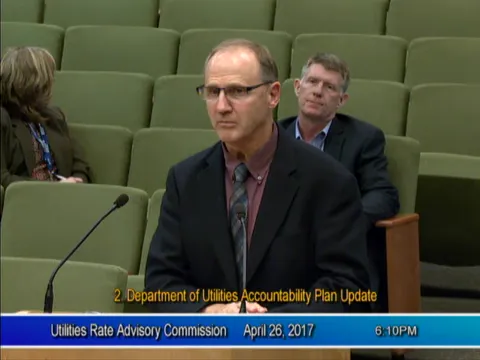
- Department of Utilities Accountability Plan Update
- Director Bill Busath presented the quarterly update and Director's Report. Topics included community engagement for the Downtown Sewer Upgrade and Combined Sewer System, FY2017-FY2020 Capital Improvement Program financing, the accelerated meter program, the Sacramento Utility Rate Assistance (SURA) program, and drought/water conservation.
- Third and Ninth Street projects: These combined-system pipe replacement/upsizing projects will run through busy downtown corridors, including near City Hall and the courthouse. Staff have hired HDR for outreach, created a dedicated website, and are meeting with businesses and the Downtown Sacramento Partnership to minimize construction impacts. The Ninth Street contract has been awarded; construction on Third Street is expected to begin within a few months. Commissioner Ryan McManus asked how out-of-town visitors near Golden 1 Center would receive construction messaging; staff described electronic message signs, detour coordination, and tunneling to reduce street closures.
- Financing: Staff are confident the State Revolving Fund (SRF) loan application will be approved by early-to-mid August, providing about 173 million dollars for drinking water projects at an anticipated interest rate of about 1.7 percent, compared with bond rates reportedly around 3.5 to 4 percent. The first bond sizing of 62 million dollars is planned for May. For wastewater, about 30 million dollars in SRF financing now appears unlikely because demand for SRF funds is roughly twice the available money, so bond funding will likely be used instead. Commissioner Javist asked about the relationship between bond funding and a possible drainage ballot measure; staff said the bond funding is a separate capital financing mechanism.
- Accelerated Meter Program: The first two contracts were awarded through the MATOC alternative competitive process: Granite Construction for about 12 million dollars and Marquez for about 6 million dollars, with a local hire component. Staff explained that contractors are pre-qualified and ranked on criteria such as safety, quality, schedule, customer service, local hire, and price. Commissioner P. Anthony Thomas asked about protecting against cost overruns; staff replied that contracts are not-to-exceed, include contingency, and can change only through agreed change orders, noting the 230 million dollar program includes a contingency. Asked about minority/women-owned business requirements, staff said the city currently has a local business requirement, with some federal grant funding exceptions.
- Rate Assistance (SURA): Staff estimate about 17,000 customers may be eligible, and almost 9,000 are currently enrolled, which staff said is slightly better than SMUD's roughly 50 percent target. The program has been losing enrollees at recertification, and staff are working with SMUD on automatic enrollment and fixing the two-year notification process. Commissioner April Javist suggested partnering with wraparound service providers such as Life Steps and SHRA, which have funds to help low-income residents stay housed. Commissioner Andrew Day asked about delinquent bill payers; staff said a water shutoff program has reduced delinquency, that eligible rate-assistance customers are not shut off, and that they will provide data on how delinquency overlaps with the assistance program.
- Drought and conservation: With the Governor's emergency drought declaration rescinded, the city will ask the Council in late May or early June to rescind the Stage 2 drought condition, returning summer watering from two to three days per week. Staff also plan to propose maintaining aggressive conservation, considering a code change to make two-day watering the standard, and continuing rebates, enforcement, park irrigation grants, and river-friendly landscape block grants. Commissioner Javist questioned how two-day watering would achieve long-term savings and whether unused water would be stored; Director Busath said he would provide a thoughtful follow-up. Commissioner McManus asked whether new meters alone would reduce demand enough to make a watering mandate unnecessary; staff noted future tiered rates would also send a conservation signal.
Key Outcomes
- The Consent Calendar was approved unanimously.
- The Commission received the Department of Utilities Accountability Plan update; no separate recorded vote was taken on the receive-and-file item.
- Staff committed to bring follow-up information on delinquent bill payment and overlap with rate assistance, the geographic distribution of rate-assistance enrollees, and the conservation/storage question.
- The meeting adjourned at 6:29 p.m.
Meeting Transcript
Good evening, ladies and gentlemen. Thank you for your patience. I think we have everything in place now. It is 5 45, and I'd like to call this meeting to order. Ms. Torpe, would you please call the role present? Here. Here. Here. Okay, thank you very much. Do you have a statement to read about input from the public? I'll just rehand it. We ask that everybody silence their cell phones, please. And if any member of the public would like to make any comments, we have comments sign up sheets at the back. Please print your name clearly and give me the sheets. Thank you. All right, thank you. We have a new commissioner tonight, so I'd like to introduce Commissioner P. Anthony. And I asked if he would like to take just a moment to introduce himself and tell us a little bit about his background. So P. Anthony. Thank you, Mr. Chairman, and thank you, members. I'll keep it short before my mic gets cut off. I'm more than happy to be here to be serving my municipality. I'm glad to be here and serving with my new colleagues. Had the opportunity to work for former mayor Richard J. Reirten, currently work in the oil and gas industry for the California Independent Petroleum Association, where they are their chief lobbyists to the legislature. Looking forward to not only tackling the issues that face the commission but our utilities utilities department and looking forward to working out the best solutions and hopefully having the balance between the folks who we serve and of course the utility that we also serve. So, Mr. Chairman, thank you very much, and I look forward to working with you and balance of my colleagues here. All right, thank you and welcome. Our first item is the consent calendar. So we've all received the consent calendar. Is there a motion to approve the consent calendar? I move to approve. Okay, thank you. And Ms. Torpe, will you please call the uh roll? Yes. Keith Ellis. Brian Bearing. Ryan McManus. Yes. April Javist. Yes. Andrew Day? Yes. P Anthony Thomas.
openpublica.com