Sacramento Water Committee Special Meeting on Water Rights, Bonds, and Water Supply - May 15, 2018
STREAMING COPY IN PREPARATION — RECORDING AVAILABLE FROM THE ORIGINAL SOURCE
Sacramento Water Committee Special Meeting on Water Rights, Bonds, and Water Supply - May 15, 2018
The Sacramento Water Committee held a special meeting on May 15, 2018, to receive and file presentations on water rights and water supply regulatory processes, and on two state water bond measures (Proposition 68 and the California Water Bond Act of 2018). The meeting included discussion of the Modified Flow Management Standard, Sites Reservoir, a proposed water transfer, and funding opportunities for disadvantaged communities. The committee voted to direct staff to develop a support position for Proposition 68 and scheduled a future discussion on aquifer storage and recovery.
Public Comments & Testimony
- Jerry Meral (former city resident, property owner) spoke in support of the California Water Bond Act of 2018, highlighting its $30 million for the American River Parkway, $10 million for American River planning, $5 million for water research at Sacramento State, and $700 million for habitat programs to balance flow requirements. He urged the committee to consider bringing the bond to the city council for endorsement.
- Michael Voy (Senior Deputy City Attorney) asked about the potential for groundwater subsidence from the proposed water transfer, noting public concerns about declining aquifer levels. Staff responded that the region's geology is different from the San Joaquin Valley and that monitoring programs are in place, with an estimated 100,000 acre-feet of groundwater storage capacity available.
Discussion Items
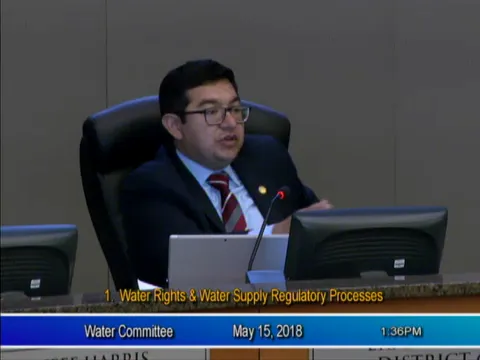
- Water Rights and Water Supply Regulatory Processes: Staff (Jim Peifer, Principal Engineer) presented an overview of risks to the city's water supply, including drought, the Water Fix water rights change petition, and the Bay Delta Water Quality Control Plan. They emphasized the Modified Flow Management Standard (MFMS) as a key tool to protect fish and water supply. The committee discussed the role of Sites Reservoir (allocated $916 million from Proposition 1) and a proposed water transfer of up to 8,000 acre-feet to Kern County, with revenue used for conservation in disadvantaged communities and well improvements. Chair Harris stressed the need to clearly communicate that the transfer does not reduce local water supply.
- Proposition 68 and the California Water Bond Act of 2018: Staff presented two bond measures: Proposition 68 (June 2018 ballot, $4.1 billion for water and parks) and the California Water Bond Act of 2018 (November 2018 ballot, $8.9 billion). Chair Harris noted that Proposition 68 includes $10 million for the American River Parkway Conservancy Program. Member Guerra highlighted the potential for funding to restore Morrison Creek, an urban creek in a disadvantaged community. The committee discussed the possibility of complementary passage of both bonds, referencing historical precedent. Staff was directed to work with the city manager's office to develop a support position for Proposition 68.
Key Outcomes
- Received and Filed: Both presentations (Item 1: Water Rights and Water Supply Regulatory Processes, File ID 2018-00655; Item 2: Proposition 68 and The California Water Bond Act of 2018, File ID 2018-00663) were received and filed by the committee.
- Direction to Staff: The committee directed staff to work with the city manager's office to develop a formal support position for Proposition 68 to be brought to the Law and Legislation Committee.
- Future Agenda Items: The committee scheduled a discussion on aquifer storage and recovery (ASR) for its August 2018 meeting. Member Guerra also requested that the August meeting include a review of how the city can leverage bond funding for urban creek restoration in disadvantaged communities, specifically Morrison Creek.
- Meeting Adjourned: The meeting was called to order at 1:02 PM and adjourned at 1:44 PM. The next regular meeting was set for August 2018.
Meeting Transcript
Yeah. Yeah. Very significant action. We appreciate it. Oh, yeah. If you guys take a moment. No, no, no. Let's keep going. Good afternoon, everybody. I'd like to welcome you to the May fifteenth edition of the Water Committee for the City of Sacramento. Madam Clerk, if you call roll. Member Ashby, Member Guerra. Chair Harris? Here. We have a quorum. If you're here to stay to speak before the committee, please fill out a speaker slip you'll find in the back window and turn into the assistant clerk. You can also see the assistant clerk for an assisted listening or speaking device. And this would be the time that you would turn your phones to silent, please. Um with that, we'll get started. Okay, so uh what you see here is a view of uh the Sacramento Valley and the Delta. Um there's Sacramento on this map, and this is to reorient us with some of the things that we'd like to talk about. Um here's some of the major cities uh in the uh Sacramento Valley and the northern part of the uh San Joaquin Valley. You see Stockton, uh Sacramento, Antioch uh circling the bay or the Delta. Uh Reading Way far up in the north. Um principal locations of our surface water supply coming out of Lake Shasta and Folsom Lake. Um to reorient you again, there's the Sacramento River, and we pick it up at the Sacramento River Water Treatment Plant. Uh we also have a diversion and treatment works on the American River at the Fairbairn Water Treatment Plant. Uh the Sacramento River continues to go into the Delta and out into the bay. Um other major rivers uh for this system include the Feather, uh, which comes out uh uh just a the confluence of such is just a little far north from the American and the Sacramento. Uh another important river is the San Joaquin. We'll be talking about Sites Reservoir today, and uh we haven't put this on the map yet. Sites Reservoir is about uh an hour north of here, or at least the town, it's wet west of the town of Maxwell, uh, which is about an hour north from here. You also see the Sacramento San Joaquin Delta in front of you. So before I leave the slide, I want to introduce sort of two schools of thought which are uh kind of are the centerpiece of a lot of discussions that we'll be having, and that is how to take care of the fish. Uh particularly in the delta, but in the in the rivers too. Um there's uh a school of thought that we should have something called unimpaired outflow, and that's where a good chunk of the water that flows through the rivers should eventually make it to the uh to the ocean fairly quickly. Uh you can think of it as a as uh uh uh if a gallon uh falls behind Folsom Reservoir, a half of a gallon of it uh is ushered out to the to the delta pretty quickly and then out to the ocean. Uh that's a called a percentage of unimpaired outflow. Another school of thought for protection of fisheries is uh building new habitat within the delta, and that may require less water for that for the for fisheries. Um with unimpaired outflow, there is a large portion of water which does get used for for fish. Um I would say that a number of environmental NGOs uh espouse the the idea of uh unimpaired outflow. Um some regulatory agencies put some stock into that. Um I would say that there's uh another group of people who like the idea of building habitat and fishery uh uh other other fish habitat in the rivers in the delta, and that's tends to be the water users uh and uh interesting some academics. Moving on. So some of the risk to the city's water supply. Um we'll talk about these more as we go through the PowerPoint presentation, but drought, water fix, the Bay Delta water quality control plan. Um quickly on the drought. So we saw what happened uh between 2013 and 2016. Uh reservoir levels in Folsom Reservoir got pretty low. We saw impacts for water quality, um harmful algal blooms popping up.
openpublica.com