Sacramento Water Committee Meeting - June 25, 2019
STREAMING COPY IN PREPARATION — RECORDING AVAILABLE FROM THE ORIGINAL SOURCE
Sacramento Water Committee Meeting - June 25, 2019
The Sacramento City Council Water Committee met on Tuesday, June 25, 2019, at 1:00 p.m. in the City Hall Council Chamber, 915 I Street, Sacramento. Chair Jeff Harris presided, joined by Vice-Chair Eric Guerra and Member Angelique Ashby (arriving at 1:03 p.m.). The committee received oral updates on water rights and supply regulation, federal and state issues, and sustainability/water efficiency. A planned groundwater bank presentation was postponed because the presenter was on jury duty. The meeting adjourned at 1:39 p.m. (minutes) or 1:40 p.m. (transcript). No public comment was offered.
Discussion Items
-
Sacramento Regional Groundwater Bank (Item 1): Postponed to the next regular meeting because presenter Rob Swartz was on jury duty. Chair Harris noted the presentation was informative and would be rescheduled.
-
Water Rights and Water Supply Regulatory Processes (Item 2): Outside water counsel Wes Miliband presented. He said the California Water Fix petition was formally withdrawn under Governor Newsom’s administration, with focus shifting toward a possible one-tunnel project not likely this year. The State Water Resources Control Board’s Phase 1 San Joaquin watershed update was adopted December 12, 2018; Phase 2 is the Sacramento Valley watershed, with a July 2018 framework document. Voluntary agreements are being negotiated with a 15-year term concept. Key American River elements include groundwater substitution in dry/critically dry years, reservoir reoperations involving Folsom, temperature management, and improved flow/supply reliability. Miliband said milestone timelines set for this year and next likely need to slide due to technical, funding, legal, and policy work. Councilmember Guerra expressed appreciation for staff’s work on voluntary agreements and described the outcome as positive for the city and habitat improvements.
-
Federal and State Issues Update (Item 3): Policy and Legislative Specialist Anne Sanger presented three FY2020 federal funding requests: (1) grants for combined sewer system updates at community water systems—the House had passed an appropriations bill, the Senate had not yet acted; (2) grants to increase security at community water systems, prompted by an unfunded federal security-plan law; and (3) a joint request with the Regional Water Authority to plan/study the Sacramento Regional Groundwater Bank, submitted to the Bureau of Reclamation. She also noted Senator Feinstein introduced bipartisan drought-resiliency legislation authorizing $700 million for California water storage projects and renewing $100 million over five years for water recycling infrastructure. Chair Harris said he had actively engaged with congressional members on the groundwater bank and Sites Reservoir and was cautiously optimistic about federal funding. Councilmember Guerra commented that recharge takes time and a better groundwater recharge strategy is needed despite the strong snowpack.
-
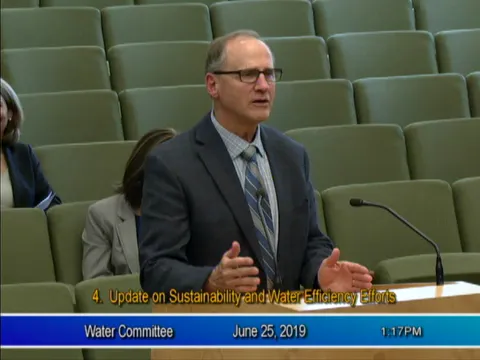
Update on Sustainability and Water Efficiency Efforts (Item 4): Sustainability Manager Roshini Das presented, with Director Bill Busath introducing the department’s transition from drought enforcement to education and broader sustainability. Das reported snowpack at 101% of the April 1 average—the largest since 2011—and a Sacramento Valley Index at 136% of average; Shasta and Folsom reservoirs near 96–97% capacity; California declared drought-free after more than seven years. Other highlights: DOU’s 2017 sustainability plan targeting carbon neutrality; participation in SB 1425 water-energy nexus registry; EPA honorable mention and Alliance for Water Efficiency gold certification; planned 2019 water conservation plan update; one-day-per-week watering schedule since March 1 with Spanish/English outreach; newsletter reaching 40,000+ residents; 223% growth in rebate participation from FY2015 to FY2019; 1,200 smart controllers sold in eight months (and Chair Harris noted about 2,000 in use); turf rebate increased from $1 to $1.50/sq ft with a $3,000 cap; landscape design assistance with 143 applications; leak repair assistance and expansion to rate-assistance households; and a neighborhood program with Councilmember Carr converting fences to river-friendly landscapes. Das noted FY2018 city-wide demand was 167 gallons per capita per day, up from 164 in 2017. Councilmember Guerra praised the education efforts and hand-watering messaging, and suggested similar messaging for tree care. Chair Harris recommended smart controllers and noted their value with future metering. Councilmember Ashby suggested inviting UC Davis water experts (Professors Lund and Pinter) to brief the committee; Chair Harris agreed.
Public Comments & Testimony
- None were made during the public comment period for matters not on the agenda.
Key Outcomes
- Item 1 postponed to the next regular meeting.
- Items 2, 3, and 4 received and filed as oral reports.
- Chair Harris agreed to consider a future presentation from UC Davis water experts.
- Staff will continue working on voluntary agreements, federal funding requests, and sustainability/water efficiency programs.
Meeting Transcript
Committee to order uh will the clerk please call roll and establish a quorum. Certainly, Member Ashby, Member Gera. Here. Chair Sh uh Shneer, I'm sorry, Chair Harris. Here. We have a quorum. If you're here today to speak to the committee, please fill out a speaker slip. They're located in the back window and turn into the assistant city clerk. You will also see the assistant clerk for a assisted listening and speaking device. And this is the time I'd remind everyone to turn your cell phones to the silent position. Please join me in uh the Pledge of Allegiance, please. Salute. I pledge allegiance to the flag of the United States of America. And to the Republic for which it stands. One nation under God, indivisible, with liberty and justice for all. Well, very good. Um if you have the agenda, uh, I would like to point out that number one is going to be postponed because the uh presenter, Rob Swartz, is on jury duty. It's too bad because it's it's really a very informative presentation. I was certainly looking forward to it, but we'll have him at our next meeting. So we're gonna move this to the next regulation. That would be the idea. We'll get him back as soon as we possibly can. So it was unexpected. So we'll move to num item number two. Water rights and water supply regular regulatory processes. And that would be Jim Pfeiffer. Good afternoon, Mr. Chair and members of the committee. Um I am Jim Piper with the Department of Utilities, and we're going to turn this one over to Wes Miliban, our outside water council. He was the preparer of this presentation. I asked that uh he participate in that process. Um he will be talking quite a bit about the voluntary agreements, and with that, Wes. Thank you. Thank you, Jim. Welcome with the President. Thank you. Good afternoon, Mr. Chair and members of the committee, West Miliband. So this committee has heard reports about the voluntary agreement process and water fix. Uh we will focus uh subject to any questions and commentary uh from the committee. We'd like to focus initially just giving an update about three big processes, which are basically the California water fix, the water quality control plan, update, regulatory proceeding, as well as the related process for the voluntary agreements. On this slide, uh with water fix, I can address that quickly, which really is to say that California water fix is no longer that petition has been formally withdrawn with the change in the state administration. Governor Newsom has made clear that water resiliency is a priority, and there's uh what seems to be a reshifted focus to have a one-tunnel project. So we could probably expect that this will come back in some form at some point. Uh likely not this year, but for now that proceeding that had been underway for a couple of years is finished. Related to that, there are the sequestuits uh which are making their kind of final stages to uh likely be dismissed or or otherwise disposed of, just given the maintenance of not having water fixed before us anymore. So with the control plan, I just wanted to hit a couple of points quickly as a refresher. Uh this is uh a formal regulatory proceeding, a rulemaking proceeding before the state water resources control board. And the purpose is essentially to evaluate existing water quality objectives with those objectives uh potentially having adverse impacts to water rights and the water supplies for various interests, including the city of Sacramento. Uh under the law, Porter Cologne Act, uh the board is to consider all beneficial uses which include the city's uses for municipal purposes.
openpublica.com