Water Committee Meeting - September 24, 2019
STREAMING COPY IN PREPARATION — RECORDING AVAILABLE FROM THE ORIGINAL SOURCE
Water Committee Meeting - September 24, 2019
The Sacramento Water Committee met on Tuesday, September 24, 2019, from 1:00 p.m. to 1:50 p.m. in the City Hall Council Chamber. Members present were Chair Jeff Harris (District 3), Vice-Chair Eric Guerra (District 6), and Member Angelique Ashby (District 1). The committee received and filed three oral reports and forwarded one resolution to the City Council.
Discussion Items
Item 2: Resolution Supporting Pam Tobin for ACWA Vice President
- The committee began with this item, taking it out of order. Chair Harris noted that Pam Tobin had been unanimously recommended by the Regional Water Authority.
- Member Guerra moved and Chair Harris seconded a motion to review the resolution and forward it to the City Council for approval. The motion passed unanimously (3-0).
Item 1: Sacramento Regional Groundwater Bank
- Ralph Schwartz presented an overview of the proposed Sacramento Regional Groundwater Bank. He explained that the North American and South American subbasins historically declined about 2 feet per year due to overdraft, but in-lieu conjunctive use since the mid-1990s has stabilized and slightly raised groundwater levels.
- Climate change is reducing Folsom Reservoir reliability; average monthly storage from 2001-2016 was 65,000 acre-feet less than historical averages. The groundwater basin offers approximately 1.8 million acre-feet of available storage.
- A regional water reliability plan found that reoperating today's system could deliver an additional 63,000 acre-feet of surface water in wet years and extract an additional 57,000 acre-feet of groundwater in dry years. With planned facilities, these amounts could increase by almost 50% to about 90,000 acre-feet each.
- Schwartz identified cost barriers: about $300 per acre-foot cost differential for switching supplies and an estimated $288 million in capital costs for new facilities.
- The city participated in a successful 2018 groundwater transfer with other agencies, using 60 production wells. The group pumped nearly 18,000 acre-feet over a three-month period versus a typical 7,000, and received credit for 10,000 acre-feet of transferred water.
- The city netted approximately $1.8 million, dedicated to well improvements (including pump-to-waste systems) and water efficiency for disadvantaged customers. A Proposition 1 grant of about $1 million is being pursued.
- In response to questions, Schwartz said monitoring wells and modeling are used to track contamination plumes, and that fully refilling the basin is not necessary; operations would use small annual increments.
Item 3: Water Rights and Water Supply Regulatory Processes
- Outside counsel Wes Miliband presented on the city's water rights portfolio and regulatory risks. The city holds a pre-1914 right, four permitted rights on the American River and one on the Sacramento River, a 1957 Bureau of Reclamation operating agreement, and groundwater rights.
- Miliband detailed the American River Voluntary Agreement, including flow measures (10,000 acre-feet from upstream partners up to six times over 15 years in wetter years; 10,000 acre-feet of groundwater substitution in critical/dry years; additional 10,000 acre-feet reservoir reoperation; up to 20,000 acre-feet more if a groundwater bank is established), non-flow measures (50 acres of spawning and 150 acres of rearing habitat), and funding mechanisms.
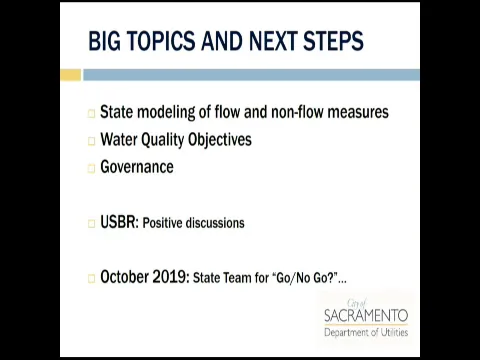
- He noted that state modeling (CalSim vs. SACWAM) is a live issue, and the October 15 "go/no-go" date may slip. Bureau of Reclamation planning minimums in Folsom are being discussed in the 250,000-300,000 acre-feet range.
- Members expressed support for the city's participation in the voluntary agreement process, with Harris saying it directly affects the city's water future.
Item 4: American River Habitat Restoration Site
- Tom Goring, executive director of the Sacramento Water Forum, presented a video and photos of an ongoing habitat project at Sailor Bar, across from the hatchery. It is the eighth such project on the Lower American River and a commitment under the Water Forum Agreement.
- The project is a ~$1 million effort, with about $900,000 in federal funds (from surcharges on agricultural water deliveries and power contracts). It involves moving 14,000 cubic yards of gravel to create spawning and rearing habitat.
- Goring explained that natural-spawned salmon are more genetically resilient, and these projects align with endangered species goals. The voluntary agreement proposes expanding spawning projects from 50 to 200 acres over 15 years.
- The equipment operators are city of Sacramento Department of Utilities staff, paid through federal grant dollars. Committee members praised the project's multiple benefits.
Key Outcomes
- Received and filed the Sacramento Regional Groundwater Bank presentation (Item 1).
- Reviewed the resolution supporting Pam Tobin and passed a motion forwarding it to City Council; the vote was 3-0 (Item 2).
- Received and filed the Water Rights and Water Supply Regulatory Processes presentation (Item 3).
- Received and filed the American River Habitat Restoration Site presentation (Item 4).
- No public comment was offered on matters not on the agenda.
- The meeting adjourned at 1:50 p.m.
Meeting Transcript
Madam Clerk, will you give us a roll call? Thank you. Member Ashby. Member Guiara. Here. And Chair Harris. All present. Will you stand and join me in the pledge? Salute. I pledge allegiance to the flag of the United States of America. And to the Republic for which is one nation under God, indivisible with liberty and justice for all. So very good. We have about 45 minutes to move through the agenda, and I think we can do that easily. What I'd like to do is reorder the items and take number two first. And just for my committee members to say that at the Regional Water Authority, Pam Tobin was uh unanimously accepted as uh recommendation uh to to serve as aqua vice president. I certainly have no objective, and apparently I mean objection, and nobody else had a problem with that either, amongst all the various uh regional water agencies. So if somebody wanted to float a motion to move this forward, I am open to it. I'll move the item. Moved by uh committee member Guerra, and I'm happy seconding since I know her. And all those in favor. All right. Aye, very good. We'll move on to item number one, which is a really uh, I think a fascinating discussion about the regional groundwater bank and Mr. Swartz, if you could come up and educate us, please. Mr. Ralph Schwartz. Thank you, good afternoon, thank you for having me. Uh, let me put up my presentation here. So while that's that's loading up, thank you very much. Uh, this is an initiative that we've been working on for several years in the basin. I'm very excited. It's it's still has a couple years worth of planning, still heavy lift, uh, but we think it's really coming to fruition. Uh so we really believe that we can improve improve the water supply reliability of this region by creating something that we're referring to as the Sacramento Regional Water Bank. So last year you had a briefing from Michelle Carey uh talked a lot about conjunctive use in the basin and how it's been successful in helping us to stabilize groundwater elevations, make them very sustainable for our future. Uh what I'm really talking about today are two sub basins as are they're defined by the Department of Water Resources, the North American and South American subbasin, and the city basically straddles those two basins with the American River running right in between them. And as was discussed previously, the the basin was overdrafted. It's it's conditioned where you're using more groundwater than is being replenished naturally. So for a period of decades, we had drawdowns by about two feet per year, and it certainly wasn't sustainable. And finally, in the mid-1990s, certain agencies that were reliant on groundwater began accepting surface water. That's what we call in lieu conjunctive use. So when it's wet, they take surface water, and it allows the groundwater basin to replenish naturally. And you can see in the mid-1990s, we not only stopped that decline, we actually started to see water elevations coming up by about a foot and a half by about a half a foot per year, excuse me. And you can even see during the last drought, which was the some of the driest hydrology we'd ever experienced in the state, the groundwater basin actually stayed in a very good status and has recovered since that time. So the conjunctive use that we've been practicing has really already paid off in dividends. But we really can't ignore the future. We have to look out longer term, and we're gonna have changes in our hydrology. Uh so if you look at the figure on the right, these are the three reservoir systems that we traditionally in the state have relied on. Locally rely on a snowpack that falls in the winter, slowly melts throughout the spring, is somewhat regulated by surface water reservoirs. You can see that tiny little dot on there represents our local reservoir, Folsom. And then you can see the groundwater basin.
openpublica.com