Sacramento Water Committee Meeting – June 29, 2021: Storm Drainage Survey and Sustainability Update
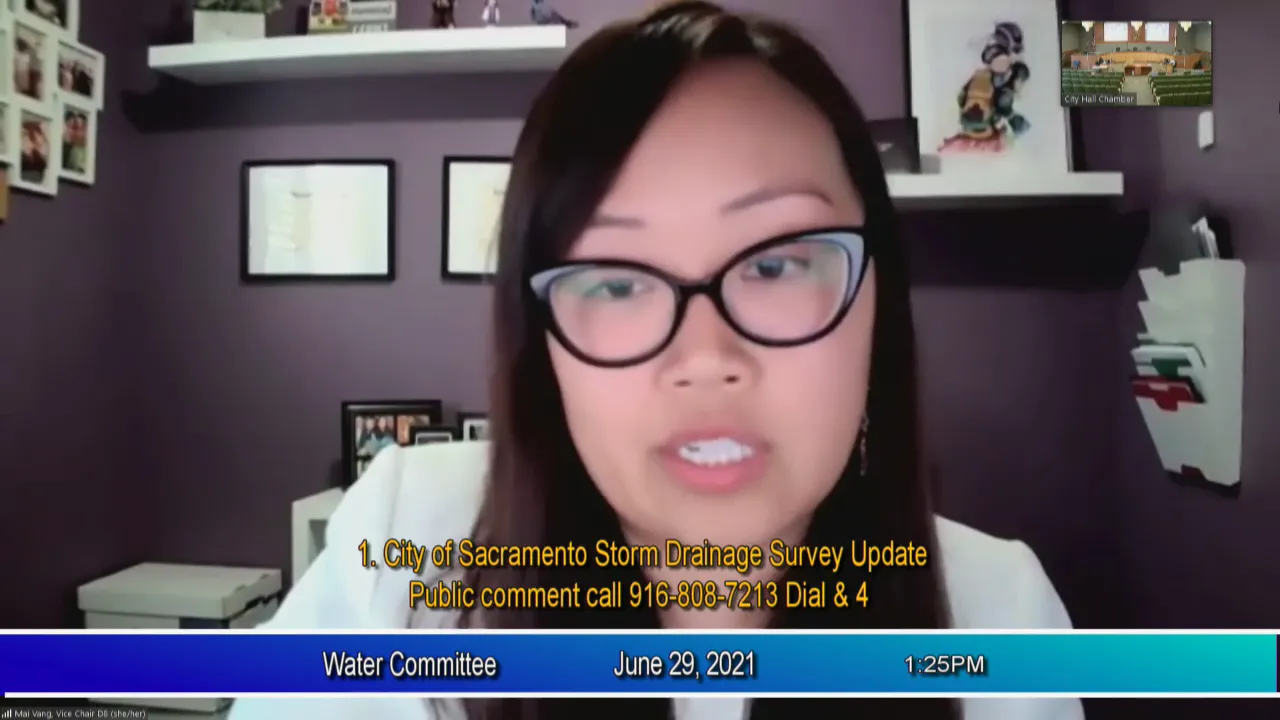
STREAMING COPY IN PREPARATION — RECORDING AVAILABLE FROM THE ORIGINAL SOURCE
Sacramento Water Committee Meeting – June 29, 2021
The Water Committee of the Sacramento City Council met via teleconference on June 29, 2021, from 1:01 p.m. to 1:56 p.m. The committee received two oral reports: a storm drainage survey update and an update on sustainability and water efficiency efforts. Key discussion focused on the results of a scientific survey of single-family property owners regarding potential storm drainage rate adjustments, and the committee expressed support for pursuing an 'increase only' option that would generate approximately $20 million annually. The committee also heard public comment and discussed drought conditions and water conservation efforts.
Public Comments & Testimony
- Chris Brown, a water conservation expert, called in to comment on the sustainability presentation. He expressed two concerns: (1) the American River Basin study used data from about 15 years ago, which he said is not accurate, and better, more recent data should have been used; (2) the per capita water use figure (25% below 2013 levels) does not reflect the fact that the city achieved lower usage in subsequent years and then per capita use rose again. He supported the city’s programs but urged staff to provide more detailed data in the future.
Discussion Items
- Item 1: City of Sacramento Storm Drainage Survey Update – Staff from the Department of Utilities and consultants from TBWBH Props & Measures and FM3 Research presented results of a scientific survey of single-family property owners regarding three potential storm drainage fee structures: replacement only (maintain current revenue, ~$40 million/year), increase only (add $20 million/year on top of current revenues), and replace and increase (replace existing fee and add $10 million/year for total ~$50 million/year). The survey found 63% support for the replacement only option, 54% for increase only, and 48% for replace and increase. Committee members discussed the need for additional revenue due to a $300 million capital improvement backlog and 25 years since the last rate adjustment. Councilmember Vang expressed strong support for moving forward with the increase only option, noting the urgency of deferred maintenance. Chair Harris asked about the impact of choosing increase only versus combining with replacement; consultants advised that a smaller increment now could build a track record for future increases. Staff indicated that the next steps involve finalizing a schedule with the city manager’s office and bringing a proposal to the city council. The committee concurred with pursuing the increase only approach.
- Item 2: 2021 Update on Sustainability and Water Efficiency Efforts – Sustainability Manager Roshini Das presented on the department’s sustainability initiatives, including a demonstration garden, climate change studies, and a sustainability plan. She also reported on current drought conditions: Folsom Lake at 36% capacity, the city using 25% less water per person than in 2013, a shift to draw more from the Sacramento River and groundwater (reducing American River diversions by 30%), doubled incentive rebates starting July 1, and continued two-day-per-week watering restrictions with no fines yet. Chair Harris noted the rapid change in conditions since the last meeting and praised the city’s conservation efforts. Councilmember Valenzuela asked about how staff plan to adjust estimates as climate data evolves; Brett Ewart responded that the urban water management plan now includes references to more recent climate studies and that the city is investing in groundwater and surface water resilience. The item was received and filed.
Key Outcomes
- The committee received and filed both oral reports (Item 1 and Item 2).
- The committee voiced support for the Department of Utilities to pursue the 'increase only' storm drainage rate adjustment option (adding ~$20 million annually) and directed staff to bring a proposal and schedule to the city council.
- Staff agreed to communicate updates to the committee via email before the next meeting, given the accelerated timeline for a potential mail ballot in early 2022.
- The committee took no formal action on the sustainability update but acknowledged the urgency of drought response and conservation efforts, with further discussion expected at the city council meeting later that evening regarding the urban water management plan and water shortage contingency plan.
Meeting Transcript
Chair Harris, staff is ready when you are. Thank you very much. Well, welcome everybody to the June 29th meeting of the Water Committee for the City of Sacramento. Madam Clerk, will you please call roll to establish a quorum? Councilmember Valenzuela. Here, Councilmember Vang. Here and Chair Harris. Present. Thank you very much. I believe we've we've just got an hour, so why don't we roll right into item number one unless you have announcements to raise? I have no announcements. Very good. So we can move to item one, which is a storm drainage survey update and an oral report. Mr. Buse. Hey, thank you, uh, Chair Harris and uh members of the uh committee. I'm Bill Buseith, uh Director of the Department of Utilities for the City of Sacramento. Um we are going to have a presentation from our consultant team on the results of some uh survey work that we've done with regard to uh the feasibility and of our storm drainage rate adjustment. Um next slide, please. Um for some time we've noted uh we've known that we needed uh that we need a storm drainage rate adjustment. Uh we had a an independent audit done on the uh on our drainage fund um back in May of 2020. Um the outcome and findings were expected. Um that you know uh around the year 26-27, we will be exceeding uh our revenues and and uh reserves, and the fund will go negative. Uh we have a system that's valued at a little over $8 billion to uh that's what it would cost to replace it. And we are not spending uh enough money on an annual basis uh to maintain that that system properly from a capital improvement standpoint. Um they determined that a best practice would be that we would be spending uh at least 34 million dollars a year on capital improvements, and that uh we have a CIP currently a CIP backlog of about 300 million dollars. That is based on uh the the current master planning that we've done, which is only about 35 to 40 percent of the system. Next, and there you see the fund um going negative. Uh, you know, about FY27. Um this is no surprise. Uh you know, we've messaged this before. Um what is different is is that we've hired a consultant team to help us to move forward with the drainage rate adjustment, and one of their first um actions was to perform a scientific survey. And so I'd like to go ahead and turn the time over to our consultant team now to uh present the results of that survey work. I is Jared Boygan speaking. Um Mindy, I'd like to ask if you could unmute the 415 number. It's better if I speak from the phone. Um, yes, I've sent you a request to unmute. You need to do that yourself. Okay, thank you. Does that work? And can you all hear me now? Yes, we can super okay. I appreciate that. Um, so this is Jared Boygan with uh TBWBH props and measures. Uh Bill said, I appreciate that my internet connection may be unstable on the video, but the audio will work this way. Um we tested um a goal, we had a goal of trying to identify 15 to 20 million dollars uh annually uh as a uh fee that would be paid by industrial commercial and residential property owners. Um and the best practices for currently calculating those fees are to base it on impervious surface, um, which is a little different from how the city has done it in the past, which is based on whim count. The goal of such a fee, as Bill, I know has and his team have explained many times to this group, protecting our local drinking water quality and supplies, including safe clean water for droughts and emergencies, preventing toxic chemicals, sewage, and even human waste from impacting rivers, creeks, and overflowing on a neighborhood streets, and that's particularly important in the older areas of the city where the combined system is in place. Obviously, replacing aging and deteriorating pumps, water pipelines, et cetera, that prevent flooding and protect our local rivers. Next slide, please, Tara.
openpublica.com