Sacramento Water Committee Meeting - November 9, 2021
STREAMING COPY IN PREPARATION — RECORDING AVAILABLE FROM THE ORIGINAL SOURCE
Sacramento Water Committee Meeting - November 9, 2021
The Water Committee of the City of Sacramento met on Tuesday, November 9, 2021, at 1:01 p.m. for a regular meeting. The committee reviewed four items: an update on the Sacramento Utility Rate Assistance (SURA) program, the storm drainage system update, drought response, and the California Water and Wastewater Arrearage Payment Program (CWWAPP). A key action was a motion to forward the SURA program recommendation to City Council for discussion, which passed unanimously. The meeting adjourned at 1:53 p.m.
Discussion Items
1. Sacramento Utility Rate Assistance (SURA) Program Update
Staff presented a recommendation to restructure the SURA program by reducing the average discount from approximately 36% to a flat 25% benefit, citing sustainability and the ability to serve more customers. They also recommended not implementing renter assistance due to high administrative costs (estimated at $2 million citywide for water and wastewater only) and the transient nature of renters. Director Bill Busath noted that the current budget would allow management of up to 9,500 customers at the 25% level without an increase. The recommendation was informed by research showing no other utility in the state offering more than a 25% benefit.
Councilmember Harris expressed support for the sustainability aspect and suggested forwarding the recommendation to council for broader discussion, including consideration of funding for apartment dwellers and mid-year budget options. Councilmember Valenzuela voiced concern about reducing benefits while rate increases were pending, preferring to delay a decision until mid-year budget discussions. Councilmember Vang agreed that a full council conversation was needed before action.
Finance Director Dawn Holm clarified that the program has historically been funded by Utility User Tax (UUT) from rate increases, not from enterprise funds. She noted that handling renter assistance would require significant additional staff and funds due to the complexity of tracking transient occupants.
Motion: Councilmember Harris moved, seconded by Councilmember Valenzuela, to forward the staff recommendation to City Council for discussion, with all options (25% reduction, renter assistance, mid-year funding) on the table. The motion passed unanimously (3-0).
2. City of Sacramento Storm Drainage System Update
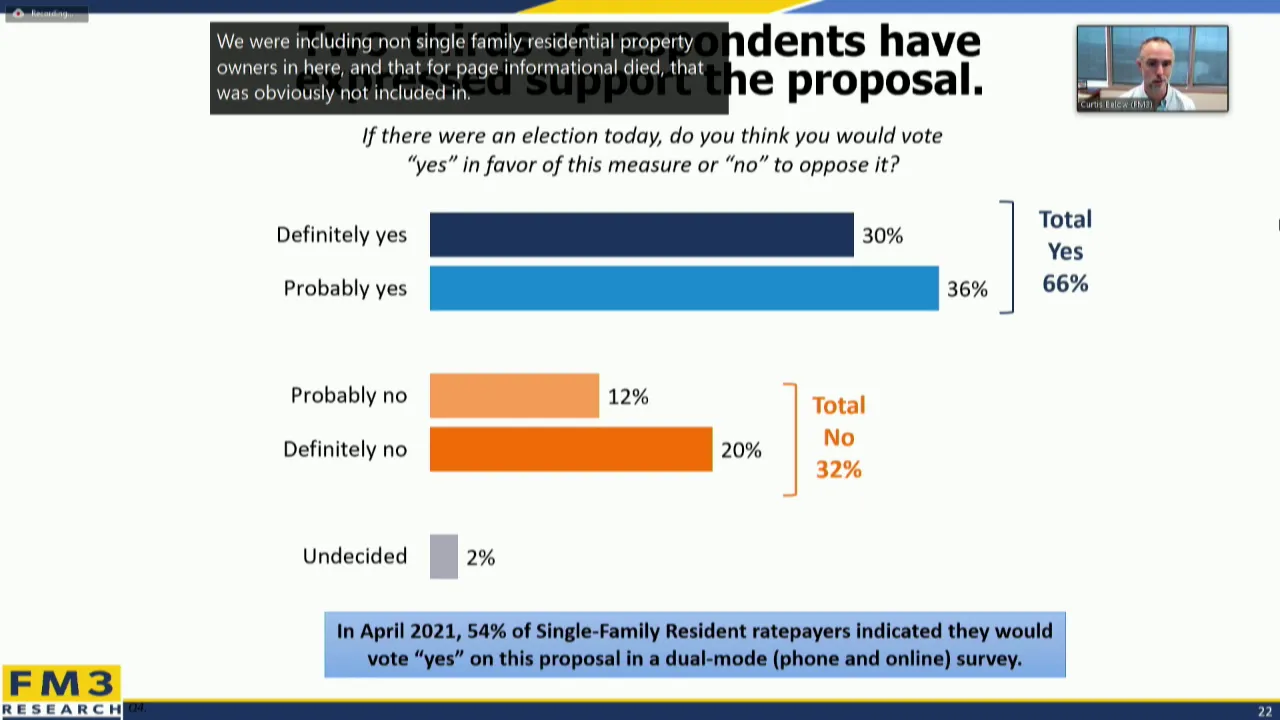
Staff presented the results of a mail survey (Phase 2) on the proposed storm drainage rate adjustment. The survey achieved 1,100 responses (margin of error ±3%) and found 66% of respondents would vote yes (30% definitely, 36% probably) versus 32% no. Support was strongest among owner-occupied single-family homes (72% yes) and weakest among retail/commercial (evenly divided). The proposed rate structure uses impervious surface coefficients and charges about $0.02 per square foot per year. The city manager's office has approved moving forward based on these positive results. A schedule was outlined: informational item at City Council on November 17, URAC meetings, six webinars in December/January, Prop 218 protest mailer, ballot mailing in February with results expected by July 1, 2022.
Committee members thanked staff and FM3 Research for thorough polling. Councilmember Valenzuela noted the McKinley vault project, funded almost entirely without drainage fees due to lack of funds, saved the city from major flooding. Councilmember Vang emphasized the need to invest in infrastructure to avoid higher future costs. The item was received and filed.
3. Drought Response: Continuing Water Alert
Staff reported that the recent atmospheric river added approximately 108,000 acre-feet to Folsom Reservoir, providing significant breathing room and avoiding a dead pool situation. However, this has not ended the drought; conservation remains critical. The committee echoed the need for continued water-saving messaging. The item was received and filed.
4. California Water and Wastewater Arrearage Payment Program (CWWAPP) Update
Brian Sanders presented an update on the CWWAPP, created by AB 148. The program provides one-time bill credits for eligible arrearages incurred between March 4, 2020, and June 15, 2021, funded by the federal American Rescue Plan Act. The city will receive 3% administrative fees without reducing customer assistance. Wastewater arrearage applications are anticipated to begin in February 2022. Councilmember Valenzuela highlighted community advocacy for the program and urged continued lobbying for additional state funding if needs exceed available funds. The item was received and filed.
Key Outcomes
- Item 1 (SURA): Unanimous motion (3-0) to forward the staff recommendation to City Council for discussion, with all options open.
- Items 2, 3, 4: Received and filed without objection.
- A schedule for the storm drainage rate adjustment was outlined, culminating in a potential ballot election in early 2022.
Meeting Transcript
Chair, you have your full committee and video recording is started. Very good. Thank you everybody for joining us for this November 9th edition of the water committee for the city of Sacramento. Madam Clerk, please call the role to establish reform. Thank you, Councilmember Valenzuela. Councilmember Vang. Yes, uh here. And Chair Harris. Present. Do you have any announcements, Madam Clerk? I have no announcements at this time. Okay, well, committee members, we have four items on the agenda. Um three are receive and discuss, and one may have an action item attached. So we'll go ahead and start with item number one having to do with the SURA program. Thank you, Chair Harris and uh members of the committee. Um, I'm Bell Busith, uh Director of the Department of Utilities for the City of Sacramento. Um we're going to cover uh time permitting uh four topics today. First, we're going to give a presentation on the SURA our SURA program recommendation. Uh second, we will be discussing the drainage rate adjustment. Uh specifically the um uh our survey two uh results and uh proposed schedule moving forward. Um time permitting. We will have a short discussion about uh our water conservation efforts, um, and then we uh will finish up with uh discussion about the uh the the rate assistance uh uh application that we have in with the state, uh the CWWAPP uh program. Um so we'll go ahead and start with the uh uh with the SURA program. I'm gonna start by articulating our recommendation and then I'm gonna go through some slides to talk about why we've made that recommendation. Uh I'll reiterate the recommendation at the end. Um just so that you know Dawn Holm uh finance director is on the call, or um, I think she's on the call anyway, um, and should be available to answer any questions that you might have that would be a you know most appropriate for her to respond to. Um next slide. So just a reminder um that the program was uh we were directed by uh council in in 2013 to establish the SURA program in uh later a little later on in FY1314 uh when we had some rate adjustments that were passed. Um funding uh was appropriated, and the program uh was a you know uh kicked off as far as actually having you know customers and and giving um uh benefits or discounts to to customers. Um in 1617 there was another rate adjustment uh that was approved by council that was also uh incorporated into the SURA program, and there was also a recycling solid waste adjustment uh that was included in the in the SURA program. Um we had been working with SMUD for some time to uh develop a program of access to their database in FY19 that became official, where we are doing that on a regular basis, and as you see there, the the uh participation in the um program uh increased significantly and has leveled off as you know at about 8500. Um in 2019, uh council member carried us to do a pilot uh to see a feasibility of uh renter assistance uh since renters are not our customers and not receiving any direct benefit from the SURA program. Um we have done that and we have a recommendation associated uh with that program. us to do a pilot uh to see a feasibility of uh renter assistance uh since renters are not our customers and not receiving any direct benefit from the sura program um we have done that and we have a a recommendation associated uh with with that that program and so our recommendation is that we change the structure from the current approximately 36 percent benefit average uh to our current customers to a what we consider a more sustainable 25 percent benefit and we also recommend that we don't incorporate the uh the renters assistance um into the program and again i have some slides that are going to detail um why why we're making this recommendation next slide at our current benefit rate um what you see here is is that um you know at our current participation level which is at about 8500 we plan on being able to barely uh make it through fy 22 under under our current budget um in fy 23 assuming that we have a solid waste rate adjustment and a drainage rate adjustment and assuming that we receive direction from council to include those rate adjustments and rates into the program um you see the budget that we uh that we anticipate needing in FY23 uh under the current benefit um you know at the current uh a participation level of 8500 we'd need a little over five million dollars uh for the budget and you can see those numbers go up if we anticipate uh an increased participation in the program um again in FY24 there are um some of the uh solid waste rate adjustments would take place in FY24 uh needing another half million or so uh budget uh from in this program and then another slight increase in f in FY25 that's based on the current uh discount average of of about 36 percent uh per for for the customers next slide we also did a lot of research about what others are doing in the state um and what we found is that nobody that we're aware of in the state is giving any more than a 25 percent uh benefit to their uh to their customers in these rate assistance programs you see that most of these are electric um customers and there are not very many uh utility what you know water wastewater drainage utility purveyors in the state that are offering any kind of a a rate assistance program um i think it's because the council felt so strongly about this that they were willing to fund it out of the general fund uh you know that the city moved forward with the with this program but you see that uh 25 percent is the you know is the most that anybody is offering in this you know in the state again that we are aware of and I'll I'll caveat caveat that next um just to be clear about what we're currently offering and what we're proposing is is that we have two different types of current customers one we call non-legacy and one legacy the legacy participants have been in the program since its inception back in 2013 the non-legacy are mostly um uh customers that have come into the program and are receiving uh the benefit uh from the second rate adjustment but not from the first rate adjustment in in uh in 2013 so we have our our non-legacy or more current participants receiving a current discount of about 37 dollars and that's about 34 percent of their uh you know discount the legacy participants receiving a total discount of uh a little over 57 which is a 52 percent discount and the average of our non-legacy and legacy is about 40 dollars a little over 40 dollars at 36 percent at the proposed 25 percent the uh the uh average customer would receive um a little over 27 dollars next slide at the 25 percent level you see that um it would be some time at our current participation level it would be some time before we would need to increase the budget of the program it also allows us to be able to even under the current um uh even under the current program to be able to or under the current budget to be able to uh you know in FY23 we could manage up to 9500 um customers without having a uh uh a budget uh increase for the for the program next slide the work that we did to investigate the cost of rental assistance and this again is based on a similar discount that we would give to these customers or these renters if they were customers based on the size of their um of their residents um we Next slide. The work that we did to investigate the cost of rental assistance, and this again is based on a similar discount that we would give to these customers or or these renters if they were customers based on the size of their um of their residents. Um we estimate that if we move forward with this rental assistance for water just for water and wastewater, that wouldn't include this. This doesn't include um solid waste or drainage, that the cost would be almost two million dollars uh citywide, and of course, uh significant budget would be needed to be added to the program in order to uh move forward with that. So our recommendation is to is to move forward with a flat 25% um uh a benefit to the customers, and um uh that and our recommendation is that we not move forward with a you know a rental assistance program in the city. Um, based on input from this uh uh from this committee, our intent is to move forward with this and bring it to council, bring this recommendation to council uh before the end of the year. Um so that ends my presentation on this part, and uh here to answer any questions uh or uh comments that you might uh or receive any comments that you might have. Okay, can you take your screen down, Bill, please? Tyler, yeah, there you go. So um committee members, I'm gonna start off with a few comments, and then I see member Valensuela's hand this up. You know, we've we've touched on this program before, had a bit of a conversation about it. Uh I kind of like where staff is going about about this um in terms of sustainability and the ability to add more participants to the program. I think that that is uh a wise way to proceed. At the same time, you know, to consider doing apartment dwellers. Um that of course would be a council discussion because it takes it's going to take a lot more budget. So I would like to go ahead and move this staff recommendation forward to council with the direction that council considers, you know, all the information, of course, in in uh what the staff recommendation is, but consider whether the council has the appetite or the budget to go ahead and include department dwellers in it.
openpublica.com