Sacramento Regional Transit District Board Workshop on Strategic Vision - March 7, 2017
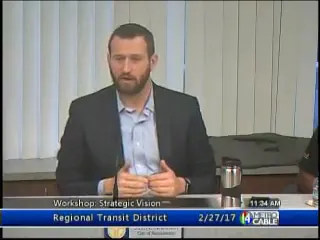
STREAMING COPY IN PREPARATION — RECORDING AVAILABLE FROM THE ORIGINAL SOURCE
Sacramento Regional Transit District Board Workshop on Strategic Vision - March 7, 2017
Note on date discrepancy: The provided meeting date is March 7, 2017, but the transcript begins with a call to order on Monday, February 27, 2017. This summary uses the date supplied for the title but reflects the content as transcribed from February 27, 2017.
The Sacramento Regional Transit District (RT) Board held a workshop to discuss the agency's strategic vision, financial challenges, and a proposed 12-initiative plan to eliminate a $10 million operating deficit and build toward a sustainable future. The meeting included a detailed presentation by General Manager Henry Lee and senior staff, followed by public testimony and board discussion.
Public Comments & Testimony
- Brenda Anderson (private advocate for disabled/elderly): Praised RT's recent innovations and improvements.
- Ellen Johnson (resident): Expressed concern about removal of benches at Broadway and Martin Luther King Jr. Blvd., citing safety and loss of seating for bus riders. RT staff explained benches were temporarily removed due to chronic loitering and sleeping, but they committed to reassessing.
- Jeffrey Tardiya: Criticized the Connect Card system, noting drivers were unfamiliar with how to offer a discounted day pass, and requested a refund policy.
- Joan Bardin (Oak Park Neighborhood Association): Supported safe, covered benches and suggested cameras to deter negative behavior; urged a broader solution to homelessness.
- Brenda Anderson (second appearance): Withdrew earlier compliments, chastising RT for excessive promotion of Golden 1 Center service and lack of community outreach to churches and job programs. She demanded removal of expensive paratransit advertisements and more surveys.
- Ray Pingle (Sierra Club California): Urged RT to aggressively transition to electric buses, citing cost declines, range improvements, and examples from other California agencies (Antelope Valley, Foothill Transit).
- Barbara Stanton (Ridership for the Masses): Highlighted Paratransit Inc.'s free mobility training to help people use fixed-route transit, suggesting it could reduce paratransit costs.
- Rory Barloo (South Natomas resident): Opposed the Green Line expansion to the airport, arguing it is unnecessary and too costly; urged focus on bus service and addressing homeless camps moved into South Natomas.
- Bill Smith (statistician/inventor): Predicted rapid technological advances (autonomous vehicles, drones) and suggested RT should prepare for a "fifth industrial revolution."
- Jeffrey Tardiya (second appearance): Asked RT to improve customer service hours (24/7) and to develop a transit-only tax measure, noting the need to compete with an affordable housing measure. He also requested better service to the Harris Center for events.
- Becky Heike (Executive Director, North Natomas Transportation Management Association): Described growing demand for shuttle services as new housing and Amazon's facility come online; proposed using North Natomas as a pilot for the route optimization study.
- Joan Bardin (second appearance): Emphasized the importance of neighborhood association partnerships and noted specific needs in Oak Park and Curtis Park.
- Tiffany Fink (CEO, Paratransit Inc.): Reaffirmed commitment to partnership with RT beyond ADA service, including mobility training for students.
Discussion Items
Strategic Vision Presentation (Henry Lee and Staff)
- Achievements last 8 months: Built cash reserve from $0 to $6 million (target $9 million by year-end); reduced fare evasion from >15% to <5%; increased fare revenue 18.5% in first 6 months; earned C COC Salutes award; saved $3 million on Buy America compliance; renegotiated union contract reducing annual pay increase from 4% to 2.5% (saving $1.5 million).
- 12 Initiatives: Covered operator attendance (target 10% reduction in unscheduled absences), route optimization (blank slate redesign), ADA paratransit cost review, IT modernization (mobile fare app, real-time train info, PA system), security and safety (expand fare paid zones, 24/7 security operations center, improve CPUC compliance), strategic communications, employee/labor relations, organizational excellence, business process optimization, facilities master plan, transit-oriented development, and fiscal management.
- Fiscal Challenges: $29 million operating line of credit, $3.5 million annual bond debt for 23 years, volatile state and federal funding (STA, cap-and-trade, CMAQ). Potential federal cuts could remove $35 million annually (21% of operating budget). Unfunded state-of-good-repair needs total $360 million, including $162 million to replace 30-year-old Siemens light rail vehicles, $50 million for station modifications for low-floor vehicles, and $40 million for CAF midlife overhaul.
- Service Gaps: RT receives 1/6 of 1 penny local sales tax; peer agencies in San Diego and Portland receive 3-4 times more. To double bus fleet and increase frequency from 30 to 15 minutes would need at least an additional 1/3 penny sales tax.
- Four Major Priorities (if new funding secured): Free student fares (K-12, projected +1 million rides), ADA fare discounts, flat fares for 10 years, free transfers/zonal fares.
- Capital Expansion: Green Line to airport ($1 billion), streetcar ($200 million), South Line extension to Elk Grove, and Sacramento Valley Station loop.
Board Member Discussion
- Director Shanier: Emphasized the turnaround from financial death spiral; Golden 1 Center helped expose choice riders to transit; route optimization will be difficult (winners/losers) and should be paired with budget exercises; praised ATU for cooperation.
- Director Cerna: Thanked public; stressed Title VI equity must be floor, not ceiling; asked about RT brand value; supported transit-oriented development working group (to be led by Director Shanier).
- Director Hansen: Called for a sustainable system; advocated for a half-cent sales tax (or more) as a fair start; noted need for first/last mile connections (bike share, TNCs); urged careful property disposition; praised Golden 1 Center as model of smart planning.
- Director Hume: Supported blank-slate approach but argued that funds should be focused on areas of highest need rather than trying to convince non-riders; suggested rebranding RT (e.g., "trolley" instead of "light rail").
- Director Harris: Said the system has not reached a tipping point; more investment needed; green line to airport essential; electric buses desirable; low-floor vehicles critical for accessibility.
- Director Natoli: Recognized the challenge of balancing day-to-day operations with long-term vision; expressed concern that potential federal cuts could derail promises made for a tax measure; stressed need for clear communication about risks.
- Director Budge: Route optimization critical for growing areas like Rancho Cordova; opportunities at Mill Station as TOD test case; supported electric buses for lower maintenance.
- Chair Moore: Summarized positive momentum; urged community to understand the board's energy and staff's hard work; noted the need to seize the moment despite funding uncertainties.
Key Outcomes
- The board received the strategic vision presentation and public input, expressing broad support for the direction.
- Staff was directed to proceed with the 12 initiatives, particularly the route optimization study, with an emphasis on community engagement and equity (Title VI plus deeper analysis).
- No formal vote was taken, but consensus emerged to explore a transit-only sales tax measure (rather than a combined transportation measure) and to consider a funding level of at least a half-cent, potentially aspiring to a full cent.
- The board committed to forming a transit-oriented development working group and to continuing the conversation with the public through additional workshops and outreach.
- Staff will report back on paratransit contract renegotiation, route optimization progress, and specific cost-saving measures in the coming months.
Meeting Transcript
And call to order the uh Sacramento Regional Transit District uh Board Meeting for Monday, February 27, 2017. Would the clerk please call the roll? Director Budge, Director Hanson, Director Harris, Director Hume, Director Jennings, Director Kennedy, Director Miller, Director Natoli. Director Shanier? Director Cerna? Here. Director Moran. Here. Or excuse me, Chair Moran. This meeting of the Sacramento Regional Transit District will be cable cast without interruption on Metro Cable 14, the local government affairs channel, and will be streamed live on RT's website. Today's meeting will air on Wednesday, March 1 at 9 a.m. and replayed on Thursday, March 2 at 6 p.m. on Channel 14 and webcast at WWW SAC Metro Cable.tv. It is also closed captioned. Members of the audience wishing to address the board should fill out a speaker card located at the rear of the room and provide it to me. Please speak into the microphone and state your name for the record. We would appreciate everyone turning off their cell phones. Thank you. Great. Thank you, Cindy. Would everyone please rise and join me in the Pledge of Allegiance. I pledge allegiance to the flag of the United States of America. And to the Republic for which is one nation under God. Okay, first item. Public addresses the board on matters not on the agenda. Okay, I do have a few members requesting to speak on matters not on the agenda. And we'll start out with uh Brenda Anderson. Brenda. Send give a microphone to her. Okay, very good. So while we're handling that after Brenda will be Ellen Johnson and then after Ellen will be Jeffrey Tardiya. Here you go, Ms. Anderson. Hi, my name is Van Anderson. I'm a private advocate for the disabled and elderly in facilities and transportation. I would like to say that I've been attending the area council of governments. And I've uh listened to some of the um regional transit uh changes and innovations and I just want to applaud it. I see great appreciation as a transportation user for all that you've done. Thank you very much. All right, Brenda, thank you thank you very much. And uh if you need more time, you have three minutes. So if you want to compliment us for a little more. He's giving it back to her. So uh Ellen, where is Ellen? Helen. Ellen I got El Ellen Johnson. Yeah, I am. There we go. Yes, here comes the microphone. Oh it's about my note.
openpublica.com