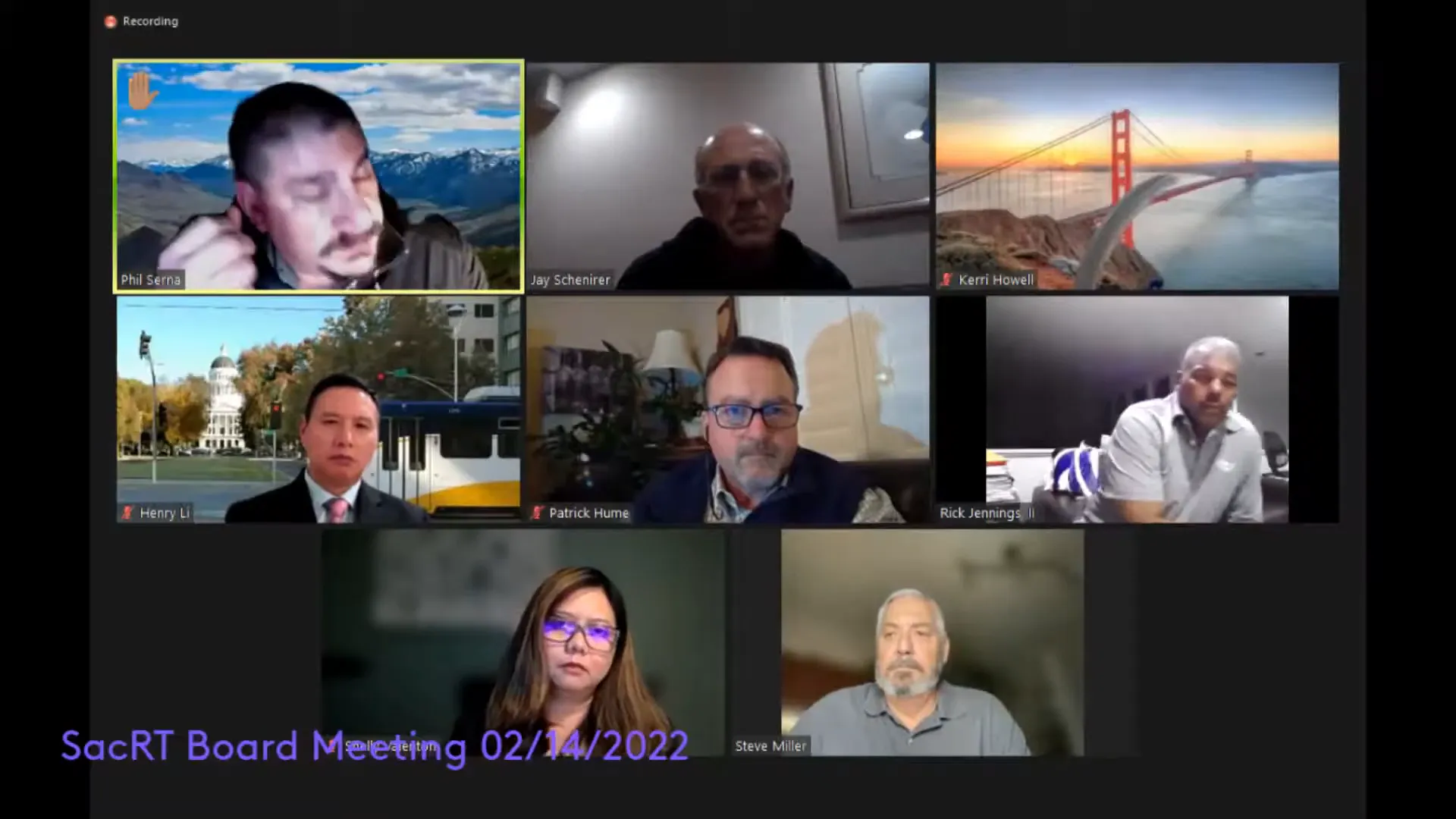
Sacramento Regional Transit Board of Directors Meeting - February 14, 2022
STREAMING COPY IN PREPARATION — RECORDING AVAILABLE FROM THE ORIGINAL SOURCE
Sacramento Regional Transit Board of Directors Meeting - February 14, 2022
The Sacramento Regional Transit (SACRT) Board of Directors met on February 14, 2022, to consider a range of items including changes to the board structure, a safe parking program at a light rail station, a resolution honoring Rosa Parks, and updates on the short-range transit plan and general manager's report. Key decisions included approving a modified board structure with expanded alternates and authorizing a lease negotiation for a safe parking site.
Consent Calendar
- None noted. All items were discussed individually.
Public Comments & Testimony
- Barbara Stanton (WriteRights for the Masses, via email): Supported board composition including non-elected community members and suggested a public application process for SACRT board positions.
- Dan Allison (Sacramento Transit Advocates): Strenuously objected to the board structure recommendation, arguing against the elected-official-only restriction and the 13-member cap, and criticized the lack of public engagement.
- Jeffrey Tartaglia (various hats): Supported additional seats for county and Elk Grove but urged more public input; recommended 18-month pilot for safe parking; highlighted missing bus cancellations and route information.
- Nick Bryant: Complained about a homeless individual at a bus bench and requested better police patrols; later raised concerns about bus cancellations and graffiti.
- Angela Hering (via email): Described inadequate public transit options in North Natomas, noting distances to bus stops.
Discussion Items
4.1 Board Structure Change
- Staff presented the ad hoc committee's recommendation to amend SACRT's enabling legislation: Sacramento County gets four seats, Elk Grove gets two, City of Sacramento can appoint an elected official alternate, board must revisit allocation every 10 years (or upon annexation/population change), maximum board size 13.
- Discussion focused on alternates: Directors Cerna, Jennings, Shanier, Valenzuela, and Budge supported allowing non-elected alternates and granting each jurisdiction alternates equal to their number of seats. The motion modified the recommendation accordingly, removing the requirement that alternates be elected officials.
- Public comment: Multiple speakers criticized lack of public engagement and the elected-only restriction.
4.2 Safe Parking Site Lease at Franklin Light Rail Station
- Staff proposed a one-year pilot safe parking program on 148 parking spaces (expanded from 92) at the Franklin station. The city would establish a good neighbor policy and public safety zone.
- Director Jennings supported, citing the need for safe parking for those sleeping in cars. Director Kennedy requested direct consultation as the board member representing the area.
- Public comment: Jeffrey Tartaglia urged an 18-month pilot; Nick Bryant complained about homeless individuals at bus stops.
7.1 Rosa Parks Day Resolution
- Staff presented an amended resolution to recognize Rosa Parks on her actual birthday, February 4, instead of the first Monday after. The board adopted the resolution.
7.2 Short Range Transit Plan (SRTP)
- Staff presented the five-year plan (2022-2027), including temporary 3% service reductions on commuter routes due to labor shortages, and a vision for enhanced service if a sales tax measure passes. Public comment period opened for 30 days.
- Directors Kennedy and Cerna emphasized collaboration with county climate action planning and accelerating airport service.
- Public comment: Jeffrey Tartaglia asked about route changes; Nick Bryant requested information on cancellations; Angela Hering highlighted North Natomas gaps.
8.1 General Manager's Report
- GM Henry Li provided updates: COVID-19 impact on operations, aggressive driver recruitment (6% more drivers by March 1), one-time $1,500 payment to non-executive employees (funded by $3M surplus), WTS award for social service practitioner program, light rail modernization with Siemens, and a rider survey open through February 25.
- Public comment: Jeffrey Tartaglia thanked staff for cancellation alerts; Nick Bryant requested more accessible cancellation notices.
Key Outcomes
- Board Structure Change (Item 4.1): Motion to adopt ad hoc committee recommendation with modifications (alternates need not be elected; each jurisdiction appoints alternates equal to their number of seats) passed 8-1 (Chair Miller opposed). Staff directed to prepare legislative language for bill to be carried by Assembly Member Ken Cooley.
- Safe Parking Lease (Item 4.2): Resolution delegating authority to GM to negotiate lease with City of Sacramento passed 9-0. The lease will be a one-year pilot with board approval for extensions.
- Rosa Parks Resolution (Item 7.1): Adopted unanimously (9-0).
- Short Range Transit Plan (Item 7.2): Informational only; 30-day public comment period initiated; staff will return for adoption in April.
- General Manager's Report: No formal action; board received the report and public comments.
Meeting Transcript
Act for changing the board structure. The first is for the voting entity to voluntarily appoint fewer members. And the second is to reallocate seats based on gross cost service. Staff already reviewed the potential impact of using gross cost of service per jurisdiction and reported that this method only further exacerbates the voting inequity. So the board decided to create an ad hoc committee to review options for changing the board structure. At the January 10th meeting, Chair Miller appointed himself, directors Valenzuela, Hume, Budge, Natalie, and Howell. All member jurisdictions of the Sacrete Board were represented in the ad hoc committee with one member each. And we want to thank our ad hoc committee members for their engagement and active participation. We've had very productive meetings at the committee meetings held on January 24th and January 31st. During this meeting, staff presented additional information for the committee's review, including the structure of comparable transit agencies, transit revenue and competitive funding by jurisdiction, as well as the legislative timeline should the board decide to make modifications to SACRT's enabling act. There was also an extensive discussion at the meetings about a population-based structure. And after a thorough deliberation, allow me to read to you the final motion that was voted on and approved by the ad hoc committee to amend Sacrete's enabling legislation. The County of Sacramento will have an additional seat or four total, and the city of Elk Grove will have an additional seat or two total on the Sacarte Board of Directors. The City of Sacramento can appoint an alternate, but they must be an elected official. The board must revisit seat allocation no less than every 10 years, but it must happen if and when YOLO or West Sacramento annexed to Sacrete or whenever a member jurisdiction has had a significant population increase or decrease or change to their landscape. The maximum size of the Sacrete Board will be 13 members. If the board accepts this modification, since the board of supervisors will have four of its five members sit on the Sacarte Board under this proposed new structure, the county will appoint as a common alternate the only member of the county board of supervisors who is not a SACRT board member. Staff believes that this motion addresses the main issues that were brought up about the diminished voting power of the county, giving them four seats total or the equivalent of 36% of the total votes as compared to the old structure that gave them 32%. This also satisfies Elgrove's request for additional representation based on their population relative to Folsom, Citrus Heights, and Rancha Cordova. Based upon the final motion to be approved by the full board tonight, staff will work on a legislative initiative to effectuate the board structure changes. And I am pleased to report that Assembly Member Ken Cooley already agreed to author and carry a bill in the legislature legislature to clean up Sacrities enabling act language. And thanks to Chair Miller for engaging with Assemblymember Cooley on this. The deadline to introduce bills for this legislative cycle is February 18th. And if the full board approves a motion to change the structure tonight, the approved changes will be incorporated in the clean up bill and will be submitted during this year's legislative cycle. And that concludes my summary, and our general counsel and I are available if you have any further questions. Thank you. Thank you, Ms. Valentin. Any questions? Yes, thank you. Thank you, Chair. Thank you for the uh the uh staff report and thanks to our colleagues who served on the uh the ad hoc uh committee for um giving of their time and thoughtfulness to this. Um, I have a question about um one other aspect of our current system and whether or not it was discussed in committee or not, and that is the fact that um when we have uh members that are absent but representing the same jurisdiction, the votes transfer over to that uh that member, that director. So in the case of what has been proposed tonight, for instance, if you only have one member of the board of supervisors uh would uh present at a meeting, um, would the other three members of the board uh transfer to that one um attending uh county representative director. I'm not sure who wants to field that question. I I this is Olga. I can answer that. No, um, so when we changed the legislation when 1196 was adopted, the language that um basically transferred votes um from let's say you know, for all the county members or city of Sacramento members, that language was removed because it was part of the weighted voting structure. So there is no language presently in our enabling act that um allows for that. The only option is alternates, but alternates currently are only available to the jurisdictions that just have one seat. It's not um something that's available to the city of Sacramento or the county of Sacramento. So that's why we have the discussion about allowing alternates for the city of Sacramento and the County of Sacramento in case um the city member cannot attend, they can have their alternate attend in their place. Um so yeah, no, but no, there was no discussion about putting and I understand that that um that nuance uh Olga, but for a jurisdiction like Sacramento County, even if we had that fifth member of our board uh as an alternate, and let's say you had two missing county directors at a meeting, we would have no opportunity to have uh the number of alternates necessary to fulfill uh the county's um presence, correct? Correct. Yeah, unless unless you had alternates and you were allowed to appoint non-elected official alternates, so that each of you could appoint someone like let's say you could appoint your chief of staff to be your alternate, correct? But yeah, now is that something that um in the course of debate and exchange tonight we could establish? Yeah, I mean the board could could add that to their motion. And uh I believe that um director Valenzuela um proposed something like that in the committee in the subcommittee here in the subcommittee meetings. Um, but it didn't make the the final cut, but it doesn't mean that the full board can't decide to do something like that. Okay, yeah, I'd like to just kind of put it out there uh through the chair, um, that it seems to me that if the single voting jurisdiction members uh are able to um satisfy uh in whole uh a missing director by way of another alternate who would uh conceivably be present at a meeting that the same should be available for the county of Sacramento.
openpublica.com