Sacramento Regional Transit Board Meeting - June 10, 2024
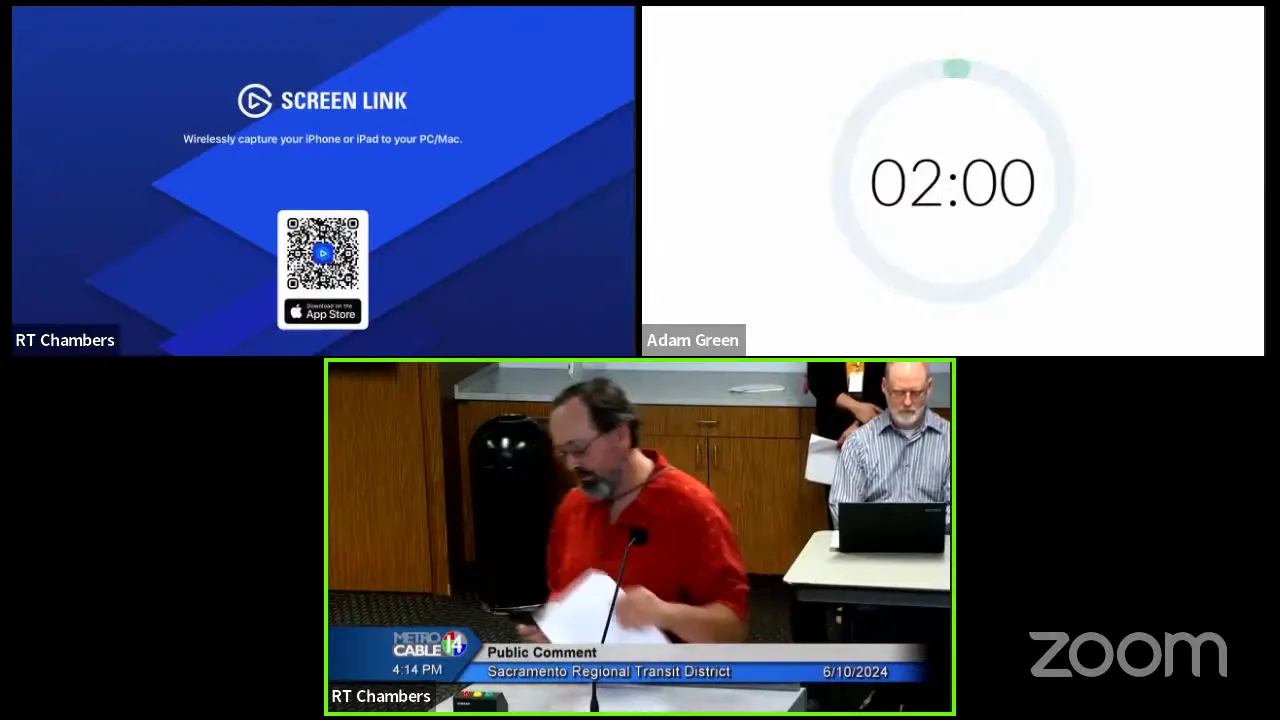
STREAMING COPY IN PREPARATION — RECORDING AVAILABLE FROM THE ORIGINAL SOURCE
Sacramento Regional Transit Board Meeting - June 10, 2024
The Sacramento Regional Transit (SACRT) Board of Directors held its regular meeting on June 10, 2024. The board adopted the consent calendar, approved the General Manager's annual performance evaluation with a 4% merit increase, received the General Manager's report, and heard public testimony on a range of transit topics.
Consent Calendar
- Approved the consent calendar via a motion by Director Kaplan, seconded by Director Budge. All members voted in favor with no opposition or abstentions. (Specific consent items were not listed in the available materials.)
Public Comments & Testimony
- Dan Allison (Sacramento Transit Advocates and Riders) criticized the operations portion of the budget, stating it lacks program-specific information such as costs, fare recovery, ridership numbers, and demographics. He cited the ride-free RT program as an example, noting it is mentioned only once without supporting data. He argued that budgets should communicate program effectiveness to the public. The board directed staff to follow up with Mr. Allison to incorporate his ideas into future budget documents.
- Michael Bevins highlighted bus service gaps, including a lack of cross-regional connections (e.g., Elk Grove to Citrus Heights or Folsom to Citrus Heights), and recommended regular bus service on major arterials, at light rail stations, and near schools. He also proposed north-south and east-west spine routes.
- Helen O'Connell raised ADA accessibility concerns with the new low-floor light rail vehicles, specifically the difficulty of reaching the emergency strip from an electric wheelchair. She also expressed concerns about pay disparities between Smart Ride and RT Go. The board acknowledged the ADA issues and said staff would review them.
- Coco Coca Zala requested access to the public portion of meeting minutes for easier cross-referencing, and later asked questions about the GM's scorecard methodology, including how strategic pillars are determined and how ratings like system cleanliness are assessed.
- Jeffrey Tartigia commented on several topics: improved shuttle signage, confusion at 13th Street, a request to review the GM's performance over two years, concerns about the delayed rollout of low-floor vehicles due to fare card machine placement, and a note that priority seating may not meet ADA 19-inch standards. He also advocated for a transit tax measure.
Discussion Items
- Resolution 2024-06061 – General Manager Performance Evaluation: Deputy CEO Shelly Valentin presented the resolution and a year-in-review video. The video highlighted achievements including $400 million secured for light rail modernization, delivery of 20 new low-floor vehicles (25 more on order with an option for up to 76), a $5 million grant for Stockton Boulevard BRT with a 4.5-mile dedicated bus lane, 4.2 million student rides (on track), ridership at ~80% of pre-COVID levels with bus ridership near 100%, and six fare-free days that boosted ridership by 10–15% per event. Board members praised GM Henry Lee's leadership, with Director Brewer calling him "more accessible, more responsive, more incredibly professional." The resolution included a 4% merit increase for the GM, consistent with other employee groups. Public comments were heard, after which the board approved the resolution unanimously (motion by Director Brewer, second by Director Daniels).
- General Manager's Report: GM Lee reported that all three of SACRT's congressional representatives submitted Community Project Funding requests: $4 million for City College/Fruitridge-Nairobi station modifications, $4 million for Gold Line station upgrades in Folsom, and $4 million for a hydrogen fueling station at the bus maintenance facility. Both U.S. senators also submitted requests ($4 million from Senator Padilla and $3 million from Senator Butler) for light rail modernization. He noted that the Sacramento City Unified School District approved $250,000 for ride-free RT, with other districts also funding it. He mentioned that paratransit service (SACRT GO) reached one million customers since its in-house launch in 2020, and that the service remains the lowest-cost in its California peer group. He also highlighted a new farmers market at Meadowview station, following similar markets at Sunrise and Florin.
Key Outcomes
- Consent calendar adopted unanimously.
- Resolution approving the General Manager's performance evaluation and 4% merit increase passed unanimously.
- Staff directed to work with Dan Allison on improving budget transparency.
- Staff to follow up on ADA accessibility issues raised by Helen O'Connell and Jeffrey Tartigia.
- GM's report received; no formal action taken.
Meeting Transcript
I will take the time to educate myself on the CIP, which is the breakout I learned from Jason. And if I have concerns, I'll come in the future as offline agenda. Things, thank you. Thank you, Coco. Dan Ellison. Dan Allison, Sacramento Transit Advocates and Riders. Um, I'm speaking specifically on the operations part of the budget. Um, the question that my organization asked itself is what are budgets for? What does this budget document mean to us? The answer is it doesn't mean anything. Um, it doesn't give us the information that we need to evaluate SAC RT's operation service. Um, there's no information about specific programs in here. Um, it doesn't tell us how much they cost, what the fare recovery is, who's being served, both numbers and demographics. That information is not here. The public doesn't have any way of determining whether these programs are good or bad. Should we have more of something? Should we have less of something? Should we drop something? That information is not in this budget, and it should be. We believe that that's the purpose of budgets is to communicate with the public about why SAC RT is doing what it's doing. Um, I'll use this uh ride-free RT as an example. It's mentioned once in the entire budget document. There's no number associated with it, it's just mentioned in text. Um is it a good program? How many riders is it generating? How much is being spent on it by SAC RT and the partners? That information's not here. Um, who's being served? What kind of students? How are they using it? I realize that information is available in some other documents. We had to ask for them, and they were finally provided. Um, but it's not in the budget. The budget should talk about programs and how effective they are, and it does not. And that's true of all of the major programs. Um we need to address um all of the programs, light rail, bus, community bus, everything. All of those major programs should be in the budget document, and they are not. Thank you very much. Thank you, Mr. Lee. Is there somebody on staff that uh Mr. Allison can follow up with to provide his input into future budgets? He may he sounds like he has some good ideas that we're actually he actually has some very great great ideas. And uh well, whatever he mentioned, you know, we can we can you know satisfactorily answer his question, but in terms of formality, how in the future we're going to you know in incorporate his ideas into our budget document. That is a great idea. Thank you. Yeah. So is there is there a staff person that will follow up, Mr. Allison? Oh, Jason, uh CFO will, you know, direct to work with him on that.
openpublica.com