Sandy City Planning Commission Meeting – June 5, 2025
STREAMING COPY IN PREPARATION — RECORDING AVAILABLE FROM THE ORIGINAL SOURCE
Sandy City Planning Commission Meeting – June 5, 2025
The Sandy City Planning Commission met on June 5, 2025, at 6:15 PM in the City Council Chambers and via Zoom. The meeting began with a training session on conditional use permits, followed by a public hearing for the Altus Rezone application, a public meeting for the Trans Jordan Sign Theme permit, and administrative business. All votes were unanimous.
Training on Conditional Use Permits
- Staff attorney Mike Wilcox led a detailed training on state code and city ordinance regarding conditional use permits (CUPs). Key points included: the city shall approve a CUP if reasonable conditions can be imposed to mitigate reasonably anticipated detrimental effects; conditions must relate to the specific impact; denial requires a finding that no conditions can mitigate the detrimental effects; conditions that eliminate the effect are not required—only substantial mitigation; decisions must be based on substantial evidence in the record; and the commission must avoid arbitrary or capricious actions, including decisions based solely on public clamor. Commissioners discussed past cases (e.g., a daycare and a dog kennel) and the need to educate the public on the limited discretion the commission has with CUPs. The suggestion was made to include a summary of legal standards in staff reports or agenda materials.
Public Hearing: Altus Rezone
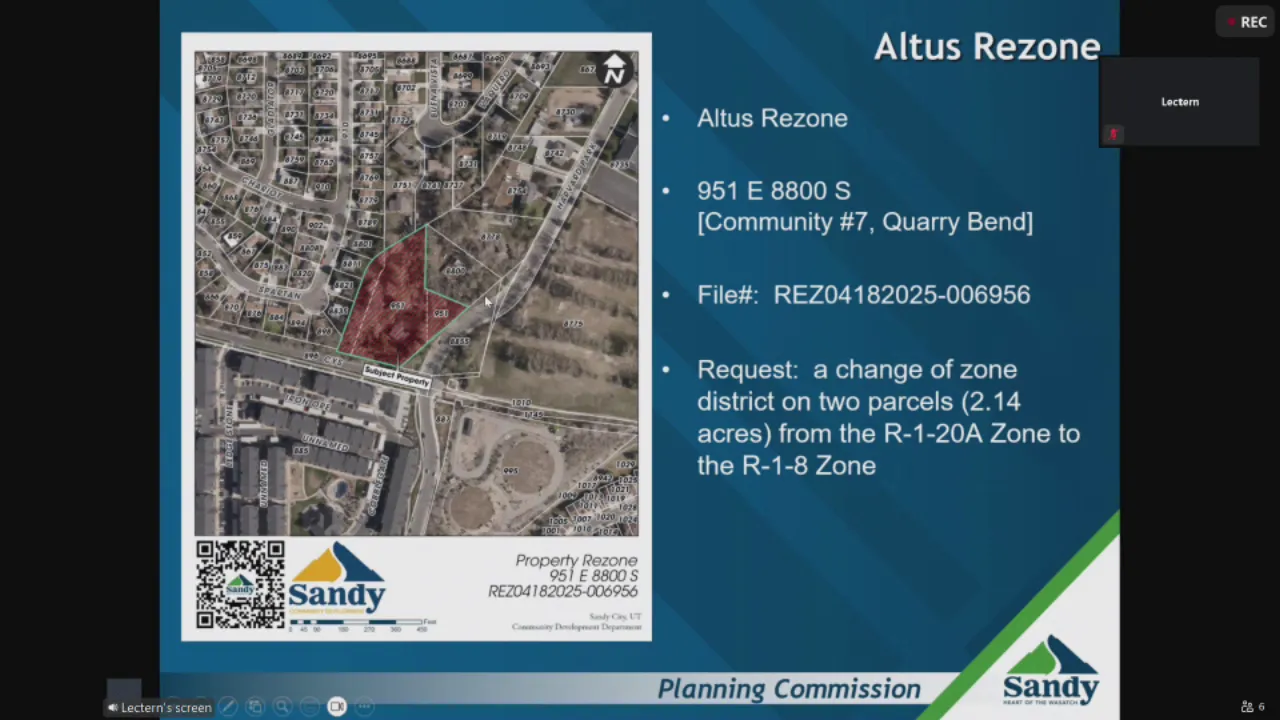
- Applicant: Altus Development Group (represented by Jake Warner, Phil Winston, and others) requested a rezone from R120A to R18 for two parcels totaling 2.14 acres at 951 E. 8800 S. The property is near Harvard Park and the Pebble Brook golf course. A concept plan showed eight single-family lots off a cul-de-sac from S. Sci Road.
- Staff Position: Staff recommended approval, but also recommended that two adjacent city-owned parcels (0.5 acre on the west and 0.16 acre on the east) be included in the rezone to ensure cohesive development. The applicant stated they are in talks with the city about incorporating those parcels.
- Public Comment: No public comments were made in person or online.
- Commission Deliberation: A commissioner asked about the creek on the property; the applicant confirmed it would remain daylighted. Another commissioner noted the city-owned parcels should be included to avoid maintenance issues.
- Motion: To forward a positive recommendation to the City Council to approve the zone change for the subject property and adjacent city-owned parcels (extending to street centerlines) from R120A to R18. The motion passed unanimously (8-0).
Public Meeting: Trans Jordan Sign Theme (Sign Theme Permit)
- Applicant: Chris Childs (Galloway and Company) requested a sign theme permit for the Trans Jordan waste transfer station at 8813 S. 700 W. The proposal included directional signs, an over-road digital reader board for the commercial entrance (displaying messages like “Commercial Only” and “All Traffic Welcome” on weekends), and replacement of a non-compliant sign. Staff and the applicant had worked on revisions, with conditions sent via email.
- Public Comment: One person, Steve Van Merlin (14178 S. Banger Parkway), spoke via Zoom, asking why there was no signage for the building itself. Staff clarified that building signage was within code, and a scale house sign larger than allowed was included in the conditions.
- Motion: To approve the sign theme based on the findings and six conditions in the staff report. The motion passed unanimously (8-0).
Administrative Business
- Minutes: The minutes from the May 15, 2025, meeting were approved by unanimous voice vote.
- Development Report: Staff discussed the shared attendance calendar, noting that some commissioners have difficulty accessing it. The meeting schedule was announced: the next meeting on June 19, 2025, and cancelation of the July 3, 2025, meeting. The only July meeting will be on July 17, 2025.
- Director’s Report: No further business.
Key Outcomes
- Unanimous recommendation to the City Council to rezone the Altus property and adjacent city parcels to R18.
- Unanimous approval of the Trans Jordan Sign Theme permit with conditions.
- Approval of the May 15, 2025, meeting minutes.
- Upcoming meeting dates: June 19, 2025; July 17, 2025 (July 3 canceled).
Meeting Transcript
Recording in progress on what uses are appropriate for that location or within that zone, what uses are not appropriate within that zone, and then the conditional uses are there because they're permitted uses that can then have conditions placed on them that make that appropriate for that though. So if any of you were there a couple of years ago, you may have seen it before. So to mitigate detrimental effects does not mean eliminate detrimental effects. So mitigate and eliminate don't mean the same thing in this context. So there are a lot of them, a lot of things that the conditions relate to. It's a really long list, but there is list, and the the one thing that has come up in litigation or that I saw in litigation, and I can't remember if this is covered in the statute or not, but I know I did see a case on it, is that the conditions that you impose have to actually be related to the effect that's being caused. So you can't say this has done a detrimental effect of increased traffic, therefore you need to have a condition of having short events, right? Those wouldn't relate to each other, so it you would have to use a condition that actually mitigates the impact that you're loosely anticipating will occur, and the uh no, it should not be denied that in order to deny a conditional use, it would have to be shown that there are no conditions that can be imposed on that application that would mitigate the detrimental effects. I don't anticipate that we would see a situation where that would happen because and the reason I typically don't anticipate it is because that zone was already created, and the the decision was already made that that use could be an appropriate use in that location, and so it I think it makes it extremely unlikely that then later down the line you're gonna find out that it just absolutely can't happen because there's nothing that can mitigate the impacts of that use because I think it's probably already been covered when we adopted the table when the city council doesn't, and so now we can move on. You can see the source where I got all this information. This is a lot of logic. I yeah, I pulled it up on uh um, so this is the actual language of the Utah code, and so it gives us the authority to have conditional uses in our code. That's one A. Um, and that's where it reflects that we have to have an objective standards associated with that. That's a universal requirement of that anyway. So anything we adopt is quite objective standards. Um it we can not impose any requirements that are in conflict with Utah code. That's also pretty general in LED. LEDMET has that statement, I think, a few times in there that can't do anything that conflicts with this code. Uh nor can we typically conflict with state law anyway. Then uh this is where the language comes that it says that the city shall approve. So the land use authority is the planning commission in the case of a conditional abuse, all of those go to you guys, so you are the land supporting, and this says that you shall approve it if reasonable conditions are proposed or can be imposed to mitigate the reasonably anticipated detrimental effects. The or the you can come up with the conditions. The other option you would have is to request the applicant to provide the conditions, so they can also propose the conditions. So if you're have a reasonably anticipated detrimental effect, and you're stumped as to what the condition might be that would have them mitigate that I would just ask them and say we need you to propose and we need you to figure out how you're gonna mitigate this detrimental effect, um, and then the it doesn't require the elimination, so I kind of touched on that with the with the short slides. So they don't have to completely eliminate the detrimental effect, it just has to substantially mitigate it is basically the requirement. And you know what? This isn't all the language that this code section, it goes on. Oh great. There is even more there is even more. Um so the conditions, so you need to state the conditions on the record. A lot of times those are in the record because they show up in a staff report. Um they can be of a record by having the applicant state them and and you accept them. Typically, when you add conditions or you change conditions, you're really good at putting that motion. So all of those work. Um the other thing we can do is we can always prepare written decisions for use. So if ever you're making any kind of decision, and you have your meeting and you have the discussion and had it brought back as a decision staff can't help with that or not. I most things aren't complicated enough that you guys would need that, but that's I think just not to interrupt, but part of the reason that's so important is because on any kind of appealer, they only go to that transcript correct, they don't come and ask us what did you intend. It's their determination is just based on what's in that record. Um so if it's lacking, then it's it's lacking. Right. And that's a really good point because in order to make a decision, there has to be substantial evidence in the record to support that decision. And so if the evidence isn't there and it goes upon appeal, then that bill authority is going to say there wasn't substantial evidence of record to support the decision. Um if you're gonna make a motion to deny a conditional use, you'd have to have substantial findings as to the reasons why you're motioning to deny and then substantiate that by evidence that there is no way to reasonably mitigate those impacts that you've listed. Right. So what about the conditions? If you put too many, so many conditions on it's easily not financially able for them to do that. Is there something in the policy on that one too? As to the conditions and the cost of the conditions you have? No.
openpublica.com