Sheridan City Council Study Session – December 8, 2025
STREAMING COPY IN PREPARATION — RECORDING AVAILABLE FROM THE ORIGINAL SOURCE
Sheridan City Council Study Session – December 8, 2025
The Sheridan City Council held a study session on December 8, 2025, with a light agenda covering three discussion items: updates to the employee handbook, a review of the city’s future land use plans, and a preliminary review of the Bucking Iron Business Park subdivision plat. The meeting also included a general discussion of future items led by the city administrator. No formal votes were taken; all items were presented for council discussion and feedback.
Discussion Items
Employee Handbook Updates
- Presenter: Heather Doe, Human Resources Director
- Proposed changes:
- Addition of a compensatory time off policy: employees who work overtime can choose to receive compensatory time (1.5 hours off for each hour of overtime) instead of overtime pay. The policy caps accrual at 40 hours per fiscal year, with any unused hours paid out at the end of the fiscal year. This change is enabled by a new time and attendance and payroll system going live on December 21, 2025.
- Change in the no-call-no-show termination policy: currently, two consecutive days of absence without notice results in termination; the proposed change extends that to three consecutive days before considering resignation. Staff noted they actively attempt to contact employees before that point.
- Follow-up on prior year’s overtime policy: Heather Doe reported that since the policy clarifying that employees should not work off the clock without pay was implemented a year ago, there have been no reported issues or complaints.
- Council questions: Councilor Brant asked about tracking increments (tenth of an hour) and confirmed that compensatory time is capped at 40 hours and will be paid out at year-end. The mayor noted that sending emails after hours is common but no response is expected.
Future Land Use Plan Discussion
- Presenters: Kelly Schroeder, City Planner, and Dan Roberts, Utilities Director
- Overview: Kelly Schroeder explained the two main land use documents: the City of Sheridan Land Use Plan (2017) and the Joint City-County Land Use Plan (2017). Both are nearly 10 years old but remain useful for guiding planning decisions. She highlighted key chapters:
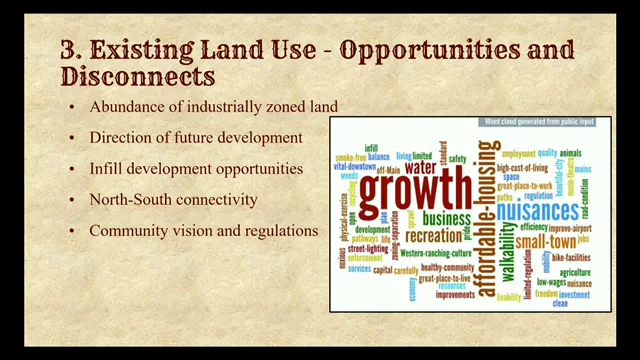
- Chapter 3: Existing land use often does not match zoning (e.g., Coffeen Avenue zoned industrial but used commercially).
- Chapter 5: Community values and guiding principles (connectivity, housing types, etc.).
- Chapter 7: Future land use map – a broad vision, not zoning.
- Chapter 8: Next steps – 24 recommendations to align city code with the plan; some already implemented (downtown overlay, M2 industrial zoning, historic design standards), others still pending (zoning code reorganization, infrastructure tie-ins, PUD components).
- Joint City-County Plan: Covers the one-mile buffer (joint planning area) around the city. Key features: urban service area (USA) where municipal services may be provided; areas outside the USA are designated for agricultural or low-density development.
- Utility Planning: Dan Roberts explained that the city’s utility master planning uses the USA as the service boundary. The wastewater system master plan includes 30 years of growth projections. The USA is the same as the sewer service area boundary established in a 40-year-old intergovernmental agreement.
- Councilor Panson’s questions:
- Urban service boundary updates: last updated in the 2017 land use plan; not a hard limit but a planning tool.
- Sewer capacity on Fifth Street: a bottleneck exists; the city is evaluating solutions, including upsizing the line between Skiles and Sheridan Avenue, and may fund a project in Fiscal Year 2028. The city has installed eight flow meters (smart covers) for real-time monitoring to calibrate models.
- Prior moratorium: only one instance – a small phase of Osprey (west side) due to capacity concerns, resolved after flow data collection.
- No formal action; the discussion aimed to inform council about the relationship between land use planning and infrastructure.
Resolution 3125 – Final Plat of Bucking Iron Business Park
- Presenter: Kelly Schroeder
- Proposal: A county subdivision of 20 acres into six lots (2.5–3.5 acres each) at 170 East Ridge Road, zoned I2 industrial in the county. Located in the joint planning area, about 1,200 feet south of city limits, within the urban service area. The site is across from the city landfill property (owned by city but not annexed).
- Staff comments/recommendations to the Board of County Commissioners:
- Water infrastructure is available and shall be extended to the subdivision in accordance with city design standards.
- Centralized sewer is not currently available; the subdivision may be served by a decentralized system.
- Bucking Iron Circle (the internal road) shall be paved and built to an appropriate rural section.
- Council questions: Councilor Panson asked why paving was required. Staff replied that the MOU requires paving if water is extended; otherwise, if no utilities, paving is not required. The water extension would likely use an easement through adjacent property or the existing right-of-way. The county is already planning to improve East Ridge Road (straightening the hairpin curve, paving) with federal grants.
- No public comments received; staff sent notices to four surrounding property owners, published a legal ad, and posted a sign. No formal vote; council will provide comments to the county at a future meeting.
General Discussion of Future Items
- Presenter: Stuart McCray, City Administrator
- Updates:
- Elevator at city hall: out of service; circuit board on back order, expected to ship next week, but installation may take several weeks. The city is working with the court to accommodate ADA needs on the first floor.
- MullinX truck traffic: seasonal slowdown expected from January through March; not a complete stop.
- FY25 budget reconciliation: completed by the treasurer; staff will bring it to council on December 22 if publishing requirements can be met, otherwise a special meeting before the January 12 study session.
- Thayer Schaefer (former employee/volunteer) is now at Legacy Living and Rehab Center in Gillette; council members were encouraged to contact him.
- Councilor Warren: Reminded everyone about the Race Across America program on December 13 at 10 a.m. at Sheridan Municipal Cemetery.
- Councilor (unidentified): Expressed desire to introduce an ordinance to protect city buildings and property from inappropriate flags, stating that only flags reflective of Western culture and values should be flown. This will be brought forward formally later.
Key Outcomes
- No formal votes were taken during the study session. All items were discussed for informational purposes and to guide future actions.
- The council will consider the employee handbook changes at a future meeting (likely for approval).
- Comments on the Bucking Iron Business Park plat will be formally submitted to the Board of County Commissioners; the council will finalize the resolution at an upcoming meeting.
- The city administrator will bring the budget reconciliation to council for approval, with a public hearing required.
- A potential ordinance regarding flags on city property will be drafted and presented later.
Meeting Transcript
Oh, okay. I heard that. Okay. Stand for Punch, please. Super States of America. And just for all. Good evening, everyone. Welcome to the December 8th, 2025 General Study Council meeting. We have pretty light agenda tonight. We have three items and then anything that we want to discuss at the end. For all those people in the audience, if I get up and label it alert, it's because I miss my holy day of obligation mass at noon, so I gotta go at six o'clock tonight. So it's not that I'm mad. Just gotta get the church. I gotta replay. Yeah. So on the item number one, discussion of the employee handbook updates, and with this is our resource director, Heather Doe. Welcome. Good evening, Mayor and Council. We do this at least once a year and sometimes twice. This is twice this year for me up in front of you. So we have a couple of changes that we're making to the employee handbook. Obviously, the first one is every time we change it, we change the dates throughout, so it'll have um the effective date of next Monday when it is is up for vote on the handbook. Uh the second one is probably the most um significant of the changes, I would say. So we are in the process of getting a new time and attendance system and a new payroll system. So with that, we have been looking forward to, and a lot of our employees have been looking forward to the ability that we will have to add compensatory time off to our time off offer offerings. For those of you who aren't quite sure what compensatory time is, public employee employers are able to offer this. So if an employee works overtime, they can choose either to be paid overtime, time and a half for that time, or they can change it to compensatory time. So for every hour of overtime they work, they can change that into one and a half hours of time off to use at a later time. So we have obviously put some parameters on this. Um we're able to put those parameters, so we are making sure that our employees during the fiscal year can only have up to 40 hours of compensatory time. And then at the end of the fiscal year, if they have any hours left of that, we will pay those out. Um reason being is usually every year people get a raise, and so you don't want to be earning it at one rate and paying it out at another rate. Um that would would there would be some budget cost to that, but the way we're doing it, there won't be any any difference between paying out time off or doing compensatory time. In fact, if people use it as compensatory time, it will actually be less of a burden on the budget because they will use that time instead of being paid a time and a half. So uh again, like I said, we have um quite a few employees that are looking forward to this. Uh December 21st is when we go live with the system. So um we have been training our employees and it's gonna be a lot of fun. It's the week of Christmas, but that's just how it happened happens to be. So anyway, uh that is on page 17, so I've added in that compensatory time off policy. And then the other one that we're changing is on page 20. Um, our current handbook says that if somebody doesn't come to work, no call no show for two days, that we terminate them. Really, if they don't come to their job, they've they've kind of chosen not to have a job. So we're just kind of changing the wording on that. We're actually changing it to three days instead of two. Um that if uh we have an employee that doesn't call in for three consecutive days that we'll consider that they have resigned from their job. And we don't just sit around and wait for them to call us either. We obviously try to get a hold of them. Um even I mean, I worry about our people. So if they don't show up for work for two days, I'm calling Travis's department and I'm sending them to your house to make sure you're okay because I'm not okay with not knowing if people are okay or not. So I've had a couple people really mad at me about that, and I'm okay with that, because I uh anyway, so we're changing that one in the handbook as well.
openpublica.com