FY27 Budget Presentation to Sheridan City Council – May 5, 2026
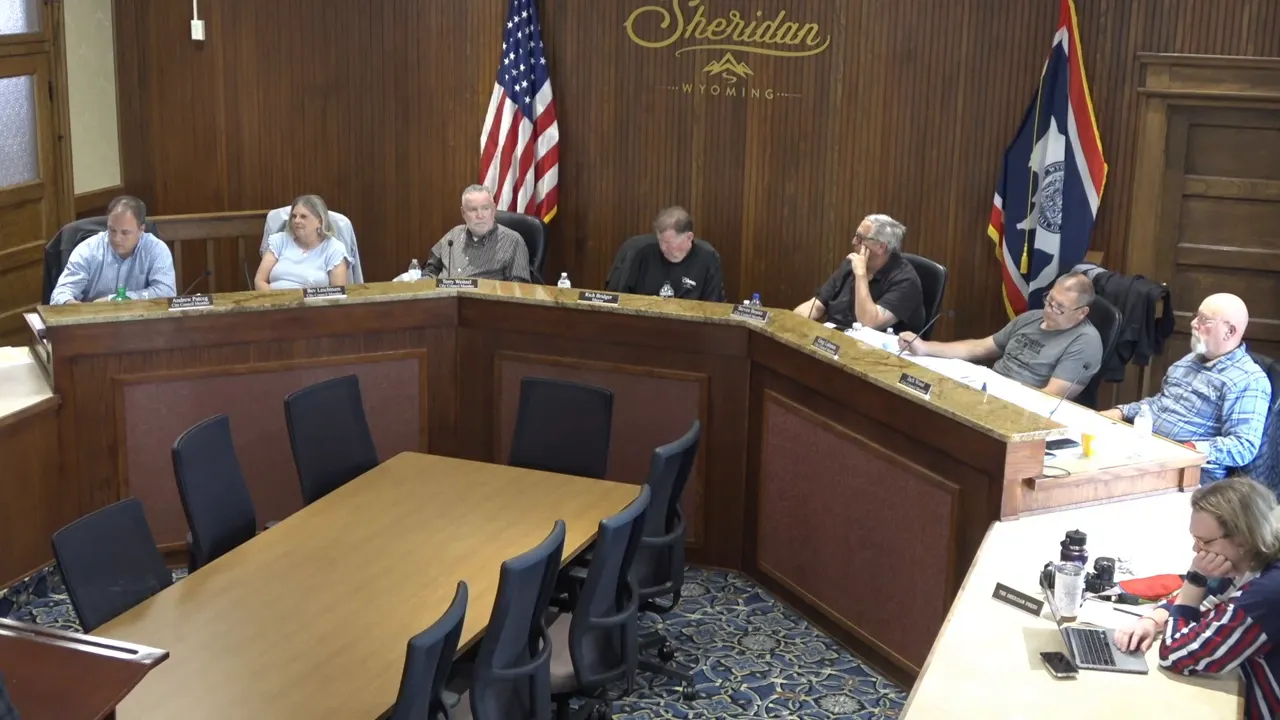
STREAMING COPY IN PREPARATION — RECORDING AVAILABLE FROM THE ORIGINAL SOURCE
FY27 Budget Presentation to Sheridan City Council – May 5, 2026
The Sheridan City Council met on May 5, 2026, to receive the proposed fiscal year 2027 (FY27) budget from City Administrator Stu, Treasurer Darla, Public Works Director Hans Mercer, and Utilities Director Dan Roberts. The presentation covered revenue projections, operating funds, the capital project list, enterprise funds, and the adoption timeline. No formal votes were taken; the budget remains under council review.
Discussion Items
-
Budget Revenue & Operating Funds: Total projected FY27 revenue is $52 million across all funds. Excluding project-specific grants, the three primary operating funds (general fund, GPET, and 8% distribution fund) are projected at approximately $26 million, up $752,000 from FY26. The general fund alone is projected at $18.4 million, compared to $17.8 million budgeted last year. Sales and use tax growth is expected to end this fiscal year about 7.5% above FY25, with a cautious 3% growth assumption built into FY27. The city faces a 7% increase in health insurance and 25–80% increases in property/auto insurance (utilities up to 80%). After subtracting salaries and benefits ($14–15 million), staff identified roughly $11.2 million in operating capability; after must-pay items, only about $1.046 million remains for new investments and reinvestments, down from $1.9 million last year.
-
One-to-N Priority List and Funding: The staff one-to-N list totals $4.7 million in needs. Items above the original funding line include a 3% employee pay increase ($269,000), parks projects ($54,000), ten public works items ($973,000), fire rescue items ($376,000), and new positions. To fund the list partially, staff proposed using $170,000 from excess cash reserves and $917,000 from unreserved fund balance, plus a $50,000 contingency, bringing funded items to about $2.1 million and leaving $2.6 million unfunded. Staff acknowledged this is not sustainable long-term and will bring service-level options to the governing body next year.
-
Personnel: The city is authorized for 147 general fund and 68 enterprise fund positions. Last year, there were 32 hires and 32 separations with no discernible trend; current vacancies are about 11. Proposed new positions include two utility meter technicians (enterprise funds), one senior accountant (general fund), and one IT support position. Staff emphasized that positions will be permanent and that cuts would be handled through attrition if needed.
-
Capital Projects (Hans Mercer): Key projects include the South Downtown project (large contract awarded), Fifth Street bridge repairs (est. $4.5 million, contingent on grant funding), Val Vista Street bridge complete deck replacement (preserving the humped profile), downtown restrooms in the 103 North Gould area (cap tax funded), and a $650,000 match for the Bighorn-Brundage intersection. The 5th Street sewer design is funded with $150,000 in enterprise funds. Contingency items include cell 9 closure costs (SRF loan), Thorn Rider restrooms (grant recommended but not yet awarded), and the Hub parking lot (WCDA block grant of $1.277 million).
-
Enterprise Funds (Dan Roberts):
- Water fund: Revenue projected up 3.6% with no rate increase (fifth year of zero). Expenses projected down 9.5%. Fund balance increases by $35,000 to $9.4 million. The fund will make its first debt service payment on the Northeast Transmission Project ($110,000). SCADA system upgrade (Ignition) budgeted at $25,000 this year, $10,000 next, with ~$25,000 annual savings after 2.5 years.
- Sewer fund: Revenue up 6%, expenses down 3.1%, fund balance up $106,000 to ~$3.5 million. A 2.95% rate increase is recommended (fifth year of a plan). The fund will purchase eight additional smart covers ($46,000), spend $80,000 on oxidation ditch gear replacements, and replace a 2004 tractor.
- Solid waste fund: Revenue up 9.6% (landfill revenues from roof replacements), expenses up 4.5%, capital equipment of $758,000 (D6 bulldozer, 60-hp tractor, pickup, pressure washer), and $350,000 cash-funded landfill remediation. Fund balance drops by $827,000 to $5.2 million, still above the $3 million minimum. A 1.5% rate increase is recommended. Future rate projections are about 2.25–3.25% for water and sewer, and ~2.25% for solid waste.
-
Budget Book Revisions (Treasurer Darla): The city adopted ClearGov software to produce the budget book. New features include clickable table of contents, combined capital project overview, glossary, organizational photos, and department pages that group expenses by fund, division, and object code. Object numbers were removed from many schedules; council members requested consideration of restoring org numbers.
-
Council Q&A: Councilors asked about redundancy analysis, high-cost/low-impact services, the senior accountant position, separation trends, the fire fund A obligation, the Val Vista bridge scope, and stormwater fee structures. The administrator noted that redundancy is limited and will be tied to workload; the stormwater enterprise discussion is ongoing, with testimony before the Select Water Commission on May 7.
Key Outcomes
- The FY27 budget was formally presented; no council action was taken.
- Council members were encouraged to submit questions via email; one councilor planned to send 14 questions.
- A budget study session is scheduled for Monday, May 11, 2026.
- The finalized budget will be submitted to the Sheridan Press for publication on June 3, 2026, with a public hearing and adoption scheduled for June 15, 2026 (statutory deadline June 16, 2026).
Meeting Transcript
Good afternoon, everyone. This is on the session for tonight. It's fire third. So we'll go ahead and get started. And I will hand the mic off. I don't know if you're gonna break with tradition. I just threw my game off. I was waiting to stand up with it. There are people who would do it. Good evening, mayor and council and staff and public and this year, like last year, we changed the uh manner in which we do the budget in the several past years. We would go through pretty much ad nauseum every item, uh including most items that have to be paid anyway. And uh I still kind of weigh the pros and cons of doing that. Uh there are some pros to doing that, but uh, but we found last year that council seemed to appreciate uh honing in on really the focused issue of the decisions that you uh will be making on priorities for us, and so um we're gonna do that. Um we um this this year was a especially challenging year as we went forward. There's a lot of factors that uh were unknowns, and some of them to the last minute uh of what we were gonna have for some revenues and and so forth. Um but uh but we have a budget uh that we're presenting to you tonight, and uh and uh this is what uh this is what we're gonna go over tonight. Um we're gonna talk about our budget revenue and our execution process. Uh then I'm gonna turn it over briefly to uh the treasurer to talk about the the new format of the new book and and what that entails with its uh both online and physical components, and then we're going to talk about how we went through our budgeting process, uh narrowing down to uh what we have available to us in our one-to-end and how we intend to do that or how we're proposing to do that. Uh then um I'll turn it back over to Hans who will talk about our capital projects for this year. He will turn it over to Dan who will talk about utilities, and then we'll and then we'll finish off uh uh talking about some last uh minute stuff. Um I've got uh on every slide I've got a number down in the bottom right-hand corner, and I think to ease the process uh rather than because we might cover some information that you might have questions on. If you have a question on a slide, I would propose we we gave everybody notebooks if you if you write the slide number so we can easily go back to that one and then write your question down when we get to the end of all three of us. I did not break and have questions at each section. Um so if you if you write your questions down, we'll cover them all, and that's why I have all the department heads here because uh there's gonna be four of us uh speaking tonight uh on the different components, but we have everybody to talk about uh the information that we have. So with that, I'll jump right into it, and we're gonna talk about our budget process and and our uh revenue projections for this year. Um as always the uh charter ordinance governs how we go about this process. The charter ordinance uh directs that in the roles of my duty I'm responsible for preparing a budget annually. Uh when we get done with tonight's uh process, it the budget will then belong to council and the governing body. Um, and it's yours to discuss and to uh uh ask further questions and so forth. Uh but it'll be your budget. Um just as a review, we have uh three different types of revenues, but they fall into two different categories. Um most of our revenues are fixed revenues, just like anybody who lives on a fixed income. We do too in most of our operations. We get what we what we get, we uh we anticipate what we think we're going to get, um, and that's the extent of any growth that we have based on projections. The only one that really has uh some flexibility uh in changing revenues if needed is our enterprise funds. The mill uh driven weed and pest has a little bit of flexibility, but not a whole lot. Um most of us are are locked into what we get, and so we have enterprise funds, we have specific use ones, and we have general operational funds, and I'll talk about those in a minute here. This is what our uh FY27 uh complete revenue projections look like. Um total revenue shows $52 million of revenue, but it really falls into four different categories. Three if you're technical. Um project funds uh are part of special revenue. That little sliver of special revenue is actually uh not only a component of, but it's also part of special revenue. Uh but project funds, we separate those two out. That's uh cap tax and public benefit, and uh you put that together, and uh we have in the vicinity of uh 6.9, we're estimated about 6.9 worth of uh of revenue that we're expecting. That's the area that Hans is going to talk about later today. Um and then enterprise funds, uh, the stuff in green there is uh comprises of our water sewers, solid waste, uh, weed and pest and uh golf, and uh that in total covers about 19 million of that 52 million. And uh what I am going to focus on today is the stuff in blue here, which are our top three funds are 10, 11, and 12. You've heard that many times, uh 10 being our general fund, uh 11 being our GPET, and 12 being what I'm now referring to as our 8% distribution fund. Used to be our direct distribution, it's not technically direct distribution now. That came out of mineral grants and stuff.
openpublica.com