Tacoma City Council Study Session 2024-06-11: Budget Forecast, Fire Levy, and Charter Review
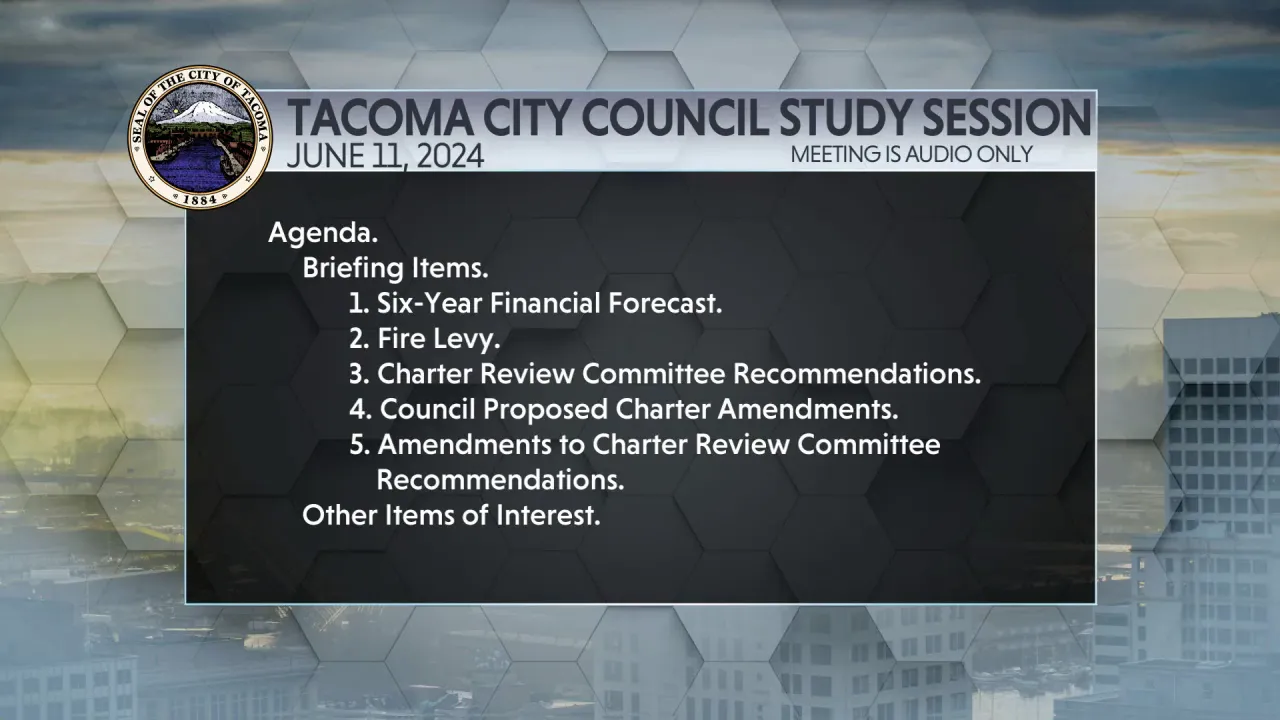
STREAMING COPY IN PREPARATION — RECORDING AVAILABLE FROM THE ORIGINAL SOURCE
Tacoma City Council Study Session 2024-06-11: Budget Forecast, Fire Levy, and Charter Review
The Tacoma City Council held a study session on June 11, 2024, to review the city's six-year financial forecast, discuss a proposed fire levy lid lift for the November ballot, and deliberate on recommendations from the Charter Review Committee (CRC).
Discussion Items
1. Six-Year Financial Forecast
- City Manager Elizabeth Pauli, Finance Director Andy Cherullo, and Budget Officer Katie Johnston presented the city's long-range financial outlook. The budget theme is "building public trust."
- Economic Context: Andy Cherullo explained that consumer spending is 60–70% of economic activity, directly impacting general fund revenues (sales tax and business taxes). Savings are depleted, credit card balances and delinquencies are rising, and Tacoma's median income has dropped to 70% of Seattle's (down from 78% in 2011). Inflation remains sticky, driven by services (wages and housing).
- Revenue vs. Expense Gap: General fund revenues are projected to grow at roughly 2.6% annually, while expenses are expected to grow at 5%, driven largely by labor costs. This creates a structural deficit of $10 million in the 2025–26 biennium, growing to $15.8 million in the 2027–28 biennium. An additional $9 million in one-time costs is needed to continue temporary sheltering services, partially offset by a $3 million legislative award.
- Other Funds: The EMS fund is sustainable through 2030. The Real Estate Excise Tax (REET) saw a 42% decline in 2023, impacting capital facilities. The Mental Health and Substance Use Disorder fund faces a projected $6 million gap.
- Next Steps: Departments face reduction targets (2.5% for public safety, 6% for others). A comprehensive revenue strategy and the proposed fire levy are key components of closing the gap. The city manager's proposed balanced budget is due in October 2024.
- Council Questions: Council members asked for detailed breakdowns of one-time expenses, questioned the impact of rising interest rates on the real estate market, and expressed concern about funding for homeless services.
2. Fire Levy Lid Lift
- Fire Chief Tory Green presented the ballot language for a property tax levy lid lift. The measure would add $0.65 per $1,000 of assessed value (total rate $2.39), generating an estimated $30 million annually.
- Justification: The department faces critical infrastructure needs: 85% of fire stations are in poor or critical condition, call volume has grown 32% over the last decade, and much of the fleet and equipment is beyond its useful life.
- Use of Funds: Of the $30 million annual revenue, $10 million would support existing general fund expenses. The remaining $20 million would fund facilities (Station 7 in South Tacoma is the top priority), apparatus and equipment replacement (replacing all frontline apparatus within 8 years), new responders, and a reserve fund.
- Next Steps: A resolution approving the ballot language is expected at the next council meeting. The measure will appear on the November 5, 2024 ballot. A public education campaign is planned.
- Council Feedback: Council members broadly supported the levy. Questions focused on serving Northeast Tacoma, fleet replacement timelines due to supply chain delays (two-year lead time for new engines), and the strategic use of infill stations. Some members requested adding facilities maps to the public website.
3. Charter Review Committee (CRC) Recommendations The council discussed several proposed charter amendments to gauge support for future formal action.
- Salary Commission: Council favored a cleanup amendment aligning the charter with state law by removing the requirement for council adoption of salary recommendations.
- Humane Society: The proposal to remove the Tacoma Humane Society from the charter (treating it like other private nonprofits) faced debate. The Humane Society withdrew an initial letter of support, citing concerns about timing with an upcoming capital campaign. Council members expressed a desire to further discuss timing before moving forward.
- Landmarks Preservation Commission: Council preferred to address membership changes (adding district representation and specific expertise) via ordinance rather than a charter amendment to maintain future flexibility.
- Eligibility for Employment – Citizenship: There was strong consensus to remove the charter's citizenship requirement, as it is unenforceable under law. The separate residency requirement generated discussion; council members considered keeping a strict requirement with waivers, shifting to a preference model, or leaving it unchanged. No amendment to the residency language was formally proposed in this session.
- Employment Anti-Discrimination: An update replacing "handicap" with "disability" and adding a requirement for periodic council review was widely supported.
- Official Newspaper: A proposal requiring parallel posting of legal notices on the city's website alongside the newspaper was met with concern from staff and legal counsel about creating procedural legal exposure. Council indicated this policy is better suited for ordinance.
4. Council Proposed Charter Amendments & CRC Amendments
- Councilmember Walker is drafting an amendment to broadly replace the term "citizen" throughout the charter; rationale is still being finalized.
- City Manager Pauli noted that a more substantial "form of government" amendment is still under development.
Key Outcomes
- The council acknowledged a significant structural deficit in the General Fund, requiring difficult budget decisions in the upcoming biennium.
- The Fire Levy lid lift ballot language is scheduled for a formal vote at the next city council meeting.
- Several CRC recommendations (Salary Commission, Citizenship requirement, Anti-Discrimination language) are expected to advance toward the ballot. Others (Humane Society, Landmarks Commission, Official Newspaper) require further refinement or will be handled via ordinance.
- The session concluded with a recess before the council entered an executive session on potential litigation.
Public Comments & Testimony
- No public testimony was taken during the study session.
Meeting Transcript
The role Dere. Councilmember DN is here. Deputy Mayor and I'm here. Here, Councilmember Spott. Here. Council Member Walker. Here, Mayor Words. Absolutely. Deputy Mayor and Council members of study session attorney. All right. And with that, our first agenda item is the six-year financial forecasts. And I'd like to call on City Manager Elizabeth Pauly to begin the presentation. Thank you, Deputy Mayor. Deputy Mayor and Council. Today we are going to be focusing on the long range forecast, but our agenda includes, as you see here, a little bit of a budget process overview. And then our budget director, budget officer Katie Johnston will talk about some of our financial projections, and then we'll end up by talking a little bit about what's next. So before we jump into the to the budget process, really wanted to share with you that our um theme in building this budget is building public trust. And we're really linking that in three different ways. And last but not least, we're looking at our um internal capacity to do the things that we're budgeting so that we can show responsiveness through reliable and efficient operations. And so we're really looking at each of those three things seriously as we build our um budget with the hopes that we can um at the same time build some public trust. So our budgeting approach starts with, and you've heard this before, but just a little bit of a review. Starts with looking at our base, what we call our baseline budget or the baseline. And what that really means is we take the current um budgets for all of the departments and all the funds, and we say what are what are we doing right now? What are we paying for right now? How what is it going to cost us to continue to do those things? And then we also take the opportunity to look at are the things that we're doing having the impacts that we hope for. And last but not least, we also look at what our financial position is and and what we what we can afford. Um we take that assessment of the budget of the baseline and we pause while we have some IT magic. Thank you. Not everybody's screens restored there, but we have it up on the big screen as well. Um see if we can find out what's going on with that. So once we make once we look at and adjust those um or look at those baseline considerations, we then look at financial issues of financial sustainability. We look at the council's um strategic priorities. So we look for both alignment and we look for how to make progress in those areas, the strategic areas, and then again, also we look at operational capacity so that we are um being clear with the council and clear with the public that we can actually perform at a level that's expected of us on the things that we're budgeting for. So out of those assessments, um, we then put together um budget proposals. So those are things to maybe close the gap between revenues and expenses. So we might be looking at reductions. We also might be needing to evaluate um new or expanded programs to meet uh a need that's been identified. And so we we um go through the budget proposal process, and we're we're we're working on that right now. Out of the kind of those three pieces, um, I put together then a proposed biannual budget. It is a balanced budget that is required by state law that I do that. The city manager um um's position is responsible for that, and that it's that proposed budget that goes to the city council for review for amendment and ultimately adoption. And later in this presentation, Katie's gonna be sure to um go walk through the timeline for the budget for you. But that's that's um hold on that because that's gonna come towards the end just as a grounding for you. Just a couple of another a couple of other reminders of what we um consider when we're creating a good budget. So uh on the left side of this screen here, you're seeing gonna see the bullets that um really are the philosophical level things that we look at as we're developing the budget. We we have our promise to um the council and the community of leading with anti-racism and equity in our budget development process. Um we have our um fiscal sustainability responsibility of considering a long-term perspective. We also um need to make sure that organizational goal goals are are aligned, looking at outcomes and um also um involving our our um stakeholders throughout the process. So those are all important pieces.
openpublica.com