Tacoma City Council Study Session - 2025-2026 Budget Presentations and Executive Session - October 15, 2024
STREAMING COPY IN PREPARATION — RECORDING AVAILABLE FROM THE ORIGINAL SOURCE
Tacoma City Council Study Session - October 15, 2024
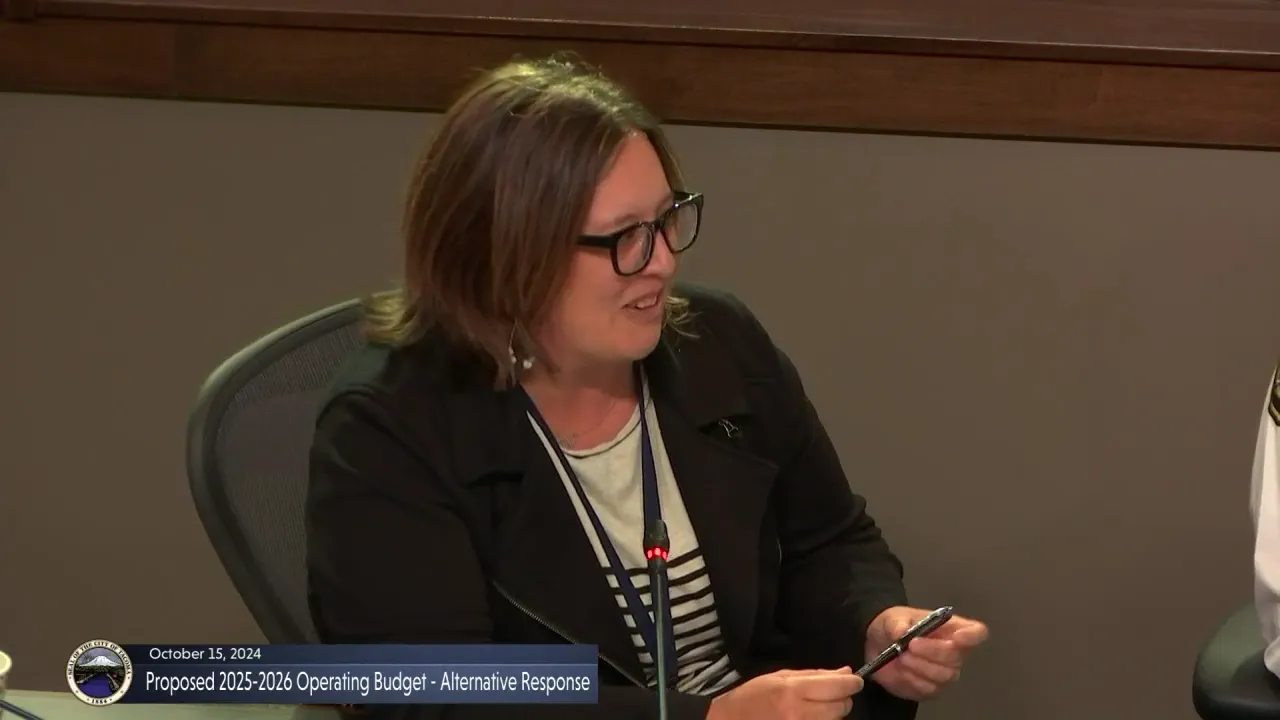
The Tacoma City Council held a study session on October 15, 2024, to review the proposed 2025-2026 Biennial Operating Budget with presentations from the Tacoma Fire Department (TFD), Tacoma Police Department (TPD), and an interdepartmental update on alternative response programs. Councilmembers received detailed budget briefings and discussed staffing, service levels, and the upcoming November 5 ballot measure. The meeting concluded with a motion to enter executive session for pending/potential litigation.
Roll Call
- Present: Councilmembers Bushnell, Diaz, Deputy Mayor Hines, Councilmembers Rumba, Sidalgay, Scott, Walker, Mayor Woodards.
- Absent: Councilmember Daniels (per roll call; however, Councilmember Daniels later participated in discussion, and no official minutes were available to reconcile this discrepancy).
Briefing Items
Proposed 2025-2026 Biennial Operating Budget - Overview
- Budget Officer Katie Johnson (Office of Management and Budget) introduced the budget framework, explaining that department presentations focus on services provided, how budgets have changed over time, funding sources, and how funds are spent.
- She noted that most 2025-2026 service delivery continues base operations rather than new proposals, due to the general fund's financial position.
Tacoma Fire Department (TFD)
- Interim Fire Chief Sienna Stallings-Alailima presented. Key accomplishments: hired 100 new employees (though not net growth, as retirements/separations occur); added two full-time aid units and three peak-time aid units; raised the EMS levy for the first time since 2006; launched the HELP team; and embedded a PLU intern for weather impact assessment.
- Budget: TFD's baseline has grown approximately $70 million since 2021. EMS fund costs grow about 14% annually; general fund costs about 3.6% annually. Funding sources: 55% general fund, 22% transport billing, 16% EMS levy. Expenditures: 80% wages/benefits, 13% fixed costs, 7% operations/capital.
- Service demand: Requests for service increased 32% from 2010 to 2023, while the number of first-response units remained at 20. The five busiest engines run 51% of calls; engines running more than 3,500 calls annually in red areas exceed the 2,500-call target.
- Unplanned leave increased 61% from pre-pandemic to 2021-2023; expected productive time dropped from 83% to about 70%.
- For 2025-2026, TFD will eliminate 16 firefighter rover positions (no layoffs expected; employees shift to BLS transport roles). The chief stated the department needs roughly double that number to reduce overtime reliance, and may need to flex down engines (temporary brownouts).
- Staffing timeline: 55 commissioned vacancies currently; 34 recruits in the largest-ever class; projected fully staffed for BLS transport around end of 2027 based on 0.83 FTE per employee.
- The chief highlighted deferred facilities and apparatus needs, a transition in fire chief leadership, and plans for station open houses on October 19.
- Proposition 1 (fire levy) is on the November 5 ballot; a special council meeting is scheduled for November 8 to address outcomes.
Council discussion:
- Councilmember Walker asked about brownouts and clarified that current budget numbers assume the ballot measure does not pass.
- Councilmember Daniels questioned the rover cuts, given high call volumes; Chief Stallings-Alailima explained the general fund versus EMS fund distinction.
- Councilmember Rumba expressed support for the department and noted the importance of stations in Northeast Tacoma (E3) and the port (E5). She supported the levy.
- Deputy Mayor Hines clarified that 100 hires were not net new officers; he expressed discomfort waiting until November 5 and indicated interest in exploring budget adjustments beforehand.
- Councilmember Bushnell voiced concern about potential brownouts and emphasized public safety; she supported the levy.
Tacoma Police Department (TPD)
- Police Chief Avery Moore presented. Key accomplishments: violent crime down 8.8% in Tacoma (statewide 5.5%); murders down 21.4% (state 5.8%); property crime down 14.4% (state 11.9%). He attributed reductions to the department's intentional crime plan.
- Created a community engagement senior manager position, recreated the bicycle response team, and ran recruiting campaigns (Reflect and Protect: 2 million views, 50,000 clicks, 7,000 leads).
- Secured grants totaling $2.6 million, including smart policing initiatives, sound thinking, recovery lift, laser scanner, vehicle pursuit (Star Chase), and EOD equipment.
- Budget: 97% funded by the general fund; increase of $42 million from personnel costs (67% salary/wages, including 12 new CSO FTEs) and indirect costs (e.g., public liability insurance at $7.6 million, vehicle maintenance/fuel).
- Staffing: currently short 24 officers; lost 65 officers in 2020-2021 while hiring only 27. Calls for service average about 10,000 per month.
- Overtime example: for the week of September 30-October 6, the department hired 79 officers back at time-and-a-half (equivalent to 118.5 officers; 158 if double time). Minimum staffing is 15 officers on day shift and 22 on night shift.
- Projection: fully staffed for primary call responders between 2029 and 2030, based on average separations of 24 per year and current hiring pace.
- Application timeline reduced from 200 days to 150 days; goal is 120 days.
- Unplanned leave averages 214 hours per officer. Of 151 primary call responders, 129 are working; after vacation/holidays, 110 are available, necessitating overtime.
- Overtime reduced by 12% from 2023 to 2024. Overtime drivers include crime plan, high-visibility patrols, property crime initiative (working with REI and Home Depot), and racing/speeding enforcement.
- CSO program: 5 active CSOs; proposed to phase in the remaining 5 positions to assess program efficacy, saving about $1 million.
Council discussion:
- Councilmember Rumba asked about community trust and organizational health; Chief Moore emphasized work-life balance and the unplanned leave components (maternity, administrative time, injuries). Mayor Woodards referenced the broader community safety strategy.
- Councilmembers Sidalgay, Bushnell, and Walker expressed support for CSOs and urged continued staffing; Moore noted the assessment would happen regardless.
- Councilmember Bushnell asked about police academy capacity; Moore said the regional academy limits classes to 3 officers per agency, though he had arranged up to 5. He noted there is no local police academy.
- Deputy Mayor Hines requested data on officer-initiated vs. dispatched calls and asked about future proactive policing; Moore discussed plans for a dedicated drug unit once staffing improves.
- Councilmember Daniels raised questions about academy slots, advocacy, and budgeting CSO vacancies.
- Councilmember Diaz asked about minimum staffing standards, grant matching (none required), and ShotSpotter community sessions (completed; implementation early next year).
- Councilmember Scott asked about other funding sources; OMB noted police funding is primarily general fund, with grants and potential levy lid lifts as options.
Alternative Response Programs
- Neighborhood and Community Services Director Alison Griffith presented an interdepartmental update.
- Homeless Engagement and Alternatives Liaison (HEAL) team: fully funded at 8 FTE in the 2025-2026 baseline ($3 million), including supplies; $500,000 allocated for additional outreach via competitive process.
- Hope Team (TFD): celebrated first anniversary; budget of $3.8 million, currently 7 FTE with two vacancies (ARNP and peer counselor). Plans to stabilize operations and build foundation before expanding to 24/7 response.
- TPD Community Services Officers (CSOs): $3.3 million dedicated, including a $963,000 grant from Congresswoman Strickland; proposed phasing in five additional positions saves $1 million.
- Tacoma Public Library: social worker/security coordinator funded at $560,000 in baseline; started January 2; responded to 140 patron requests; top needs included housing/shelter, behavioral health, and employment; staff CPI training underway.
Council discussion:
- Councilmember Walker asked about coordination among alternative response programs and library security; Griffith confirmed ongoing liaison meetings and noted that the library does not have security guards but has a security coordinator for de-escalation and training.
- Councilmember Rumba requested a future presentation on how the programs work together and asked whether services could be referred outside the county; Griffith said referrals may be possible but specifics would be needed.
- Councilmember Sidalgay praised the designated co-responder program and its value in his district.
City Manager's Weekly Report
- City Manager Elizabeth Pauli provided the weekly report. No agenda modifications; a ceremonial item proclaims Thursday, October 17, 2024, as Community Conflict Resolution Day.
- She noted two public comment opportunities at the evening meetings: the regular city council meeting and the Transportation Benefit District (TBD) meeting. The TBD, created in 2012, is an independent taxing district with councilmembers acting as its board; a 2015 voter-approved sales tax of 0.1% supports street maintenance and is set to sunset December 31, 2025. Tonight's TBD meeting will set a public hearing.
Executive Session
- The council voted unanimously to convene an executive session under RCW 42.30.110(1)(i) to discuss pending and potential litigation, not to exceed 30 minutes. The session began at approximately 2:25 p.m.; after its conclusion, the meeting was adjourned with no further business.
Key Outcomes
- No formal council action was taken on the proposed budget during the study session; presentations were received and discussed.
- The council unanimously approved entering executive session for pending/potential litigation.
- Councilmember Hines expressed intent to work with staff on budget adjustments before the November 5 election, reflecting concerns about proposed TFD rover cuts and potential brownouts.
- The city manager announced two public comment periods for the evening meetings, including the TBD meeting to schedule a public hearing on the proposed transportation program.
- A special council meeting is scheduled for November 8, 2024, to discuss next steps based on the outcome of the fire levy (Proposition 1) on the November 5 ballot.
Meeting Transcript
I'd like to call to order the city council study session of October 15th, 2024. Clerk, will you please call the role? Councilmember Bushnell? Present. Councilmember Daniels. Absent councilmember Diaz. Here. Deputy Mayor Hines. Here. Councilmember Rumba. Here. Councilmember Sidalgay? Here. Councilmember Scott. Here. Councilmember Walker. Here. Mayor Woodards. Here. Mayor and Council, your materials were sent to you at 11 a.m. All right. Our first agenda item today is the proposed 2025-2026 biannual operating budget. And today we're going to have two presentations, one from the Tacoma Fire Department and one from the Tacoma Police Department. At this time, I like to call on Office of Management and Budget Budget Officer Katie Johnson to begin the presentations. And she will be followed by interim fire chief Selena Ala Alima. Did I get it right? Sienna. Oh, yes, so I get your last name right. And I say, you know what? From the for the Tacoma Fire Department depart department portion of the presentation, followed by police chief Avery Moore for the police department. With that, I'll start with Katie and then we will start those presentations. Thank you, Mayor and Council. So you know, we were able to do a quick walkthrough of your materials on the first day that we proposed the budget. But what we wanted to do today was to come back and just talk a little bit about how we designed the budget book information that you have as well as the presentation to answer some key questions that you have as policymakers. And so I just wanted to go through how we framed that up. So what you'll see is a slide with a couple of key budget questions. And really just as we get started, the budget document and all of the presentations that you'll have from departments, what they're intended to do is start with the basics because we know that members of the public listen to these meetings, they go to the budget document to learn about departments. So you'll always see us start with a focus on what a department does and the key services that they provide. From a financial focus, though, the the questions that we really focus on answering and the various materials that you receive are how a budget changed over time. So in general, what we're trying to do is explain if a service area's costs are growing or declining and what the major reason for that change is. So changes you might see or hear about our grant funding or one-time ARPA funds or cost growth that's changing over bienniums. And so ways that you'll see that information presented to you is on the department pages. You have a line graph that you'll see, as well as in all of the department presentations. We have a simple line graph that is really just at a high level to talk about how that service area has changed over time. If you go to our financial detail dashboard or departmental dashboard, you'll also be able to see that information on a more detailed level. So you can look at that for program areas, divisions, or specific funds like the city's general fund and see changes. One thing I do just want to orient you to is that in each department's um budget book pages, there is a narrative called the financial summary that's intended to be just a quick walkthrough of what's changed over time. They can be kind of long, and the reason for that is because some departments have things that happened, you know, perhaps last biennium, they had lots of one-time expenses that didn't continue into this biennium, but they may also have things like cost growth that occurs in other areas, or perhaps in some of the presentations that you'll hear today, you'll hear about new services that were added during modification, for example, that then added costs as we went into the 25-26 um budget on an ongoing basis. So those some places where you'll see that information and you can kind of crosswalk between the presentations that will be at a high level and then what's in your budget document. Um the other note that I'll made it make is that if you want to see specific changes that were approved to the baseline in all of your budget sheets.
openpublica.com