Tacoma City Council Study Session - October 22, 2024: Budget Presentations and Home in Tacoma Amendments
STREAMING COPY IN PREPARATION — RECORDING AVAILABLE FROM THE ORIGINAL SOURCE
Tacoma City Council Study Session – October 22, 2024
The Tacoma City Council held a study session on October 22, 2024, to review the proposed 2025-2026 biennial operating budget from three departments and to discuss 15 potential amendments to the Home in Tacoma zoning and standards package. No formal votes were taken; the amendments are expected to be introduced at the first reading on October 29, 2024.
Proposed 2025-2026 Biennial Operating Budget
Neighborhood and Community Services (NCS)
- Director Allyson Griffith presented a budget focused on core services and partnerships. Key proposals include:
- Realigning code compliance to Planning and Development Services (PDS) to streamline enforcement.
- Realigning senior services to Metro Parks Tacoma, expanding from two to four locations, with transportation provided. Transition discussions began October 9, 2024.
- Realigning graffiti removal and Adopt-a-Spot to the Tidy Up Tacoma program under Environmental Services.
- Shelter funding gap: The city currently supports 307 temporary/emergency shelter units at a cost of $12 million per biennium. State funding of $3 million runs through June 2025. The city will request $9 million from the state to maintain operations through 2027. The HEAL team made 2,000 contacts in 2024, with 1,037 acceptances, 191 placed in shelter, and 13 into detox.
- Competitive funding: $7.7 million awarded from 106 applications, with 57% success rate for capacity-building participants. Non-compete funding totaled $17.3 million.
Community and Economic Development (CED)
- Interim Director Pat Beard highlighted accomplishments: $230 million in private investment for 1,200 housing units through MFTE, 380 affordable housing units with $13 million, and 40 new downtown retailers. The proposed biennial budget is $62 million, a $3.3 million decrease.
- Key initiatives: new small loan fund ($300,000) for business safety, $4 million state grant for job creation, expanded race-conscious homeownership program, and continued Tacoma Creates funding ($10 million).
Planning and Development Services (PDS)
- Director Peter Huffman noted the department’s budget is 7% general fund, rest from permit fees. The department added 11 FTEs in mid-biennium and holds seven vacancies for flexibility. Key initiatives:
- Consolidating code enforcement from NCS into a Regulatory Enforcement Group, saving $760,000.
- Creating a communication team (two staff) to improve community engagement on construction projects.
- Implementing salvage assessments for deconstruction/demolition to advance climate goals.
- Performance: Permit values and volumes are steady but expected to fluctuate with interest rates and Home in Tacoma implementation. Pre-application services will be strengthened.
Home in Tacoma Zoning and Standards Package – Potential Amendments
Planning Division Manager Brian Boudet presented 15 proposed amendments for council consideration. Council members spoke to their respective amendments. Key discussion points:
- Zoning map amendments (Deputy Mayor Hines, Councilmember Sidalgi): Adjust zoning for properties at 49th & Waterview (UR1 to UR3) and at 49th & Wilkison and 54th & Alaska (UR1 to UR2) for consistency near mixed-use centers.
- Side yard setback (Councilmember Bushnell): Clarify that the 8-foot setback for walkways applies only when units front on that side yard.
- Unit lot subdivisions (Councilmember Sidalgi): Broaden allowed legal entities for shared utilities beyond HOAs.
- Reduced parking area (Councilmember Rumbaugh): Remove the reduced parking area (zero parking requirement) along 6th Avenue and 19th Street, except within ½ mile of major transit stops (T Line, TCC Transit Center, Narrows Park & Ride). Councilmembers divided; further discussion expected.
- Homeownership incentives (Councilmember Sidalgi): Provide flexibility in alleys, trees, setbacks for owner-occupied projects (ADUs, townhouses, condos). Some councilmembers requested affordability requirements.
- Tree and landscaping amendments (Deputy Mayor Hines, Councilmember Sidalgi, Councilmember Rumbaugh): Several related amendments:
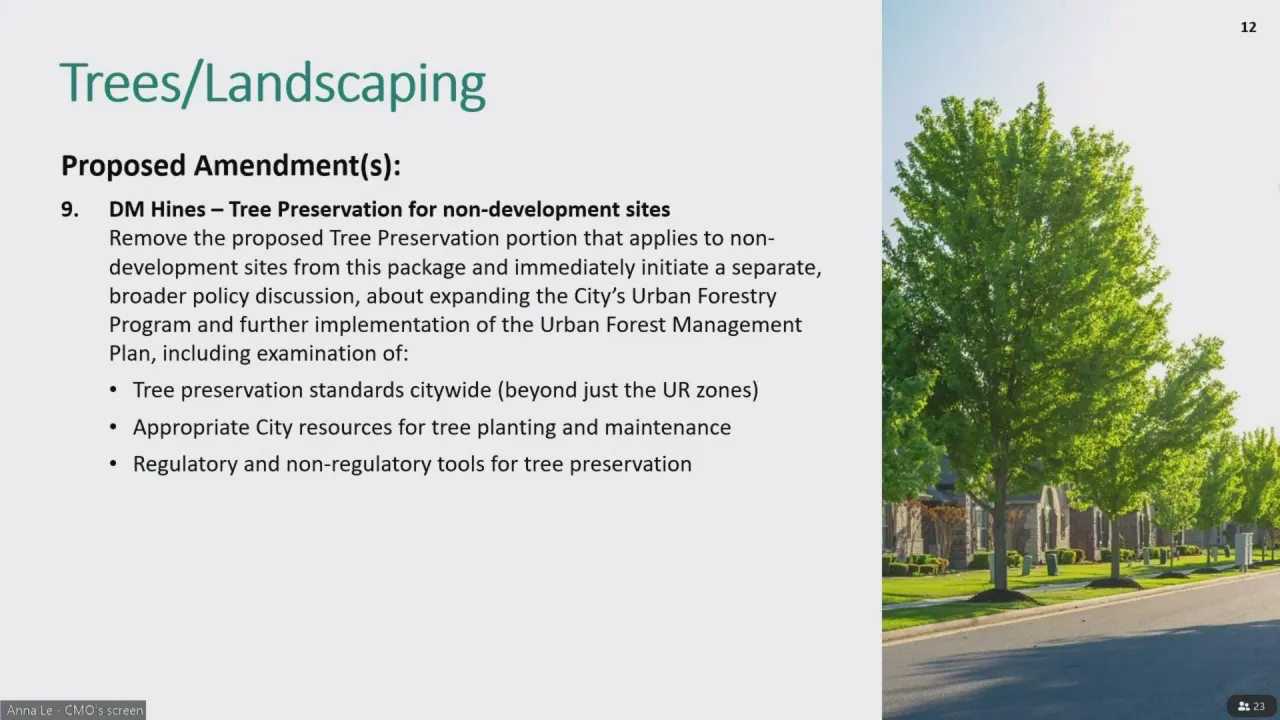
- Remove tree preservation for non-development sites from Home in Tacoma to initiate a separate citywide tree policy discussion.
- Expand mitigation fee flexibility from ⅛ mile to watershed areas.
- Reduce minimum on-site tree requirement floor from 20%/15% to 10% in UR zones.
- Remove variance requirement for reducing on-site tree credits but maintain incentives.
- Create a tree bank option allowing off-site planting on public/quasi-public property.
- Require inch-for-inch replanting for removal of large trees (≥6 inches diameter).
- Reduced on-site tree credit requirements (Councilmember Sidalgi): Reduce canopy equivalent requirement by 5% in each zone and bonus level, to strike balance between development and tree preservation.
Key Outcomes
- No formal votes were taken; council members discussed the amendments and indicated intent to move them forward to first reading on October 29, 2024.
- Staff will incorporate council direction into the agenda packet for the October 29 meeting.
- The council will consider the amendments individually at first reading and final reading on November 19, 2024.
- The city will proceed with launching a separate policy discussion on tree preservation citywide, likely in the Infrastructure, Planning, and Sustainability (IPS) committee.
Agenda Review and City Manager's Weekly Report
- City Manager Elizabeth Pauli noted a ceremonial recognition for David Fisher and potential resolution regarding a levy spending plan. Two public comment opportunities are scheduled for the evening's regular council meeting.
Meeting Transcript
I'd like to call to order the city council study session of October 22nd, 2024. Will the clerk please call the role? Councilmember Bushnell. Present. Councilmember Daniels. Absent. Councilmember Diaz. Here. Deputy Mayor Hines. Here. Councilmember Rumba. Here. Councilmember Sidalgay. Here. Councilmember Scott. Here. Councilmember Walker. Here. Mayor Woodards. Here. Mayor and Council, your materials were sent at 11 a.m. Thank you. Our first agenda item today is we are going to be hearing from several different departments this morning who are going to be presenting the proposed 2025-2026 binary operating budget. And we're going to have neighborhood and community services, community and economic development, and planning and development services provide their presentations today. We are going to start with NCS, and I'd like to call on Neighborhood and Community Services Director, Alison Griffith to begin the NCS presentation. And she is already here at the table along with Pat Beard, who is the director of who's the interim director for the community and economic development department. And I think Peter will be joining us a little bit later. So we will start with Alison. Good afternoon, Mayor and Council members, and thank you for having me here today to present NCS's proposal package. Before we get started, I want to thank each and every one of NCS's employees who have worked hard over the last few months to prepare a recommended package that we feel meets key council priorities while being conscious of the charge to build the public's trust through effective targeted service delivery. The recommendations in this package are not made lightly, but we feel what is before you for consideration is generally a focusing in on our core services or a focus on building external partnership or excuse me, focusing in on core services where we believe the city should be in the lead and a realignment of service or a focus on building external partnership where we believe the city better plays a support role. If we can move to the next slide, and I'll provide a brief overview of what we will cover today. Thank you. Council, this slide should look familiar to you as it's included in most department budget presentations. We'll go over a department overview, cover a financial overview, talk a little bit about our major accomplishments for the past biennium, discuss some community issues and considerations that were part of building our budget package, talk a little bit about what I'm looking forward to in 2526, and then I really want to spend some time with you, council, talking about some areas of the budget that I think are going to be of particular interest, and that's a realignment of senior services, violence reduction and prevention, shelter services, and then also touch on our 25-26 funding process, which we bring to you as part of the budget process. Here's an overview of how the department is structured. And you'll see that this organizational chart is actually alluding to some realignment we're working on to complete as part of this budget process. Currently, neighborhood and community services houses our homelessness response through both our homeless engagement and alternatives liaison team as well as our homeless systems and strategy team. We also have a focus on community wellness with youth violence reduction programming, senior services, and domestic violence services, and our resource allocation and management team is responsible to do the contracting management that allows us to actualize our strategic goals while our administrative staff is responsible for supporting the day-to-day business of the department. You'll see on the left-hand side talking a little bit about realigning our code compliance efforts to planning and development services, and I'll touch on that later in the presentation. With some grounding in how the department is structured, I will now address the department's financials, and that'll be the next two slides, Council. What you can see here is that our 2526 budget is basically an even split between general fund and our grants, taxes, and other revenues. That grants taxes and other revenues includes the mental health and substance use disorder sales tax, criminal justice sales tax, the Department of Justice Assistance Grant or J Grant, as well as one-time revenues from the Washington State Department of Commerce and the U.S. Department of Housing and Urban Development or HUD. Those uh particular revenues are listed as grants for shelter, and we'll be touching on the specific investments a little bit later in this presentation. I also want to note for council that the department's expenditures are primarily made up of support for personnel and investment in external services. And I also want to note for you here that homelessness and housing services do make up the department's largest investment of our budget. Here, council is a look at our Biennia over Biennial Ovie. On the left hand side of the side of the slide, goodness gracious. It appears that the department has experienced a steep decrease byania over biennia.
openpublica.com