Valdez City Council Work Session on BOE Complex Appeal Procedures - June 3, 2025
STREAMING COPY IN PREPARATION — RECORDING AVAILABLE FROM THE ORIGINAL SOURCE
Valdez City Council Work Session on Board of Equalization Complex Appeal Procedures - June 3, 2025
On June 3, 2025, the Valdez City Council held a work session to receive training on the Board of Equalization (BOE) complex appeal procedures, which were adopted at a prior meeting. The session focused on ensuring due process in appeals, particularly for a pending valuation and taxability appeal involving Alaska Ventures and VMC 3.30 property. No formal votes or decisions were taken; the session was informational.
Discussion Items
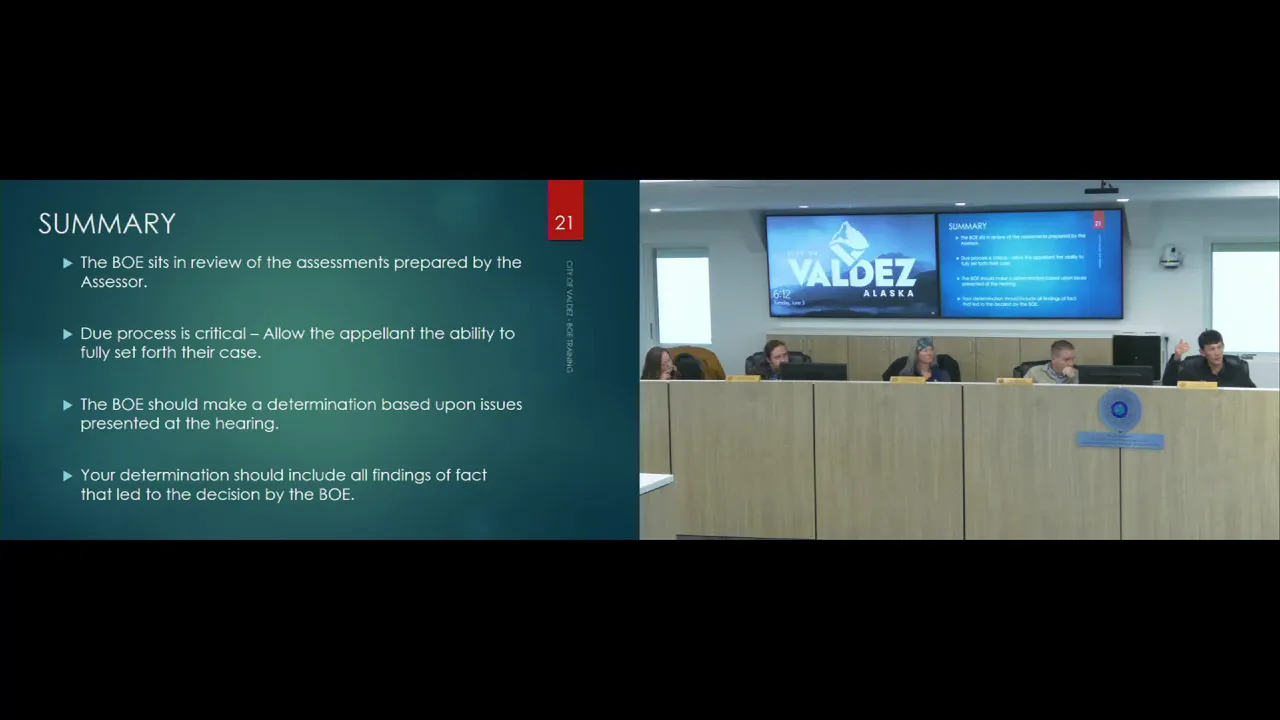
- Training on Complex Appeal Procedures: Mr. Stacer presented an overview of the newly adopted complex appeal procedures, emphasizing due process, the quasi-judicial role of the council sitting as BOE, and the importance of creating a defensible record. Key topics included discovery rules (15 interrogatories, requests for production, evidence submission 10 days before hearing), pre-hearing conferences, hearing conduct, the burden of proof on the appellant, and the reasonable basis standard of review.
- Litigation Update: Mr. Stacer noted that on May 29, 2025, Alaska Ventures filed a complaint and motion for a temporary restraining order and preliminary injunction to preclude BOE review of taxability appeals. The city filed an opposition on May 30, and the appellant replied on June 3. No court ruling had been received as of the meeting. If a preliminary injunction is granted, the BOE will not hear taxability appeals; otherwise, the council will hear both valuation and taxability issues.
- Scheduling Discussion: The initial hearing date of June 16 was not feasible; June 26 was also unlikely. Possible dates considered included June 18 and later in July, but no date was set. It was recommended to hold a pre-hearing conference as soon as possible to establish procedural deadlines. Councilmember availability was discussed, but no consensus was reached.
- Procedural Questions: Councilmembers asked about ex parte contacts (avoid substantive discussion outside hearings), managing multiple expert witnesses (flexible time limits set in pre-hearing conference), the order of issues (taxability first, then valuation if applicable), and applicable exemptions under VMC 3.30 (e.g., fishing vessels). It was clarified that the appellant has advanced alternative valuations if the property is deemed taxable.
Key Outcomes
- No votes or formal decisions were made.
- The council will schedule a pre-hearing conference to set procedural rules and a timeline for the pending appeal.
- The hearing on the appeal is expected to occur no earlier than late July 2025, subject to court rulings on the TRO motion and council availability.
- Councilmembers were advised to prepare for a potentially voluminous record and to avoid any ex parte or outside discussions about the appeal until the hearing concludes.
Meeting Transcript
All right. Well, it's five thirty-one, so I'll call this uh work session to order regarding the Board of Equalization Procedures for Comple Appeals, and I believe Mr. Stacer is going to be teaching us all there is to know about complex appeals. I'll give it a college try. And uh so um under the code, the city council sits as the board of equalization, uh, unless it were to appoint another board. Practice has been for the council to sit as the board of equalization. It'll start some of this will be duplicative for council members who were here for our last training, but I want uh councilmember Whitey and Lumba to have the benefit of some of the background fundamental information at least. So I'm not gonna repeat that whole presentation, but I'm gonna hit the high notes in the context of complex appeals. Um under the code, the board has the ability to adopt complex appeal procedures, which it did at our last meeting. The whole purpose of this is to allow for due process. That's what we're doing here. Uh, it's to allow when there's a level of complexity, um, that wouldn't allow the parties to fully advance their positions through the normal board of equalization process. Um, the board of equalization can accommodate that and allow for more time, discovery rights, that type of thing, and that's what we've done here. Um at least, I don't know if I can made the presenter on this. I do have some slides to guide us through. So while we get that sorted out, um, the goal of these complex procedures is to afford due process for the appellant. Um these procedures could be applied to any appeal that the board determines to be complex. We have one that uh was the impetus for adopting these right now. Valuation appeal on the VMC 3.30 property on by Alaska Ventures. And um we thought in light of the nature of that appeal that's so as we continue to get that sorted. Um the Board of Equalization, it's a quasi-judicial body, right? So you perform the function of a judge, essentially. And we'll get into some key tenants here, but it's not like you're sitting up there as city council. It's a different function, right? And the scope of your review is limited to the evidence that'll be presented to you. Okay. Everybody started at least now. I'll just I'll just get going. I can speak to the basics, right? So your job is to listen to the case that is presented to you. Um as I said, there's flexibility flexibility built in here. If you want to request a written briefing on issues, you can do that. Um there's limitations in here on you know how evidence is to be presented, how many days before hearing, that type of thing. But your basic function is to take the facts they're presented from the appellant and the assessor and then render your decision. And as much as of you are aware, it's the appellant's burden of proof. So they need to convince you that the assessor made an error. Um we talked about due process. We'll also talk um in a fair bit of detail about how you make a defensible record. Um you need to explain to somebody who didn't observe these proceedings how you got to the decision that you did. In these complex appeals, you have the ability to recess and prepare written findings, and I would recommend that you do that. So anything you can do to make a more complete record, how you got to your decision, I would encourage you to do. Oh really? Oh, probably because I'm not on the internet. That would make sense. Okay, it should be sent into you now at least. Something doesn't sound right, and you want more information, feel free to do that. It's um a generally informal process. We're not applying the same evidentiary rules if you voting court. Um so you have flexibility with regard to how evidence is gathered. While we're waiting here, um we've been working on a date for these complex appeals.
openpublica.com