City Council Work Session on VMC 10.20 RV Parks and Tent Campgrounds - June 17, 2025
STREAMING COPY IN PREPARATION — RECORDING AVAILABLE FROM THE ORIGINAL SOURCE
City Council Work Session on VMC 10.20 Recreational Vehicle Parks and Tent Campgrounds - June 17, 2025
This work session, held at 5:30 PM on June 17, 2025, was devoted to reviewing and discussing the history, current language, and potential revisions to Valdez Municipal Code 10.20, which governs recreational vehicle parks and tent campgrounds. City Manager Nate presented staff analysis and options, and council members debated key issues such as the city manager permit, enforcement, posting of no-camping signs, and the balance between promoting visitation and addressing nuisance concerns. Public testimony was also heard, and the council provided direction for staff to draft a revised ordinance.
Public Comments & Testimony
- Kyle Anderson, lifelong resident, opposed restrictive limits on the number of RVs allowed on private property or at clubs/lodges, arguing that such limits hurt both homeowners who need contractors and local businesses that rely on visitors. He supported expanding city campgrounds and favored using signs to designate where camping is prohibited rather than limiting the number of RVs.
- Jeff Sachs agreed with using signs to prohibit camping in specific areas (e.g., West Dike) and noted that state land camping is beyond city control.
- Lars emphasized that Valdez’s city limits are unusually large (extending to 19 mile), so a blanket no-camping rule would be inappropriate. He supported a permissive approach with targeted prohibitions.
- Another unnamed speaker (likely from earlier public comment) echoed support for allowing camping where it is not a problem and cautioned against overly broad restrictions.
Discussion Items
- History and Purpose: The city manager reviewed the ordinance’s origins (1995 task force, 1996 adoption, 2007 amendments) and explained that the current discussion arose from a 2023 inquiry about a city manager permit. Staff recommended separating RV/camping regulation from Title 17 (zoning) and moving it to Title 12 (streets and public places) for clarity.
- City Manager Permit: Council members expressed concern that the permit system could be burdensome to enforce and conflict with state land rights. The consensus leaned toward eliminating the permit and instead relying on posted prohibitions and temporary land use permits for large events.
- Posting No-Camping Signs: Several council members (Austin, Jimmy) supported a “where posted” approach for city-controlled property, rather than a blanket prohibition. The city manager agreed to add “where posted” language for Section B (recreational vehicles on city property).
- Number of RVs on Private Property: Debate arose on limits. Kyle Anderson argued for no arbitrary limits based on lot size. Council member Jimmy suggested linking the number of RVs to lot size (e.g., one per half-acre). The city manager offered to leave the original language (one RV per lot) in the draft and include potential amendment language for council to modify later.
- Temporary Occupancy Duration: Council member Austin raised the need to define “temporary occupancy” (e.g., 30 days for residential, 180 days for commercial) to aid enforcement. The city manager noted that existing revisions included such time limits and would retain them in the draft.
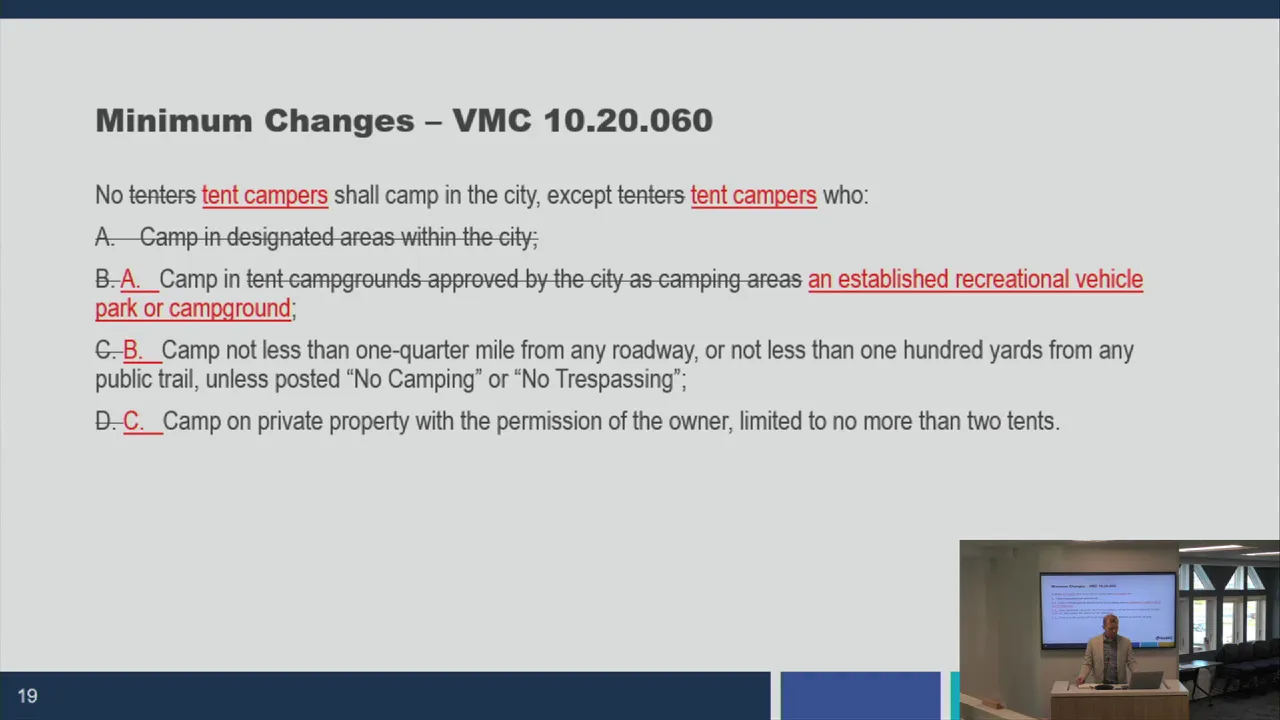
- Tent Camping: The city manager reviewed current tent camping rules (proximity to roads/trails, private property with owner permission) and proposed striking language on designated areas and on dogs, while keeping cleanliness rules. Council member Jimmy argued to retain “designated areas” language for future flexibility, but others preferred to remove it and rely on the temporary land use permit process. The council agreed to include the strike-through version in the draft and revisit at first reading.
- Health and Safety Provisions: Council member Jim noted that many camping-related concerns (littering, animal attractants) are already covered by other city codes, and recommended removing duplicative or difficult-to-enforce sections. Staff will cross-reference existing nuisance and animal control ordinances.
Key Outcomes
- Staff was directed to draft a revised ordinance that:
- Eliminates the city manager permit for RV camping.
- Uses a “where posted” approach to prohibit camping on city-controlled property (Section B).
- Retains original language for residential and commercial lots (one RV per lot) with possible amendments for lot-size-based allowances.
- Includes specific time limits for temporary occupancy (30 days residential, 180 days commercial).
- For clubs/lodges, keeps the limit of three RVs but will provide amendment language to increase if desired.
- For tent camping, adopts the strike-through version that removes the “designated areas” subsection and the dog restriction, and keeps the quarter-mile/100-yard rule with “no camping” posting exceptions.
- References temporary land use permits for groups and events.
- The draft ordinance will be presented for first reading at a future meeting, with amendment options available for council consideration. The council emphasized that this is not a final decision and that further public input will be taken.
Meeting Transcript
Session on VMC 10.20 titled Recreational Vehicle Parks and Tent Campgrounds. Overview and discussion. We're going to go ahead and have our city manager go ahead and uh start us off. All right. Thank you, Mayor Fleming. Good evening, Council. I can't take credit for the slideshow. The clerks did a great job of compiling information, but uh I will be the presenter. Um just to kind of start things off. I figured before we start moving forward, let's take a step back and see where we're coming from, right? So on this slide, it really kind of gives the history of ordinance of BMC 10.20. Uh, 1995 was when it was introduced. Um I think there are some important notes from when that happened and why as to kind of where we are now and perhaps the direction we want to move forward with. Um it was amended in uh well. So they created a task force in 1995. They created an ordinance in 1996, right? Uh 2007 was the last time that it was modified. 2023 is where the current conversation really kind of started. There was an inquiry, and I don't recall if it was a phone call, an email, or just casual conversation uh relating to how someone could get a permit referencing a city manager permit. Um in the meeting minutes from the 90s, the permit was more or less in reference to large group gatherings. Um, so that was kind of what that was put in for. Not necessarily a single use type of a permit. So kind of going back to the intent at that time, that's what that came up. Um we brought forth an ordinance, we postponed it indefinitely because again, uh from the perspective of administration, I don't know that I don't know that the ordinance proposed was necessarily going to meet the purpose of a the original intent of the ordinance, or B the current and future desires of council and community. So that's kind of where we're at. That's a little bit of the history. Uh I guess to elaborate a little bit further on that, uh, some of the reason we we made modifications to the ordinance are because we changed Title 17, the zoning code. And there's a lot of real specific information related to RV parks and campgrounds, like the facilities themselves that are actually covered under Title 17 that really don't make any don't make a lot of sense being duplicative in Title 10. And so that was another impetus like, hey, let's clarify this permit thing, but let's also clean up some of this code language. Uh so what really kind of started is an administrative exercise turned more into a uh a policy exercise, and so that's kind of where we call the timeout and uh want to have another conversation. Uh a summary from what we've heard based on what was presented last time is uh desire to eliminate or limit the city manager issued permit, uh which again I I think is I think is going back to the original intent of the original ordinance. You know, maybe it's probably in line with what that original ordinance was looking to do. Uh avoid competing with private industry, avoid being overly restrictive on regulating camping outside of the downtown area, increase signage and public information available. Again, some of these points are in conflict with one another, but it's because we heard opposing viewpoints. Uh maintain public health and safety, make sure not to put law enforcement in an uncomfortable position. Consider adding fees for RV parking on city land, make sure the fees don't cost more to collect than they bring in. Make sure fees are comparable to private RV parks, make sure code provisions match and are easily easy to understand. Make camping and RVs less restrictive, make camping and parking RVs more restrictive. Another thing that, as we've been looking at this big picture, is by incorporating most of the requirements for RV parks and campgrounds in the Title 17 land use definitions. It really begs the question where should regulation related to camping and overnight parking, where should that actually live? Uh Title 10 is related to vehicles and traffic. It might fit better under Title 12 with street sidewalks and public places. Um, more of a land use right-of-way use type of a scenario versus vehicles and traffic. Again, uh, I think that's that's certainly the recommendation from the clerk's office. I don't know that I have enough knowledge or opinion to say one way or the other, so I'm gonna defer to the clerks. Uh, here's something I think is important the purpose. This is what's in the current code, which was the 96 code as amended in 2007. Says the purpose of this chapter is to set reasonable standards for recreational vehicle parks and tent campgrounds within the city. Is the intent of the city to assure that the public health, safety, and welfare of the community is preserved and protected while not creating burdensome and unduly restrictive regulations that would deter recreational vehicle travelers and tent campers from visiting Valdees. I really think that's a very good purpose.
openpublica.com