City of Valdez City Council Work Session on Fund Balance Policy - July 1, 2025
STREAMING COPY IN PREPARATION — RECORDING AVAILABLE FROM THE ORIGINAL SOURCE
City of Valdez City Council Work Session on Fund Balance Policy - July 1, 2025
On Tuesday, July 1, 2025, at 6:00 PM, the Valdez City Council held a work session in Council Chambers to discuss a proposed comprehensive fund balance policy. The session was led by Jordan (finance director) and focused on the purpose, current practices, proposed revisions, and next steps for adopting a formal policy by December 2025.
Discussion Items
- Purpose and Background: Jordan explained that fund balance is equivalent to ownership equity—available spendable resources that provide a financial cushion to mitigate current and future risks. He cited Government Finance Officers Association (GFOA) guidelines emphasizing that each government should establish a formal fund balance policy reflecting its own circumstances. Valdez's unique situation includes heavy reliance on property tax revenue and ongoing litigation, justifying a higher-than-average cushion.
- Current Policy: There is no comprehensive standalone policy; only scattered code language, including a static $4.5 million working capital reserve requirement that is now outdated. The city's current overall fund balance equates to about eight months of expenses. Jordan noted that this informal practice has guided operations but lacks regular review and adaptability.
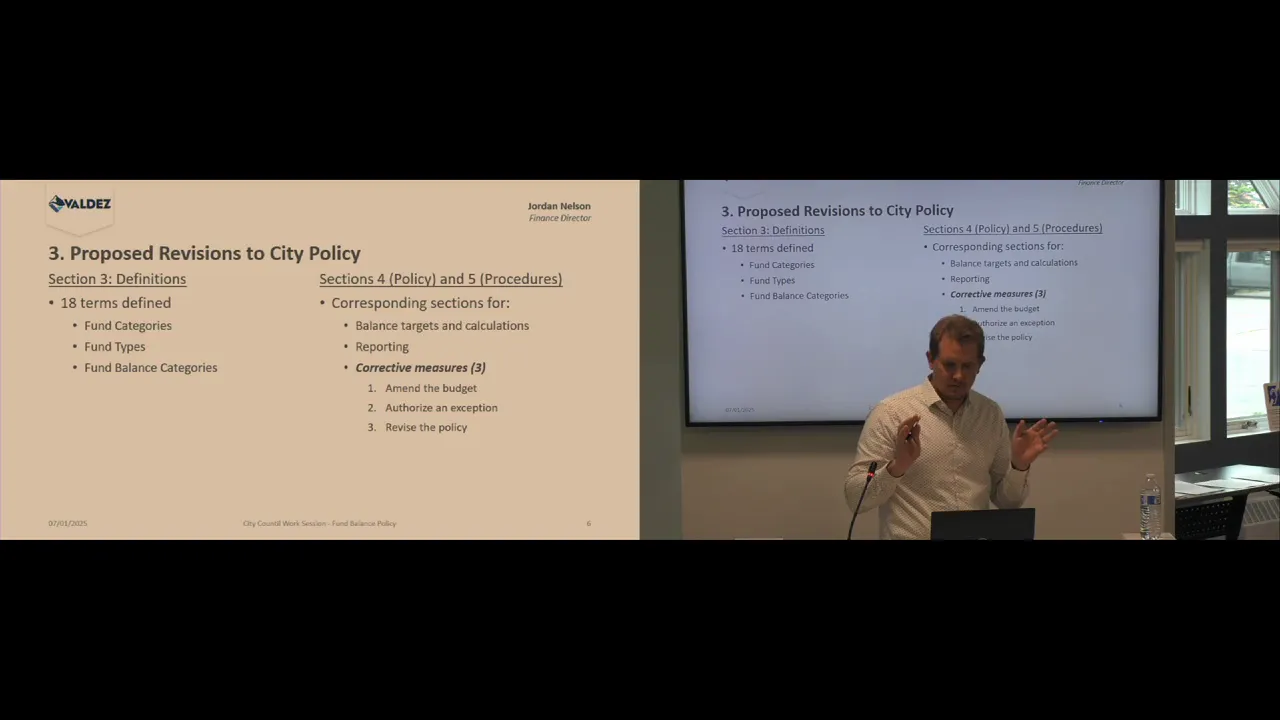
- Proposed Revisions: The draft policy (excluded for permanent fund, proprietary self-insurance, hospital, and schools) includes:
- General Fund: Minimum of one-third and maximum of one-half of combined ad valorem tax revenue and Permanent Fund transfer. This translates to a range of $18 million to $27 million (current balance is $26.5 million, including the $4.5 million working capital reserve).
- Special Revenue Funds (e.g., airport, port, harbor, utility): Minimum of two months (17%) of budgeted annual revenue and maximum of 12 months (100%). Jordan noted that all special revenue funds currently exceed 100% of annual revenue, resulting in an estimated $7.5 million in excess fund balance that could be reallocated to council priorities such as major maintenance or replacement reserves, or to offset subsidies from the general fund.
- Corrective Measures: If fund balances fall outside targets, prescriptive options will be available; council will be apprised of needed corrections before budget development.
- Review Cadence: The policy would be reviewed three times per year—during the annual operating budget, after audited financials, and during budget parameter discussions.
- Council Questions and Comments:
- The Mayor suggested adding an overarching purpose statement to the policy, such as “to ensure funds are allocated to maximize public benefits” and emphasized proactive value.
- Councilmember Foster asked about the rationale for the one-third/one-half metric on the general fund versus the two-month minimum on special revenue funds. Jordan responded that Valdez’s singular and volatile revenue source necessitates a larger cushion, and the range is deliberately narrow to maintain a constant solid cushion. He also confirmed that the litigation reserve is separate and assigned.
- Councilmember Foster also inquired about tracking funds reallocated to major maintenance reserves; Jordan explained each reserve has a separate GL account, ensuring funds are spent only on that purpose.
- Councilmember Olivia asked whether the general fund balance would return to the two-month level after litigation subsides. Jordan confirmed the policy is reviewed annually and can be revised as circumstances change, so the balance could be adjusted later.
- Olivia also asked about investment of general fund unassigned balances. Jordan explained that all city funds are part of a central treasury invested in treasuries, agencies, and money market funds, earning competitive market rates (detail available in the treasury report).
- Next Steps: Jordan proposed a timeline: council feedback today; incorporation into budget discussions in September–October; final draft and resolution adoption by December 2025. He requested high-level direction and offered to bring more visual aides showing what the policy would look like in real dollar terms. Council expressed general support and no alarms, with the Mayor stating “this is a real good start.”
Key Outcomes
- No formal vote was taken, but council consensus indicated direction to proceed with the proposed fund balance policy framework.
- Staff will return with additional visual materials (graphs, real-life dollar comparisons) to help council evaluate the impacts before final adoption.
- The policy is expected to be adopted by resolution in December 2025, with annual evaluations thereafter.
- No code changes were discussed in detail; those will be addressed separately.
Meeting Transcript
Thank you so much, Mayor. You all knew it was coming. We're going to put the fun in fund balance policy. So here it comes. All right. Got that out of the way. We got to start with the first things first. The impetus for this work session was some conversation around council contingency reserve. And there was some talk about that last year during this council retreat. And some desire to address balances in not only council contingency reserve but also reserves across the organization. And then you drill down from there. And so we got we got to start, we got to start at the highest high level. So the agenda for tonight, we're going to start with what is it? Fund balance policy, the background purpose. Number two, current city policy, what it is. So what is it? What it is, proposed revisions, what it could be, timeline and next steps is uh gonna be what it takes. So with that, um right, clearing up a couple of things on on as far as the timeline and next steps. Uh there's there's some procedural questions that we're going to have to get to. I and in evaluating fund balance policy for the entire organization, the topics like council contingency reserve and some of those other reserves are really procedural in nature, and so we're gonna just need to drill down on those later, and in the draft language of the fund balance policy that's included in your packet. It speaks to that about the regular budget process as some of those reserves are subject to appropriation by the city council. Though we recognize that management staff has a uh role to play in that with recommendations as well. So fund balance policy is a way for all of us to agree on what that process is, do it regularly, and uh revise it as the needs of the organization dictate. So here we are. We're going to try to bring this to bear throughout the budget process this year this year, and hopefully adopt a fund balance policy by uh December when we adopt the 26th operating budget. So without further ado. The fund and fund balance. It's uh funds are distinct subsidiaries within uh within a government entity, right? So this is this is an accounting convention that uh that we employ in many governments across the nation also employ is using fund accounting to separate and organize the uses and um operations of any of any or of any government entity. Those categories, governmental proprietary fiduciary, you're gonna hear that type of thing now and then. Um just note that that those just reference fund balance or uh funds within a within a government entity. There are also the types, right? So general fund is where most of the activity is going to take place, especially in our structure and form of government, and and really in any form of government, the general fund is if there is not a specific if there are not specific rates and fees that drive the uh operations, then it just all belongs in general fund. Um we have special revenue funds within the within the organization, those as far as the city of Aldi's is concerned, airport, port, harbor, those are all the I'm naming distinct special revenue funds. There's also utility fund, which contains two departments. One of them is water, one of them is sewer, but it's all contained under one fund called utility fund. So those are just some of the different types. You'll hear me reference debt service fund once in a while, debt service fund. The only function of that is to separate bond proceeds or bonded indebtedness, and so by function that that fund, a debt service fund is distinct within the city's books, but it should always be zero by the end of the year because your your payments to debt service should equal whatever you're appropriating to it in any given year. Right. I'm not gonna nerd out too much on this, sorry about that. Uh went a little bit too far. The final point, and really the only thing that matters is down here at the bottom, the bullet point that just says fund balance is equivalent to owner ownership equity. So if you're in a private organization, you're gonna talk about ownership equity. Fund balance is that it's available spendable resources, which is the important stuff and segues to the next slide here. Oh, right. Sorry about that. So available spendable resources. The first bullet point under the under the top, they're providing a financial cushion to mitigate current future risks. That is I think one of the most important things when we consider fund balance policy.
openpublica.com