Valdez City Council Work Session on 2026 Budget Parameters - August 5, 2025
STREAMING COPY IN PREPARATION — RECORDING AVAILABLE FROM THE ORIGINAL SOURCE
Valdez City Council Work Session on 2026 Budget Parameters - August 5, 2025
The Valdez City Council held a work session on August 5, 2025, to discuss and provide direction on the 2026 budget parameters resolution. The meeting focused on revenues, including the permanent fund draw and hotel occupancy tax, and expenses, including personnel costs and health benefits. Council members expressed positions on key fiscal policies, and staff were directed to develop plans and proposals for the upcoming budget cycle.
Discussion Items
-
Permanent Fund Draw (1.5%): Councilmember Love advocated for reinvesting the 1.5% permanent fund draw to allow compounding, citing long-term growth projections ($300M to $623M or $974M in 30 years under moderate projections). Councilmember Devons agreed, while Councilmember Joe expressed concern that a larger fund could become a target. Councilmember Lowley (Olivia) supported reinvestment. Mayor Fleming proposed reviewing budget numbers before finalizing. City Manager Jordan noted that last year only $900k of the $4M draw was unallocated; the rest supported bond payments. Council consensus directed management to create a multi-year plan (e.g., five years) to reduce reliance on the 1.5% draw, with the goal of full reinvestment over time. Councilmember Devons also noted that changing the charter from "shall" to "may" for the draw could be considered in the future.
-
Hotel Occupancy Tax on RVs: Councilmember Love proposed extending the 6% hotel occupancy tax to recreational vehicles (RVs), arguing that RVs use city services and that the tax could generate new revenue without increasing the rate. He suggested the revenue be used for operational/capital expenses rather than tourism promotion. Councilmember Devons supported the idea but recommended addressing it through a separate ordinance rather than in the budget parameters to specify the use of funds. Councilmembers Lowley and Joe expressed support, with Joe noting a potential need for a phased approach. Consensus was to revisit the hotel occupancy tax scope via ordinance, but no immediate change to the budget parameters language was made; staff will draft ordinance language for a future meeting.
-
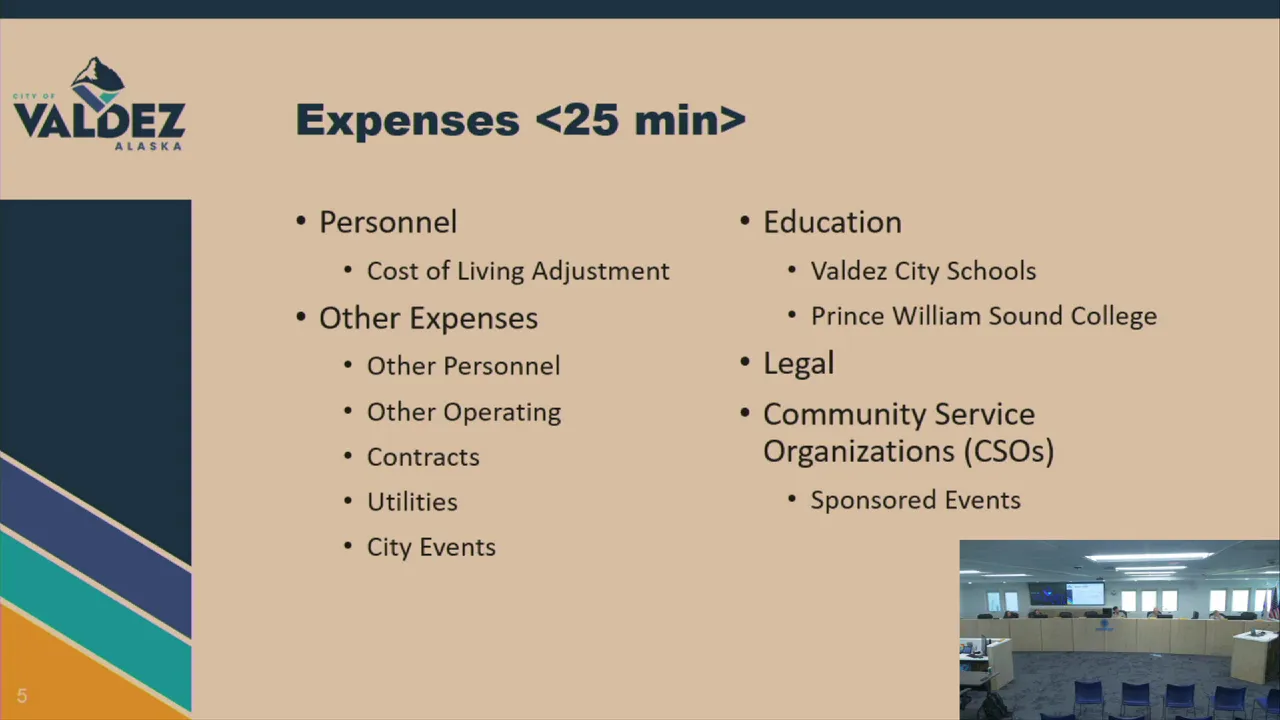
Cost of Living Adjustment (COLA): The draft budget parameters included a 2.3% COLA based on Anchorage CPI. Councilmember Love proposed using a rolling average (e.g., five or ten years) to reduce volatility. Council agreed to evaluate this option for the 2027 budget cycle, not include it in the current resolution. Staff will present a comparison of methods before the next budget cycle.
-
Health Benefits: Councilmember Love proposed adding language that management identify options to reduce healthcare expenditures while maintaining top-tier benefits, including coverage reviews, wellness programs, and cost-sharing adjustments. Councilmember Devons opposed reducing benefits, citing the importance of health benefits for recruitment and retention. Councilmember Joe agreed with caution, but ultimately the council reached consensus to include broad language as proposed by Love, recognizing that staff already conducts annual reviews.
Key Outcomes
- Permanent Fund Draw: Directed City Manager to develop a plan to reduce reliance on the 1.5% permanent fund draw over a reasonable timeline (e.g., five years), with the goal of full reinvestment. This plan will be reflected in the 2026 budget parameters resolution.
- RV Hotel Tax: Council agreed to introduce an ordinance to extend the hotel occupancy tax to RVs; the budget parameters resolution will not include specific language but will note the intent to explore this revenue source.
- COLA Rolling Average: Staff will evaluate a multi-year rolling average for COLA for consideration in the 2027 budget; the 2026 budget will use the traditional 2.3% Anchorage CPI.
- Health Benefits: The budget parameters resolution will include language directing management to identify options to reduce healthcare costs while maintaining top-quality benefits.
- Next Steps: The budget parameters resolution is scheduled for adoption on August 19, 2025. Budget workshops will be held October 27–30, 2025 (focus week).
Meeting Transcript
Okay, we'll go ahead and get started on our work session of budget parameters. Jordan, take us off. Thank you, Mayor. And council, thank you so much for joining us on this beautiful evening. I've got a slide deck prepared that is going to be our agenda. And we're going to follow that in your packet as well for the workshop tonight is attachment A that says council priorities for the 2026 budget. This is the document we will be revising tonight. Just a little background on a budget. It's all of those things. And annually we have started this tradition of adopting by resolution budget parameters. And this informs staff as they draft their department budgets. Tonight in route for adoption by resolution on the 19th, that would be that's really the task that we're that we're doing tonight. Keeps the 2026 budget process on track. So this is what we're trying to do. Complete and draft the 2026 budget parameters resolution, and that's how we're gonna do it down below. And uh no need to waste time. Let's get going. Um we're gonna start with revenues at the top, which is not the first thing in the attachment A, it is a little bit further down. Each of these sections has a little title. We're moving down towards the end of the first page to where it says revenues, and the reason for this, as Brian Tracy says, you eat the frog. The everything gets easier from there. The biggest hardest and most important task you start with first. You get through that, and it's all downhill. So let's eat the frog, if you will. And uh, we're gonna start with uh revenues, property tax and mill rate. Um, based on what I have in the draft council priorities document. Is there any objections or or or desire to change the wording on that one? Go ahead. No. Oh, okay. Second bullet point on the screen, permanent fund. That's also included in revenues. Take it away. So this is definitely one I want to talk about, and this is one that you know I've talked about in the um permanent fund committee. Uh I'm on the permanent fund committee with council member Devons and Council Member Lowley. Um I'm just gonna pull up the draft language here. But yeah, I think I think we should consider revising this part of the budget memo. The budget parameters memo. And you know, basically it's like it's a it's a big it's a big deal to me. And um the the permanent fund is a really important asset to the city's you know overall asset playbook. And you know, it it's it's only been recently that we've been using that 1.5% draw kind of as normal operations and capital expenses. Um the permanent fund was it started 47 years ago, 1977. It started at 13.6 million dollars, now it's you know 300 million dollars, and that's been continually invested in stocks, real estate, bonds, and other fixed assets over that time. Um I guess like one of the things that you know where I'm coming from, uh a quote from Charlie Munger kind of captures it, is the first rule of compounding is never interrupt it unnecessarily. And for those of you who don't know who Charlie Munger is, he's a co-founder of you know Berkshire Hathaway with Warren Buffett. So the guy knows how to invest money and make it over the long term. They're both billionaires. So, you know, 1977, 13.6 million. Today it's almost 300 million. I know that charter mandates that the 1.5% of the market value is supposed to be placed in the general fund annually for appropriation for operational and capital expenses of the city.
openpublica.com