Valdez City Council Budget Work Session – Facilities, Fleet & Infrastructure – October 28, 2025
STREAMING COPY IN PREPARATION — RECORDING AVAILABLE FROM THE ORIGINAL SOURCE
Valdez City Council Budget Work Session – Facilities, Fleet & Infrastructure – October 28, 2025
The Valdez City Council held a budget work session on October 28, 2025, starting at 6:30 PM, to review the proposed FY2026 budgets for the Facilities, Fleet and Infrastructure Division, major equipment purchases, and capital projects. City Manager Nate and division directors presented detailed breakdowns of departmental expenses, revenues, and project options. Council members discussed utility rate adjustments, capital project prioritization, and equipment replacement, reaching consensus on several budgetary directions.
Discussion Items
-
Budget Overview: City Manager Nate presented a high-level view of the division, noting that the budget is dominated by roughly half payroll and half supplies/services. He highlighted that the utility fund is a special revenue fund with its own insurance costs. Personnel costs include overtime and standby wages, particularly for snow removal in streets, solid waste, and building maintenance.
-
Building Maintenance: The budget increased 1.5% year-over-year. Highlights included a new fire alarm contractor, funds for outdated system upgrades, self-monitoring system integration with IT, and a slight janitorial increase. A council member asked about a heating reduction; staff clarified it was a correction from over-budgeting in 2023 due to high fuel prices. Temp staffing was added to backfill employees undergoing medical repairs.
-
Engineering Department: The new director position was filled. Budget essentially status quo, with some project manager support for the new director.
-
Solid Waste: Budget proposed a 0.5% reduction. A $92,000 reduction in dumpster purchases was offset by a $20,000 increase for parts. Discussion included the success of a temporary employee at the baylor (scrap metal program) and plans to professionalize recycling. The dumpster pod program was mentioned for future revival.
-
Street Shop: Budget remained flat year-over-year. Overtime and rural snow removal were reduced to reflect actuals, though the city manager promised to request additional funds from the budget variance reserve if a heavy snow year occurs. Public Works Director John Whitty noted trenching safety training was planned for the upcoming year. A $50,000 reduction in rural snow removal was based on historical highs, but the recent contract change (Harris vacating) may affect costs.
-
Utility Fund (Water & Sewer): The operating subsidy has hovered around $1.2 million annually, driven by fish processing usage (higher in odd years). Current rates were set in 2004. City Manager advocated a 5% rate increase applied universally, noting that a full CPI adjustment would require a 60% increase for larger commercial users. He recommended a future CIP project to install meters for all commercial users before making substantive rate changes. Council members expressed support for a gradual increase, with some noting the need to address the budget deficit. The budget was presented with current rates, but a future ordinance for a 5% increase was anticipated.
-
Sewer Department: Budget reduced by $72,000 (8%) due to removal of a permit renewal and other true-ups. Staff confirmed progress on NPDES renewal and compliance.
-
Water Department: Budget increased by $5,000 on a $1 million base. True-ups reduced overtime and electricity; leak detection services were obtained through Alaska Rural Water. Funds were added for pump and motor parts, categorized as major equipment.
-
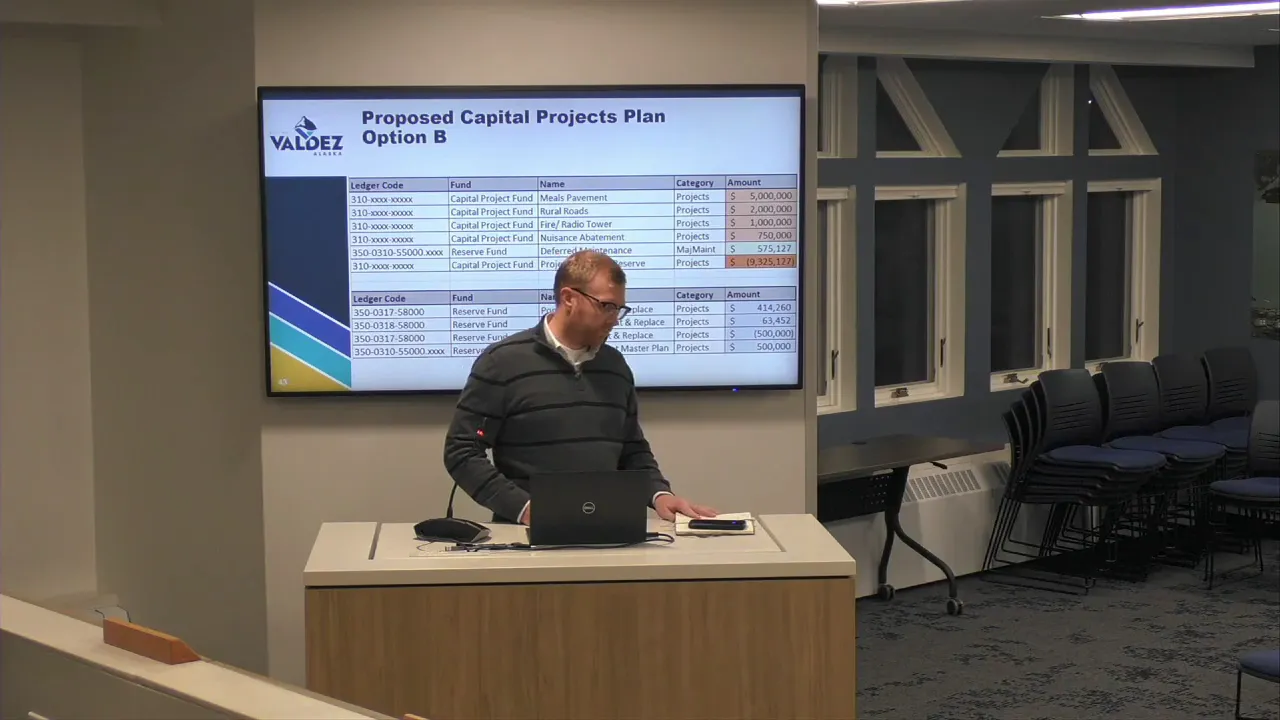
Capital Projects: The FY2025 carryforward was $4.2 million, plus $5 million from debt service reserve, totaling $9.3 million in the planning reserve. City Manager presented three options:
- Option A: Fully fund Meals Avenue paving (engineer estimate $9.8 million, budgeted at $8.6 million) and scrap barge removal. This would use nearly all funds, leaving little for other projects.
- Option B: Fund rural roads ($2 million), radio tower ($1 million), nuisance abatement ($750,000), deferred maintenance ($500,000), and put the remaining $5 million toward a scaled-back Meals project (possibly without Rogue River Drive) or hold for future years.
- Option C (developed during discussion): Fully fund Meals Avenue, scrap barge, radio tower, nuisance abatement, and deferred maintenance by reallocating $1.6 million from the rural roads line and funding the difference from the general fund unrestricted balance (or repayment reserve). Several council members supported Option C, with the condition that the city manager could find savings elsewhere. Councilmember Devons proposed deleting rural roads entirely to fully fund Meals. The council generally favored proceeding with as many projects as possible while deferring rural roads, with a plan to adjust based on actual bids.
-
Major Equipment: The total appropriation was $1.8 million, with $1.6 million from the 10-year average and $200,000 for other items. Replacement list included a single man lift, trackless sidewalk machine, two police vehicles, a loader (Cat 966), a vacuum truck (brand to be evaluated), a mower attachment, and fire decon equipment (roto decon extractor and hazmat tent). A council member asked about compatibility of brands; staff confirmed the loader would be Cat and the vacuum truck would be compatible with existing fleet. The snow grooming machines were discussed; a 20-year-old machine was overhauled and slated for replacement in 2030. The grand piano at the Civic Center was noted on the long-range list.
-
Late Item – KVAK/KCHU Presentation: A council member requested to bring back a presentation from KVAK/KCHU (public radio) that had a mix-up with presenters. Two council members supported adding it to the Thursday meeting agenda. No formal vote was taken, but direction was given to add the item.
Key Outcomes
- The council directed staff to proceed with Option C for capital projects: fully fund Meals Avenue paving (using the $8.6 million allocation plus an additional $1.6 million from rural roads and possibly general fund/repayment reserve), fund scrap barge removal, radio tower (one site), nuisance abatement, and deferred maintenance. The rural roads project was deferred. The city manager will seek to identify savings from existing project funds to minimize draws from reserves.
- Staff will bring back a future ordinance for a 5% utility rate increase applied universally (residential and commercial), with a separate conversation about commercial metering.
- All departmental budgets (building maintenance, engineering, solid waste, street shop, water, sewer) were moved forward as presented, subject to the overall budget adoption later.
- The major equipment list was accepted as presented, with replacement of two police cars completing the 6-7 year cycle, and evaluation of a different vacuum truck brand.
- The KVAK/KCHU presentation was added to the regular meeting agenda scheduled for October 30, 2025.
Meeting Transcript
Such a mouthful. There are budget categories that look like this on the pie chart, dominated by about half payroll, half stuff and things. So let's look at what's in each expense category, and I'll call out some things that I think are interesting as far as these expense categories. When you're looking at the departments, uh building maintenance, engineering, solid waste, street shop, and the utility fund. Other operating is uh about 50%. It's actually more like 75% just supplies and stuff. Other operating, the name kind of describes what that is. It's just a bunch of supplies and equipment or equipment, supplies for equipment and parts to keep all the the equipment that is running throughout the city, running throughout the city as we like. There's also an insurance item in the other operating, and that is interesting to see, especially since we did cover insurance the administration division last night. The reason for that is because the utility fund is uh special revenue fund, it's a standalone fund. And so anything that is this that is a special revenue fund, such as Ports and Harbor or utility, Port Harbor Airport are all special revenue funds, and utility fund, which contains the water and sewer department, they reflect their own insurance costs. And so that's why you see insurance and other operating. There is no insurance line item in the general fund departments of building maintenance engineering street shop solid waste, but there is insurance line items in the water and sewer departments as well because of the nature of their fund. Other personnel is about people doing work and being flexible to expand operations as Mother Nature and or the level of service dictates. So and then contracts is very similar where it's pretty evenly spaced between different uh rural snow removal, obviously, is half of the contracts, and that's in one department, streets and shop. The other ones have general contractual services, where we're leveraging staff time to get more things done, and janitorial services. We're also mostly in the building maintenance department, actually, I think exclusively there. I also have this chart with the hours, and I like this one because it gives you an idea of um which departments have what what different types of hours. So streets and shop, for example, has temp temp hours budgeted, so solid waste. That just reflects some seasonal operations. Building maintenance, a big part of I'm sorry, I misspoke streets and shop. Wow, building maintenance, solid waste, have temp wages to expand operations, right? So building maintenance, uh snow shovelers, that's a big one on the temp wages side, solid waste seasonal operations, especially at the baylor. Things ramp up in the summer. There is also overtime and standby wages, and you see that emphasized in streets and shop. Overtime and standby wages are gonna be mostly related to snow removal, and you see that in solid waste and building maintenance as well to some degree, and again, solid waste folks are being repurposed for snow removal and building maintenance folks are assisting with snow removal, especially with some of the smaller equipment that they have. And with that, I'll turn it over to Nate, and City Manager is going to take you through an overview of the division and then kick off department use. Alright. So to kind of follow somewhat of what we did last time. I'll set the table with the high-level stuff if there are any specific subject matter expert type questions. We'll defer to those who are such. Excuse me. Big picture. Uh, we do have the projects slide in here, and so with that, we have the very forward money that goes into the project planning reserve. Uh, as Director Nelson mentioned on a previous meeting, we have this debt service money that has to be cannot be in that reserve any longer. Uh my proposal is to put it into the projects fund. Um, so that will be later on. Uh we've trued up some of the utility expenses, so you'll see that in some of the various departments. We're really close. Rates and total expenses has been beyond our control. We've reduced the rural snow removal budget to reflect actuals. I made a promise to uh public works department that if we do that when when time comes to come to council to draw money from budget variance reserve, they're gonna understand that it's snowing and we need to move the snow. Um that's just if if every department were to budget for the worst case scenario, our budget expands dramatically, and so by just let's bring it closer to the average or the knowns, and then we've got the variance reserve to cushion the blows of any extremes. And so that's the intent of this. So there is a there is a likelihood that should we get a massive snow year, we'll come to council and say, hey, we need additional funds for snow removal because we've we budgeted for a high end average, and it's more than that. Um we increased uh appropriations for maintenance and parts. You heard uh Director Woody talk about in his department report. Just the cost of various pieces is more expensive. Lead times and shipping are becoming more expensive for various parts, so there's some increased cost to reflect that. Um we've got some personnel issues coming up, some known repairs, I guess you could say.
openpublica.com