Council Budget Work Session on Education, Parks, Recreation, and Emergency Services - October 29, 2025
STREAMING COPY IN PREPARATION — RECORDING AVAILABLE FROM THE ORIGINAL SOURCE
Council Budget Work Session on Education, Parks, Recreation, and Emergency Services - October 29, 2025
The Valdez City Council held a budget work session on October 29, 2025, at 6:00 PM in Council Chambers to review proposed 2026 budgets for the Education, Parks, Recreation & Cultural Services (PRCS), and Emergency Services divisions. Council members discussed funding requests, departmental adjustments, and long-term financial planning, including implications of the expiration of the Tap Settlement agreement.
Education Division
Valdez City Schools (VCS)
- Superintendent Jason Weber presented a budget request of $11.7 million, in line with statutory funding. Key cost drivers included a 26% increase in bus contract costs, raising transportation expenses from $94,000 to $162,000. The district also requested an additional $300,000 from the city to cover inflationary costs and maintain programs.
- Council members expressed support for the funding level. A council member noted that the school district's math curriculum update, funded by previous city support, led to a 9% proficiency increase in grades 3-9.
- Superintendent Weber reported that the undesignated reserve fund remained under 10% and that funds were designated for security upgrades (doors and cameras) and high school elevator replacement.
- Council member Jim questioned the school district's involvement in strategic discussions about community demographic shifts and enrollment. Superintendent Weber agreed to participate in such discussions.
Prince William Sound College (PWSC)
- The college requested a total of $950,000, including an additional $100,000 for shop and table facilities. Council members had questions about recruitment, dual credit programs, and the Jesse Whitney Museum's financial performance.
- A council member proposed deferring the additional $100,000 to a later work session for more detailed discussion, while maintaining the base $950,000 in the budget. The council agreed to this plan.
- College representatives highlighted successful enrollment growth, with a goal of double-digit annual increases. Recruitment efforts include in-state college fairs and expanded dual credit offerings.
Parks, Recreation & Cultural Services (PRCS)
Civic Center
- City Manager Nate reported a planned increase in civic center promotion to boost revenue, including advertising at wedding expos and revising fee schedules. A sound panel replacement was noted as a capital expense.
- The Memorial Day picnic event is being removed (savings estimated at $10,000–$20,000), with funds redirected to bolster the Coast Guard welcome event.
Library
- The library budget maintains status quo staffing at 4.98 FTEs, but City Manager indicated a review of operations, noting potential changes to hours and staffing to better meet community needs. Council members expressed interest in maintaining current service levels.
Recreation Department
- The recreation budget reflects a reduction in temporary wages due to difficulty hiring, but Director Rich assured no reduction in gym or pool hours. Staff will reallocate duties internally.
- Council members noted the need to adapt programming to current trends (e.g., pickleball declining) and maximize facility usage.
Parks Maintenance
- The parks maintenance budget includes increases for replacement of deteriorating items (trash cans, awnings, grills) and a focus on sprucing up campgrounds. The skate park replacement is planned using major maintenance funds.
- The lawn care contract will go out for bid; the city has taken on some in-house mowing.
- The campground contract with MWR was revised to improve maintenance, oversight, and advertising. Council was informed of low occupancy (20% before Labor Day) and efforts to improve.
Emergency Services Division
Fire and EMS
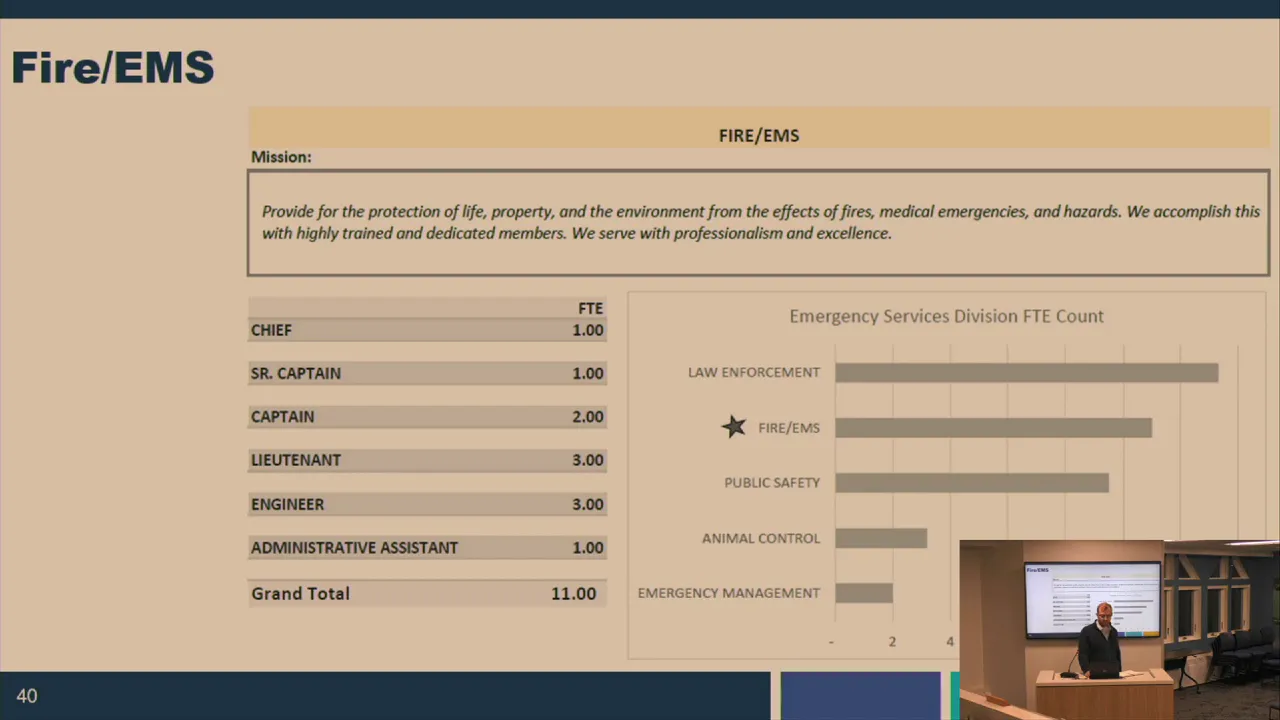
- The fire department budget shows a 3.9% increase, including $125,000 in additional ambulance revenue. Overtime reduced due to full staffing. Training budget increased for new hires.
- Temporary wages fund a person to shovel fire hydrants in winter.
Animal Control
- The budget reflects a shift from one full-time temp to multiple part-time college students for better coverage. Increased intakes have been observed.
Emergency Management
- The emergency management budget reduced training costs by partnering with Coast Guard and State EOC. Focus shifts from supplies to staffing and team training.
Police Department (COPPS 13)
- The police budget reflects a net reduction of $50,000 in payroll due to vacancies. Recruitment efforts ongoing; one officer position was vacant for over a year. Body camera footage processing increased records workload.
Public Safety (Dispatch)
- Dispatch now handles Whittier and Girdwood calls (added without additional staff). Revenue from this contract is positive. Council noted challenges filling jailer/dispatcher positions, currently combined as corrections officers.
Key Outcomes
- Council expressed unanimous support for the school district funding at the requested level.
- The council agreed to defer the additional $100,000 college request for a future work session and keep the base $950,000 in the budget.
- No formal votes were taken on PRCS or emergency services budgets, but council members indicated support for the presented budgets and adjustments.
- City Manager Nate recommended moving $5.1 million in debt service appropriation to the Meals repaving project in 2025 to ensure a clean audit. Council concurred with this recommendation.
- The overall citywide appropriation could grow from $73 million to approximately $78–$80 million depending on capital project decisions, with potential revenue risks from state tax valuation and Tap Settlement expiration.
Note: The meeting was a work session; no formal votes were recorded, but council members voiced consensus on several items.
Meeting Transcript
Okay, we'll go ahead and get this uh budget work session uh going. We'll start. Uh Jordan, take us away. Thanks so much, Mayor. You all know the drill by now. It is education division, which includes contributions to both the college and the schools, school district. There are staff departments in Parks and Rec, there are staff departments and emergency services that we'll get to later. But since we have folks visiting on behalf of those two organizations I mentioned at the beginning, we'll get started. We're gonna start with LD City Schools. In your packet, it staff just put together a little bit of analysis based on some of the information that we got from VCS. Their budget request is pursuant to statutory funding, and uh it is 11.7 million. And if there are questions, I will step aside. Go ahead. Thanks, Jordan. Kicking us off. Um thanks, Superintendent Weber for being here. Um I guess the first question was I get first off. I support um this level of um funding for the schools, but just some questions for understanding. Um in regards to that 162,000 for increased student transportation costs. Could you just explain more why it's going up? I think it was from 94K to 162K in a year. Yeah, and so we've been we had a couple of things happen in the last year. We last year we had to renew our our bus contract, and what I found our contra the the offer that they made, and we only got one bid, and I made several calls out to other companies as well. Um, to keep the same exact services we had the year before is a 26% increase. We negotiated, we ended up taking out a route and consolidating as much as we could. We still ended up with over a three percent increase. Um the issue that we were running into is that we're we're we're dipping into other accounts to be able to make ends meet each year with transportation. So we're kind of getting to a point where we're gonna run out of the ability to fund at fund the routes we have currently this year very soon. Um so me and Amber talked about what it would take to shore up transportation. And this is something you're gonna hear about probably across the state this year a lot. Um, because when I called around other districts to figure out what was like, is this just someone trying to take advantage of us in Valdez, you know, because they have contracts around the state and found out that no, that's that's kind of the case around the state. And when I told them our numbers, they're like, Jason, just take it. You know, I'm like, wait, what? I mean, because then they told me what they were up against for financial constraints with busing and what the what they were pushing back on with these companies coming in. Uh some some school districts have gone to just paying the families to bring the kids in because it's cheaper, unfortunately. Um so in 2015 we were getting um from the state eight hundred dollars per per student for ridership. And now it's 2026 and you know the FY2026, and we're getting you know eight hundred and thirteen dollars. Okay. Back then we were spending five hundred and thirty-seven thousand dollars on transportation. Now we're over seven hundred thousand dollars in transportation. So um the the funding source that's supposed to fund it through the state isn't keeping up, is the reason why we're asking for more in that that area. Um and I do want to thank you guys too for your support and advocacy in the local control piece. And when I listened to the commissioner explain in those work sessions, like, oh, if you've got a special project that has a defined outcome and goal, then that's what special revenue is supposed to be used for. And in this case, um, I know before my time coming here that I think the community had reached out to the schools because of the safety issues with the snow in the community area to ensure that we provide transportation to every student regardless of distance that they live from the school. Um other communities generally it's reimbursable. You take your school and then you you go out one mile and you draw a circle, and then anything in that circle is non-reimbursable. Everything outside of it is what you get money from the state for. Um, but because of our safety issues with in our location and where we live, that's important to us to be able to ensure our kids can get safely to school in the town block. Um so that's another constraint that we have, and we we felt passionate enough about it that we don't want to give up the in town route. And we we felt passionate enough about it that we don't want to give up the in town route.
openpublica.com