Valdez City Council Work Session on Public Accommodation Tax Update – December 2, 2025
STREAMING COPY IN PREPARATION — RECORDING AVAILABLE FROM THE ORIGINAL SOURCE
Valdez City Council Work Session on Public Accommodation Tax Update – December 2, 2025
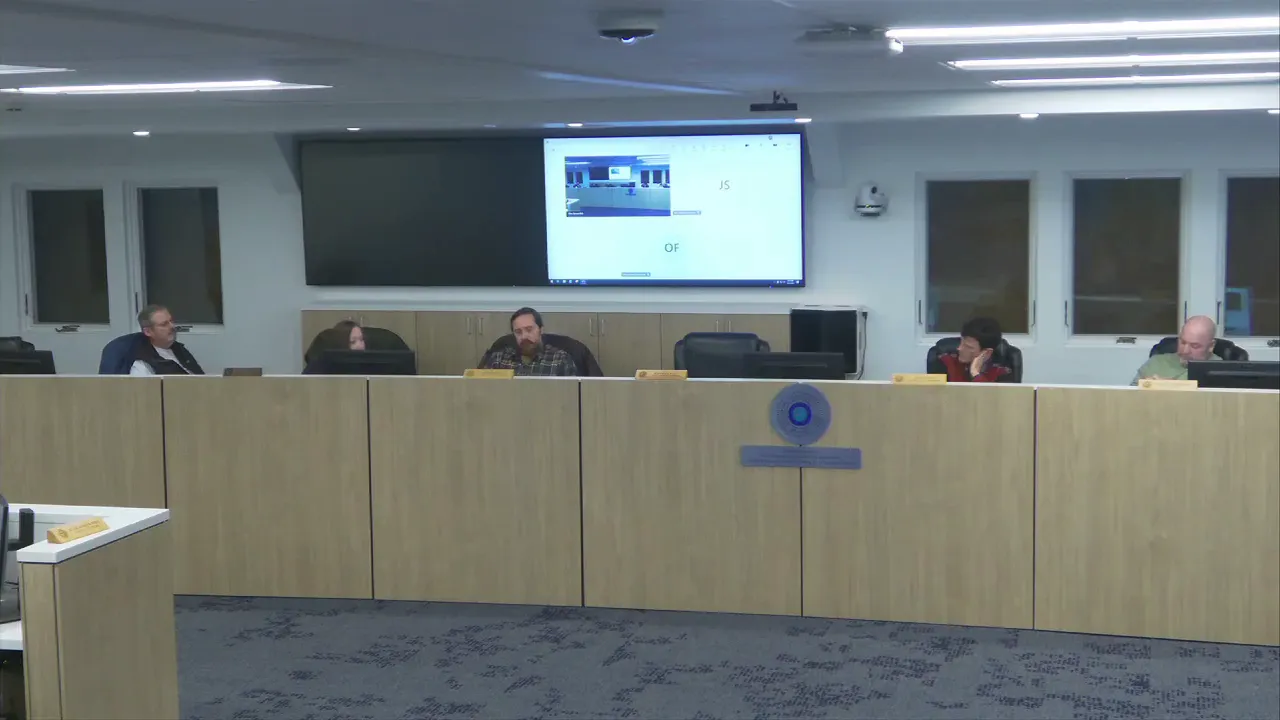
The Valdez City Council held a work session on December 2, 2025, at 6:00 PM to review and discuss revisions to the city's Public Accommodation Tax (bed tax) ordinance. City Manager Nate and staff presented proposed administrative and clerical corrections, and the council debated policy issues including the tax's purpose, expanding the tax base to include RVs and tent camping, and the distribution of funds. No formal votes were taken, but council directed staff to draft an updated ordinance with expanded definitions and to conduct outreach to affected operators before public hearings.
Discussion Items
- Administrative Revisions: Staff outlined several amendments to Title 17: adding "rental cabin" to definitions (already covered elsewhere), removing a one-time-only waiver from 1994, updating confidentiality language to align with public records law, simplifying investigation authority, and correcting collection responsibility from "guest" to operator or hosting platform (e.g., Airbnb, VRBO). The distribution of funds section was revised to reflect current practice (100% of bed tax proceeds appropriated to the Valdez Convention & Visitors Bureau (VCVB) for the last eight years, with no codified grant process), leaving future allocation at council discretion but noting funds are used for economic development.
- Purpose of the Tax: Councilmember Austin Love argued the purpose should be more specific (e.g., tourism development) rather than broad "economic development" to provide clearer guidance. Other members (Councilmember Green, Lester, Olivia) supported adding specificity while maintaining flexibility. The current language directs funds to "economic development purposes."
- Expansion of Tax Base: Councilmember Love proposed including RVs, tent camping, and potentially overnight charters under the public accommodation definition to achieve equity and eliminate "free riders." He noted that six percent on a $50 RV site (amounting to $3) would not deter visitors. Councilmembers Olivia, Lester, and Green agreed, citing equitable treatment of all visitors using city services. Councilmember Whitty expressed caution, citing the administrative burden on finance to track expanded collections and concern about potential loss of visitors, but was not opposed if tracking could be simplified. Mayor Whitty suggested pausing to better assess VCVB's performance before adding new taxes. Councilmember Love countered that the ordinance process provides two public hearings for input.
- Data Presented: Staff shared historical bed tax revenues: historically around $400,000–$450,000, rising to $500,000–$550,000 post-COVID. Short-term rentals (Airbnb/VRBO) contribute an estimated $50,000–$100,000 annually. Economic development appropriations (VCVB, city events, beautification) have often exceeded bed tax receipts. A chart comparing Alaska municipalities showed Valdez's 6% rate is in the middle of the range (3%–12%), with Fairbanks corrected to 8%.
- Distribution of Funds: Council agreed to keep the current ad hoc process (no codified distribution) for now, with plans to develop a more specific process later. Staff noted that bed tax revenues currently go to the general fund, not a dedicated account.
Key Outcomes
- Council directed staff to draft a revised ordinance that expands the definition of "public accommodation" to include RVs, tent camping, and potentially other short-term rentals not currently captured. The goal is to present a first draft in January 2026 (first quarter), with both ordinance hearings completed before May 2026 (summer season).
- Staff will reach out to affected operators (e.g., RV parks, campgrounds) to gather input before the draft ordinance is introduced, ensuring operators are aware of proposed changes.
- No additional public meeting is scheduled before the ordinance process; council will rely on the two public hearings inherent in the ordinance process for community input.
- An effective date for any new tax will be determined during the public hearing process, with discussion of possible grandfathering for existing reservations.
Meeting Transcript
So tonight we're going to talk about the public accommodations tax. What you have before you know the packet is kind of a draft ordinance, I guess if you will. The bulk of the revisions in the ordinance pertain to administrative and clerical corrections that we made or are proposing, I guess. And I'll walk through each of those kind of one by one. There are some policy components to this that have been brought up in various other conversations that staff doesn't necessarily have a strong opinion or a recommendation on them. If you want to know some information, we've done some research and can provide some data. But as far as far as we're concerned, and you may have heard otherwise, that's probably not true. We don't have a recommendation as to the rate or applicability outside of what is currently being done. But the again, the request was to review the ordinance, and uh again, in doing so, there's some administrative changes, and I guess I'll walk through those at this time. I'll just go page by page, it's not very long, it's six pages and only about half a dozen or so uh change recommendations. Uh so the first one to point out is in the definitions where it says public accommodation. We added the term rental cabin. Uh, rental cabins have always been included in the Title 17 definition for public accommodation, but it wasn't explicitly listed in this section of code. So we're simply adding a uh an accommodation that frankly was already included in by definition. Good. And just to clarify, city manager, rental cabin is just what it sounds like the cabin that's for rent, or is it is there something else that I'm missing there? No, yes, that's all it is. As simple as that. Yep, okay. Uh the next one is on page three, uh, page three letter C. We remove the one-time only waiver of penalty or tax returns filed after April 30th, 1994. We figured that was no longer relevant. Uh at the bottom is section E, uh, where it talks about returns to be confidential. Uh, the language that's being proposed is also being reviewed by legal, but uh more or less it's to be in line with public records and FOIA uh statutes. So that's what this language is is trying to embody. But more or less is that returns are held confidential unless and until they're not allowed to be confidential any longer. That's the basic premise of it. Uh, more or less clarifying and cleaning up the language that was in there prior. Again, that's it's still under uh revision and review by by legal to make sure that it's in compliance. Uh the next one is where it talks about investigations by the city. Uh, that was frankly, in our opinion, a lot of legal ease, and so we moved it up into the section above, tried to simplify it and make it uh again using a little bit more common language, but the again the basic premise isn't changing, is that if there's a suspicion that something is not being paid, we have the authority to look into it and ensure that proper taxes are being applied and uh people are paying what what's required. Legal is looking at that as correct. Um so in suits for collection. Uh, in in reviewing this one, it talked about how unpaid taxes may be recovered by the guest. Uh, that didn't make a lot of sense from a practical perspective, it should be the person providing the accommodation. We also added or hosting platform because we do require uh Airbnbs and VRBOs, etc. Those short-term rentals are hosted on a platform who by code are supposed to remit those taxes on their behalf. Uh we have found that they don't. Um so we're still trying to work through that. Anyhow, long story short, the revision to this section is to remove the collection from the guest and put it on the proper party of the operator or the club the hosting platform. Uh distribution of funds. Uh so this uh this is probably more a conceptual revision than than anything. Uh we don't currently follow the process in code. What happens right now uh is that the well, at least for the last eight years, 100% of bed tax proceeds have roughly been appropriated towards the VCBB. We don't necessarily follow this program where it goes into a public fund and then you can solicit grants, etc. So the thought was if we're not doing it, let's not put it in code. And so we remove that. What it does do though is it does still allow for the city council to appropriate funds at your discretion. That's not to say you couldn't set up a separate fund to distribute to some grant program or give them to any other purpose, but more or less our general philosophy has been if it's in code, we should do it or change it if we're not doing it. And so because we're not doing it, the proposal is to change it to what is actually occurring and leave the door open for council to modify or adjust as you see fit.
openpublica.com