Virginia Beach Planning Commission Meeting - June 19, 2026
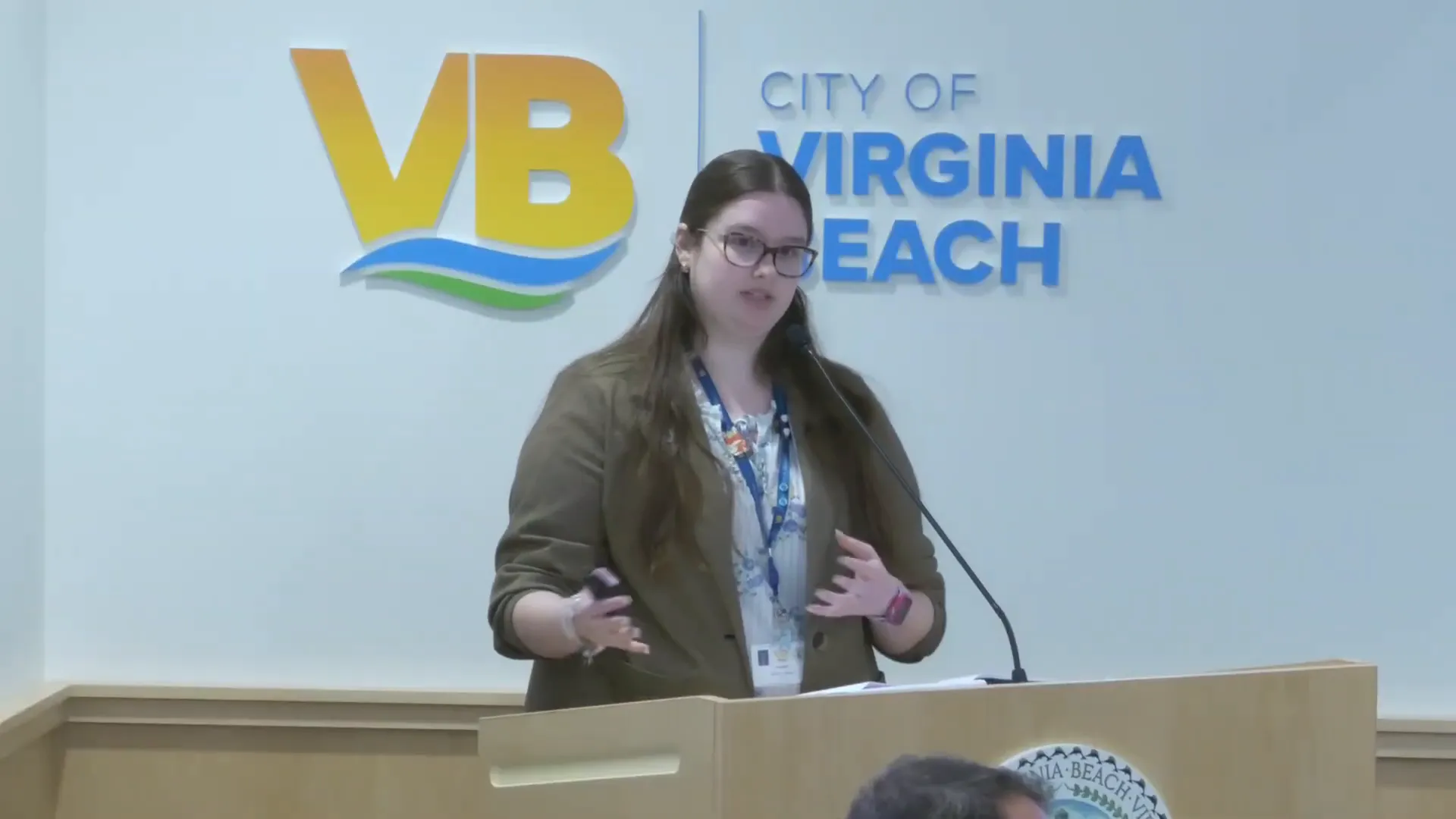
STREAMING COPY IN PREPARATION — RECORDING AVAILABLE FROM THE ORIGINAL SOURCE
Virginia Beach Planning Commission Meeting - June 19, 2026
The Virginia Beach Planning Commission convened on June 19, 2026, for an informal session in the morning followed by a formal public hearing in the afternoon. The commission considered a wide range of items including zoning ordinance amendments, subdivision variances, conditional use permits, rezonings, and short-term rental applications. Key discussions centered on a proposed group home expansion, a mixed-use development on Shore Drive, and several short-term rental permits. The commission recommended approval for most consent items and several contested applications, denied one, and deferred multiple items.
Consent Calendar
- Items 1-5 (Zoning Ordinance Amendments) – Adopted updates to comply with state legislation regarding solar facilities (HB 711), building-mounted antennas (HB 876), parking reductions near transit (HB 888), small lot residential (HB 1212), and mobile homes (HB 1463). All approved unanimously.
- Item 6 – Subdivision variance for 1117 Beautiful Street to correct a 1954 subdivision error. Approved unanimously.
- Item 8 – Modification of conditions for a home occupation (gunsmithing) at 1492 Back Bay Landing Road. Approved with a condition modification clarifying gun transfers.
- Items 15-16 – Conditional rezoning and conditional use permit for an automobile repair garage at 3388 Dam Neck Road. Approved unanimously.
- Items 17-18 – Conditional use permits for an adult daycare facility at 215 and 241 Expressway Court. Approved unanimously.
- Item 19 – Conditional use permit for a food truck (open air market) at 549 Newtown Road. Approved unanimously.
Public Comments & Testimony
- Item 10 (Westminster Canterbury parking garage) – No public speakers; commission heard applicant's presentation.
- Item 11 (City rezoning on Upton Drive) – One speaker in support (Bob Kugler, South Shore Estates Civic League) highlighted community desire for preservation.
- Items 13-14 (Shore Drive condos and commercial) – Nine speakers total; two in support (Dave Redmond, Terry Browning) and six in opposition (Kim Mayo, Wendy Crutchfield, John Moss, Martha Thoreau, Mary Reisemeyer, Leslie Colbertson), plus neutral statement from Ocean Park Civic League. Opposition cited density, traffic, flooding, and precedent.
- Item 20 (Group home expansion) – Thirteen speakers; 12 opposed, one in support. Opponents raised parking hazards, safety, and commercial nature; supporters highlighted compassionate care.
- Items 21-24 (Short-term rentals) – Multiple speakers opposed, citing parking congestion, noise, and neighborhood character.
Discussion Items
- Item 9 (Short-term rental parking modification) – Applicant Jason Cox sought to add a third parking space within right-of-way. Staff confirmed policy allows counting right-of-way parking if it does not impede traffic. Approved on consent at formal hearing.
- Item 10 (Westminster Canterbury parking garage) – Applicant presented four-level, 340-space garage. Commission added conditions from Bayfront Advisory Commission: protect live oaks, replace damaged trees with minimum 4-inch caliper, and applicant committed to restoring ADA beach access. Approved 10-0-1 (Plumley abstained).
- Item 11 (City rezoning from R7.5 to P1 Preservation) – City real estate agent explained the 1.68-acre parcel was acquired in 1985. Civic league president supported preservation. Commission debated housing need vs. hospice house buffer and easement constraints. Approved unanimously.
- Items 13-14 (Shore Drive mixed-use condos) – Applicant highlighted community outreach resulting in reduction from 197 apartments to 52 for-sale condos. Public works director clarified stormwater pump station location is not finalized. Commission discussed density (23.6 units/acre), height deviations, traffic, and stormwater. Approved 10-0-1 (Plumley abstained).
- Item 20 (Group home expansion from 8 to 14 residents) – Owner Charlene Livers testified to five-year record of care. Neighbors reported parking overflow, ambulance delays, and safety risks. Applicant willing to add parking and signage. Commission denied 7-4, citing insufficient parking and neighborhood burden.
- Items 21-24 (Short-term rentals) – All four applications were within the STR overlay. Commissioners approved three (items 22, 23, 24) and one (item 21) – one commissioner voted against citing neighborhood disruption. Approved 10-1, 9-1, 9-1 respectively.
Key Outcomes
- Consent Agenda – All 12 consent items approved unanimously (items 1-6, 8, 15-19).
- Item 7 – Deferred 30 days at applicant's request.
- Items 12 and 25 – Deferred indefinitely.
- Item 9 – Recommended approval.
- Item 10 – Recommended approval with additional landscaping conditions.
- Item 11 – Recommended approval.
- Items 13-14 – Recommended approval.
- Item 20 – Recommended denial (7-4).
- Items 21-24 – Recommended approval (votes: 10-1, 10-1, 9-1, 9-1).
- New Business – Commission voted 10-0 to request a 60-day extension from City Council to consider the short-term rental boundary overlay; parking amendment will proceed to July meeting.
- Site Visit Abstentions – Commissioners Cromwell, Kiffin, Maush, Morjani, and Plumley abstained from voting on site visit minutes.
- Meeting Schedule – Staff presented analysis showing moving the commission's hearing date would disrupt City Council timelines; commission decided to maintain current schedule.
Meeting Transcript
Good morning, everyone, and thank you, planning commissioners of CSF for your participation today. My name is John Coston, and I'm the chair of the G Planning Commission. Welcome to the June 10th informal session of the Virginia Beach Planning Commission. All this meetings or the staff anything have anything for us. I'll have any updates this morning. I know we have a full agenda, so we'll allot the time to that. Let's get started. Good morning, everyone. I'm Hannah Setho, the zoning administrator for the city of Virginia Beach. Um, these next five items were all briefed to you previously, and our updates to the zoning ordinance in response to the new bills that were approved by the state legislature to bring our ordinance into compliance with that updated state code. Item one is an ordinance pertaining to solar facilities as conditional and accessory use. This update is in response to House Bill 711. It codifies an existing interpretation that permits accessory solar equipment and adds solar facilities as a principal use with a conditional use permit in the agricultural business and industrial districts. The change to state code now requires that localities permit solar facilities in certain districts. We can require conditional use permit, which is what this ordinance does. So it adds the use to those districts, which are the agricultural districts, business districts, and industrial districts, again, with a conditional use permit required. Solar facilities would have to comply with all of the district screening and setback requirements of that base district, and then any conditions that are added to that conditional use permit. Due to the short turnaround for this amendment, um we did not include specific use conditions in the code, but we could always come back and add those to the zoning ordinance. And in the meantime, any conditions that are specific to the use specific to the site can be added during that conditional use permit process. For accessory structures, this amendment um codifies the existing interpretation that already allows solar panels as an accessory structure on the roofs, they must meet the height requirements, and then ground mounted equipment must comply with the accessory structure setbacks and size limitations for accessory structures. So the same setbacks and size limitations that you would have for any other, like a shed, for example, in your backyard. Any questions on solar panels? One quick question that will apply to all six of these. I'll just ask it once. When the state law changed, and you had to then take those changes and incorporate them into our code. Can you tell us did you exercise any discretion or did you only make a limited change permitted by state law? For example, if it said you must change this, of course, you would change just that. But if it said you may change for a range of things, did you change it for a range of things or just one thing? So the answer is yes and no. Um, because all of these changes were requirements for state code, so there was not a discretionary decision on should we bring this forward for your consideration. But there are elements to some of these, such as the small lots ordinance that Hannah will be getting to that said that we have to have single family as a permitted use in a small lot, and they need some dimensional requirements that they did not nitpick far enough to say your front yard setback has to be this. Your lot with for all dimensional requirements, so there was a little bit of discretion that was exercised in that way, but um all of these were must adopt something in in this fashion. Understand. So if it in any of the other five, if there is some element like you may extend it to five different types of use districts, and you chose to do all five instead of just three, for example. Could you just tell us if one of those examples arises? Yes, I will do my best to try and keep some of those. Yes. Okay. So for moving forward to the um next one, item two is an ordinance to amend section 207 of the city zoning ordinance pertaining to building mounted antennas, small wireless facilities, and temporary communication towers. So this uh amendment is in response to House Bill 876, which provides specific requirements and limitations for how locality can regulate these temporary wireless structures. And I will note that this is one that they have very specific requirements. So I think everything listed in here is directly from the state. Um, temporary wireless structures are monopoles or other wireless communication facilities that are used to provide wireless transmissions within a designated area. They do not have a permanent foundation. And so these types of structures are used during times when an increase in wireless coverage is needed. So during a city permitted special events, wireless testing outages during an emergency, and in the code, we specify which of these that you have to meet one of these conditions in order to get this permit. They're approved for 180 days initially with an option to extend up to two years if that event or incident is continuing. The wireless provider is required to restore the installers required to restore the site within 48 hours of removal. Okay, sorry, any questions on that one? Item three.
openpublica.com