Wichita City Council Workshop – November 26, 2024
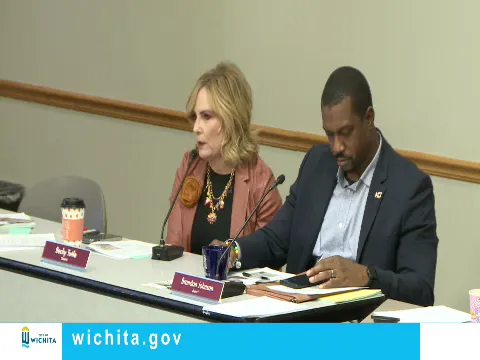
STREAMING COPY IN PREPARATION — RECORDING AVAILABLE FROM THE ORIGINAL SOURCE
Wichita City Council Workshop – November 26, 2024
The workshop covered four major agenda items: proposed amendments to illegal camping ordinances, an update on drought response and water supply resiliency, potential changes to City Council Policy #9 regarding zoning items, and revisions to zoning notification processes. Council members provided feedback and guidance on each item, with a consensus to advance the camping ordinance to a vote and to refine notification procedures.
Illegal Camping Ordinance Amendments
- Presentation by Sharon Dickraft (City Law Department): Overview of current ordinances from 2013, WPD Hot Team, and recent costs: in 2024, $165,000 in contractor fees for WPD cleanups; Parks cleaned 1,700 campsites using 1,300 staff hours and $33,000. Proposed revisions: allow immediate cleanup at publicly visible/ safety-critical locations (doorways, sidewalks, bridges, bus shelters, playgrounds, and the MAC); 48-hour notice for other areas; reduce maximum fine from $500 to $200; outline property seizure and storage procedures (30 days for IDs and non-soiled items); repeal the rarely-used aggressive/harassing conduct ordinance (70 citations since 2020, many dismissed); and add pedestrian safety provisions targeting median standing and traffic obstruction.
- Council Discussion: Councilmember Johnson expressed concern about the lack of shelter capacity before the MAC is fully operational (full buildout expected late 2026), particularly for families, domestic violence victims, and those unwilling to use shelter. He questioned enforcement when no bed is available. Councilmember Hoheisel noted the city should balance enforcement with compassion and emphasized housing as the key bottleneck. Mayor and several members supported early implementation, citing increased shelter capacity (230 beds this winter) and the need for public trust. Councilmember Tuttle highlighted the importance of the Homeless Outreach Team’s discretion and suggested exploring a homeless court. Vice Mayor Ballard indicated flexibility on timing.
- Next Steps: Council directed staff to bring the ordinance for a formal vote on December 17, 2024. Some members requested minor clarifications (e.g., extending the MAC buffer from 50 ft to 500 ft, adding weapons to immediate-threat property classification).
Drought Response and Water Supply Resiliency
- Update by Gary Jansen (Public Works & Utilities): Despite record November precipitation, Cheney Reservoir remains 7.5 feet below normal. Stage 2 drought restrictions continue; Stage 3 may be reached by late 2025 if conditions persist. The 8-year drought plan is working as intended. Long-term strategies include: expanding the Aquifer Storage and Recovery (ASR) project with new recharge basins funded by the Bureau of Reclamation; a reuse feasibility study beginning in early 2025 to explore direct potable reuse and industrial reuse from the city’s 40 million gallons per day of treated effluent; and partnering with the development community (WABA) to encourage drought-tolerant landscaping over traditional fescue. Other communities’ permanent restrictions (Hayes, Oklahoma City, Denver) are being studied for possible adoption in Wichita.
- Council Feedback: Council members expressed strong support for conservation leadership, water reuse, and permanent behavioral changes. Councilmember Tuttle suggested tax credits or incentives for new developments to prepare for future recycled water use. Gary Jansen noted that the new water treatment plant (Wichita Waterworks) will bring flexibility to use more groundwater, but full transition will take time. The city’s wholesale customers (Derby, Valley Center) are developing their own treatment plants, which could reduce peak demand.
- No formal action taken; staff will continue outreach and bring recommendations in spring 2025.
Potential Changes to Policy #9 – Zoning and Planning Items
- Presentation by Scott Weddle (Planning): Current policy places zoning items on the non-consent agenda if they receive any protest (even a single one) or if DAB and MAPC recommendations differ. Proposed change: only trigger non-consent if protest petitions represent more than 20% of the statutory protest area, or if recommendations differ, or if an appeal is filed. This aligns with state statute threshold for changing the required council vote. Council members requested a geographical calibration: a protest should only shift an item from consent if the protesting property is within a reasonable distance (e.g., 1,000 feet) of the subject site, to prevent citywide protests from forcing unnecessary hearings.
- Consensus: Council supported the 20% threshold concept but directed staff to add a proximity condition (e.g., within 1,000 feet) for protests to trigger non-consent. Items with differing DAB/MAPC recommendations or applicant appeals would remain on non-consent. Staff will revise and return with a final draft.
Zoning Notification Letters
- Discussion led by Scott Weddle: Current notification distances vary from 200 to 1,000 feet depending on site size. Research shows most peer cities use 200–300 feet. Expanding to 500 or 1,000 feet would substantially increase costs (applicant $2,000–$7,000; city $300–$1,000 per case). DAB feedback was mixed on distance. Council consensus: do not expand notification distance, but add tenant notification as a courtesy at minimal cost (approx. $2 extra per property for applicant, plus $2.64 per additional letter for city). Staff will also streamline the notification letter content and explore translation options (e.g., adding a line directing readers to online translation services). A switch to postcards was rejected as unlikely to save money.
- Outcome: Staff will prepare updated notification letters that include tenants (occupants) and simplified text, and will explore multilingual options. The draft policy changes will be brought back for formal adoption.
Meeting Transcript
Has to do with uh encampments and also solicitation in the city. Uh this is part of uh uh overall strategy now that uh we have taken steps to create the multi-agency center, excuse me. Uh the council has said what can we do to address the encampment issue now that we have a resource uh available to us. So staff has been spending a significant amount of time uh trying to work through all of the issues. How do we um uh eliminate this uh some of the problems created by encampments, but in a humane way, and I I think we found a good balance in that regard. So with that, I'm gonna turn it over to Sharon Dickraff uh to present the ordinances for your review and comment. Good morning, Sharon Dickraft City Law Department. A little bit about the history of our camping ordinances. Um they were passed in 2013. At that time, the Wichita Police Department started what is known as the Hot Team. Um the team focuses on homelessness, and their goal is to connect people who are homeless with the necessary services and housing. The hot team and WPD officers have been the primary point of contact for enforcement of illegal camping ordinances. WPD policy currently is based on federal case law that limits charging illegal camping to situations where there is a shelter bed available, and then the person refuses to go to shelter. WPD policy also currently requires that illegal campsites be posted for 72 hours prior to cleanup. Up until recently, the Wichita Police Department had a private contractor to assist with cleanups. Park has also been responsible for illegal encampment cleanups on park and other park, other public property. A little bit about costs. Um these are costs for for Wichita Police Department. So far in 2024, approximately 165,000 has been charged to the contractor fees. These costs do not include WPD staff time hours to post and assist the contractor with any cleanups. Parks has also been heavily involved in these cleanups in 2024. Park cleaned up approximately 1,700 campsites, utilizing 1,300 hours of staff time and $33,000 in additional cost. So I wanted to give a couple examples of uh illegal camping, and I chose these for a purpose. Um this first group is an a more less dense area as far as a population. Um not something that the public would have a lot of use for this property. These properties are going to be treated differently in the ordinances that is proposed versus this, which is a street in downtown Wichita. Um clearly uh the street and sidewalk is impeded, traffic is impeded, people could not walk along those sidewalks. Um you will see in this picture, uh actually both pictures, the bright green notice that is currently the process that PD is using is that it is posted, uh, then 72 hours later, uh it can be cleaned up. Since early 2023, members from a number of departments have been working together, um, as I think has been stated early. This is not a one way to fix homelessness. Um it's gonna take a group effort of uh internal staff working with our partners in the community. WPD, uh public works, park, housing services, MABCD and law were our part were all part of the working group. A lot has been said about grant pass. Grant PAT was a Supreme Court decision, which was uh decided recently that clarified what cities can do regarding illegal camping. Um the opinion held that uh sentencing provisions in this particular ordinance did not violate the Eighth Amendment. Um the court also held that there was no legal requirement that a shelter bed be available to enforce the illegal camping activities. Um this case came from the Ninth Circuit, which tends to be a pretty liberal and many cases from the Ninth Circuit limit what municipalities can do regarding these types of activities. Number of ordinances, amendments are being proposed, illegal camping, camping in parks, um, aggressive and harassing conduct, and pedestrian conduct. Illegal camping, the revisions that you have, the definitions are refined and expanded to provide clarification as to what it is that we are trying to prohibit. The ordinance is revised to allow clicker, quicker cleanup at certain public visible locations, which is similar to the photographs that I presented, doorways, sidewalks, areas near bridges, bus shelters, playgrounds, and the MAC. These locations could be cleaned up without a waiting period or posted notice. For locations that are less visible, individuals will be given 48 hours notice to leave or clean up the property. If no one is present at those locations, the location will be posted with 48 hours to vacate. The notice will provide information on homeless services and the process to retrieve any property of value or identification information. If the person is present and refuses to leave and clean up the property or has been told previously that they cannot camp there, the individual may be cited with a violation of the camping ordinance. The ordinance also outlines a process and procedure for the items that are seized or impounded. They require that staff, if we find any identification documents, any non-soiled workable items, that those be maintained for a period of at least 30 days. Items that are soiled, mildewed, broken, or inoperable do not have to be maintained. Parks will be responsible for storage and return of these items. Currently, I think the plan is to use a portion of rounds and porter to store these items for the 30 days.
openpublica.com