4641
SEP 22, 2026 · NEW ALBANY, INDIANA · CITY COUNCIL & BOARDS
New Albany City Meeting – September 22, 2026: Brief Session and Adjournment
PROCEDURAL 100%
The meeting was held on September 22, 2026, at 17:00 UTC. No agenda or minutes were available, and the raw transcript is largely garbled. The only formal action was a motion to adjourn, which carried unanimously. Procedural Notes & Remarks - One speaker mentioned their wife's ongoing recovery from an unspecified health issue and noted an upcoming sleep study scheduled for October 8th. - A speaker referenced a list of upcoming events provided by "Tony," including a groundbreaking scheduled for the 28th and a parking map that was said to have been sent via email. Key Outcomes - Motion to adjourn was made, seconded, and carried by voice vote (all in favor).
The Budget and Finance Committee met on September 22, 2026, at 1:00 p.m. to discuss three major agenda items: identification of peer cities, a proposed budget amendment, and an ordinance to cap property tax increases. No public comments were heard. The committee decided to continue deliberations at a follow-up meeting on September 29, 2026. Consent Calendar - No consent calendar items were presented. Public Comments & Testimony - No public comments were received. Discussion Items - Identification of Peer Cities: Dr. Acuff presented a list of 15 peer cities from his budget analysis. Council members discussed the need to ensure apples-to-apples comparisons, especially regarding wastewater and other enterprise funds that affect full-time employee counts. The administration expressed comfort with the full list, but council prefers to narrow it to 5–7 cities. Councilwoman Heel raised concerns about confidence in comparability for specific departments (e.g., fire ISO rating). Councilman Clark suggested the council first decide what metrics to compare rather than rely solely on Dr. Acuff’s list. The committee agreed to gather further input via email and revisit the topic next week. - Budget Amendment: Chairman Henderson introduced a proposed budget amendment drawing from the unreserved fund balance (targeting 29% reserve) for the following items: $17.5 million for mold remediation at the police service center (with additional $1.5–2.5 million contingency), $3.6 million for a one-time holiday bonus of $1,000 per full-time employee (possibly tiered), $250,000 for a WTCI endowment, and $245,000 to preserve early learning seats at Purpose Point Learning Academy. Chief added two more items: funding for an Eastdale Collaborative project through the Enterprise Center (amount not finalized) and a reallocation of existing Bessie Smith Hall reserve funds (estimated $250,000) for capacity-building toward the museum's “Dream Forward” project. Councilwoman Hill questioned the lack of detail on several items, noting the large size of the amendment early in the fiscal year. Councilwoman Dotley requested specifics on the holiday bonus (whether part-time employees are included, potential tiering) and whether moving to a new building might be more cost-effective for police. Chairman Henderson urged council to email additional questions for next week’s meeting. - Ordinance to Cap Property Tax Increases: Chairman Henderson presented an ordinance to cap future property tax increases at 12% over the previous year, unless a supermajority of seven council members approves a higher amount via roll call. The 12% figure is based on Chattanooga’s historical average over four-year reassessment cycles. Council members expressed support, with Councilwoman Dotley and Councilman Harvey favoring the cap for taxpayer protection. Councilman Clark asked about frequency of increases and suggested tying the cap to revenue growth or cost increases. Councilman Harvey noted that some states (e.g., Texas) have similar caps. The committee took no formal vote but agreed to continue discussion. Key Outcomes - Peer Cities: The committee will collect council members’ criteria for comparison via email and aim to narrow the list to 5–7 cities for the September 29 meeting. - Budget Amendment: No decisions were made. The committee will hold a special meeting on Tuesday, September 29, 2026, from 1:00 to 3:00 p.m. (possibly adjusted to 12:30 p.m.) to discuss detailed proposals and costs. Council members were asked to submit questions in advance. - Property Tax Cap Ordinance: The ordinance was introduced and discussed but not voted on. It will be revisited in future meetings. - Next Meeting: Scheduled for September 29, 2026, from 1:00 to 3:00 p.m., with the possibility of starting at 12:30 p.m. The committee will focus on the budget amendment and peer city selection.
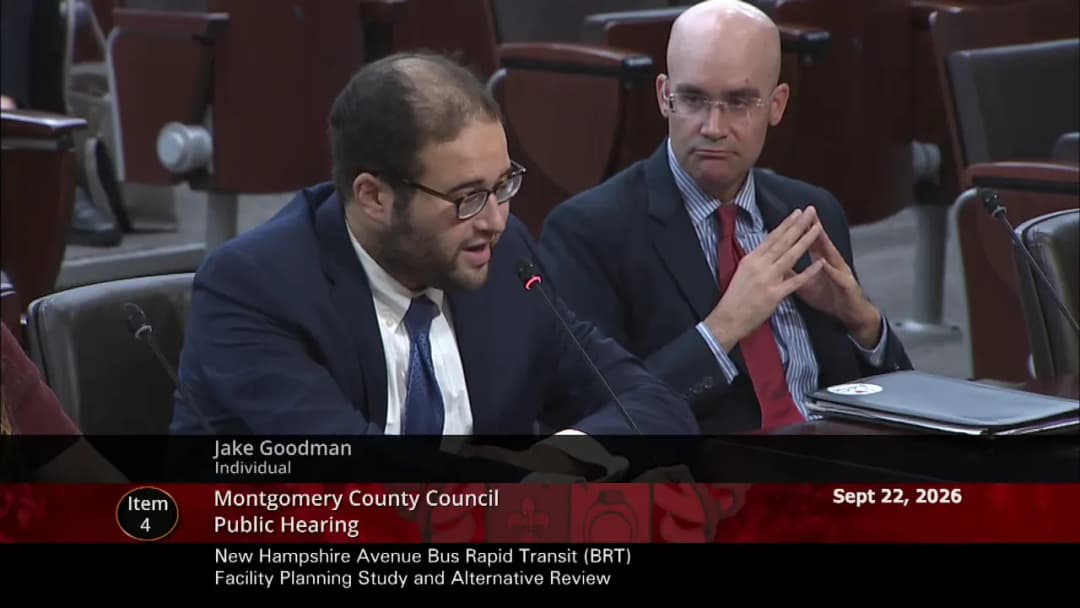
The Montgomery County Council met on September 22, 2026, for a full-day session that began with two proclamations—recognizing National Senior Citizens Day and celebrating the county's 250th anniversary—and continued with four public hearings and a district council session. Key actions included a resolution to approve an amendment to the FY27-32 Capital Improvements Program for road resurfacing, which was adopted after a public hearing, and the introduction of a resolution to revise the process for zoning text amendments. Presentations & Proclamations - National Senior Citizens Day (11:45 a.m.): Councilmember Sayles presented a proclamation recognizing National Senior Citizens Day. Remarks were delivered by Wayne Berman (co-chair, Commission on Aging), Wina Dixon (program manager, African American Health Program), Jennifer Holes (senior associate state director, AARP), and Dr. Patrice McGee (director, Aging and Disability Services, DHHS). Speakers highlighted the contributions of older adults and advocated for equitable transportation, affordable housing, caregiving, and social connection. Dr. McGee noted that residents aged 60 and older will make up 25% of the county’s population by 2030 and 27% by 2040. - 250th Anniversary of Montgomery County (1:00 p.m.): Council President Natalie Fani Gonzalez led a ceremony recognizing the county’s 250th anniversary. Speakers included County Executive Mark Elrich, former County Executive Ike Leggett, Maryland Secretary of State Susan Lee, Delegate Lily Chi, former Councilmember Nancy Navarro, Matt Bohn (president, Montgomery History), and Michelle Johnson (Maryland 250 Commission). Speakers reflected on the county’s transformation from a segregated, mostly white community to a diverse, inclusive population (currently 16% Asian, 21% Black, 22% Hispanic, 43% White). The proclamation was read and presented. Public Hearings & Testimony Amendment to FY27-32 CIP – Resurfacing: Residential/Rural Roads (No. 500511) - The public hearing was held at 1:30 p.m. with no registered speakers. The record was closed immediately, and the Council proceeded to action. Bill 36-26 – Fire and Emergency Services Commission – Duties and Responsibilities - A public hearing was held; no speakers registered. The record remained open until September 23, 2026. A Public Safety Committee worksession was scheduled for September 30, 2026. Bill 37-26 – Disruptive Behavior – Public Facilities – Amendments - The Council heard testimony from nine speakers. In support: Earl Stoddard (Assistant Chief Administrative Officer, for County Executive Mark Elrich) argued the bill is necessary to address rare but egregious behavior, clarified that the current process (since 2004) has been used only once for a juvenile, and announced the Executive’s intent to seek input from the Intellectual and Developmental Disabilities Commission and to develop a community engagement mechanism prior to the October 19 joint committee worksession. In opposition: - Dina Ilebewitz (Jews United for Justice, in collaboration with Black United Front of Montgomery County) expressed concern that the bill would disproportionately affect vulnerable residents, could restrict free speech, and would increase police contacts. - Patricia Tumi (We the People Civil Rights Organization) argued the bill is improperly filed under civil rights jurisdiction and could lead to criminalization of presence in public spaces. - Brenna Olsen (Shepherd’s Table) supported the possibility of longer-term orders in extreme cases but opposed bans covering multiple facilities, warning it could criminalize access to essential services for unhoused individuals. - Thomas Gibson (Neville Street Emergency Men’s Shelter resident, Housing Justice Montgomery) testified that since 2019, 739 disruptive behavior orders had been issued, 78% from libraries, and that Black residents (18% of county population) constitute over 61% of the unhoused population. He argued the bill would effectively criminalize homelessness and urged investment in behavioral health outreach instead of expanded exclusion. - Robert Gravit (plaintiff in a federal lawsuit against the county) described receiving a DBO at a Bethesda pool in 2021, claiming the process lacked due process and the underlying statute was not violated. - Marley Polito (Young People for Progress) opposed the bill as written, citing insufficient safeguards, potential equity impacts on youth and communities of color, and the need for narrow criteria limiting bans to single facilities and shorter durations. - The hearing record remained open until October 12, 2026. New Hampshire Avenue Bus Rapid Transit (BRT) Facility Planning Study and Alternatives Review - Seven speakers testified, all in support of advancing the hybrid alternative recommended by MCDOT and the Planning Board. - Mike Larkin (Action Committee for Transit) supported the hybrid alternative for allowing both Ride-On and Metrobus to use curbside bus lanes, called for repurposing travel lanes, and emphasized the need for immediate safety improvements on New Hampshire Avenue (citing a pedestrian strike less than two weeks prior). - Jake Woodman urged immediate frequency improvements countywide, noting he could not travel car-free due to long headways. - Julian Beckett supported the hybrid alternative and bus priority lanes to improve safety and reduce emissions, referencing recent fatal accidents on the corridor. - Bill Pugh (Coalition for Smarter Growth) supported the plan, noting New Hampshire Avenue serves 14,000 daily bus trips, aligning with Thrive 2050 goals and safety needs. - David Schneider supported BRT and called for incremental improvements like priority turn signals. - Alexis Larames (White Oak resident) supported bus lanes to make transit competitive with driving. - The hearing record remained open until October 12, 2026. Key Outcomes - Resolution to approve CIP amendment (Resurfacing: Residential/Rural Roads): The public hearing was held and the record closed. The Council then voted to adopt the amendment. According to the meeting minutes, the resolution was adopted with 9 votes in favor (DL voted yes; EG abstained). (The transcript described the vote as unanimous, but the official minutes indicate the abstention.) - Bill 36-26: Public hearing held; record open until 9/23/26. - Bill 37-26: Public hearing held; record open until 10/12/26. The County Executive’s office announced it would seek input from the Intellectual and Developmental Disabilities Commission and develop a community engagement mechanism before the joint worksession scheduled for 10/19/26. - New Hampshire Avenue BRT: Public hearing held; record open until 10/12/26. A Transportation and Environment Committee worksession is scheduled for 10/19/26. - District Council Session: A resolution to approve revisions to the Process for the Introduction and Consideration of Amendments to the Text of the Zoning Ordinance was introduced (sponsored by Councilmember Ndou). Action is tentatively scheduled for September 29, 2026.
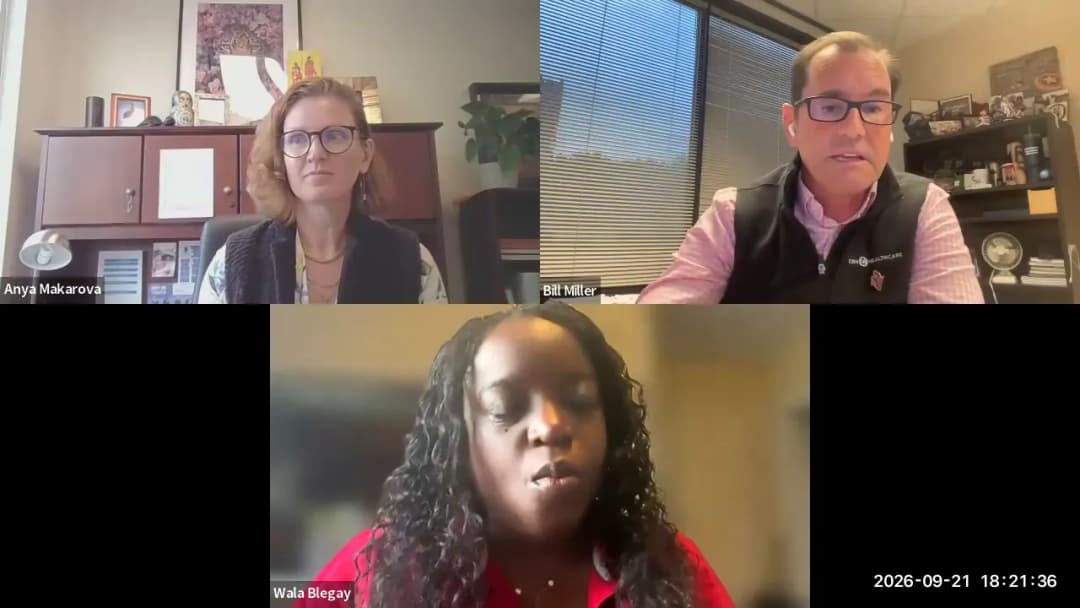
The Prince George's County Council Emergency Room Away Times Task Force met on September 22, 2026, at 4:45 PM ET to review and consider a revised draft report, address state concerns, and discuss next steps. The meeting included roll call, adoption of prior minutes, a presentation of the revised report, and extensive member discussion about the removal of key sections. The task force decided to invite HSCRC representatives to a future meeting to clarify state concerns before voting on the report. Consent Calendar - Minutes Approval: The task force adopted the minutes from the February 2, 2026 and April 13, 2026 meetings. Motion by [member], seconded. Roll call vote: 8 ayes, 1 abstention (Dr. Archinnard, who was not present at those meetings). Approved. Discussion Items - Revised Report Overview: Staff member Anya presented a summary of the revised draft report, which was condensed from the original 60-page, 32-recommendation version to a 19-page, 9-recommendation version. The revision was led by former Deputy Chief Administrative Officer Erica Turner in response to concerns from the state (specifically HSCRC and the Governor's office). Removed sections included analysis of HSCRC's role and global budget revenue methodology, bed capacity trend data, urgent care structural barriers, post-acute care, fire/EMS staffing, and equity infrastructure. The health department (Andrew Ballard) provided a comparative analysis, noting the revised report retains core data and direction but in a condensed format, and offered no objection to adoption. - Member Concerns: Mr. Bill Miller expressed strong concern that the original report represented two years of work and that removing sections (e.g., HSCRC payment program, urgent care access barriers) materially changed the findings. He questioned who requested a concise report and felt an outside force (state/governor) altered the task force's product. Councilmember Bligay acknowledged the political pressures—the Governor's office reached out, and county officials needed state buy-in—but argued the revised report still makes the key points. Dr. Archinnard suggested including an appendix or note acknowledging the longer version. Another member asked for clarity on why the full report was rejected, noting confusion about whether HSCRC or the Governor's office drove the changes. - Path Forward: Councilmember Bligay made a motion to adopt the revised report. However, due to lack of a second and member unease, the motion was not voted on. Instead, the task force agreed to invite HSCRC representatives to a virtual meeting within two weeks to explain their concerns directly. Councilmember Bligay noted her term ends in late November; if the report cannot be finalized by then, the task force may dissolve or be handed to another council member. Key Outcomes - Minutes approved from February 2 and April 13, 2026. - No vote on the revised report; motion was not seconded. - Directive: Task force staff to schedule a meeting with HSCRC representatives within two weeks (by early October 2026) to discuss state concerns. - Materials: A side-by-side comparison of the original and revised reports will be distributed to members. - Deadline: Councilmember Bligay indicated a desire to release a report before her term ends in late November 2026; if unresolved, the task force will be suspended and potentially reassigned.

The meeting scheduled for September 22, 2026 at 16:30 UTC did not have an agenda, minutes, or transcript provided for summarization. Therefore, no details about discussions, decisions, or public comments can be included.

The Los Angeles City Council held its regular meeting on Tuesday, September 22, 2026. The council took unanimous action on most consent and contested items, continued two items, and heard extensive public testimony. Major actions included approval of a more than $450 million affordable-housing NOFA round, support for a behavioral-health crisis-response workforce, a resolution backing SB 1246 on autonomous vehicles, and recognition of Braun’s Law. Councilmembers also debated the city’s application and role in the regional homelessness Continuum of Care. Consent Calendar / Routine Approvals - Items 5, 6, 8, and 10 were approved by a 10-0 roll-call vote after item 3 was pulled for a separate vote. - Items 7 and 9 were approved 12-0 after Councilmember Price recused himself because his wife’s previous employer worked on those projects. - Items 1, 11–33, 36, 38–39, 42–55, 57–62, and 66–72 were approved 13-0. - Item 2 was continued to November 10, 2026; item 56 was continued to September 29, 2026. - Item 37, a city attorney commission appointment that had been withdrawn, was received and filed on a 13-0 vote. - Item 65, the Budget and Finance Committee report, was moved/approved 13-0. - Closed-session litigation items 73–85 were approved 13-0, including refund payments and settlements; the largest listed settlement was $5,499,904.45 plus 7% interest. Public Comments & Testimony - Several speakers urged the council to pass item 4 and protect Measure ULA funding, describing the next NOFA as over $450 million for affordable housing, including representatives from Act LA Coalition, Sage, and SCANPH/United to House LA. One speaker cited 5,600 affordable homes already produced through ULA and the creation of union construction jobs. - A speaker on behalf of the mini-mart applicant (item 2) asked for approval of the conditional use permit, noting the zoning administrator had approved it, 101 community signatures supported it, and the proposed alcohol display would be less than 2% of the store display. - A Salvadoran TPS holder and CARECEN representatives urged support for item 3, saying about 170,000 Salvadoran TPS holders are in legal limbo and asking the city to expand multilingual outreach, immigration legal services, work-permit and driver’s-license education, and family preparedness. - Commenters on homelessness items 63/64 asked that after-hours outreach be built into the new system, that night/weekend/holiday services be funded, and that relationship continuity be preserved during RV cleanups. One speaker cited wound-care street teams and a family that moved into permanent housing after volunteers stayed connected. - General public comment included demands for city-accountability investigations, criticism of the city attorney’s handling of human-trafficking complaints, allegations about Scientology’s role in the Hollywood parade and city advisory bodies, opposition to street vacations, and calls to restore street-lighting and public-works funding. One commenter criticized police overtime, homicide rewards, and the budget; another asked that Sergeant Duarte be assigned to robbery/homicide. - Animal-welfare commenters asked for more support for community cats/TNR and reported that Best Friends Animal Society’s Adventure Buddy Day with LA Animal Services drew 395 dogs and resulted in 23 adoptions. - Virtual callers also criticized the withdrawn ethics-commission appointee and questioned the city’s climate-commission plans. Discussion Items - Welcome and Recognition: The council recognized the Historic Highland Park Neighborhood Council as a finalist for the 2026 Neighborhood Council Excellence Awards. - Item 3 – TPS Preparedness: Councilmember Soto Martinez said the Trump administration has stripped Temporary Protected Status from several countries and warned that hundreds of thousands of Salvadoran families are in limbo. Councilmember Hernandez recommended that TPS holders seek information from trusted organizations such as CARECEN and CHIRLA. A roll-call vote was taken; the transcript does not state the final tally. - Item 4 – Affordable Housing NOFA: Councilmember Padilla said the Housing Committee advanced more than $450 million for new construction, preservation, and operating assistance and directed LAHD to make programs easier to navigate. Councilmember Jurado said the investment would have major impact in CD14, where nearly 70% of residents are renters. LAHD plans to open the NOFA on October 13, 2026. The item passed 13-0. - Items 34/35 – Crisis-Response Workforce: Councilmember Blumenfield said the city should build a career pipeline for unarmed crisis-response workers and behavioral health professionals, using opioid settlement dollars. Councilmember Hernandez added support. The items passed 13-0. - Item 40 – Autonomous Vehicles: Councilmember Hernandez moved the city to support SB 1246, arguing AVs are using public streets without paying for infrastructure and that first responders are left to handle problems. The item passed 13-0. - Item 41 – Braun’s Law: Councilmember Park described SB 907/Braun’s Law, signed by Governor Newsom that weekend, and the advocacy of Jennifer Levy. The item passed 13-0. - Items 63/64 – Homelessness Continuum of Care: Councilmember Jurado said the city receives only about 20 cents back per dollar of Measure A sales-tax contributions and argued the city should apply to take on HMIS and coordinated-entry functions for the LA Continuum of Care. Councilmember Blumenfield expressed doubt about the city winning the application but called for agency over beds and transparency. Councilmember Rodriguez sharply criticized the county and LAHSA. Assistant CAO Meg Barclay confirmed the application would cover the region, including 85 cities and three other continuums. After debate, the clerk said there was nothing before the council to vote on for item 63, so no action was taken on item 63. Item 64 passed 13-0. - Other announcements: Councilmember Jurado said Governor Newsom declared a state of emergency ahead of El Niño, with a projected 69% chance of a record-strength event, and moved to report on shelter and homeless-response preparedness. Councilmember Blumenfield honored intern Felina Rothwell. Councilmember Price invited the public to the Latino Carnival in CD9 on Saturday. Key Outcomes - Item 4 approved 13-0: more than $450 million affordable-housing NOFA, with LAHD opening applications October 13, 2026. - Items 34/35 approved 13-0. - Item 40 approved 13-0, placing the city on record in support of SB 1246. - Item 41 approved 13-0. - Items 7 and 9 approved 12-0 with Councilmember Price recused. - Item 63 was discussed but received no vote; item 64 passed 13-0. - Consent calendar, Budget and Finance report, and closed-session items approved; item 37 received and filed; items 2 and 56 continued. - The meeting adjourned in memory of Alejandra Rodriguez, mother of Councilmember Monica Rodriguez.
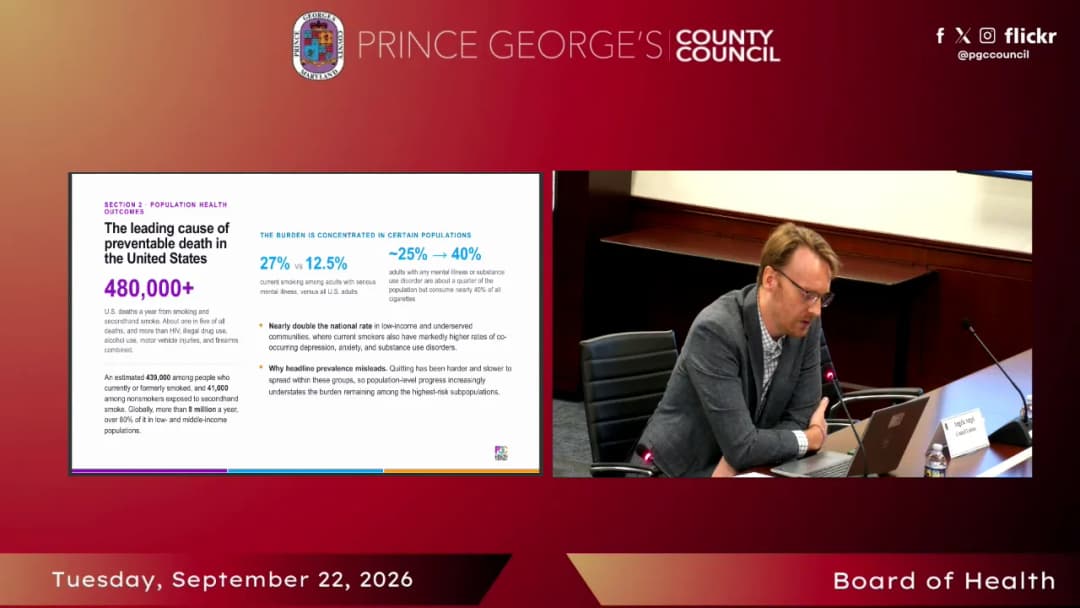
The Prince George's County Council, sitting as the Board of Health, convened on September 22, 2026, at 10:00 AM for a briefing on the community health effects of tobacco and alcohol retailers. The session began without a quorum but proceeded as a briefing until a quorum was established; seven members were present. The meeting featured presentations from staff and the Prince George's County Health Department on retailer distribution, health impacts, and associated costs, followed by questions and discussion among councilmembers. Presentation on Retailer Distribution - Anya Makarova, Committee Director, presented data on tobacco and alcohol retailer density by councilmatic district. - There are 932 active tobacco licenses in the county, averaging 9.5 per 10,000 residents, but distribution is uneven: District 7 has the highest density (16.6 per 10,000), nearly double the county average, while District 4 has the lowest (6 per 10,000). Approximately 86% of licensed tobacco locations are general retailers. - For alcohol, there are 142 active Class A licenses (liquor stores), averaging 1.4 per 10,000 residents. District 7 again has the highest density, District 4 the lowest. - Councilmember Fisher requested additional analysis by per-square-mile density to better reflect saturation, noting that geographic size varies by district. Ms. Makarova acknowledged the complexity due to urban, suburban, and rural areas and suggested the Health Atlas tool could provide a more comprehensive view. - Ms. Makarova highlighted two existing decision-making tools: the Health Atlas (a countywide evidence-based tool integrating health, land use, and demographic data, soft-launched August 26, 2026) and health impact assessments in the zoning process. She noted that retail density findings could feed into future health assessments to inform land-use decisions. Presentation on Health Impacts of Tobacco and Alcohol - Dr. Toin Okwesomi (Dr. O), Health Officer, and Dr. Andrew Ballard, Chief of Public Health Policy and Innovation, presented county-level statistics and documented harms. - Tobacco: About 8% of Prince Georgians smoke regularly, down from 14% a decade ago, but the decline has flattened since 2022. Smoking rates vary widely by community (6.7% in Woodmore vs. 17.7% in Langley Park), with highest rates inside the Beltway where retailer density is also highest. Youth cigarette use has collapsed to 2.1%, but youth vaping remains elevated (14.3% in Maryland high schools). Adult vaping is rising slowly. Nationally, tobacco causes 480,000 deaths and $600 billion in annual costs, with 60% of healthcare spending paid by government programs. Smokers die on average 10 years earlier. Quitting by age 30 eliminates nearly all excess risk. - Alcohol: Excessive alcohol use causes 178,000 deaths and $249 billion in annual costs nationally, with government paying nearly $100 billion. Alcohol is causally linked to at least seven types of cancer, including breast cancer (60% of alcohol-related cancer deaths among women). In 2023, 28.9 million people met criteria for past-year alcohol use disorder. Alcohol-related costs include $38 billion for criminal justice and motor vehicle crashes. In Prince George's County, 70% of arrests involve some form of intoxication. - Dr. Ballard noted that tobacco and alcohol burdens disproportionately affect low-income communities and communities of color. Discussion Items - Councilmember Sheila Adam Stafford requested data on treatment facility locations by district, cross-referenced with alcohol-related crime data, to better understand the impact of liquor store saturation on quality of life. She also asked about existing programs and gaps. - Councilmember Fisher emphasized the need to map resources intentionally to areas of highest need (e.g., Districts 7 and 8) rather than current patterns where resources may concentrate in northern parts of the county. - Caitlin Murphy (Associate Director, Health and Wellness) described current tobacco programs: a state-funded grant focused on preventing sales to minors through undercover compliance checks, and a small cessation outreach program. She noted limited funding and the need for community-based cessation services. - Dr. Alex Budenz (former program manager) added that there is a huge unmet need for smoking cessation services in the county, with few trained community organizations. She mentioned federal programs like the "Real Cost" campaign and smokefree.gov. - Councilmember Stafford inquired about school-based programs, especially for vaping and energy drinks with synthetic opioids (e.g., 7OH). Staff confirmed partnerships with schools, use of youth decoys for peer education, and ongoing work on safe storage and interactive programming. They noted recent state legislation (HB 1523) limiting 7OH concentration and requiring age restrictions, but enforcement funding remains a challenge. - Councilmember Fisher raised the upcoming ballot question that would allow the county to charge fees on certain industries (e.g., tobacco, alcohol) to fund health mitigation, similar to traffic or school fees. She expressed hope that dedicated resources could support health department programs. Key Outcomes - The Board requested follow-up data and analysis, including: - Retailer density per square mile by councilmatic district (per Councilmember Fisher's request). - Mapping of treatment facilities and cross-walking with alcohol-related crime data by district (per Councilmember Stafford). - An overview of potential programming options and associated costs to address gaps in funding and resources (per Chair Orieta). - No formal votes were taken; the meeting concluded with a motion to adjourn, seconded, and passed by voice vote. - Chair Orieta noted the council placed a ballot question on health impact fees, which if passed, could create a dedicated resource fund for health mitigation related to tobacco and alcohol retailers.
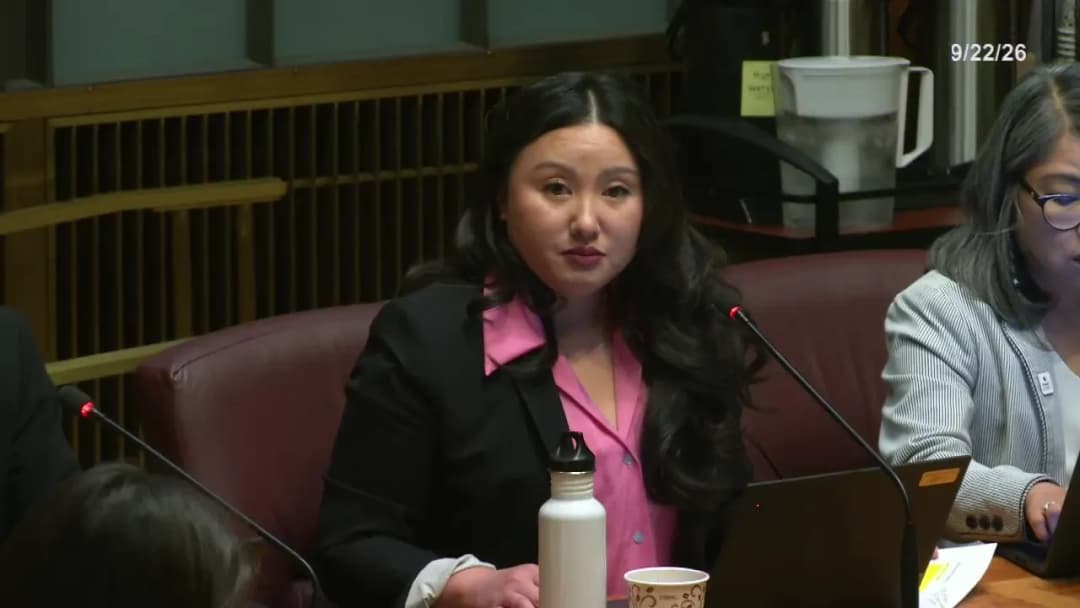
The Ramsey County Housing and Redevelopment Authority (HRA) met in regular session on September 22, 2026. The meeting was scheduled for 10:15 a.m. in Council Chambers, Courthouse Room 300, Saint Paul, MN; roll call convened at 10:16 a.m., and the meeting adjourned at 10:17 a.m. All seven members were present: Jebens-Singh, McGuire, McMurtrey, Miller, Moran, Ortega, and Chair Xiong. Also present were County Manager Ling Becker and Assistant County Attorney Scott Schwahn. The board unanimously approved the meeting agenda, the prior meeting minutes, and the certification of the maximum 2027 tax levy. Consent Calendar - Agenda Approval (2026-365): Motion by Miller, seconded by Moran, passed unanimously by roll call vote (7 ayes). - Minutes Approval (2026-366): Motion by Miller, seconded by Ortega, passed unanimously (7 ayes) for the August 18, 2026 minutes. Discussion Items - Certification of Maximum Tax Levy (2026-349 / Resolution H2026-014): The Community & Economic Development sponsors presented a proposed maximum tax levy to finance the 2027 HRA budget in the amount of $14,072,510. A board member noted that the resolution sets the maximum levy allowed. The raw transcript renders this as 'max lobby,' but the agenda and minutes confirm the item concerns the maximum tax levy. No further discussion was held. Motion by Miller, seconded by Moran, passed unanimously (7 ayes). Board Chair Update - Chair Xiong reported no update. Key Outcomes - The board certified the proposed maximum tax levy of $14,072,510 for the 2027 Ramsey County HRA budget (Resolution H2026-014). - All votes were unanimous: 7 ayes with no nays or abstentions. - Chair Xiong declared the meeting adjourned at 10:17 a.m.
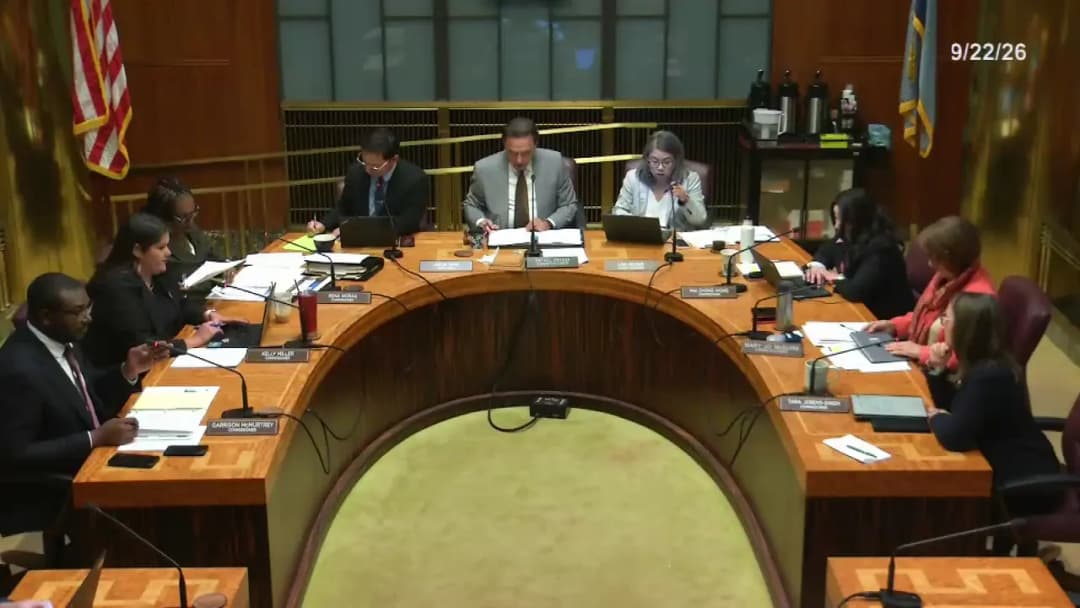
The Ramsey County Regional Railroad Authority met on September 22, 2026, at 10 a.m. in Council Chambers, Room 300 of the Courthouse. The meeting approved the agenda and minutes from August 18, 2026, and addressed a key policy item: certification of the maximum tax levy for the 2027 budget. Consent Calendar - Approval of Agenda (2026-363): Motion made, seconded, and approved by roll call. All members present voted in favor. - Approval of Minutes from August 18, 2026 (2026-364): Motion made, seconded, and approved by roll call. All members present voted in favor. Policy Item - Certification of the Maximum Tax Levy for the Ramsey County Regional Railroad Authority (2026-350): The proposed maximum tax levy to finance the 2027 budget is $36,219,703. The authority moved to keep the levy increase at zero (same as last year). Motion made, seconded, and approved by roll call with all members voting aye. Key Outcomes - Approved the agenda and minutes unanimously. - Certified the maximum tax levy of $36,219,703 with a zero percent increase for 2027. - No corridor updates were provided; the meeting adjourned shortly after the vote. - Quorum present: Travis, McGuire, McMurtry, Miller, Moran, Jean (as Zhang? transcript: "Zhang" likely a variant), and Ortega. All votes were unanimous.
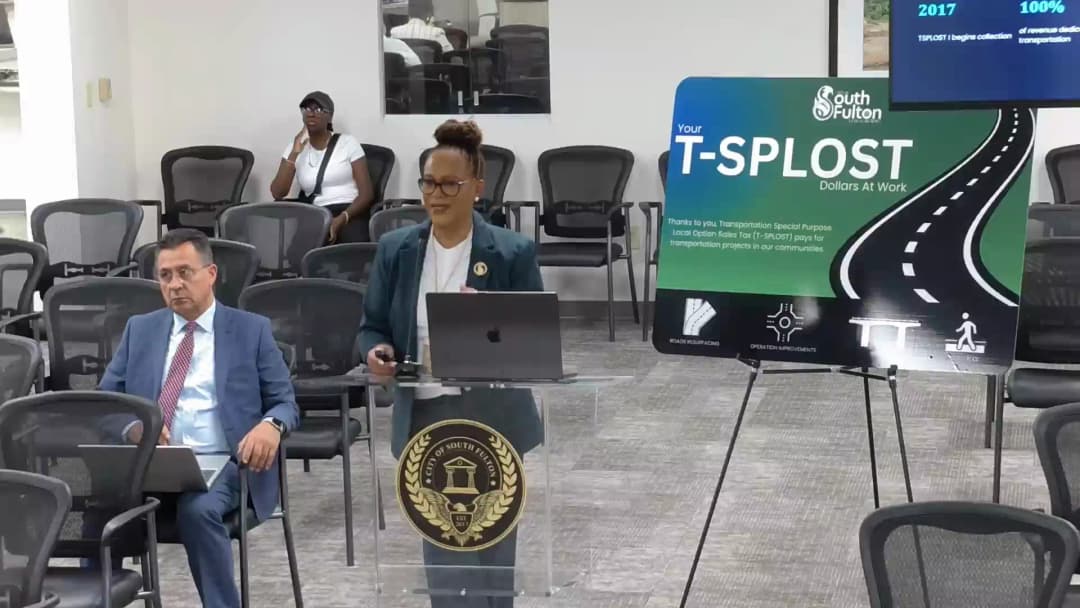
The City of South Fulton City Council held a work session on Tuesday, September 22, 2026 at 4:00 PM. All council members were present, and a quorum was established. The sole agenda item was an update on the Transportation Special Purpose Local Option Sales Tax (TSPLOST) III, presented by City Manager Sharon Subadan. The meeting recessed for executive session and later adjourned. Presentation: TSPLOST III Update City Manager Sharon Subadan provided an overview of TSPLOST, a 0.75-cent (three-quarter penny) dedicated sales tax for transportation projects. Key points included: - The city of South Fulton participates with Fulton County and 13 other cities under an intergovernmental agreement. For the first time, South Fulton receives the largest share of TSPLOST among those cities. - Total TSPLOST revenue to date: approximately $173 million. Obligated projects total $185 million, with $81.7 million in expenditures paid out so far. - The tax generates about $40 million annually, compared to the general fund's ad valorem property tax of about $65 million. - Past projects funded include road resurfacing, sidewalks, intersection improvements, roundabouts, bridges, and culverts. Out of 150 projects, 124 were funded with TSPLOST dollars. - For TSPLOST III, the city has proposed 102 projects with an estimated cost of $137.1 million, subject to voter approval on the November 2026 ballot. New categories include gravel roads. - The city will conduct a "road show" of town hall meetings to educate residents on TSPLOST accomplishments and plans. The city may educate but not advocate for the tax. Council Discussion Councilmembers asked clarifying questions and made suggestions for the public education campaign: - Councilmember Natasha Williams-Brown requested an updated pavement condition index report using a red-yellow-green visual to help residents understand the prioritization of road projects. The city manager confirmed the report is updated annually and can be made available. - Councilmember Jaceey Sebastian asked about "leakage" of sales tax dollars spent outside the city, suggesting information on how much TSPLOST revenue is generated from non-residents could be useful for public education. - Mayor Pro Tem Keosha B. Bell requested that when visiting districts for town halls, the city provide a project-by-project breakdown of what residents requested in each district to show how funds are allocated. The city manager agreed. Key Outcomes - No votes were taken on the TSPLOST III presentation itself. - The council unanimously consented to recess into executive session at 4:20 PM for discussion of cybersecurity, litigation, personnel, and real estate. - No actions requiring a public vote were taken in executive session. - The work session was reconvened at 5:04 PM and then adjourned by unanimous consent.