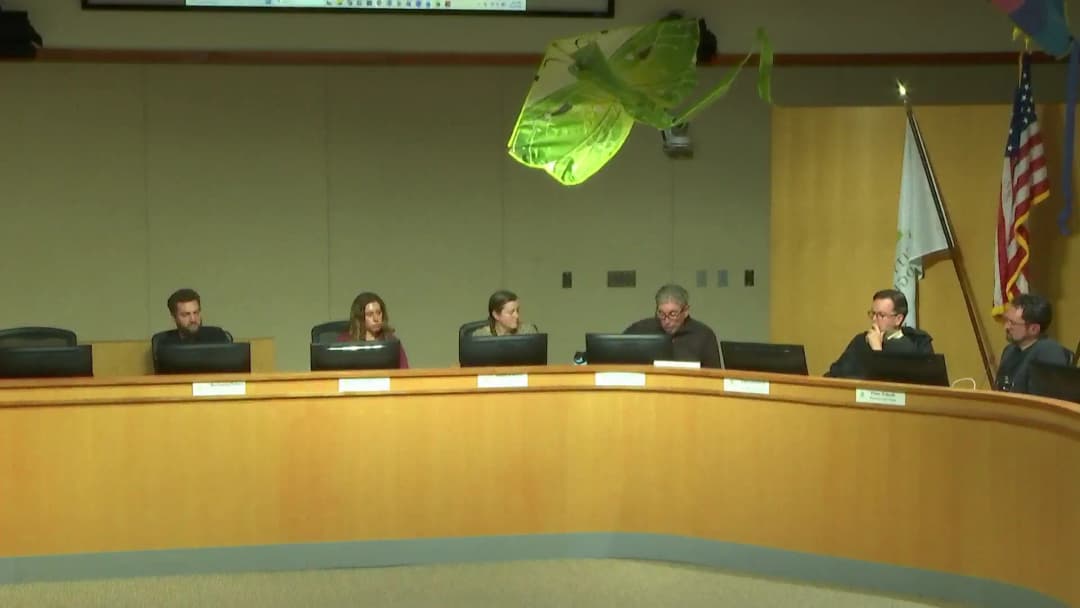
On September 10, 2026, at 6:00 PM, the Bainbridge Island Planning Commission met in Council Chambers at 280 Madison Ave N and remotely to review and prioritize the 2027 Planning Commission Work Plan. Chair Chris Garcia presided; Vice Chair Sarah Blossom and Commissioners Alexandra Costin, John Sandich, Ben Dinas, and Peter Schaub were present. Alex Prudholm was excused. Planning Director Emily Terrell and Senior Planner Jennifer Sutton presented, and Council Members Laura Lant and Ashley Matthews participated as liaisons. The meeting opened with the Suquamish land acknowledgement. Opening, Agenda, Minutes, and Public Comment - The agenda was approved unanimously and no conflicts of interest were disclosed. - The August 27, 2026 Planning Commission meeting minutes were approved unanimously. - There were no public commenters in person or remotely. Planning Director's Report - Director Terrell reported that the comprehensive plan update is moving forward. The City Council refined modeling assumptions for LMN and sent them to consultants. Commissioner Blossom's clarification helped resolve the bonus floor area ratio discussion for High School Road and Ferry. - A new city manager has started, and Terrell offered to share the list of Planning & Community Development items and the updated comp plan calendar. - Terrell reported four Growth Management Hearing Board decisions since 2025. The first two accepted 'plan for and accommodate' for affordable housing, while the more recent two require jurisdictions to fund affordable housing. She cited Port Townsend's finding of $170 million in affordable housing need with no identified funding source, and said the city may ask the Legislature for clarification. 2027 Work Plan Discussion Staff prepared a work plan table with a blank priority column, level-of-effort estimates, consultant needs, and dependencies. Sutton explained that the Department of Commerce reviews most land-use code changes and has a 60-day review period; SEPA review is also embedded. The city is on a status-quo budget because permit revenue is down, so consultant funding is limited. The Commission scored items using 5 (high), 3 (medium), and 1 (low), considering value, effort, dependencies, external stakeholders, and regulatory requirements. - Park overlay / park permit process: Scored 24; seen as a possible quick win with existing community commitments, though some members rated its standalone value as medium. - Hotel location: Received low priority. - Voluntary and mandatory inclusionary zoning (VIZ/MIZ): Scored 26; a high-effort, consultant-supported item including market review, funding mechanisms, and new code recommendations. Commissioner Schaub called funding mechanisms the most important piece. - TDR and bonus FAR: Scored 28; members supported improving the transfer of development rights program and using bonus FAR for public benefits, conservation-area relief, groundwater management, and agricultural land protection. Commissioner Schaub said reducing conservation-area development pressure is essential. - Minimum floor area ratio (FAR): The Commission unanimously moved this item into the VIZ/MIZ program item as a supporting element rather than a standalone priority. - Civic/cultural/connection overlay (CCCO): Scored 24; tied to a Hagar Scribner Properties proposal and external stakeholders who have waited for action. It would reward community benefits such as affordable housing, connectivity, and open space with flexibility in development standards. - Sub-area plans for Ferry and High School Road: Scored 12; members said these should run in parallel with base/bonus FAR work rather than before or after it, and some worried the plans could sit on the shelf. Commissioner Schaub suggested encouraging grassroots community visioning instead of a formal top-down priority. - Minimum residential density: The Commission unanimously split this into two items: upzoning existing R zones (raising the cap, scored 6) and requiring a minimum density within existing zones without changing caps (raising the floor, scored 20). Discussion referenced the Sportsman's Club Road R0.4 property on city water/sewer and commercial sewer capacity issues raised by Council Member Lant. - Middle housing: The Commission unanimously renamed the 'middle housing' item to 'middle housing: strategies other than form-based code' and the 'form-based code' item to 'form-based code in support of middle housing.' Middle housing strategies scored 24. Form-based code was described as a key tool for middle-scale, middle-income housing serving households above the 80% AMI threshold. - Subdivisions: Received a low priority score of 8; members thought subdivision standards were updated relatively recently. - HAP report card: The Commission unanimously struck this row and replaced it with a column identifying whether each work plan item is a Housing Action Plan action or supports one. Staff were also asked to flag HAP actions that are not complete and not otherwise captured. - Attracting development/partnerships/process improvements: Scored 26. Members emphasized partnerships, updated MFTE (multifamily property tax exemption) rules, priority permitting, and permit-process confidence. Commissioner Blossom noted Kitsap Builders Association feedback about MFTE and priority permitting. - Modular/pre-approved construction: Discussed as a worthwhile but not urgent tool; Council Member Lant noted local modular and pre-approved ADU producers. - Suzuki and Senior Center affordable housing: The Commission unanimously voted not to prioritize this item at this time and instead to ask the City Council what, if anything, it needs from the Planning Commission to start work; if no action is needed, the item will be struck. - Relief from standards: Scored 10. Director Terrell framed this as a general code allowance for affordable housing projects, not a project-specific waiver; it would identify which standards can be relaxed, by how much, and who decides. - Shoreline Master Program: Scored 16. It is a mandatory update due June 30, 2029, with significant Ecology rulemaking underway. Terrell noted a small state grant of $22,400 for consultant help. - Annual joint meeting with City Council: Scored 22; supported as a way to align priorities and avoid surprises, possibly starting with a full-day retreat. - Process improvement, time management, and Commerce short course: Scored 22. The Department of Commerce offers a free three-hour short course; new commissioners welcomed it as a way to level the learning curve, and the group supported a comp plan post-mortem while the process is still fresh. - Agricultural resource lands: Scored 16. Members noted the dependency on a functional TDR program and discussed protecting city-owned and private farmland. Council Member Matthews said an agricultural advisory group proposal is heading to the City Council. - Housekeeping ordinance: Scored 24. Staff identified scriveners' errors, broken references, and conflicting code sections across many BIMC chapters; Terrell said fixing them reduces legal liability and improves customer service. Key Outcomes - The Commission directed staff to consolidate the individual 5/3/1 scores into a prioritized 2027 work plan and bring it back for further review. - Unanimous votes taken during the discussion included: - Moving minimum FAR into the VIZ/MIZ item. - Splitting minimum residential density into 'raising the cap' and 'raising the floor' items. - Renaming the middle housing and form-based code items to clarify that form-based code is in support of middle housing. - Striking the HAP report card row and adding a HAP action column, plus requesting staff to flag unaddressed HAP actions. - Not prioritizing the Suzuki and Senior Center item absent Council direction. - In Good of the Order, Commissioner Schaub apologized for his absences, explaining that his wife had suffered a severe leg break and he had been caring for her. Commissioner Blossom clarified that city-owned farmland is not expected to be developed for housing, though farmworker housing may be needed. The Chair marked the 25th anniversary of 9/11 with a moment of silence, and the meeting adjourned.
Public Meetings - Bainbridge Island, Washington
Public Meetings - Bainbridge Island, WashingtonThe Bainbridge Island City Council met in Council Chambers and remotely on Tuesday, September 8, 2026, at 6:00 pm. All seven council members were present: Mayor Morwaki, Deputy Mayor Hytopolis, and Councilmembers Matthews, Fantroy-Johnson, Nelson, Land, and Schneider. The council approved the agenda 7-0, heard a land acknowledgement, and reported no conflicts of interest. Presentations - Welcome to City Manager John Mauro: The council welcomed John Mauro, who was in his first day in the role. Mauro previously served in Port Townsend and was recently elected chair of the Washington City County Managers Association. He expressed gratitude and eagerness to learn about the community. - Christy Shipman Retirement Proclamation: The council recognized Senior Accounting Technician Christy Shipman for 30 years of city service, including utility billing, support for audits without findings, and 11 years leading the wellness committee, achieving a 2% health insurance cost savings. The proclamation was approved unanimously. Shipman gave brief remarks thanking city staff. - Community Preparedness Month: The council proclaimed September 2026 as Community Preparedness Month. Emergency Manager Anne Lesage accepted the proclamation and encouraged residents to prepare for earthquakes, tsunami, severe storms, wildfire, and power outages. She invited the community to the annual Day of Preparedness on September 19 at Fire Station 21. - Hispanic and Latine Heritage Month: The council proclaimed September 15 through October 15, 2026 as Hispanic and Latine Heritage Month. The proclamation was presented to the Spanish immersion program teaching team from Ordway Elementary. Speakers highlighted the value of dual-language education and honoring diverse histories and contributions. - September 11 Day of Service and Remembrance: Councilmember Matthews read a proclamation designating September 11, 2026 as a Day of Service and Remembrance. She shared personal reflections on the 25th anniversary of the 9/11 attacks. The proclamation was accepted by American Legion Commander Matt Klauss, Police Chief Joe Clark, and Fire Chief Jared Moravec. A remembrance ceremony will be held at Fire Station 21 at 11:00 am on September 11. Consent Calendar - The council approved the consent agenda unanimously, including accounts payable and payroll, meeting minutes, project acceptance for the 2025 Annual Roads Project, the Ethics Board 2025 annual report and 2026 workplan, and Ordinance No. 2026-11 extending the Bonus Floor Area Ratio program sunset until June 30, 2027. Public Comments & Testimony - Hakuye Karen Vargas thanked the council and announced a September 13 emergency preparedness event at the Marvin Williams Center focused on public safety and emergency response for underserved, marginalized, and immigrant communities. - Stephen Hoskins, speaking remotely, welcomed City Manager Mauro and expressed support for Councilmember Nelson's leadership on upzoning High School Road to a base floor area ratio of 1.0. He cautioned against trimming the bonus FAR down to the functional maximum, saying it could repeat an April mistake and reduce capacity from voluntary inclusionary zoning. He urged the council to retain the Planning Commission's bonus FAR levels or use the safer full-extrusion FAR figures. - Ron, an audience member who did not give a last name, welcomed the new city manager but reminded the council about the groundwater management plan and Bainbridge Island's finite water resources. He said the current plan did not estimate water use from unused zoning capacity, expressed disappointment that the council did not more forcefully oppose Washington State Department of Commerce demands, and suggested that ADUs, as discussed on Vashon Island, would be a more appropriate approach. City Manager's Report - City Manager John Mauro gave a brief inaugural report, saying he felt grateful, inspired, eager to learn, and joked that he was sore from playing pickleball. Discussion Items Council Budget Priorities and Areas of Emphasis - Deputy City Manager Ellen presented the draft budget priorities and areas of emphasis. She asked the council to confirm the final language, clarify whether the utility infrastructure bullet should include wastewater or stormwater, and decide whether to add language on equity and climate lenses and implementation of the updated comprehensive plan. - Councilmember Fantroy-Johnson moved to add documented use of the equity lens and climate lens in city decision making toward these priorities. The motion passed 6-1, with Councilmember Nelson dissenting. - After extended discussion, the council voted to add the word implement before groundwater management plan, passing 6-1 with Councilmember Fantroy-Johnson dissenting. - The council removed a proposed separate item on implementation of the updated comprehensive plan and directed staff to continue prioritizing the post-adoption/parking-lot list. - The council also amended the infrastructure priority to read water, stormwater, wastewater, and sewer infrastructure, retaining wastewater and adding stormwater. After a voice vote and vote-count clarification, the amendment passed with one abstention from Councilmember Land. - The council then adopted the amended list of budget priorities and areas of emphasis on a final 7-0 vote. Land Capacity Analysis and Comprehensive Plan Update - Interim Planning Director Emily presented the assumptions, consultant scope, and schedule for the land capacity analysis and comprehensive plan update. She corrected several items in the assumptions table and noted that the mandatory inclusionary zoning program is currently more favorable to developers than voluntary inclusionary zoning, so most developers are expected to use the MIZ. - Staff asked consultants LMN and Strategic Economics to model High School Road with a base FAR of 1.0 and bonus FAR alternatives of 2.0 and 3.0, with the 3.0 alternative tied to the higher 85% lot coverage allowed under the MIZ. The Planning Commission had recommended a 3.0 bonus FAR and 85% lot coverage in both High School Road and Ferry. - Staff also requested that environmental review begin using February data to determine whether a supplemental environmental impact statement is needed, because the February assumptions had more units and would help meet the critical path for adoption by the end of the year. - Councilmember Nelson moved to set the maximum bonus FAR in High School Road at 2.0, with 3.0 available only for mandatory inclusionary zoning projects, in both residential and mixed-use projects. Staff confirmed this matched the Planning Commission's intent, and the motion passed 7-0. - The council then directed the city manager to obtain the land capacity analysis and associated information based on the assumptions approved by the council as amended. That motion passed 7-0. Kitsap County Solid Waste Advisory Committee Appointment - The council confirmed Laura Ryser as the city representative to the Kitsap County Solid Waste Advisory Committee, with Adam Nebenzahl as the voting alternate. The motion passed 7-0. Announcements - Councilmember Land reported that the utility advisory committee subcommittee for the KPUD intertie is making progress and scheduled another Friday meeting. - Councilmember Matthews invited the public to the city booth at the farmers market on Saturday, where council members will play a budget game with residents to gather budget priorities. - The mayor reminded the community about the September 11 remembrance ceremony at Fire Station 21 at 11:00 am. Key Outcomes - Approved the consent agenda, including Ordinance No. 2026-11 extending the Bonus FAR program sunset. - Approved proclamations honoring Christy Shipman, Community Preparedness Month, Hispanic and Latine Heritage Month, and September 11 as a Day of Service and Remembrance. - Adopted council budget priorities and areas of emphasis as amended, including an equity and climate lens commitment, implement groundwater management plan, and the infrastructure priority water, stormwater, wastewater, and sewer infrastructure. - Directed the city manager to obtain a land capacity analysis based on the amended assumptions, with a 2.0 maximum bonus FAR and a 3.0 bonus FAR limited to mandatory inclusionary zoning projects. - Confirmed Laura Ryser and Adam Nebenzahl to the Kitsap County Solid Waste Advisory Committee.
The Bainbridge Island City Council held a study session on Tuesday, September 1, 2026, at 6:00 PM in Council Chambers and via Zoom. The primary agenda item was a detailed discussion of land use and zoning assumptions for the Comprehensive Plan and Winslow Subarea Plan Update, specifically regarding the Land Capacity Analysis (LCA) and Mandatory Inclusionary Zoning (MIZ). The council aimed to provide specific direction to staff to finalize the LCA and meet state housing targets by the December 19, 2026, deadline. The meeting concluded with a motion directing staff to make specific adjustments to Floor Area Ratios (FAR) in certain zones. Consent Calendar - Approval of Agenda (6:05 pm): Councilmember Nelson moved, Mayor Moriwaki seconded, to approve the agenda as presented. The motion carried 6-0. No conflicts of interest were disclosed. Discussion Items - Comprehensive Plan and Winslow Subarea Plan Update (6:10 pm - 7:58 pm): - Interim City Manager Alan Schroer introduced the topic, explaining the need to triangulate between two LCA sets of assumptions (February and July) to meet the city's housing targets. The council needed to provide guidance on MIZ parameters and other levers (FAR, lot coverage, height) to close a deficit of 151 multifamily dwelling units against a requirement of 1,186 units. - Interim Planning Director Terrell and Planning Manager Darren Buchanan presented questions from consultants LMN regarding MIZ assumptions and LCA modeling. The council debated whether to rely on MIZ to meet targets, with consensus leaning toward not counting on MIZ for quantitative targets but using it as a qualitative overlay. - Councilmembers expressed positions on various levers: - Councilmember Nelson proposed increasing the base mixed-use FAR in the High School Road zone to 1.0 (adding an estimated 250 units) and reducing bonus FARs to functional maximums (Connection to 1.1, Ferry to 3.0, High School Road to 2.0) based on existing lot coverage and height constraints, resulting in an estimated 73-unit surplus. - Deputy Mayor Hytopoulos and Councilmember Lant expressed preference for increasing height over lot coverage, particularly in the High School Road zone. - Councilmember Mathews expressed concerns about the human impact of high lot coverage and supported preserving livability. - Councilmember Schneider supported transparency by aligning published FAR with functional maximums. - Mayor Moriwaki cautioned against overly specific motions during a study session but emphasized the need to meet targets. - The council also discussed the target number: whether to aim for exactly 151 units or a 10-15% buffer (270-330 units). Most councilmembers agreed to aim for closing the 151-unit gap without seeking a buffer, though some noted that exceeding it slightly would be acceptable. Key Outcomes - Motion (Nelson/Lant): To direct the Interim City Manager to revise the July 14 Council direction by: - Increasing the Base Mixed Use Floor Area Ratio in the High School Road zone to 1.0. - Decreasing the Bonus Mixed Use Floor Area Ratio in Connection to 1.1. - Reducing the Bonus Mixed Use Floor Area Ratio in Ferry to 3.0. - Reducing the Bonus Mixed Use Floor Area Ratio in High School Road to 2.0. - Vote: The motion carried 4-0 with Councilmember Mathews and Mayor Moriwaki abstaining. This direction is for staff to bring back to the next business meeting for final consideration and public comment. - Staff will use this direction to update the LCA and return with a formal proposal. - The council will consider the proposal at a subsequent business meeting, allowing for public comment and final approval. Committee Reports (7:58 pm) - Mayor Moriwaki reported on Kitsap Transit and Kitsap 911 meetings, noting a $1.9 million appropriation for inductive chargers at the ferry terminal and a 13% increase in Bainbridge Island's user fees for 911 services, along with comparative call statistics highlighting the island's safety. - Councilmember Mathews reported that Kratum has been classified as a Schedule One drug federally, obviating local action. - Councilmember Schneider reported on a volunteer incident during Bike for Pie, where a driver confronted a volunteer, and encouraged community care. - Councilmember Lant noted a community discussion at Harbor Square. The meeting was adjourned at 8:23 PM.
The Bainbridge Island Planning Commission held a regular meeting on August 27, 2026, from 6:00 PM to 8:38 PM in Council Chambers and via Zoom. The main agenda item was a workshop to develop the 2027 Planning Commission Work Plan. Commissioners discussed and organized a list of potential work items, identified priorities, and outlined next steps. No formal votes were taken; the meeting was a collaborative brainstorming session. Consent Calendar - Call to Order / Land Acknowledgement: The meeting began with a land acknowledgement recognizing the ancestral territory of the Suquamish people. - Approval of Agenda: Approved unanimously. - Approval of Minutes (August 13, 2026): Approved unanimously. Public Comments & Testimony - Steve Hoskins (Winslow resident): Welcomed new commissioners. Noted that Futurewise may drop the Mercer Island case after satisfactory interim zoning. Suggested prioritizing mandatory inclusionary zoning for core and connection zones, and studying in-lieu fees to fund affordable housing. Emphasized that middle housing is the greatest need on Bainbridge Island. - Laura Lambs (City Council liaison): Requested that the work plan include items previously discussed but not on the agenda, such as rezoning R0.4 parcels on municipal water/sewer for more density. Encouraged staff to add items from the “parking lot” of past meetings. - John Quitson (former Planning Commissioner, 9 years): Reminded commissioners of their role as stewards of the comprehensive plan. Encouraged creativity, close work with staff, and outreach to community partners like the Housing Resources Board. Stressed that code must be grounded in real-world feasibility. Discussion Items - Planning Director’s Report (Emily Tyrell, Interim Planning Director): Introduced herself and stated her primary goal is to get the comprehensive plan approved. Expressed desire to improve relationships between the planning commission, staff, and council. Outlined the workshop format: commissioners would review and refine a list of potential 2027 work items, considering scope, complexity, staff/consultant effort, budget, and dependencies. - 2027 Work Plan Workshop: Chair Garcia noted that the initial list provided by staff was incomplete and needed commissioner input. The group used easel paper to brainstorm and categorize items. Key discussions included: - Middle Housing – identified as a top goal. Tactics include form-based codes, ADU updates, duplex retrofits, and co-living standards. Commissioners debated whether form-based code should apply only to middle housing or also to mixed-use areas. Director Tyrell noted that the state is requiring updates (e.g., unit‑lot subdivision, co-living) that will soon come to the commission. - Incentives – grouped under “community benefits beyond affordable housing.” Includes the Civic and Cultural Overlay (CCCO), TDR program, bonus FAR provisions, and in-lieu fees. TDR may require an economist (budget needed). - Affordable Housing Follow-up – includes report cards on housing action plan, public-private partnerships, expedited permitting, modular/pre-approved forms, and in-lieu fees. Commissioner noted need for developer input on what makes partnerships successful. - Park Standards – discussion shifted from a park zone to creating use‑specific standards (performance standards) to avoid costly conditional use permits. Could be a quick win if done as a staff-led code amendment. - Sub-area/Community Plans – for Ferry and High School zones. Commissioner argued Ferry district has limited redevelopment potential; High School more promising. Minimum FAR considered a potential strategy for these areas. - Process Improvement – items such as joint meetings with council, roles/responsibilities training, and post‑comp‑plan after‑action review were added. Director Tyrell noted that current process inefficiencies cause staff burnout and quality issues. - Other items: Hotels code, connectivity/subdivision standards, agriculture zone consideration, and simplification of subdivision code. - Staff Input: Director Tyrell and Senior Planner Jennifer Sutton offered expertise on feasibility, typical timelines, and budget implications. They noted that many items are large and would require significant staff time or consultant funds. Key Outcomes - No formal votes were taken. The commission agreed to continue refining the work plan at future meetings. - Next Steps: Staff will assess each grouped item for scope, effort, and budget. The commission will then prioritize and sequence work for 2027. The parks use‑standard item was identified as a potential “quick win” and may be tackled first. - Steering Committee: Commissioner offered his seat on the steering committee to new commissioners as the comp plan process winds down. - Meeting adjourned at 8:38 PM.
The Bainbridge Island City Council held a regular business meeting on August 25, 2026, at 6:00 PM in Council Chambers and via Zoom. The meeting included presentations, public comments, approvals, and discussions on key items such as interim development regulations, the Comprehensive Plan update, and the extension of a bonus floor area ratio program. Presentations - Eagle Scout Certificate of Achievement: The Council presented a certificate to Logan Maxwell for completing his Eagle Scout project, which involved relocating and replacing the sign at Eagle Harbor Waterfront Park. - Senior Center Month Proclamation: The Council proclaimed September 2026 as Senior Center Month. City staff and community partners received the proclamation. Consent Agenda - Approved the agenda as amended (moving item 5D to regular business). - Approved accounts payable and payroll, meeting minutes, and cancellation of the September 1, 2026 study session. Public Comments & Testimony - Angela Bennick (Kitsap Public Utility District): Urged the Council to expedite an interlocal agreement for a water intertie to support the South Bainbridge water system, citing reliability and emergency preparedness needs. Noted that the Utility Advisory Committee (UAC) has not yet provided a recommendation after four months. - Mary Heckman: Suggested that the Council, not the interim city manager, make decisions on the Lehigh master development plan extension. Recommended a 2- to 3-month extension to allow time for a second legal opinion on the contract's design-build nature. - David Schultz: Supported a short-term extension for Lehigh, arguing that failing to extend does not void the contract and allows the new city manager to assess the project. - Ellen Lockard: Encouraged the Council to have an outside expert review the Lehigh agreement, citing potential risks and the need for careful spending of tax dollars. - Lisa Neal: Expressed concerns about the intertie's impact on groundwater and sewer capacity, questioning whether mandatory inclusionary zoning (2026-10) would worsen the situation compared to the builder's remedy. Requested better quantification of impacts. - Phaedra Elliott (Housing Resources Bainbridge): Expressed support for the interim development regulations, particularly the mandatory inclusionary zoning provisions, and urged flexibility in refining the ordinance this fall. Highlighted the importance of parking flexibility and financial feasibility for affordable housing developers. - Don Jano: Criticized the lack of early and continuous public participation in adopting interim zoning ordinance 2026-10, citing a recent Growth Management Hearings Board ruling in Port Townsend. Argued the emergency claim does not meet legal thresholds. Discussion Items - Ordinance 2026-10 – Interim Development Regulations (7:00 PM): The Council discussed and adopted an interim ordinance that includes mandatory inclusionary zoning for developments of 10+ units (10% at 50-80% AMI and 10% at 80-110% AMI). A motion to amend the income bands to "up to 80% AMI" and "up to 110% AMI" failed 4-3. The original ordinance passed 6-1, with Councilmember Nelson dissenting. The public hearing was rescheduled from October 13 to September 22, 2026. - Comprehensive Plan Update (7:15 PM): Interim Planning Director Emily Terrell presented a timeline and key milestones, including the need for a land capacity analysis with mandatory inclusionary zoning, supplemental environmental impact statements, and addressing Department of Commerce concerns. The Council approved a study session on September 1, 2026, to discuss modeling assumptions. - Ordinance 2026-11 – Bonus Floor Area Ratio Extension (7:30 PM): The Council discussed extending the sunset provisions for the bonus FAR program (Ordinance 2021-10) until June 30, 2027. The item was forwarded to the September 8, 2026 consent agenda for final approval. - Appointments to Human Services Funding Advisory Task Force (7:45 PM): The Council unanimously approved the appointments of Brian Lindgren, Bert Rinderley, Marcy Lynn, Cynthia Huffman, and Teo Welde to the task force for the 2027-2028 funding cycle. Key Outcomes - Ordinance 2026-10 adopted: 6-1 (Nelson nay). Public hearing set for September 22, 2026. - Comprehensive Plan study session approved: September 1, 2026, at 6:00 PM. - Ordinance 2026-11 forwarded: To September 8, 2026 consent agenda (vote 7-0). - Human Services Funding Advisory Task Force appointments approved unanimously.
The Bainbridge Island City Council held a study session on Tuesday, August 18, 2026, from 6:00 PM to 7:09 PM in Council Chambers and via Zoom. Mayor Moriwaki presided with Councilmembers Fantroy-Johnson, Lant, Mathews, Nelson, and Schneider present; Deputy Mayor Hytopoulos was absent and excused. The council discussed three regular business items: the Ethics Board annual report and workplan, proposed amendments to the short-term rental ordinance, and prioritization of the Planning Commission's deferred items list. All agenda items were approved, and motions were passed with one dissent. Ethics Board Report Former Ethics Board Chair Dona Keating presented the 2025 annual report and 2026 workplan. In 2025, the board dismissed three deferred complaints (EB2021-04, EB2021-05, EB2021-06) after finding no violations under the City Code of Conduct and Ethics Program. Votes were 4-1 or 4-0 with one abstention. The board experienced vacancies and new appointments, and training updates were delayed pending council action on code changes. Outstanding recommendations include establishing a statute of limitations for complaints, maintaining mandatory annual training, updating the code to allow city manager advisory opinions, and increasing youth participation. Councilmember Land asked about communication without a council liaison; Keating noted direct communication with the mayor and deputy mayor. Councilmember Nelson questioned Article 1 (code of conduct) and supported a statute of limitations. Keating emphasized the educational role of the board. Council moved to forward the report and workplan to a future business meeting; the motion carried 6-0. Short-Term Rental Ordinance 2026-03 Management Analyst Laura Shear presented clarifying amendments to the short-term rental (STR) code after two years of implementation. Current stats: 155 licensed STRs, 200 applications resulting in 120 new business licenses, 97% registration rate, and six noise/party violations involving three properties. Proposed amendments clarify the STR definition (removing kitchen requirement), update penalties/enforcement, and streamline registration. A revised purpose statement adds language about operating standards for compatibility with residential neighborhoods. Councilmember Land reported consulting with innkeepers, Airbnb, and staff; supports adding bedroom count consistency with city-approved records instead of septic capacity. Councilmember Nelson expressed concern about allowing STRs (effectively hotels) in conservation areas and moved to strike “bed and breakfast” from Section 2.E, but the motion failed for lack of a second. Councilmember Mathews noted the 21st Century Road to Housing Act limits institutional investors in single-family homes. The council then voted 6-1 (Nelson opposed) to forward Ordinance 2026-03 to a future meeting for consideration of approval. Planning Commission Deferred Items (Post-Adoption List) Planning Commission Chair Chris Garcia described the list of 10+ items carried over from the Comprehensive Plan update as a “junk drawer” needing validation and prioritization. The list had not been reviewed by the full planning commission and varies in scope from minor fixes to major structural changes (e.g., park zoning, form-based code, inclusionary zoning). Garcia proposed a workshop on August 27 with Interim Planning Director Emily Terrell to triage, estimate effort, and build a 2027 workplan. Council supported sending the list back to the planning commission for refinement. Councilmember Mathews emphasized the value of new member orientation. Councilmember Nelson suggested park zoning as a high priority and raised concerns about in-lieu fees for inclusionary zoning. Councilmember Schneider asked for estimated effort and an impact/why statement for each item. Councilmember Land requested staff input (Emily Terrell) and favored prioritizing quick wins. Council voted 6-0 to refer the post-adoption list to the Planning Commission for refinement and prioritization in connection with its 2027 workplan. Committee Reports Councilmember Mathews shared experiences volunteering at Chief Seattle Days and noted recent Kitsap Public Health District board interviews and a state health board meeting regarding upcoming OSS (on-site sewage system) regulations. Councilmember Land reported interviewing five applicants for the Human Services Funding Task Force. Mayor Moriwaki noted the senior center project is progressing well. Councilmember Schneider raised concerns about traffic safety at the intersection of Winslow Way and Highway 305 during a demonstration, with dangerous pedestrian and vehicle conflicts. Key Outcomes - Approval of Agenda: Approved 6-0. - Ethics Board Report and Workplan: Motion to forward to a future business meeting for approval carried 6-0. - Short-Term Rental Ordinance 2026-03: Motion to forward to a future council meeting carried 6-1 (Councilmember Nelson opposed). - Planning Commission Deferred List: Motion to refer to Planning Commission for refinement and prioritization in connection with the 2027 workplan carried 6-0. - Adjournment: Meeting adjourned at 7:09 PM.
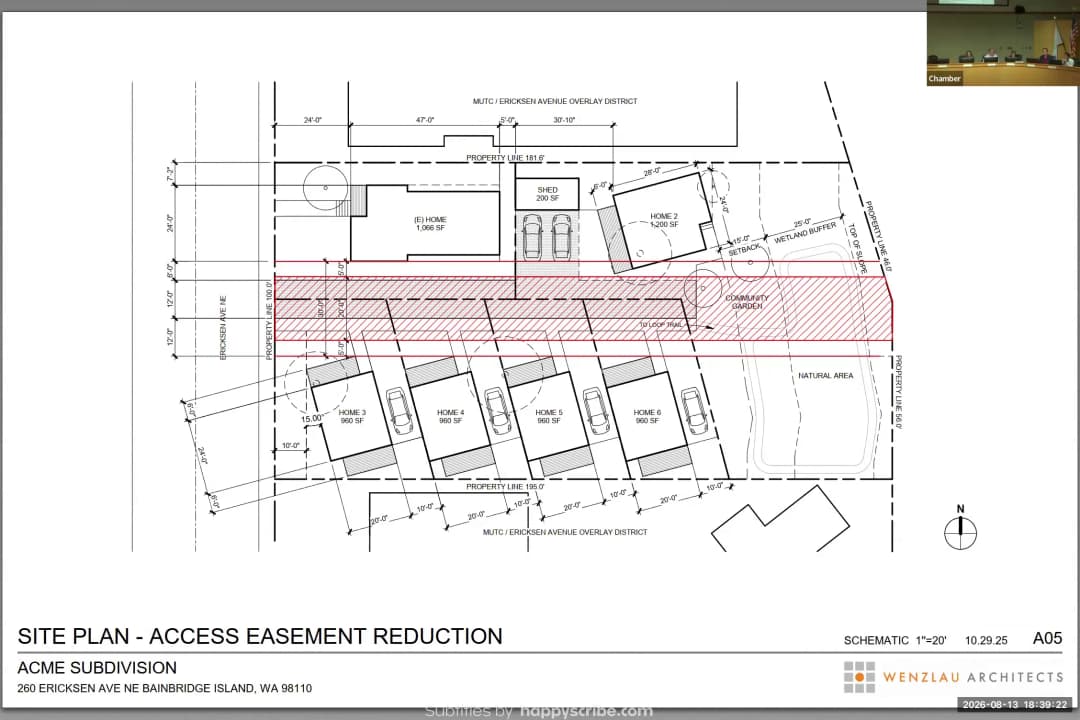
The Bainbridge Island Planning Commission held a regular meeting on August 13, 2026, at 6:03 PM in Council Chambers and via Zoom. Commissioners present: Sarah Blossom (Vice Chair), Criss Garcia, Alex Preudhomme, Ben Deines, Alexandra Costin, and new member John Sandage. Peter Schaab was excused. Staff included Associate Planner Joanne Mendenhall, Interim City Manager Ellen Schroer, and Interim PCD Director Emily Terril (via Zoom). Council Liaisons Ashley Mathews and Lara Lant also attended. Opening Business: Election of Chair and Vice Chair - Commissioner Alex Preudhomme nominated Criss Garcia for Chair; seconded by Ben Deines. The motion carried unanimously (6-0). - Commissioner Ben Deines nominated Sarah Blossom for Vice Chair; seconded by Criss Garcia. The motion carried unanimously (6-0). - Commissioner Ben Deines disclosed a conflict of interest: his wife works for Winslow Architects, the applicant for the ACME Long Subdivision (item 7A). He recused himself from that portion of the meeting. Consent Calendar - Motion to approve the agenda as presented (Preudhomme/Deines & Blossom) carried unanimously (6-0). - Motion to approve the July 23, 2026 minutes as presented (Blossom/Preudhomme) carried unanimously (6-0). Public Comments No members of the public offered comments in person or remotely. Planning Director’s Report Interim PCD Director Emily Terril reported on the Housing Accountability Act (HAA) audit. The city requested an extension of the 120-day correction period from August 21 to December 19, 2026, but the Department of Commerce rejected this on August 5. Commerce offered a compromise: the city could receive the 120-day correction period if it submitted development regulations and a land capacity analysis for a 60-day review. On August 12, City Council directed staff to pursue this extension by submitting draft development regulations (including mandatory inclusionary zoning as recommended by the Planning Commission on July23) by August 12, and to schedule interim adoption on August 25. Staff have extended LMN’s contract to run updated models and will work toward adopting the comprehensive plan and development regulations by early December. The need for a supplemental environmental impact statement is being evaluated. Discussion Items: ACME Long Subdivision Public Participation Meeting Chair Garcia opened the public participation meeting at 6:23 PM. Associate Planner Joanne Mendenhall introduced the project: a long subdivision of two lots on Erickson Avenue into six clustered lots, similar to the Erickson Cottages. The existing historic house on the site was recently placed on the local historic register, which exempts it from floor area ratio calculations. Project manager Charlie Wenzlau presented the site plan, noting that the home will be renovated and used as part of the subdivision. The development requires a deviation to narrow the access road width from 30 to 20 feet. Commissioners asked questions about a shed, the historic designation, and road width. Commissioner Preudhomme expressed strong support, stating the project provides “the type of housing that we just need more of around the island.” No public comments were offered. The meeting closed at 6:30 PM. Good of the Order Commissioner Blossom raised a concern about the City Council’s priority matrix, which initially omitted “parking lot items” important to the Planning Commission. Council Liaisons Lara Lant and Ashley Mathews clarified that the omission was because those items were considered already in progress, and the Council later expressed support for including them. Commissioner Preudhomme flagged a future discussion about the 2021 moratorium on bonus FAR programs and its effect on residential density baselines, requesting a detailed briefing from Director Sutton at the next meeting. Key Outcomes - Criss Garcia elected Chair, Sarah Blossom elected Vice Chair (unanimous). - Agenda and July 23, 2026 minutes approved (unanimous). - Ben Deines recused from the ACME Long Subdivision discussion due to conflict of interest. - Staff directed to pursue HAA extension and prepare interim development regulations for Council adoption on August 25. - Public participation meeting held for ACME Long Subdivision; written comments due by August 19. - Future agenda item requested: staff briefing on the 2021 moratorium and its impact on baseline FAR.
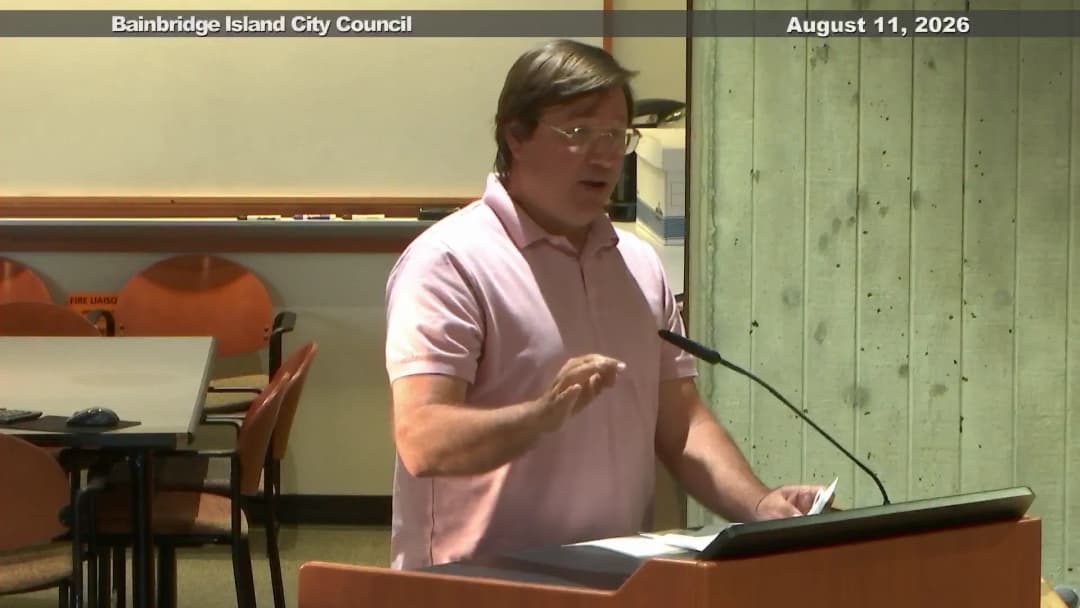
The Bainbridge Island City Council met on Tuesday, August 11, 2026, from 6:00 pm to 9:33 pm in Council Chambers and via Zoom. Mayor Moriwaki presided; Deputy Mayor Hytopoulos and Councilmembers Fantroy-Johnson, Lant, Nelson, and Schneider were present, and Councilmember Mathews joined remotely at 6:02 pm. Councilmember Fantroy-Johnson read the Land Acknowledgement. The agenda was approved 7-0 and no conflicts were disclosed. Presentations - Mayor Moriwaki and Councilmember Schneider presented a proclamation declaring August 2026 as National Emergency Management Awareness Month. Emergency Manager Ann LeSage accepted and invited residents to a disaster hubs open house on August 14 at 4:30 pm at Highland Middle School. - Tony Ives, Executive Director of Kitsap Community Resources (KCR), presented the Community Needs Survey. KCR's 2025 data includes supporting 210 veterans, assisting nearly 8,800 households with energy assistance, and producing 75,000 meals. Bainbridge-specific results from the prior survey showed 50% of respondents reported no concerns, 25% cited cost of rent, 16% cited not enough housing supply, 15% cited utility costs, 12% cited weatherization needs, and 3% cited fear of eviction or insufficient shelters. The current survey opened July 6 and closes at the end of October; Kitsap Public Health District epidemiologists help validate responses. Last survey's top needs were housing, multilingual resource information, health care access, and transportation. Consent Calendar - Councilmember Nelson pulled item 5.F, and Councilmember Lant pulled item 5.E. The remaining consent agenda was approved 7-0, including accounts payable/payroll, meeting minutes, and Amendment No. 8 to the Skillings, Inc. professional services agreement ($42,715 from the Sewer Fund). - Item 5.E, an interlocal agreement with Kitsap County for noxious weed control, was approved 7-0 after Interim Public Works Director Hash explained use is limited to designated noxious weeds, applied only when requested and after homeowner notification/opt-out. - Item 5.F, the Pleasant Beach Drive Extension construction contract with Nordland Construction NW, Inc. for $490,087.41 plus an $86,000 budget amendment, was approved 6-1. A prior motion to rebid failed 1-6. Councilmember Nelson voted against, citing a single bid $115,000 over the engineer's estimate. Public Comments & Testimony - Several residents discussed infrastructure costs, road maintenance, and budget priorities. Chris Frey noted the combined water tower and Head of the Bay projects he estimated at $17 million and urged fiscal caution. David Schutz cited a 2023 road condition score of 70 out of 100 for 280 lane miles and said over 50% of community survey respondents prioritized roads. Carole Clement called for a post-mortem on overruns and asked council to review staffing/FtE growth since COVID. John Grinter, speaking as a private individual, supported pragmatic infrastructure investments and local funding. Ron Peltier opposed a road bond or levy lid lift and urged prioritization of core services. Lisa Neal raised road maintenance, code enforcement, and infrastructure costs for housing projects. Dawn Janow supported the Finch Green and Wintergreen grant applications and urged a holistic budget and comp plan approach. - Stephen Hoskins addressed the Department of Commerce extension: he asked council to submit the 'February values' plus the two-acre mandatory inclusionary zoning program to Commerce, warning that large parcels could otherwise be lost to market-rate development; he said if Commerce rejects it, going non-compliant may be preferable. Jon Quitslund criticized lack of public information about the extension and comp plan process, calling the extension request a mistake. - Mary Hekman, speaking as a community member, urged responsible contracting, especially regarding the Lehigh contract, and said design-build contracts are inherently risky and require certification under state law; she asked for parent guarantees and 'skin in the game.' Hayes Gori, on behalf of Wintergreen Townhomes, spoke in favor of the Wintergreen CHIP grant application, noting last year's application scored 74 points, one point below the 75 cutoff, and the project needs funding due to rising costs and loss of USDA financing. Discussion Items - Council Budget Priorities: Interim City Manager Schroer presented a consolidated priority list based on council members' project selections. The top areas with at least four votes were affordable housing, water conservation/groundwater management, road maintenance, climate action, and sustainable transportation. Councilmembers discussed missing items, including comprehensive plan implementation and equity/climate lenses. A motion to endorse the list as a strong tentative list for a future business meeting carried 7-0. The council took a recess from 8:14 pm to 8:18 pm. - Housing Accountability Act Extension Response: Staff explained Commerce denied the 120-day extension and set August 26 as the deadline for interim development regulations; noncompliance would trigger the builder's remedy. Council approved, 6-1 with Councilmember Nelson opposed, an amended motion directing staff to submit development regulations to Commerce for a 60-day review by August 12, including the Planning Commission's July 23 mandatory inclusionary zoning recommendation, and to schedule interim adoption consideration for August 25. A second motion to direct staff to obtain a land capacity analysis comparing July 14 council direction and July 23 Planning Commission recommendation carried 5-1, with Mayor Moriwaki voting against and Councilmember Lant abstaining. - Finch Green CHIP Grant: Council unanimously authorized the Interim City Manager to prepare an MOU with Housing Resources Bainbridge and apply for a $418,000 CHIP grant for the Finch Green 100% Affordable Housing Project. - Wintergreen Phase II CHIP Grant: Council unanimously authorized an MOU with Central Highland Homes and a CHIP application for the Wintergreen Phase II 32% Affordable Housing Project. The agenda listed the request as approximately $744,000, while the approved motion and minutes stated approximately $774,000. - Eagle Harbor Drive / Wyatt Way Change Order: City Engineer Corelis explained Change Order No. 3 ($474,867.46) resulted from bid and WSDOT review delays, traffic control costs, design fixes, utility conflicts, and PSE scheduling disruptions. Total change orders were about $718,000, roughly 28% of project cost; the engineer's estimate was $2.95 million and final costs with maintenance items were about $3.174 million, with a future credit of $50,000–$60,000 expected. Consolidated spending for the road, water main, and culvert projects is $8.7 million, not $17 million. The change order was approved 7-0. Key Outcomes - Consent agenda and interlocal agreement approved; Pleasant Beach contract approved with one dissent. - Endorsed tentative council budget priority list unanimously. - Directed staff to submit interim Housing Accountability Act regulations with mandatory inclusionary zoning by August 12 and scheduled interim adoption consideration for August 25 (6-1). - Directed staff to obtain a land capacity analysis on mandatory inclusionary zoning (5-1, one abstention). - Authorized CHIP grant applications for Finch Green ($418,000) and Wintergreen (approximately $744,000 per agenda; approximately $774,000 per motion/minutes), both 7-0. - Approved Change Order No. 3 for the Eagle Harbor Drive/Wyatt Way project 7-0. - Agreed to place residential sport court standards on a future council agenda (7-0).
The Bainbridge Island City Council held a special executive session on Tuesday, August 11, 2026, beginning at 5:00 pm in Council Chambers at 280 Madison Ave N and on Zoom, with Mayor Clarence Moriwaki presiding. The sole purpose of the meeting was an executive session under RCW 42.30.110(1)(i) to discuss with legal counsel matters relating to agency enforcement actions and litigation or potential litigation. No public testimony, discussion items, votes, or formal actions occurred. Call to Order / Roll Call - Mayor Moriwaki called the meeting to order at 5:00 pm. - Initially present: Mayor Moriwaki and Councilmembers Lant, Nelson, and Schneider. - Deputy Mayor Hytopoulos and Councilmember Fantroy-Johnson joined during the executive session; Councilmember Mathews joined remotely. Executive Session - The council adjourned to executive session at 5:00 pm pursuant to RCW 42.30.110(1)(i). - The purpose was discussion with legal counsel representing the agency regarding agency enforcement actions, or litigation or potential litigation to which the agency, the governing body, or a member acting in an official capacity is or is likely to become a party, when public knowledge would likely result in adverse legal or financial consequences. - The council returned from executive session at 5:58 pm. Adjournment - Mayor Moriwaki adjourned the meeting after the council returned from executive session. Key Outcomes - No votes, motions, resolutions, or policy actions were taken; the only agenda item was the exempt executive session. - Source discrepancy: The agenda scheduled the executive session for 5:00–6:00 pm, and the raw transcript begins with a statement about a sixty-minute executive session followed by the unclear phrase, "No, actually, there's a minute." The official minutes state the executive session was 30 minutes but also record the council returning at 5:58 pm, which does not align with a 30-minute duration.
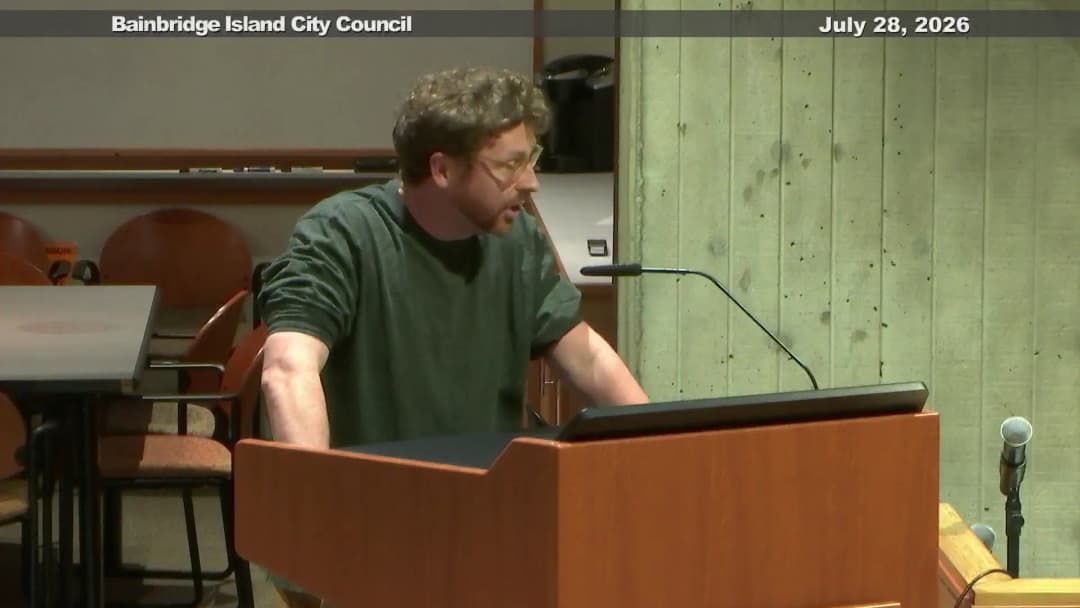
The Bainbridge Island City Council met in regular session on Tuesday, July 28, 2026, from 6:00 pm to 8:41 pm in Council Chambers at 280 Madison Ave N and via Zoom. Mayor Clarence Moriwaki presided. Present were Deputy Mayor Kirsten Hytopoulos and Councilmembers Fantroy-Johnson, Lant, Mathews, and Nelson. Councilmember Schneider was absent and excused. The Council approved the agenda 6-0, and no conflicts of interest were disclosed. Major topics included two proclamations, a large consent agenda, a joint public hearing with the Washington State Department of Commerce on the Housing Accountability Act, the Wintergreen Phase 2 multifamily tax exemption contract, a Planning Commission appointment, and a request to discuss a Kitsap Public Utility District intertie in Fort Ward. Presentations - Council approved by a 6-0 vote a proclamation declaring July 28, 2026, as Melanie Marie Keenan, Champion for Water Resources Day. Deputy Mayor Hytopoulos read the proclamation, and Malcolm and Maddie Gander accepted it. The proclamation recognized Keenan's environmental work, including leading the successful EPA sole-source aquifer designation petition for Bainbridge Island in 2009, codified in 2013. - Councilmember Mathews read a proclamation declaring August 4, 2026, from 4 to 7 pm at Waterfront Park as National Night Out. Police Chief Joe Clark accepted the proclamation and invited residents to attend. Note: the transcript contains an apparent misstatement of the National Night Out date, but the agenda, proclamation, and minutes all state August 4, 2026. Consent Calendar - Councilmember Mathews moved and Councilmember Lant seconded approval of the consent agenda. Following discussion of selected items, the full consent agenda was approved 6-0. - At Councilmember Mathews' request, Item I was discussed: a license agreement with the YWCA of Kitsap County for office space in the Ted Spearman Justice Center. Interim City Manager Schroer said the city had been allowing the YWCA to provide services without an agreement and the license provides assurance of continued access. Deputy Mayor Hytopoulos clarified the YWCA provides support and counseling for domestic violence victims at court. Councilmember Lant noted the agreement could create new insurance costs for the YWCA. - Items J and K were discussed as major state investments: a $1,000,000 CHIP grant and an additional $582,000 grant amendment, both in partnership with Housing Resources Bainbridge for utility improvements for the Finch Green Affordable Housing Project. Councilmember Fantroy-Johnson noted the infrastructure deferral is only for affordable housing. - Other consent items approved included accounts payable and payroll; meeting minutes; acceptance of the Winslow Water Tank Replacement Project; a sidewalk assessment and repairs contract with Precision Concrete Cutting Inc. for $85,176.00; a Fletcher Bay Well variable frequency drive and remote terminal unit replacement contract with George's Electric Inc. for $180,873.42 plus a $30,000 budget adjustment; LTAC RFP criteria for $400,000; Human Services RFP criteria for $660,000; and the YWCA license agreement. Public Comments & Testimony - J.P. Powell, a Chamber of Commerce communications coordinator and front desk worker, expressed strong support for affordable housing and the 625 housing project, saying many service and hospitality workers cannot afford to live on the island. He cited Census statistics that the island is 83.7% white and up to 95.8% able-bodied under age 65, and said Bainbridge minimum wage is $17.13 per hour. - Malcolm Gander thanked the Council for the Keenan proclamation and discussed groundwater constraints. He said the island grew from about 21,000 people in 2001 to about 25,000 today, production well extraction has increased, and the city should prioritize preserving recharge areas and redirecting stormwater into the ground. - Ron Peltier praised Keenan's water advocacy and said the Department of Commerce is forcing unsustainable growth on the only sole-source-aquifer island city in Washington, and perhaps the entire United States. - Mary Clare Kersten raised concerns about roads, evacuation capacity, traffic, and the island's EPA-designated sole-source aquifer, saying HB 1220 disregards the island's unique status. - Mary Hekman said the entire island is a critical aquifer recharge area, the new groundwater management plan is the best available science, and development decisions need a hard second look with mitigation. She said she helped draft a Responsible Bainbridge letter flagging these issues. City Manager's Report - Interim City Manager Schroer reported on automated traffic safety camera outreach, emphasizing these are not Flock cameras and are triggered only when a violation occurs. State law requires a city ordinance to authorize them. The city will meet with advisory committees and community groups, hold an open house likely in October, and report to Council in November. Outreach was paced to extend into the school year to hear from families about school zones. - Schroer highlighted a new public workplan dashboard, which is live on the city website and tracks more than 130 projects by initiative, department, and status. Public Hearing – Housing Accountability Act Joint Review - The Council held a joint public hearing with the Washington State Department of Commerce on the city's progress in meeting the Housing Accountability Act. Commerce Housing Section Manager Anne Fritzel and Housing Planning and Data Manager Laura Hodgson joined in person. Schroer noted this hearing is part of Commerce's audit process and does not replace the separate future public hearings on the comprehensive plan and development regulations. - Hodgson explained that the Housing Accountability Act, created by Senate Bill 5148 in 2025, gives Commerce authority to review and determine compliance with the Growth Management Act. Bainbridge Island was one of eight jurisdictions selected in the first year because it had not yet adopted its comprehensive plan and development regulations. Commerce issued a preliminary report on April 23, the city submitted pre-adoption materials on May 14, Commerce sent a follow-up review letter on July 13, and the city requested an extension. The statutory deadline is August 21, 2026. If the city does not comply, it may become ineligible for certain grants and loans, and the state builder's remedy would allow qualifying affordable housing projects to request waivers from regulations that block affordability. Hodgson also said Bainbridge Island is not subject to the state's two-ADU-per-lot requirement or the modest-density middle housing requirement. - In Council discussion, Deputy Mayor Hytopoulos expressed frustration that the process appears to require market-rate upzoning rather than producing housing affordable to lower-income residents, including workers at 30% of area median income. Councilmember Nelson asked Commerce to grant the extension and shared the frustration that mandatory inclusionary zoning is difficult to count toward compliance, while market-rate upzoning is counted. He also asked whether the builder's remedy exemption for critical areas applies to Bainbridge; Hodgson responded that Commerce, in consultation with the Attorney General, interprets the critical areas protection as remaining intact but development outside those protections must still be allowed. Councilmember Fantroy-Johnson confirmed the city's extension request was received on Monday and would be answered within about a week. Councilmember Mathews asked about the voluntary pathway and noted the city had already lost an approximately $800,000 stormwater grant and was advised not to apply for another because of the late plan. Councilmember Lant asked about regional housing collaboration and water-based living units; Hodgson said county-city collaboration should account for local circumstances, and new water-based housing is unlikely due to the Shoreline Management Act. She also said the city's SEPA 30-day comment period would be considered in the extension request. - Public hearing testimony included the following positions: - Malcolm Gander said he is pro-growth and pro-affordable housing but argued the Growth Management Act requires balancing growth with unique island circumstances, water limits, and recharge protection. He also suggested reducing the city workforce over five years through attrition to free funds for affordable housing. - Eric Ludwig, on behalf of the Bainbridge Island Chamber of Commerce and more than 300 businesses, supported the comprehensive plan changes and urged approval without delay. He specifically supported increasing base floor area ratio to 1.0 in the central core, ferry terminal, and high school road zones, and bonus FAR of 3.0 in the central core and 4.0 in the ferry terminal and high school road zones to attract private funding for affordable housing. - Ron Peltier argued Commerce's interpretation of the builder's remedy is wrong, that the entire island is a critical aquifer recharge area, and that market-rate housing will not produce affordability. He encouraged the Council not to be bullied by Commerce. - Benjamin Harrison, a water resources professional and ETAC volunteer speaking individually, said the GMA requires balancing housing with natural resources, current water use sustainability is uncertain, and the city should implement the groundwater management plan and fix its transfer of development rights program. - Jon Quitslund, a former planning commissioner and councilmember, thanked Commerce for funding the housing needs assessment and housing action plan, and said the racially disparate impacts analysis in the agenda packet shows why the work matters. - Sarah Blossom, a Planning Commissioner speaking individually, said she was frustrated and defeated, that the mandatory inclusionary zoning program the Planning Commission crafted probably will not count, and that market-rate upzoning will not create affordability on Bainbridge. She said volunteers had spent more than 100 hours on the process and asked the Council to make that time matter. - Bevan Taylor, a service industry worker, said the housing crisis is decades in the making and many affected workers are absent from the process. He asked Commerce to ensure the next comprehensive plan meaningfully increases affordable and multifamily housing and expressed anger at those who fought the 625 project, which he described as 100% affordable housing. - Lisa Neal listed outstanding items including key plan elements, land capacity analysis, a selected DEIS alternative, SEPA review, infrastructure analysis, and concurrency analysis. She questioned how the city could adopt a compliant plan by August 21 and called the process backward and too focused on builders. - Nora Masters said opposition to Project 625 does not mean opposition to affordable housing, citing risks in developer selection, contracts, and cost mitigation. She said she fully supports affordable housing where it makes sense and raised concerns about market-rate upzoning without affordable housing requirements. - Stephen Hoskins, a housing economist and pro-housing advocate, said the state housing crisis is driven by exclusionary zoning and that Bainbridge is a prime example of why state oversight is needed. He argued the city's failure to meet the August 21 deadline is self-inflicted and asked Commerce to be skeptical of the extension request. - David Smith, an affordable housing developer, said affordable housing is not hopeless. He described the Wintergreen project as combining a $2 million Housing Trust Fund grant, about $80,000 per unit, other subsidies, and bonus density. He supported affordable housing but did not comment on 625, and he suggested the vacant Suzuki property could be ideal for affordable housing. - Eric Kortum, a former Historic Commission member, opposed placing affordable housing where the old police station or first fire station stood, opposed state mandates, and said water sustainability must come before population growth. - Rob Drury said all natural systems have carrying capacity and the city must quantify data and determine capacity before regulating growth. He said conflating affordable housing with ecological constraints is a red herring, but growth cannot exceed capacity. - Michael Schwank, a resident since 1982, said Commerce is trying to put a square peg in a round hole and that the city needs help, not unfunded mandates. He noted the hours spent on the process could have built affordable housing. - Gene Mellenbacher, a resident since 2014, said priorities should not make affordable housing and other community needs mutually exclusive, and urged continued public involvement. Regular Business - Council authorized the City Manager to sign the Wintergreen Phase 2 Multifamily Tax Exemption contract by a 6-0 vote. Interim City Manager Schroer said the contract provides a partial property tax exemption for 43 units in Phase 2, of which 14 are income-qualified households at or below 80% of area median income. - Council confirmed the appointment of John Sandage to the Planning Commission, Position 6, for a three-year term ending June 30, 2028, by a 6-0 vote. The appointment was the alternate recommended by the selection committee after a resignation. Communications - Councilmember Mathews requested a future Council discussion of Kitsap Public Utility District's proposed intertie in Fort Ward. Council consensus was to broaden the topic to include an update on all interties. The item is scheduled for the August Utility Advisory Committee meeting, and Council discussion could follow soon after. Council Announcements - Deputy Mayor Hytopoulos announced she accepted an invitation to a Senior Center podcast about civil dialogue and community trust. - Councilmember Nelson announced he would appear on the BI Standard podcast and reported on the steering committee meeting about mandatory inclusionary zoning. He said the consultant had difficulty estimating housing units from both prior versions, developers expressed concerns about feasibility, and the planning department will bring back compliant options, including the February land capacity analysis, an increased maximum FAR option with the older mandatory program estimated at about 193 units, or an estimate for the Planning Commission's newest recommendation. - Councilmember Lant praised the Utility Advisory Committee's farmers market map with colored push pins for collecting cell coverage complaints. - Councilmember Mathews announced an open house about a planned controlled burn on Hilltop, reminded residents of National Night Out on August 4, said the usual first Saturday coffee would not occur in August, and welcomed a large fiber arts festival visiting the island. Key Outcomes - Agenda approved 6-0; no conflicts disclosed. - Proclamation honoring Melanie Marie Keenan approved 6-0. - National Night Out proclamation presented for August 4, 2026. - Full consent agenda approved 6-0, including contracts, grants, RFP criteria, the YWCA license agreement, and Finch Green infrastructure grants. - Joint Housing Accountability Act public hearing held with Department of Commerce. Commerce will rule on the city's extension request within roughly one week. The city still faces the August 21, 2026 statutory deadline, with builder's remedy and grant ineligibility as potential consequences if it does not comply. - Wintergreen Phase 2 Multifamily Tax Exemption contract authorized 6-0. - John Sandage confirmed to the Planning Commission 6-0. - Council reached consensus to schedule a future update on all KPUD interties after the August Utility Advisory Committee meeting.