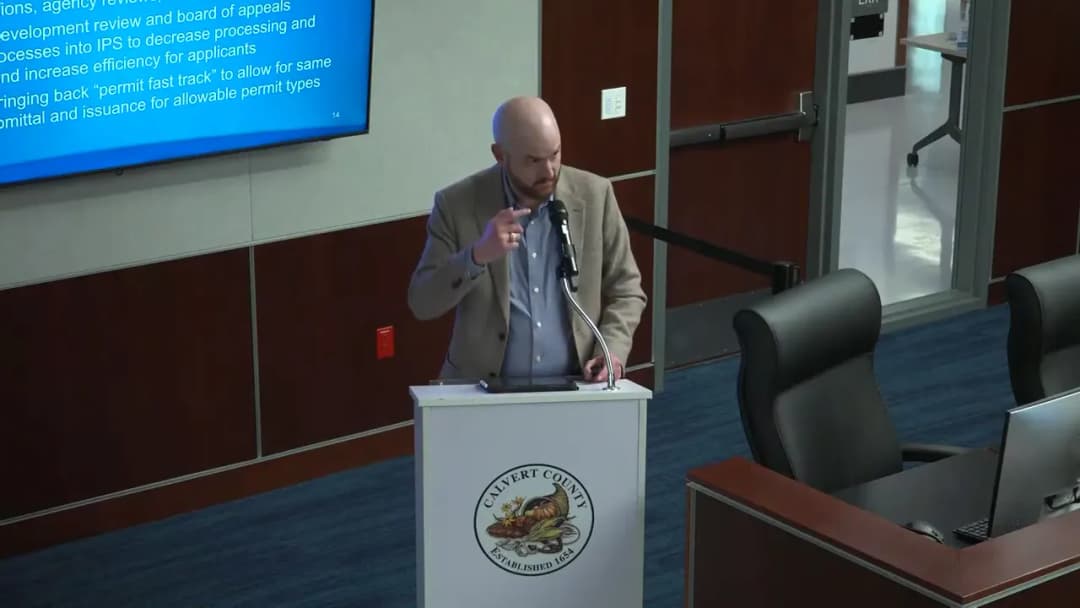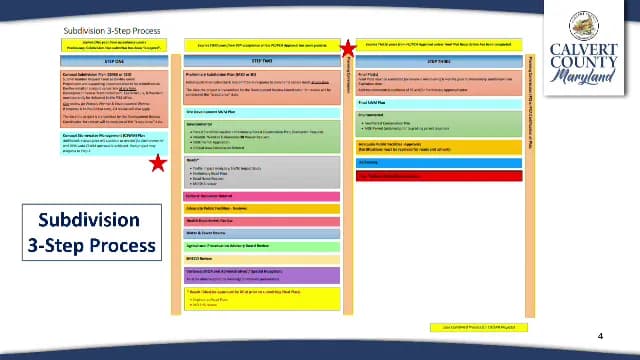
The Calvert County Planning Commission held a regular meeting on Wednesday, March 18, 2026, at 7:00 p.m. The meeting included work sessions on proposed text amendments for data center conditions and a comprehensive set of other zoning ordinance amendments, a legislative update, a presentation on the new development review process, and public comment. No major subdivisions or site plan applications were on the agenda. The Commission voted to continue review of the data center text amendment with comments due by April 2, 2026, and received information on other amendments for future public hearings. Public speakers expressed strong concerns about a potential data center project near Calvert Cliffs. Consent Calendar - The Commission approved the agenda as presented. - The Commission approved the summary of actions from the February 18, 2026, Public Hearing and the February 18, 2026, Regular Meeting. Public Comments & Testimony - Bob Estus (self): Suggested that the county use modern communication methods beyond newspaper advertisements for public meetings, particularly for data center public meetings. - Marty Hurry (self): Commented on stormwater rainfall values, noting DPW plans to increase them by 30% and offered his own data. - Sylvia Baton (self): Urged the Commission to consider light pollution impacts on bird migration, promote liquid cooling over evaporative cooling to save water, require a decommissioning bond, and address thermal pollution of the Chesapeake Bay. - Susan DeZurik (self): Presented details from a state application (MDE) for the proposed Calvert County Data Center project by Minute Developers LLC, describing three campuses totaling 225,000 square feet and 500 megawatts of capacity. She argued the proposed amendments are insufficient and called for a comprehensive consultant review. - Miriam Gole (self): Questioned why the Commission is proposing amendments if the BOCC has called for a moratorium. She raised concerns about water use (well vs. public system) and suggested requiring water recycling, LEED certification, solar power, strict compliance with environmental regulations, and air quality monitoring. She urged a moratorium and thorough study. - Ernest Schifflet (self, lifelong resident): Described buying a lot adjacent to Calvert Cliffs property zoned Farm and Forest, which was rezoned to Heavy Industrial in 2025. He argued the proposed 400-foot setback is inadequate and requested a larger setback to protect existing residents. - Joseph Cormier (self, virtual): Expressed concern that staff sent draft amendments to AWS for feedback before public input, calling it “letting the fox design the hen house.” He emphasized the need for enforcement teeth, regulation of discharged water, and consideration of electromagnetic frequency (EMF) impacts. He called for transparency and a halt to the process. Discussion Items Work Session – Proposed Text Amendment 26-23 (Data Center Conditions) - Presentation and Background: Rachel O'Shea, Deputy Director of Zoning, presented the proposed conditions for data center uses. The BOCC directed staff to draft these amendments. Existing conditions include a 200-foot setback from property lines, 400 feet from residential lots, building facade treatments, and noise compliance with Chapter 80. New proposed conditions include: - No groundwater wells for cooling; water use must focus on efficiency and sustainability, with a water services plan reviewed by P&Z, Public Works, and Health Dept. - Detailed water plan requirements (e.g., peak and annual demand, identification of sources, evaluation of non-potable water, prohibition of inefficient evaporative systems like once-through cooling). - Outdoor generators must meet EPA Tier 4 final emission standards. - A third-party review provision for compliance, paid by the applicant. - Commissioner Questions and Discussion: - A Commissioner noted that the current noise ordinance may not adequately address low-frequency hums from data centers; staff noted this for further research. - Another Commissioner questioned the phrasing “no groundwater well shall be drilled or used” – clarified it means no groundwater use at all. - The third-party reviewer selection process: the county procures independent reviewers; it is not the applicant’s choice. - Staff explained the amendments were drafted by examining other jurisdictions (Virginia, Arizona), not from data center companies. Data centers were informed but did not drive the amendments. - A Commissioner expressed strong opposition, stating that without proper research on noise and other impacts, he would vote against any data center proposal. He also noted that the proposed amendments are the most comprehensive he has seen. - Motion: A motion was made to further review the proposed text amendment, have commissioners email comments to staff by April 2, 2026, and direct staff to compile those comments (including discussion from the meeting) for review at the April meeting. The motion passed. Work Session – Proposed Text Amendments 26-01 through 26-06, 26-08 through 26-22, 26-24 - Presentation: Beth Rimmer, Zoning & Permitting Division Chief, presented a series of text amendments addressing state law updates and outstanding issues. Key amendments included: - 26-01: Update forest conservation to comply with state law (SB 526), requiring 1:1 reforestation (with exceptions for priority funding areas and multifamily). Also includes local incentives for preserving monument trees and granting credit for green infrastructure. - 26-02: Exempt Board of Education properties from certain requirements. - 26-03: Remove “tenant house” as a separate use; include as dwelling accessory to a residence. - 26-04: Align with state accessory dwelling unit law (HB 1466), providing a waiver for parking if on-street space is available. - 26-05: Add “retail accessory” use in light industrial and mixed-use districts (up to 25% of net space) to replace removed “flex space.” - 26-06: Remove harbor line provisions (state jurisdiction). - 26-08: Sign article clarifications, including allowing home occupation signs (1 sign, 4 sq ft, 6 ft height) without permit, and revising setback for electronic message centers from residential property line to residential dwelling. - 26-09: Allow exemptions from sidewalk requirements in I-1 and I-2 districts upon justification. - 26-10: Limit bike rack requirements to town centers. - 26-11: Restore side and rear setback reduction policy (to zero feet) for adjacent properties under same ownership or in specified commercial/industrial zones, subject to safety and screening. - 26-12: Remove additional setback requirements for auto filling stations and repair shops (staff considers them too restrictive). - 26-13: Limit 40-foot buffer requirement to solar, commercial power, and data centers; revert others to 20-foot buffer. - 26-14: Use “enclosed space” instead of “gross floor area” for residential structures to prevent garage conversion abuse. - 26-15: Clarify manufactured home conditions, including allowing as accessory dwelling per state law; remove requirement for wood/masonry exterior appearance. - 26-16: Prohibit food trucks in public rights-of-way. - 26-17: Update definition of “personal services” to replace “health club” with “personal training services.” - 26-18: Restore 5,000 sq ft limit for office/medical office in St. Leonard Town Center. - 26-19: Clarify plat certificate requirements. - 26-20: Clarify Board of Appeals authority for special exceptions and appeals. - 26-21: Revise site plan requirements for farm structures: less than 5,000 sq ft only plot plan; 5,000+ sq ft requires Category 2 site plan. - 26-22: Add 100-foot setback for dispensaries from residential districts. - 26-24: Allow up to two family conveyance lots per eligible parcel for two years after adoption; then revert to one. This provides a grace period for those affected by the previous change. - Commissioner Questions and Discussion: - Regarding 26-11 (zero setbacks), a Commissioner expressed concern about future changes in ownership and non-conforming uses; staff noted it was common practice and reviewed by safety agencies. - On 26-13 (40-foot buffer), a Commissioner questioned why other industrial uses (e.g., sawmills) were excluded; staff acknowledged and noted it is a policy choice. - On 26-24 (family conveyance), a Commissioner strongly supported removing the sunset provision to allow more time for farm families, arguing that development in towns is not helping current residents afford housing. - The amendments were presented for information only; staff will proceed with public hearing process. Key Outcomes - Motion on Data Center Text Amendment (TA 26-23): The Commission voted (with one opposed) to further review the proposed text amendment, invite email comments from commissioners by April 2, 2026, and direct staff to compile those comments (including tonight’s discussion) for review at the April meeting before forwarding to the Board of County Commissioners. - Other Text Amendments: No vote was taken; these amendments will go through the public hearing process as informational items. The Commission provided comments and concerns for staff to consider. - Legislative Update: Jason Brinkley reported that the BOCC sent opposition letters to three state bills (HB 239/SB 360, HB 548/SB 325, HB 778) that could significantly increase density in town centers. HB 239 (Starter and Silver Homes Act) is the most advanced and has amendments but still concerns. - New Development Review Process: Tamara Blake Wallace presented the revised three-step process (concept, detailed preliminary, final) implemented in November 2025, which allows earlier electronic submittals and gives the Planning Commission more complete plans at review. The process is available via the Encompass portal. - Public Comment Noted: The Commission heard significant public opposition to the proposed data center project, with many speakers calling for a moratorium, stricter regulations, and more comprehensive study of environmental and health impacts.
Public Meetings - Calvert County, Maryland
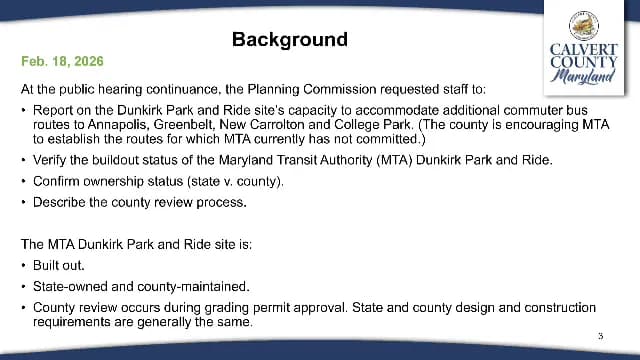
Public Meetings - Calvert County, MarylandThe Calvert County Planning Commission held a public hearing on March 18, 2026, at 7:00 PM (hybrid format) to consider two draft chapters of the Master Plan of Town Centers: Chapter 2 (Prince Frederick Town Center) and Chapters 1 and 3 (Dunkirk Town Center). All seven commissioners were present: David Bury, Victor W. Freeland, Christopher J. Gadway, Greg Kernan, James S. McQueen Sr., John Toohey, and Dale Weems. Staff presentations were given by Tay Harris, Long Range Planner. The public hearing resulted in votes to close the record and recommend adoption of both plans to the Board of County Commissioners, with Commissioner Gadway voting against each. Prince Frederick Town Center Master Plan (Chapter 2) - Staff summarized the draft, including updates from previous meetings and revisions to address Mill Creek watershed protection. Key statistics: developed land in the Upper Mill Creek watershed accounted for 38.8% of the area, including 14.6% impervious surface. Staff noted that when impervious surface exceeds 10% of a watershed, stream ecosystems show distress, and Mill Creek is currently stressed based on 2023 sampling. - Commissioner Bury suggested a wording clarification that the Prince Frederick Town Center drains into Mill Creek, not the reverse. Staff agreed to make the change. - Commissioner McQueen thanked staff for adding Mill Creek language, noting constituent concern. Public Comments & Testimony (Prince Frederick) - Bob Estus (self-identified, representing Friends of Hunting Creek) expressed strong support for the Mill Creek language and described ongoing restoration efforts, including plans to apply for grant money to restore the creek and create wetland benefits. He emphasized the ecological value of wetlands for pollutant removal and wildlife. Vote on Prince Frederick Chapter 2 - Commissioner Bury moved to close the record, find the draft consistent with the Calvert County Comprehensive Plan, and recommend adoption by the Board of County Commissioners. The motion was seconded. - The motion carried 6-1, with Commissioner Gadway voting nay. Dunkirk Town Center Master Plan (Chapters 1 and 3) - Staff presented this as a continuance of a previous public hearing. Key updates: The Planning Commission had requested information on the MTA park and ride capacity, ownership, and process for review. Staff reported that the park and ride is built out to capacity, state-owned but county-maintained, and the county reviews modifications during grading permit approval. MTA has not committed to establishing additional commuter bus routes to Annapolis, Greenbelt, New Carrollton, or College Park, though the plan encourages such routes. - No public comment was offered either in-person or virtually. Vote on Dunkirk Chapters 1 and 3 - Commissioner Bury moved to close the record, find the draft chapters consistent with the Comprehensive Plan, and recommend adoption by the Board of County Commissioners. The motion was seconded. - The motion carried 6-1, with Commissioner Gadway voting nay. Key Outcomes - The Planning Commission closed the public hearing record for both items and voted 6-1 to recommend adoption of the Prince Frederick Town Center Master Plan (Chapter 2) and the Dunkirk Town Center Master Plan (Chapters 1 and 3) to the Board of County Commissioners. Commissioner Gadway was the sole dissenter in both votes. - The meeting adjourned after the votes, with no additional public comment.
The Board of County Commissioners met on Tuesday, March 17, 2026, at 10:00 a.m. in Prince Frederick, Maryland. The meeting included a swearing-in ceremony for new sheriff's deputies, adoption of revised animal control ordinance, a public hearing on funding for driving range safety netting, public comments, and commissioners' reports. The board also announced several upcoming events and budget hearings. Opening & Ceremonies - Invocation by Rev. Glenn Swanson of Bayside Baptist Church, who also highlighted the church's ongoing food pantry and assistance to fire victims. - The agenda was approved unanimously. - The Calvert County Sheriff's Office held a swearing-in ceremony for three new deputies: Trent Conley, Morgan Snyder, and Destiny O'Donnell. Sheriff Ricky Cox noted the academy has been extended to 31 weeks. Deputy O'Donnell is also an Army Reservist and volunteer EMS. The sheriff also announced plans to expand the School Resource Officer program to cover every school. - Congratulations were extended to retiring Clerk Kathy Smith for her service. Old Business: Adoption of Updates to Chapter 7 (Animals) - April Coleman, Deputy Director of Animal Services, presented the proposed revisions to the animal control ordinance. The ordinance was modernized to align with state law, clarify accountability, and set specific parameters (e.g., temperature thresholds for pet care). - Three public comments were received during the comment period; two were responded to, one was anonymous. - A three-year license option and a fancier license for multiple animals were added. - The board voted unanimously to close the record and adopt the ordinance. Public Hearing: Budget Adjustment for Driving Range Safety Netting - Director Bob Branham and staff requested $390,000 for safety netting at Chesapeake Hills Golf Course to prevent errant golf balls from striking people or property. Funding would come from closing a CIP project ($150,000) and $240,000 from the general fund. - Public speakers: Barbara Warner (supportive, citing personal near-misses) and Joseph Cormier (opposed, arguing it should be part of regular budget cycle). - The board discussed incidents of balls hitting patrons, liability concerns, and the course's increased usage and revenue. Commissioner Hart emphasized that the golf course is a public amenity, not a profit center. - The board voted to leave the record open for ten days per Local Government Article §9-105, with a final decision expected at the next meeting. Public Comments & Testimony - Joe Cormir (Owings, MD): Criticized the board for delaying the BOE efficiency study presentation, questioned NDAs related to a data center project, and demanded transparency. He referenced a $300,000 efficiency study and asked for whistleblower protections. - Kenneth Lee (Huntingtown, MD): Questioned why the netting was not included in original golf course costs, expressed frustration over budget cuts, and criticized the use of NDAs. He noted he testified in Annapolis against NDAs. Commissioners Reports - Commissioner Hart reported on attending the Liberty and Legacy event at Mount Harmony Elementary and the ribbon cutting for Mathasium. He addressed his moratorium motion on data centers, explaining he wants to ensure proper planning and avoid past mistakes. He stated that the county can balance its budget without a data center. - Commissioner Grasso highlighted the same event, commended public safety for weather notifications, announced the Maryland Asphalt Association award for road resurfacing, and thanked Pastor Swanson and Kathy Smith. She urged citizens to contact commissioners directly rather than relying on social media rumors. - Commissioner Cox noted that the Board of Education efficiency study is 500 pages and a meeting with Dr. Newsom is scheduled soon. He announced an open house on data centers on March 26, and that text amendments are going to the planning commission. He also read to first graders for Ag Literacy Week. - Commissioner Hance reported on the Optimist Club dinner, public safety during storms, and the upcoming budget hearing. He emphasized the county's fiscal challenges, including rising costs for EMS and school funding, and the need for new revenue sources. Key Outcomes - Approved: Agenda, revised Chapter 7 animal ordinance (unanimous). - Vote to leave record open: Public hearing on driving range netting (unanimous, decision pending after 10 days). - Upcoming: Staff recommended budget public hearing on March 24 at 7 p.m.; Data center open house on March 26; Planning commission meeting on text amendments on March 18. - The board recessed into executive session at approximately 11:00 a.m. to discuss personnel, business location, and legal advice.
The Board of County Commissioners held a special informational session on March 11, 2026, from 6:00 p.m. to 7:30 p.m. to discuss the residential permitting process and recent system improvements. County Administrator Linda Turner facilitated the session, which featured presentations from Planning & Zoning, Public Works, Environmental Health, and the Soil Conservation District. The meeting aimed to educate the public on what to expect when applying for a residential permit and to highlight process enhancements implemented to streamline reviews. Presentation Overview - Purpose of Permitting: Director of Planning & Zoning Jason Brinkley emphasized that permitting ensures health, safety, and welfare, plans for attractive communities with adequate infrastructure, and provides a fair, consistent approach to property rights. He noted that the team aims to "find a way to get to yes" and that "ties go to the applicant." - What Requires a Permit: Beth Rimmer, Zoning & Permitting Division Chief, listed new dwellings, additions, accessory structures, commercial alterations, tower/antenna construction, trade work (electrical, plumbing, gas), demolition, exterior modifications, signage, and vegetation removal/clearing/grading as typical permit-required activities. - Why Permits Are Needed: Rimmer cited public safety (ensuring emergency responders are updated on new structures), compliance with local/state/federal laws (critical area, forest retention, stormwater management), zoning ordinance compliance (setbacks, permissible uses), building/electrical/plumbing/gas codes, and the requirement for licensed professionals. - Permit Process Steps: Danielle Rio, Residential Permit Coordinator, detailed the application, site plan, plat, floor plan, and architectural plan requirements. Applications are reviewed by multiple agencies: Environmental Health (well/septic), Zoning (ordinance compliance), Department of Public Works (water/sewer, stormwater engineering), and Soil Conservation District (sediment/erosion control). Reviews occur in a two-week window, with comments sent together after all agencies respond. - Agency Roles: Abigail Lingenfelter (Environmental Health) explained setback requirements from wells and septic, and noted that concept plan reviews are available to identify potential issues upfront. Beth Rimmer covered zoning review aspects (buildable lot, setbacks, parking, architectural requirements in town centers, critical area, cultural resources, environmental impacts). Lindsay Halterman (Public Works) described engineering review for stormwater management and road/site development compliance. Jason Levitt (Soil Conservation District) explained review for sediment/erosion control, including perimeter controls and stabilized construction entrances. Joe Hawkshurst (Inspections) outlined pre-issuance conditions and the inspection process (structural, electrical, plumbing, life safety). Process Enhancements - Jason Brinkley reported that in 2025, for the first time, more permit submissions were made online than in person. He highlighted updates to the land management software (IPS) to improve tracking and alerts. - Electrical permit review times were reduced from several weeks to less than a week on average (a two-thirds cut). - Fast-track process is being finalized for simple permits like decks and sheds, aiming for same-day issuance (similar to previous "Fast Track Wednesdays"). - Pre-concept meetings are available for applicants to discuss potential roadblocks before submitting. - A public dashboard was launched showing monthly permit review counts; average review times per permit type will be added soon. Question & Answer Session - Prefab sheds: Permits required if 200 sq. ft. or larger; smaller sheds still must meet setbacks. All structures in critical area require a permit. - Setbacks: Vary by property; consult recorded plat or county for specific information. - Fences: Permits required in critical area and for fences over 7 feet tall. - Inspection calls: Property owner or contractor can call for building inspection; licensed contractor must call for plumbing/electrical. - Tree removal: Up to 20 trees may be removed without permit outside critical area if no stump removal or earth disturbance. Tree removal in critical area or recorded forest retention areas requires a permit. - Concept review for environmental health: Anyone can request it prior to permit submission. - Critical area specialist: Ron Marnie currently holds the role but recently moved to a new division; replacement will be announced. - Impact fees/water-sewer taps: Director Cosgrove explained that preservation requires proof of occupancy (e.g., 12 months of electric bill) and that existing structure must be present to take advantage of setback adjustments. - TDR program: Update to come before the planning commission in coming weeks. - Forest retention area development: Cannot be developed; can be relocated to another forested area or a planted area with bonding if approved. - ADU regulations: Maximum 1,500 sq. ft. (state law); property owner must occupy either primary or ADU. Separate septic often needed; percolation testing required. - Parcel of record: Property existing prior to June 29, 1967, without being subdivided out. - Agricultural division development: Agricultural structures are allowed for bona fide agricultural purposes; farm plan required for tax-designated ag parcels. - Online portal: Use different email addresses for individual vs. professional accounts. - Database of permitted site plans: No public-facing database. - Stormwater as-builts for residential: Not required. - Environmental health approvals: Not required prior to submission; concept plan optional. If plan changes, re-review occurs. - Grading: DPW vs. Soil Conservation: DPW reviews for stormwater management (drainage, runoff to neighbors) and prevention of flooding; Soil Conservation reviews for sediment/erosion control (preventing sediment leaving site). Grading permit required if disturbing 5,000 sq. ft. or moving 100 cubic yards of earth. - Setbacks in Chesapeake Ranch Estates: 15-ft front setback; 5-ft side/rear; corner lots have two front setbacks. - Environmental health requirements: Based on total square footage of living space (changed from bedrooms in 2018). - Open well/septic permits: Cannot be transferred to new owner; must be closed before new permits or subdivision can proceed. Key Outcomes - The session was purely informational; no formal votes or decisions were made. - Staff encouraged ongoing feedback through cards and future meetings to further improve the permitting process.
On Tuesday, March 10, 2026, the Calvert County Board of Commissioners met at 150 Main Street, Prince Frederick, Maryland. The agenda listed a 10:00 a.m. start; the supplied timestamp for the meeting is 2026-03-10 15:00:00+00:00. The board approved the amended agenda, held ceremonial recognitions, approved consent and new/old business items, heard three work-session presentations, received public comment, gave commissioner reports, and recessed to executive session. The agenda estimated adjournment at 1:20 p.m. No minutes were available for comparison. Opening and Announcements - The invocation was given by Pastor Jason Baxter of New Life Baptist Church, Prince Frederick. The agenda listed Jason Baxter; the transcript referred to “Pastor John Baxter.” - The board approved the amended agenda as submitted by voice vote, with no opposition heard. - Announcements included a residential permitting information session, a $17 cat/dog adoption event at the Linda L. Kelly Animal Shelter through March 17, the shelter’s 4,000th adoption milestone, and a fully booked March 11 blood drive. Shelter dog Remy was featured and adopted during the meeting. Ceremonial Items - The board presented a citation to the Patuxent High School football team for the 2025 state championship season. The citation noted the team ended Fort Hill’s four-year title run, won its third state title and second straight championship, became the only Southern Maryland Athletic Conference school to win back-to-back titles, earned a fourth consecutive regional championship, and finished seventh in the Washington Post All-Met rankings. The senior class compiled a 46-8 record. Superintendent and school staff spoke in support of the students. - The board proclaimed March 9–15, 2026 as Youth Appreciation Week. Optimist Club representatives said the program has honored Calvert County youth since 1969; 40 students were selected from Calvert, Huntingtown, Northern, and Patuxent high schools, and 22 were present. - The Department of Public Safety recognized Calvert County Emergency Communications as the 31st tri-accredited Center of Excellence in the world for police, fire, and EMS dispatch. Staff cited 19 lives saved and one successful baby delivery during the accreditation period. Consent Calendar - The board approved, by voice vote with no opposition heard, the First Amendment to the Island Creek Tower Lease Agreement with CellCo Partnership (Verizon Wireless). New Business - Digital Evidence Solution Software: The board approved a five-year contract with Axon Enterprise for a digital evidence management subscription for the State’s Attorney’s Office. The first-year cost is $48,547.15, budgeted in CIP 000170S Public Safety. State’s Attorney Robert Harvey said it would meet discovery obligations for body-worn camera footage, cell-phone downloads, and other evidence and reduce mailing and storage costs. The motion carried with no opposition heard. - KABOOM! Cove Point Park Small Playground Renovation: The board authorized the board president to sign the KABOOM Community Partner Agreement. The county’s contribution is estimated at less than $500 plus staff time; design day is planned for March 18 and build days May 19–21, 2026. The project will replace an aging playground and include an ADA-compliant pathway. The motion carried with no opposition heard. Old Business - Strategic Fleet Replacement Budget Amendment: After a February 24, 2026 public hearing, the board approved Budget Amendments BA 2026-713 and BA 2026-714. No vehicles were replaced in FY2024 or FY2025, and the county will purchase 31 of 216 non-police/public-safety vehicles in 2026. BA 2026-713 allocates $4,600,004 to establish CIP 497 Strategic Fleet Replacement; BA 2026-714 allocates $160,000 to establish CIP 498 Enterprise Strategic Fleet Replacement. Funding comes from prior-year fund balance, is categorized as operating expenditures, and is intended to preserve the county’s Moody’s triple-A bond rating. A plan for police and public-safety vehicles is expected from staff in the coming weeks. The motion carried with no opposition heard. Discussion Items - Calvert–St. Mary’s MPO Boundary Expansion: Planning and Zoning staff presented the proposed expansion of the Metropolitan Planning Organization boundary to Calvert County’s jurisdictional boundary. The current MPO boundary covers about 13.5 miles in Calvert County, less than one-third of the county. The MPO was designated in December 2013 after the 2010 census showed a regional population of 58,000. Expanding would add urbanized areas in Chesapeake Beach/North Beach and, if St. Mary’s County agrees, Leonardtown, increasing federal planning funding by roughly $87,000–$88,000 total. Staff outlined next steps and requested direction; no formal vote was taken. - CTP Transportation Priorities: Staff reviewed the annual transportation priority letter to MDOT’s Consolidated Transportation Program. Projects include Maryland 24/Solomons Island Road widening for Phases 3A/3B, Thomas Johnson Bridge replacement, a Maryland 260 roundabout feasibility study, and bike/pedestrian projects. Commissioner Grasso asked staff to push the Dunkirk Route 4 pedestrian crossing, which is in design but not funded for construction. The board also directed adding the Chesapeake Bay passenger ferry study to the transit-oriented development list. - Data Center Text Amendment 26-23: Staff presented options A, B, and C for water-related data center conditions. Option C adds a water services plan prepared by a Maryland-licensed professional engineer, third-party review, annual reporting, no groundwater wells, and limits on inefficient evaporative cooling. Staff recommended Option C. Several commissioners expressed concerns about public trust, environmental impact, and the need for more education. The board directed staff to take the amendment to the Planning Commission for a work session first and report back before any public adoption process; no formal vote was taken. - NDA/ENRA Work Session: Commissioner Cox moved to direct staff to prepare a work session on non-disclosure agreements (NDAs) and ENRAs. The motion carried with no opposition heard. Public Comments & Testimony - Barbara Warner, a District One resident, urged the board to seek input from residents who are for, against, and undecided about data centers, and to keep communication open. - Patrick Flarity, District One and speaking for himself, proposed numerous text amendment conditions for data centers, including water discharge limits, no increase in Chesapeake Bay/Patuxent River/aquifer demand, screening, restricted diesel storage, independent traffic studies, a 10-year property value guarantee bond, construction-hour limits, monitoring with stop-work authority, a decommissioning bond of at least $75 million adjusted for inflation, a countywide cumulative-impact study, a 30-decibel noise limit at 50 feet, and a $50 million perpetual surety bond. - Megan Farringer, representing the group transcribed as Save Lesbian and referred to as Save Lusby, opposed the Lusby Villas project and the Board of Appeals’ tolling ruling, saying the ruling ignored jurisdictional limits and harmed a fragile critical area. She asked the board to reject the tolling approval. - A resident opposed a proposed apartment development in the Lusby/Prince Frederick area, citing traffic, tree removal, and lack of community input. - Myra Gowins, a Calvert County citizen, said the Board of Appeals’ tolling outcome appeared predetermined, warned of a fight similar to McConkey, and said citizens do not trust the board. - Ernest Schifflet, a lifelong Calvert County resident, said he bought 40 acres adjacent to Calvert Cliffs in 2015, built a home relying on farm-and-forest zoning and growth-tier protections, and now faces a potential data center 400 feet from his front porch after a March 2025 rezoning to heavy industrial. He disputed claims that heavy-industrial areas are not near homes. - Joe Cormir criticized what he called board-created emergencies, including fleet maintenance, no-bid legal contracts, and use of fund balance; he called for zero-based budgeting, realigned tax rates, and making large companies pay their fair share. - An online caller who had been listed for comment did not speak when prompted. Commissioner Reports - Commissioners reported on attendance at sheriff’s awards, volunteer fire department banquets, American Chestnut Land Trust events, and other community meetings. - Commissioner Grasso explained that NDAs are standard in economic development, that the board did not vote itself a salary increase, that Constellation’s property agreement with AWS cannot be stopped by the county, and that she is still evaluating data centers and listening to constituents. - Commissioner Hart said he would not support tax incentives for data centers, estimated that $1 billion of investment would generate about $25 million in real and personal property tax revenue, and described budget pressures from Blueprint school funding, career EMS, and sheriff’s office needs. - Commissioner Cox announced a community open house on data centers on March 26 at Calvert Middle School and reported on school resource officers and other county items. Key Outcomes - Approved the amended agenda, the Verizon Island Creek Tower lease consent item, the Axon digital evidence contract, the KABOOM agreement, and the fleet replacement budget amendments. - Directed staff to bring the data center text amendment to the Planning Commission for a work session before proceeding. - Directed staff to prepare a work session on NDAs and ENRAs. - Recessed to executive session under Maryland General Provisions Article §3-305(b)(4), (7), and (8); the public portion of the meeting ended there.
The Board of County Commissioners held a regular meeting on March 3, 2026, starting at 10:00 a.m. After the invocation and pledge, the agenda was amended to move a budget adjustment to new business and to add a briefing from Amazon Web Services (AWS) regarding a potential data center project. The meeting included a proclamation, a Board of Health session on the Destination Wellness program, approval of consent agenda items (with one item moved), action on tax differential rates for two towns, a budget reallocation, a presentation from the College of Southern Maryland, a briefing on data center exploration, and public comment. Commissioners also gave reports and moved into executive session. Consent Calendar - Approval of the following items as a block: Huntingtown Tower Lease Agreement with CellCo Partnership (Verizon Wireless); Emmanuel Church Tower Lease Agreement with CellCo Partnership (Verizon Wireless); Approval of Agency Safety Plan for Bus Transit; Fiscal Year 2026 Transportation Grant Agreements; King Memorial Park Stewardship Agreement. - Item 3 (Facilities Budget Adjustment) was removed from consent and considered under new business. Proclamation – National Senior Nutrition Program - Commissioner Earl F. Hance read a proclamation declaring March 2026 as the 54th anniversary of the National Senior Nutrition Program. Volunteers and staff from the Office on Aging and Meals on Wheels were recognized. Statistics provided: in 2025, Calvert County served 40,755 meals (average 3,396 per month) to 1,182 seniors. Drivers total 110 volunteers. Board of Health – Destination Wellness Program - The Board convened as the Calvert County Board of Health to receive a presentation from Dr. Tunisa Moore and Miko Blizzard (Community Resources). The Destination Wellness program, launched July 2025, targets high-utilizers of emergency departments. From July to December 2025, 41 clients were enrolled; in January 2026, 19 new clients enrolled. 80% of factors driving overuse were non-medical (35% housing/utilities, 25% food insecurity, 20% transportation, 20% chronic conditions). Annual operating cost is $200,000; break-even requires preventing 1.5 hospital admissions/month, 11 ED visits/month, or 21 EMS transports/month. Future plans include integrating into a Mobile Integrated Health Model funded by the Rural Health Transformation Program. Commissioners expressed support. New Business – Tax Differential Rates - Chesapeake Beach: Malena Brookshire (CFO) presented a new methodology yielding a rate of $0.362 per $100 assessed value (previously $0.336). Mayor Wall and Town Treasurer Dan Baden expressed support. Motion passed unanimously. - North Beach: Proposed rate of $0.340 per $100. No representative present; staff had communicated with the town. Commissioner Hart initially sought to delay for town feedback but was advised adoption was needed for budget timeline. Motion passed 3–1? (Commissioner Hart voted opposed). New Business – Facilities Budget Adjustment (BA2026-000571) - J.R. Cosgrove (Public Works) requested a $100,000 reallocation from maintenance/repair projects under $10,000 to contract services for unforeseen repairs (fire alarm, annex generator, elevator coverage). The FY26 contract services budget was reduced to $355,000 and exhausted. No net budget increase. Motion approved unanimously. Presentation – College of Southern Maryland State of the College - Dr. Yolanda Wilson, President, highlighted achievements: CSM ranked 6th among Maryland’s 16 community colleges, 40th nationally; enrollment back to pre-pandemic levels with a 7.7% increase fall 2025; new Aviation Maintenance Technology degree (first in Maryland); two congressional earmarks ($997,000 for aviation, $732,000 for wastewater treatment); nursing program reaccredited; Quantum forum planned for May 20; Dual enrollment served over 1,400 students; 790 re-enrolled through “Re-Up” initiative; economic impact of $280 million annually. Student Melanie Davies (Chesapeake Beach) shared her path to a forensic science degree. Commissioners commended CSM for its workforce development role. Presentation – Amazon Web Services Data Center Briefing - Becky Ford, AWS representative, stated the company is exploring a potential investment in Calvert County but has no plans, permits, or agreements in place. She confirmed job postings are routine due diligence. The NDA signed with the county only covered the client’s name and did not commit to incentives. Commissioners expressed frustration over lack of public information. After discussion, Commissioner Mike Hart moved to “begin the process for a moratorium for 24 months on approvals related to data center development until a comprehensive environmental impact study is completed.” The motion was seconded and passed (vote: ayes – Commissioners Hart, Grasso, Hance, Ireland; Cox online affirmed). Staff will bring back a timeline for public hearings and an ordinance. Public Comments & Testimony - Several residents spoke on the data center issue, expressing concerns about water usage, electricity costs, environmental impacts, and lack of transparency. Others raised issues about the Lusby Villas development (save Lusby), need for independent studies, and the importance of economic development. One resident requested changes to pool hours at Edward T. Hall Aquatic Center and Kings Landing. In total, 14 speakers addressed the board in person and 5 online. Key Outcomes - Approved: Tax differential rate of $0.362 for Chesapeake Beach for FY2027. - Approved: Tax differential rate of $0.340 for North Beach for FY2027 (vote split). - Approved: $100,000 budget reallocation for facilities contract services. - Approved: Motion to begin process for a 24-month moratorium on data center approvals, pending environmental study and public hearings. - Directive: Staff to coordinate with AWS for community informational sessions and prepare timeline for moratorium ordinance. - Executive Session: Board recessed into closed session pursuant to §3-305(b)(4) and (b)(13).
The Calvert County Board of Commissioners held its regular meeting on February 24, 2026, at 10:00 AM. The meeting opened with an invocation, approval of an amended agenda (removing Work Session Item 2 on Data Center conditions), and public service announcements. Key items included appointments to advisory boards, a consent agenda item for a court grant, an old business discussion on Rural Legacy expansion, a public hearing for a strategic fleet replacement budget amendment, and a work session on the FY2027 capital budget and CIP. Public comment included criticism of development, tax hikes, data centers, and campaign announcements. Commissioners reported on snow operations, community events, and condolences for a fatal accident. Consent Calendar - Approved Calvert County Circuit Court Fiscal Year 2027 Grant Application for Adult Treatment Court. (Unanimous) Public Comments & Testimony - Joseph Cormier (individual): Criticized the fleet replacement budget amendment as a "slush fund" and lack of transparency; urged performing purchases through the regular budget cycle and a third-party performance evaluation. - Kenneth Lee (individual): Opposed high-density development (citing recent projects and planned "low-income" housing near Calvert High School), tax hikes, and proposed data centers; announced candidacy for Commissioner District 2. - Patrick Flarity (individual): Announced candidacy for Commissioner District 1 and pledged to serve a maximum of two terms (8 years); criticized Commissioner Hart for seeking a fourth term after earlier statements about term limits. - Joe Cormier (individual): Urged dissolution of NDAs and blocking future NDAs; criticized lack of CCPS representative to review performance audit; opposed data centers and noncompliance permit practices; urged preservation of land near Lusby (between Constellation and Dominion facilities). - John Lupo (online, individual): Expressed concern about data centers' environmental impact and infrasound effects on children; criticized NDA use. Discussion Items - Rural Legacy Expansion Outreach for 2026: Jennifer David (Rural Planner) presented plans for three public meetings (May, June, July) to gauge landowner interest in expanding the Calvert Creeks Rural Legacy Area (approx. 13,948 acres, 1,800 parcels). The expansion would require redesignating Tier 3 properties to Tier 4 (no major subdivisions) under state law. Commissioners discussed impacts on development potential, benefits for preservation, coordination with partners, and landowner voluntary participation. Staff requested board direction on data points for meetings. No formal motion needed. - Strategic Fleet Replacement Budget Amendment (Public Hearing): Malena Brookshire (CFO) presented a $4.76 million budget amendment (BA2026-000713 and BA2026-000714) from prior year fund balance to replace 31 critically aging non-police/non-public safety vehicles, including snow removal dump trucks and a vacuum truck. Public works director Jared Cosgrove detailed vehicle failures (e.g., a dump truck went into limp mode during the snowstorm). The board voted to leave the record open for 10 days per Local Government Article 9-105. (Unanimous) - FY2027 Staff-Recommended Capital Budget & FY2027–2032 Capital Improvement Plan (Work Session): Danielle Russell (Capital Improvement Projects and Grants Manager) presented the $86.2 million FY2027 capital budget and $569.4 million six-year program. Major drivers included education (Calvert Elementary/Calvert Country co-location, Northern Middle School), public safety (detention center medical unit, Sheriff District 2, fire/rescue apparatus), and infrastructure (stormwater, water/sewer). The program is structurally balanced, with general fund debt and grants as primary funding sources. The county operates under self-imposed debt limits (9.5% debt service to revenue, 1.8% debt to assessed value). Staff proposed reviewing the 1.8% cap with financial advisors. Commissioners praised the team and clarity. No motion; public hearing scheduled for March 24, 2026. Key Outcomes - Appointments Approved (Unanimous): - Heritage Committee: Jennifer Pitts appointed (1 vacancy remains). - Gambling Permit Review Committee: Stuart Gibson, Raymond Mahar, Dustin Walker reappointed as regular members; Eric Thompson as first alternate; Cynthia Comproni as second alternate (no vacancies). - Economic Development Advisory Commission: Lawrence Doroski reappointed (no vacancies). - Consent Agenda Approved: Calvert County Circuit Court Adult Treatment Court grant application. - Public Hearing Record Left Open: Fleet replacement budget amendment to remain open for 10 days; formal adoption to follow. - Executive Session: Board recessed into closed session under General Provisions Article Section 3-305 for personnel, real property, business recruitment, and pending litigation discussions. Meeting adjourned at approximately 2:40 PM.
The Calvert County Planning Commission held a regular meeting on February 18, 2026, at 7:00 p.m. in the Chesapeake Room of the County Administration Building, with virtual participation available. The Commission addressed a draft chapter of the Prince Frederick Town Center Master Plan, a work session on the Marley Run Recreation Area, and a legislative update on state housing bills. Two members of the public provided comments. Consent Calendar - The Commission unanimously approved the proposed agenda as presented. - The Commission unanimously approved the Summary of Actions from the January 21, 2026 regular meeting. Public Comments & Testimony - Susan DeZurick (Huntingtown, speaking as a member of Keep Calvert Country) expressed opposition to state housing bills (Starter and Silver Homes Act, Middle Housing Option Bill, Maryland Housing Certainty Act). She noted that her organization had sent an Action Network letter signed by nearly 500 Calvert County residents to the Southern Maryland delegation and committee chairs, urging bipartisan opposition. She stated that they are not opposed to starter homes but are concerned about market rates and the bills’ impacts on local control. - Bob Estus (speaking as a member of Friends of Hunting Creek) discussed his ongoing work collecting local rainfall data (over 7,200 lines of data) and his intention to make it available. He noted that Public Works had already adopted a 30% increase in rainfall tables, which he considered good news, and he plans to provide a digestible summary of his data. Discussion Items - Prince Frederick Town Center Master Plan – Draft Chapter 2 (February 2026 Draft) Tay Harris, Long Range Planner, presented an overview of the draft plan. She summarized the history of Commission and Board actions from July 2025 through January 2026, including public hearings and remand to the Planning Commission for consistency review. Key points included: - The plan realigns town center boundaries to include employment center zone parcels (totaling 252 acres, with approximately 50–60 developable acres) and proposes rezoning those parcels from suburban traditional to Edge Commercial District. - Staff revised the plan based on public comments, notably adding language about Mill Creek watershed stress (38.8% developed land, 14% impervious surface; benthic macroinvertebrate and eDNA sampling from 2023). - A statement was added on page 36 clarifying that the Board of County Commissioners adopted a zoning ordinance in 2025 that significantly reduced allowed density from 14 units per acre to four units per acre, but the plan does not specify the number to avoid future amendments. - A recommendation on page 44 to assess impervious surface data every five to seven years was added, and Appendix C provides links to online town center maps. - Commissioners discussed definitions (e.g., dwelling attached to non-residential building, group home up to 16 residents) and the potential for increased residential density in a future Main Street designation, noting that any change would require a zoning ordinance amendment. - The Commission directed staff to schedule and advertise a public meeting for March 18, 2026 on the draft chapter. Motion passed unanimously. - Marley Run Recreation Area – Resolution 3-92 Amendment Amanda Stillwagen, Parks and Safety Division Chief, presented a work session on proposed enhancements to Marley Run Recreation Area. The park currently has three baseball fields, a gravel parking lot, restroom/concession building, and maintenance sheds. Proposed improvements include paving the parking lot, adding curb and gutter, addressing stormwater management, regrading the existing berm along Cox Road, and improving ADA accessibility. However, the existing gravel parking and sheds encroach into a 100-foot buffer established by Resolution 51-89. Staff requested guidance on whether a public hearing was needed. Legal counsel explained that the Commission could recommend an amendment to the buffer to the Board of County Commissioners, which would then hold a public hearing. Commissioners discussed the berm’s visual and safety functions; staff indicated they would soften the berm and add vegetation. A commissioner moved to recommend amending Section 9 of Resolution 51-89 by eliminating the 100-foot buffer while maintaining the existing 35-foot setback. The motion was seconded and passed unanimously. - Legislative Update Jason Brinkley, Director of Planning and Zoning, provided an update on state legislation affecting planning and zoning. He highlighted five bills: - HB 239 / SB 36 (Starter and Silver Homes Act of 2026): Allows townhouses in all residential areas and permits splitting any lot in subdivisions three years or older into three lots. The Board of County Commissioners sent a letter of opposition. 14 amendments were introduced but not yet detailed. - HB 778 (Middle Housing Option Bill): Redefines single-family dwelling to include townhomes, with similar impacts. BOCC also sent an opposition letter. - HB 548 / SB 325 (Maryland Housing Certainty Act): Extends tolling on residential developments to five years and shifts impact fee payment to occupancy. BOCC is drafting an opposition letter. - Brinkley noted these are governor-pushed bills early in the process. A commissioner suggested the Planning Commission might consider sending its own letter, but it was agreed to wait until the 14 amendments to HB 239 are reviewed. The information was presented for awareness. - Site Plan and Subdivision Lists (Item 11B) – Commissioners had no questions or concerns, and the lists were acknowledged. Key Outcomes - Master Plan Public Hearing Scheduled: Unanimous vote (all in favor) to direct staff to schedule and advertise a public meeting on March 18, 2026 for the draft Prince Frederick Town Center Master Plan Chapter 2. - Marley Run Buffer Recommendation: Unanimous vote to recommend that the Board of County Commissioners amend Resolution 51-89 by eliminating the 100-foot buffer and maintaining the 35-foot setback for the Marley Run Recreation Area improvements. - Legislative Monitoring: Staff will continue tracking state bills and provide updates; the Planning Commission may consider issuing a separate letter after reviewing proposed amendments. - The meeting adjourned at approximately [time not specified in transcript].
This public hearing, held both in-person and virtually on Wednesday, February 18, 2026 at 7:00 PM at the County Administration Building in Prince Frederick, MD, addressed two agenda items: a text amendment to the Ten-Year Comprehensive Solid Waste Management Plan and a draft update to the Dunkirk Town Center Master Plan. The Planning Commission took action on the first item and deferred a decision on the second pending further research. Text Amendment 26-01 – Comprehensive Solid Waste Management Plan Staff from the Department of Public Works presented a proposal to amend the 2019-2028 Comprehensive Solid Waste Management Plan to include a privately owned and financed recycling and transfer station to be located at 5340 Catch Road, Prince Frederick, with a permitted capacity of 750 tons per day of non-hazardous construction and demolition (C&D) waste. The facility would separate and process recyclable materials, serving Calvert County and neighboring Southern Maryland counties. The amendment is required by the Maryland Department of the Environment (MDE) before a permit can be issued. Public Comments & Testimony - Andrew Springer, a partner in the applicant company (Sun), stated the majority of waste is expected to come from Calvert County, with small amounts from neighboring jurisdictions. He confirmed the material currently goes to the county’s transfer station and then to Virginia, but the new facility would allow direct hauling by contractors and construction companies, eliminating the intermediate step. - No other public comments or agency remarks were received. Discussion Items - Commissioners questioned the necessity of the amendment and the current disposal path. Staff clarified the facility cannot operate without being listed in the county’s plan. - The applicant described the waste stream as mixed C&D (wood, concrete, drywall, metal, dirt, brick, block, plastics) and noted the facility would sort materials, not produce finished products. The county would report the recycled tonnage in its annual recycling rate. - Commissioner McQueen asked about the fiscal impact; staff replied it is unknown until operations begin. Key Outcomes - Motion: Commissioner Freeland moved to find the text amendment consistent with the Calvert County Comprehensive Plan and recommend adoption by the Board of County Commissioners. Commissioner Gadway seconded. - Vote: 5 in favor, 1 against (Commissioner McQueen). The motion carried. Chapter 1: Town Centers & Chapter 3: Dunkirk Town Center Master Plan (December 2025 Draft) Tay Harris, Long Range Planner, presented the draft update. The plan reflects revisions from a 60-day comment period (June–August 2025) and subsequent direction from the Planning Commission (December 2025). Key revisions include updates to housing affordability assessments, census data, impervious surface percentages, broadband status, and a recommendation to coordinate with the Maryland Transit Administration (MTA) for commuter bus services to Annapolis, New Carrollton, College Park, and Greenbelt. The plan also proposes realigning town center boundaries to include the Dunkirk District Park (county-owned, purchased with Program Open Space funds) and the Dunkirk Park & Ride (state-owned). Public Comments & Testimony - John Kaiser (speaking for himself, lives in Dunkirk) questioned the benefit of expanding the town center to include the park and park & ride, and expressed concern about increased impervious surfaces. - Sarah Rothhouse (speaking for herself, lives in Applegreen, Dunkirk) opposed a proposed restriction making Apple Way onto Route 4 right-turn-only, citing safety and potential congestion at the Ward Road intersection. She supported the proposed Shops Way connection between Apple Way and Dunkirk Way. Discussion Items - Staff responded that including the park and park & ride aligns with the town center’s mixed-use intent (including civic uses). The boundary change does not transfer ownership or increase impervious surface; any future development would require separate review. - Regarding the right-turn-only proposal, staff noted the State Highway Administration (SHA) identified accident risks and sight-distance limitations at that location; the recommendation is based on an SHA study, but no funding or plans exist. - Commissioner McQueen expressed opposition to any town center expansions that include undeveloped land, referring to similar expansions in Prince Frederick and Owings. - Questions were raised about the current zoning of the park (Rural Neighborhood) and the potential for residential development within town centers (only assisted housing is permitted in Dunkirk Town Center, with a max density of 4 units/acre via TDRs). Parks Director Bob Brennan confirmed the park is restricted from sale or development due to Program Open Space funding. - A commissioner requested an asterisk or footnote in the plan regarding population estimates derived from different Census methodologies (2020 actual vs. 2023 estimate) to avoid implying a precise population increase. Key Outcomes - Motion: Commissioner Freeland moved to direct staff to provide further research as requested during testimony on or before the next Planning Commission meeting, and to keep the record open until that meeting. Commissioner Gadway seconded. - Vote: Unanimous in favor. - The draft plan remains open for additional comment; no final action was taken on the proposed amendments.
The Calvert County Board of County Commissioners held their regular meeting on Tuesday, February 10, 2026, at 10:00 a.m. in the Commissioners' Meeting Room at 150 Main Street, Prince Frederick. The meeting included a citation for the Huntingtown High School football team, three proclamations, new business items on the Board of Appeals rules, volunteer fire apparatus grants, and water infrastructure financing, as well as work sessions on the strategic roadway safety plan and multiple zoning text amendments. The board also conducted public comment (none delivered), commissioners' reports, and recessed into executive session. All votes were unanimous unless noted. Proclamations - Black History Month: February 2026 was proclaimed as Black History Month, marking the 100th anniversary of Black History recognition. The proclamation was presented to members of the Calvert County NAACP and community leaders. - National Engineers Week: February 22–28, 2026 was proclaimed as National Engineers Week. The College of Southern Maryland engineering program and students were recognized, noting that CSM's engineering partnership has doubled the number of engineers from the previous year and that the UAS robotics team recently defeated UMBC, Randolph Macon, and University of Delaware. - National Entrepreneurship Week: February 14–21, 2026 was proclaimed as National Entrepreneurship Week. Huntingtown High School FBLA students spoke about their leadership and competition successes. New Business - Proposed Amendments to Board of Appeals Rules of Procedure: Director Jason Brinkley and Deputy Director Tamara Blake Wallace presented updates to the Board of Appeals rules of procedure. Key changes included removing the "clerk" position due to decreased caseload, updating the coordinator's duties, and aligning rules with the new zoning ordinance. A discussion arose about the Board of Appeals' practice of selecting its own attorney, unlike other county boards. Commissioner Grasso expressed concern about procurement procedures and potential savings. The board voted to change the attorney selection process to align with other boards (motion by Commissioner Grasso, seconded, passed unanimously). The remaining rules (except the occupation question) were adopted with a motion to finalize the attorney language later. - Volunteer Fire, Rescue and EMS Apparatus Grant Agreements: Director Dave McDowell and Division Chief Richardson presented updated master and apparatus grant agreements, the first updates in over 20 years. Key revisions address procurement standards, bonding, service timelines, and electronic signatures. All volunteer department presidents signed the documents. The board unanimously approved the agreements. - Maryland Water Infrastructure Financing Administration Applications: Deputy Director James Ritter and engineers presented five applications for low-interest loans/grant funding: Windy Hills pump station replacement, Shores of Calvert water distribution replacement ($2.064M), AMI Prince Frederick ($2M), Highlands Low Pressure Sewer ($16.4M), and Chesapeake Heights/Dare's Beach water distribution replacement ($1.5M). The board approved submission. Commissioner Hart noted the Highlands project still requires community input; residents will be informed of final costs before a special tax district vote. Work Sessions - Calvert County Strategic Roadway Safety Plan Update: Jessica Catano presented data from the Traffic Safety Council. Over five years (2021–2025), there were 5,010 reported crashes, including 46 fatal and 213 serious injury crashes. The county now uses real-time crash data (updated bi-weekly) to proactively address safety. Emphasis areas include speeding, distracted driving, impairment, occupant protection, and vulnerable road users. The board voted to support staff in updating the plan. - Proposed Text Amendments to the Zoning Ordinance: Planner Will Hager presented 23 proposed amendments (TA 2601–2624, with TA 2607 withdrawn). Major amendments include: - TA 2601 (Forest Conservation): Updates to meet state law (SB 526), requiring 1 acre reforestation per acre removed (0.5 in priority funding areas, 0.25 for multifamily housing with 25+ units). County-proposed flexibilities allow credit for monument trees and individual trees in town centers. - TA 2602: Exempts county and Board of Education properties from zoning unless state/federal law requires compliance. - TA 2603: Removes "tenant house" as a separate use, folding it into accessory dwelling conditions. - TA 2604: Adds waiver for ADU parking if sufficient on-street space exists. - TA 2605: Adds "retail accessory" use in I-1 district (up to 25% of net space) to replace lost flex space use. - TA 2606: Removes harbor line provisions (county has no authority). - TA 2608: Allows home occupation signs (4 sq ft, 6 ft high) without permit; revises electronic message center setback to 200 ft from a dwelling, not property line. - TA 2609: Allows sidewalk exemption in industrial districts with written justification. - TA 2610: Limits bike rack installation requirements to town centers. - TA 2611: Restores zero-foot setback reduction policy for properties under common ownership in certain districts. - TA 2612: Removes excessive setbacks for filling stations/auto repair (currently 80–150 ft). - TA 2613: Limits 40-ft buffer requirement to solar, data centers, and similar uses. - TA 2614: Uses "enclosed space" instead of "gross floor area" to prevent garage conversion circumvention. - TA 2615: Removes requirement for manufactured home walls to appear as wood/masonry. - TA 2616: Clarifies food trucks cannot be in public right-of-way (exempts events). - TA 2617: Replaces "health club" with "personal training services" in personal services definition. - TA 2618: Restores 5,000 sq ft limit for office/medical in St. Leonard Village District. - TA 2619: Clarifies plat signature requirements. - TA 2620: Clarifies Board of Appeals authority for special exceptions and appeals. - TA 2621: Exempts agritourism structures under 5,000 sq ft from site plan, requiring only plot plan. - TA 2622: Adds 100-ft setback for dispensaries from residential districts. - TA 2623: Data center conditions (per BOCC directive): closed-loop cooling, no groundwater for cooling, collect rooftop stormwater for cooling, applicant pays for all public infrastructure, stationary generators must meet EPA Tier 4 final standards. Staff noted the technology is evolving and requested a follow-up work session in two weeks to refine conditions. - TA 2624: Allows up to two family conveyance lots per eligible parcel until March 1, 2028 sunset (then one lot). Commissioners requested public outreach about the deadline; a two-year post-adoption timeline was suggested. No vote was taken; the board gave direction to staff to return in two weeks for further discussion on data center conditions and any other items. Public Comments & Testimony - One individual joined via telephone but did not speak. Commissioners Reports - Commissioner Grasso thanked Public Works, Public Safety, and Emergency Management for snow removal efforts and noted Calvert County's roads were far better than neighboring counties. She also memorialized Dr. Raja Howit, the county's first pediatrician. - Commissioner Hance reported on attending the Taste of Maryland Agriculture, a youth waterfowl hunt (Hunting for Jacob), and a correctional officer retirement. - Commissioner Hart praised Public Works Director J.R. Cosgrove for snow operations and attended retirements for Lieutenant Bradford and Tim Evans at the detention center. He reminded of the Therapeutic Recreation Duck Race on Feb 28. - Commissioner Cox requested prayers for the Smack and Suffined families, attended a sportsman's dinner and youth hunt, and reported on a ribbon cutting for Heat Lab wellness center. He noted the recent passing of local icons. He also alerted the public to a state housing bill (Senate Bill 36) that would threaten local control over density. - Commissioner Ireland reported traveling 3,500 miles across the U.S. and commended CTE students who won medals in skills competitions. Key Outcomes - Board of Appeals Attorney Selection: Approved (motion to change selection process to align with other county boards). - Volunteer Fire/Rescue Apparatus Grant Agreements: Approved. - Maryland Water Infrastructure Financing Applications: Approved. - Strategic Roadway Safety Plan Update: Board supported staff in moving forward. - Zoning Text Amendments: No vote; staff directed to return in two weeks for further discussion on data center conditions and other items as needed. - Executive Session: The board voted to recess into closed session (5–0) to discuss personnel and business relocation matters.