Browse by city
Date range
Search help

Search titles, summaries, topics and stored transcripts together. Keywords may match separately; put the whole query in double quotes for a phrase. Matching follows word analysis, so punctuation is not exact. Both dates are included. Documents are not searched.

SHOWING 21–25 ENTRIES
21
JUN 17, 2026 · DALLAS, TEXAS · CITY COUNCIL
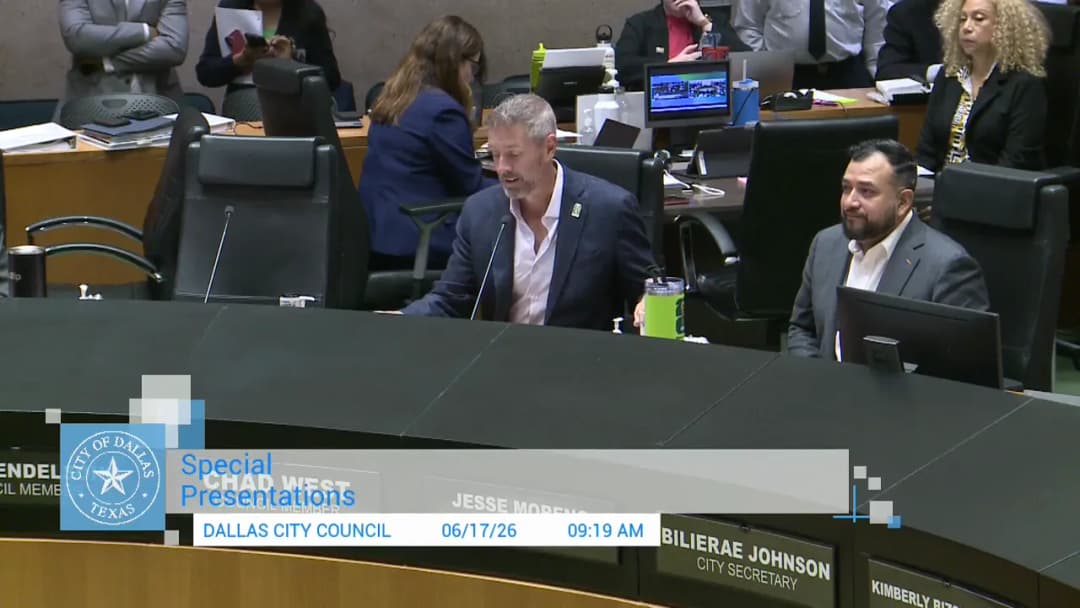
Dallas City Council Meeting - June 17, 2026: Recognitions and Ceremonial Proceedings

The Dallas City Council convened on June 17, 2026, at 9:09 a.m. for a special call meeting. The session opened with an invocation led by Deputy Mayor Pro Tem Maxie Johnson and pledges of allegiance. The meeting primarily featured recognition of city employees and community heroes following the May 28 Oak Cliff apartment explosion, as well as welcome remarks for the city's summer intern program. The meeting recessed at 9:30 a.m. until the conclusion of the special call meeting. Recognitions and Announcements - City Manager Kimberly Tolbert recognized personnel from Dallas Fire Rescue, Dallas Water Utilities, Transportation & Public Works, Office of Emergency Management, Office of Homeless Solutions and Community Empowerment, and the Dallas Police Department for their response to the May 28 apartment explosion in Oak Cliff. The explosion claimed three lives (including an infant), injured residents, and displaced families. Tolbert praised the departments' bravery, coordination, and compassion. - Councilmember Chad West (District 1) presented a special recognition to Rodney Brown, a resident who, on May 28, pulled a young girl from a burning building moments before a second explosion. West also thanked Pastor Gannon Sims of Mission Oak Cliff and representatives from Dominium and Savoy Equities for assisting displaced residents. - Councilmember Adam Grace (District 3) welcomed the city's largest-ever cohort of 31 summer interns, who will work across departments for nine weeks. Grace noted that the program had opened doors for him and encouraged the interns to learn from their experiences. - The meeting adjourned at 9:30 a.m. into recess.

COMMUNITY ENGAGEMENT 43% · PROCEDURAL 24% · PUBLIC SAFETY 14% · YOUTH PROGRAMS 13%
22
JUN 10, 2026 · DALLAS, TEXAS · CITY COUNCIL
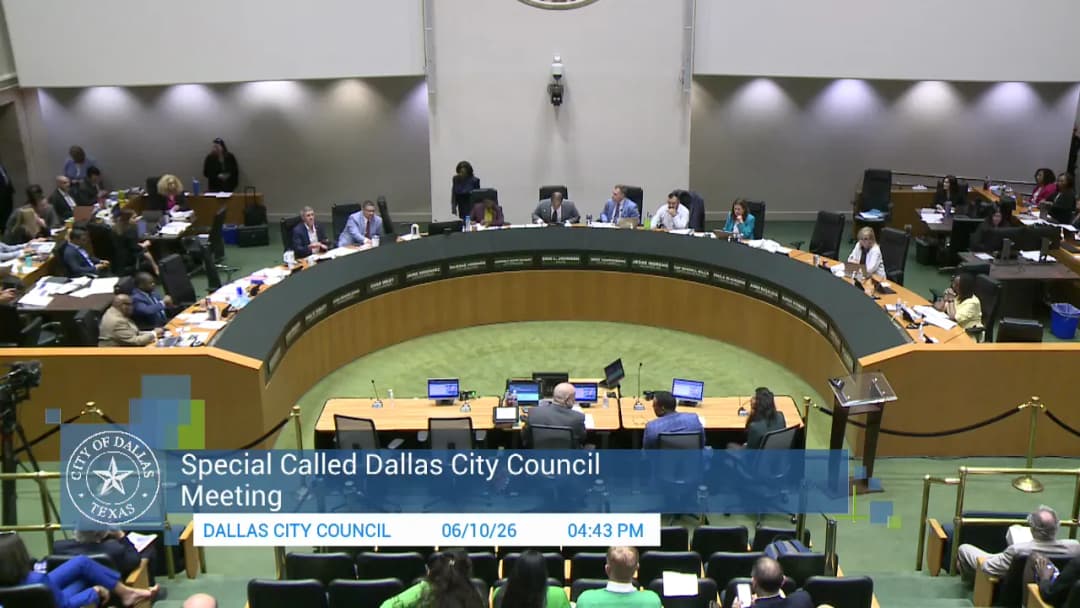
Dallas City Council Special Meeting: City Hall Repair and Relocation Discussion - June 10, 2026

On June 10, 2026, the Dallas City Council held a special called meeting to discuss financial considerations for public safety facilities, potential relocation of the 911 and Emergency Operations Center (EOC), a phased repair plan for City Hall, and potential relocation of City Hall. The meeting included a detailed presentation from the city manager and chief financial officer, followed by public testimony and a vote on a resolution to authorize a phased City Hall repair strategy (Agenda Item 3). After extended debate and several failed amendments, the council voted 9-6 to deny the repair proposal and instead direct the city manager to continue exploring site disposition options. Public Comments & Testimony - Kevin Walker (CEO, Dallas Citizens Council): Urged council to vote no on Item 3, stating the decision is about the next 50 years, not the next budget, and encouraged moving from analysis to action. - Melissa Lara (Co-founder, Bicole): Supported relocation, arguing that investing in City Hall repairs would be a missed opportunity for economic development and that Dallas needs bold vision. - Robert Walters (former Police and Fire Pension Board member): Opposed repairs, stating the cost of rehabilitating the building is far too great and would reduce funding for parks, police, and potholes. - Amanda Moreno Lake (business owner, District 1): Urged a no vote, citing multiple expert estimates that show repairing the aging facility is not a good long-term investment. - Jim Lake (developer): Supported relocation, comparing the City Hall site to Victory Park, which grew from $16 million to $2.5 billion in tax value after redevelopment. - Michael Tregoning (president, Hedington Companies): Warned against under-budgeting repairs based on his experience with historic renovations. - Michael Ablon (developer, Bank of America Plaza area): Supported relocation as a transformative economic development opportunity, stating that $500–$650 million in deferred maintenance is not prudent. - Luke Jokel (downtown resident): Supported relocation, speaking for his generation in favor of growth and creating interesting places. - Adam Cross (downtown business owner): Opposed repairs, stating downtown is dying and that spending hundreds of millions on a "decaying mausoleum" would harm small businesses. - Kishan Vashi (hotel owner near City Hall): Supported relocation, noting that guests feel unsafe walking near City Hall and that the area needs revitalization. - Arthur Santa Maria: Urged a no vote, arguing that a declining downtown harms Southern Dallas and that the wrong move could pull investment away from the southern sector. - Sana Saeed (president, Farmers Market Stakeholders Association): Urged a no vote, calling for reimagining downtown to attract investment and talent. - Jose Avila: Supported relocation, thanking council members ready to vote for Dallas's future and criticizing the TRO that blocked the relocation vote but not Item 3. - Jennifer Scripps (president/CEO, Downtown Dallas Inc.): Urged not to spend hundreds of millions on repairs, but instead to invest in community needs and plan a vibrant urban core. - Frank Michalopoulos (Corinth Properties): Opposed repairs, calling it a "generational opportunity" to free up 50 acres for a campus next to the convention center. - Amy Tharp (COO, Downtown Dallas Inc.): Urged rejecting a costly repair strategy to support residential growth and long-term success. - Osmar Reyes: Supported relocation, stating Dallas has lost too much already and needs to reinvest in infrastructure. - Kanti Sharesh (business owner, District 8): Supported relocation, asking council to have the vision to leave Dallas better than they found it. - Mark Nunley (CPA): Opposed repairs, stating the fully loaded cost to stay is $1.49–$1.6 billion versus $482 million to relocate, yielding over $1 billion in savings. - Kirk Presley (District 6 resident): Opposed repairs, citing Boston's City Hall renovation that ballooned from $225 million to over $1 billion. - Jamie Jolly (president/CEO, Real Estate Council): Opposed repairs, supporting redevelopment of the City Hall site as a once-in-a-generation opportunity. - Rudy Kareemy (District 14): Opposed repairs, analogizing that tenants bear all costs in commercial real estate and that the city should not treat taxpayers that way. - Michael Weisberg (native Dallasite): Supported repairs, arguing that scraping an iconic I.M. Pei landmark is reckless and that the forced timetable is suspicious. - Sarah Crane (executive director, Preservation Dallas): Supported repairs, saying the city can have both a vibrant downtown and a repaired City Hall, and that the process needs a thoughtful comprehensive strategy. - Stephanie Drenka: Supported repairs, quoting I.M. Pei and arguing the building represents the will of the people and should be restored. - Jessica Stewart Lindvey: Supported repairs, stating the numbers from consultants are rough order of magnitude and not meant for final decisions, and that the building is a model of democracy. - Mike Davis: Supported relocation, urging use of City Hall as a down payment on the future for downtown hospitality, restaurant, and nightlife uses. - Mark Grace: Supported repairs, encouraging council to move forward in leadership and vote yes. - Joanna Hampton (Swiss Avenue resident): Supported repairs, asking for a compelling vision for the site and noting the building is meant to last 200–400 years. - Abigail Clausen: Supported repairs, arguing the building is not the cause of downtown's problems and that taxpayers deserve better than to see it discarded. - Belle Bettson (South Oak Cliff): Supported repairs, citing the successful renovation of South Oak Cliff High School as an example of responsible investment in public assets. - Debbie Orozco Solis (neighborhood association leader): Supported repairs, asking for transparency and more community meetings before any decision on relocation. - PJ Moton: Opposed repairs, stating city employees deserve a modern work environment and residents deserve a civic home worthy of a 21st-century city. - Michaela Watkins (District 2): Supported repairs, asking for full transparency and comparative data, and noting the potential impact on unhoused individuals in the area. - Kristen Atwell (marketing firm owner): Supported downtown vitality but questioned the rush and lack of detailed information. - Kate Parish (District 2): Supported repairs, asking not to let City Hall become another disinvested public asset. - Ruben Landa (president, Greater Dallas Planning Council): Opposed repairs, saying the council has a fiduciary duty to spend wisely and that the cost to renovate is too high. - Ed Zara (District 14): Supported repairs, arguing that owning is better than renting and that lease options will have the same end-of-service-life costs. - Benjamin Boyer: Opposed repairs, suggesting the city should consider decentralizing services and modernizing service delivery digitally. - Marcel Quimby (District 14): Supported repairs, asking for a full comparison of all options before making a decision. - Sydney Walker (District 7): Opposed the repair plan, questioning why Class A office standards were used for renovation estimates and asking where money for relocation would come from. - Jedediah Ulrich (District 1): Supported repairs, arguing the building can be an anchor for downtown with housing built nearby rather than tearing it down. - Ariana Smith (downtown homeowner): Opposed repairs, supporting redevelopment to bring investment, jobs, and energy to downtown. - Betty Neal (46-year Dallas resident): Opposed repairs, stating $600 million would only cover deferred maintenance and that funds could be better spent on street maintenance, parks, and libraries. - Sam Williams (District 9): Supported repairs, citing lack of relocation cost data and questioning why business interests are prioritized over community needs. - Ronnie Mestis (West Dallas): Supported repairs, criticizing the process as non-transparent and arguing that historical buildings should be preserved. - Joe Tave (District 3): Opposed repairs, calling for relocation to unlock redevelopment and generate revenue for neighborhoods, especially Southern Dallas. - Yolanda Williams: Opposed repairs, criticizing council members who claim insufficient data and urging a vote against Item 3. - David Voss (District 2): Supported repairs but argued the proposed plan is too expensive and includes excessive contingency allowances; voted for a better plan. - Kevin Pfeiffer: Supported repairs, citing available ARPA funds and urging council to do the right thing and save City Hall. - Erica Cole: Criticized the process, saying council works for the people and should provide complete information on relocation costs and plans. - Jim DePetris (native Dallasite, downtown resident): Supported relocation, noting the high cost of renovating old buildings and that City Hall could move into an existing tower. - Ann Harrington: Supported repairs, asking leaders to slow down, listen to residents, and keep the people's voice at the center. - Diane Birdwell: Supported repairs, accusing developers of not caring about South Dallas and stating the public is not being heard. - Jeanette Bridges: Called for an apples-to-apples comparison of 30-year costs for staying vs. leaving before any decision. - Isaias Alvarez: Questioned why a detailed repair plan is being compared to a relocation concept, and asked for a full cost analysis including land acquisition and 30-year costs. - Meredith Jones: Supported repairs, arguing leasing forever does not make financial sense and that the city must fix its pattern of asset neglect. - Donna Denson: Supported repairs, asking for a complete accounting of costs before abandoning a structurally sound public asset. - Catherine Garrison: Supported repairs, noting that council members themselves say they lack complete cost numbers, and calling for transparency. - Gail Grace (District 1): Opposed relocation, stating the building and campus are not the cause of downtown's problems. - Alex Scott (District 9): Suggested strategic contracting to find savings, and opposed the repair plan. - Sean Pease (president, Dallas Police Association): Supported public safety facility investments but did not directly address City Hall. - Harrison Blair: Opposed repairs, saying there are hundreds of other budget needs and that young families do not want a $600 million bill for one asset. - Christopher Weiss (District 2 resident/business owner): Called for deferring the vote and holding a public bond referendum on all options. - Peter Young (Holland Park resident): Supported repairs, urging council to stop listening to developers and oligarchs. - Cynthia Michaels (president, Kessler Heights/Oak Cliff): Supported repairs, arguing that repair costs are inflated by unnecessary code upgrades, and that the process has been rushed. - Michael Emanette: Opposed relocation, stating that government buildings are not economic engines and that giving up an I.M. Pei building for an abandoned office tower is not a good deal. - Andrew Chabutaru: Supported repairs, arguing the $500–$600 million repair estimate is artificially inflated to justify an agenda. - Sarob Gupta: Opposed repairs, citing the $532–$614 million cost to maintain the building and arguing that money should go to street repairs and public safety. - Preeti Gupta: Opposed repairs, saying modernizing the aging infrastructure will cost hundreds of millions and that relocation is a forward-thinking path. - Bruce Richardson: Supported repairs, referencing a professional report that disagrees with the process. - Jim Anderson (additional speaker): Supported repairs, warning that leasing land for City Hall could cost $400–$500 million in rent over 20 years, comparable to repair costs. - Naomi Green (community advocate): Opposed repairs, urging that taxpayer dollars be spent wisely on neighborhoods. Discussion Items - Presentation by City Manager Kimberly Tolbert and CFO Jack Ireland: - Reviewed the history of underinvestment in City Hall since 1978 and provided updated cost estimates for a 10-year phased repair plan: $532 million to $614 million from consultants, with a separate corrective repair and modernization scenario costing $769.8 million (capital) and $1.5 billion total including interest and 20-year operating costs. - Presented public safety facility needs: $441 million for law enforcement training center shortfall ($82M), public safety training complex ($149M), 911/EOC relocation ($40M), property room/evidentiary vehicle storage ($150M), and fire station 4 replacement ($20M). - Discussed pension obligation bonds as a tool to shift general fund costs to debt service, noting risks and that the city already has a 30-year funding plan in place. - CBRE's Peter Jensen reported that market exploration shows material savings opportunities from relocation, with multiple financing options (lease-to-own, purchase, etc.) that could consolidate city operations and generate revenue. - Slides showed that using debt for repairs would slow the 2024 bond program from three to six years and reduce the 2029 bond program capacity from $1.1 billion to $330 million. - Cash funding would require a tax rate increase of about 7 cents (equivalent to $212/year on median home) or massive cuts to other departments (e.g., 20% cut to non-public-safety departments, elimination of 2,200 civilian employees). - Council Questions and Debate: - Mayor Johnson asked about consequences of delaying bond projects, noting that costs escalate and residents' expectations may not be met. - Chairman Ridley questioned the pension obligation bond proposal, stating it is not required and the city is already on track to fully fund pensions; he argued the current market conditions make POBs unattractive. - Councilmember Stewart questioned the justification for co-locating the property room and evidentiary storage, asking for metrics on efficiency gains. He also asked about the need to replace Fire Station 4. - Councilmember Roth asked about bond authorization timelines, flexibility in issuing bonds, and call provisions. - Councilmember Blair asked about the impact on taxpayers and how her district (District 8) can get needed infrastructure if large amounts of debt capacity are used for City Hall. - Councilmember West proposed a motion to deny the phased repair strategy (Item 3) and direct the city manager to continue exploring options for City Hall site disposition, with a report due by August 26, 2026. - Several council members expressed support for the repair plan (Mendelsohn, Basilduea, Cadena, Roth, Blackman) and argued that the repair costs are exaggerated because they include upgrades beyond critical repairs. Ridley offered an amendment to create a repair plan focused only on critical needs, which failed 6-9. - Basilduea offered an amendment to the West motion to include demolition cost, environmental impact, and disposal plan, which was further amended by Mendelsohn to include specifics on demolition timeline, landfill impact, and move-out costs. These amendments also failed after votes. - The final vote on the underlying motion (West's motion to deny Item 3) passed 9-6. Key Outcomes - Motion to Deny Item 3 (Phased City Hall Repair Strategy): Passed 9-6. The motion directs the city manager to continue following the March 4, 2026 resolution, subparagraph 3, to explore options for the disposition of the City Hall site and bring those options back to the city council no later than August 26, 2026. - Failed Amendments: - Ridley amendment for a critical-needs-only repair plan: Failed 6-9. - Basilduea amendment to include demolition, environmental, and disposal costs: Failed 7-8. - Mendelsohn amendment to the Basilduea amendment (specifics on demolition timeline, landfill impact, road damage): Failed 5-9. - Basilduea's second attempt at a similar amendment: Failed 7-8. - Next Steps: The city council will not proceed with the proposed Phase 2 repair strategy at this time. The city manager is to continue researching site disposition options and report back by August 26, 2026. A potential bond election on November 3, 2026, for pension obligation bonds and public safety facilities remains under consideration, with the call date of August 12, 2026.

ENGINEERING AND INFRASTRUCTURE 38% · FISCAL SUSTAINABILITY 27% · ECONOMIC DEVELOPMENT 9% · MISCELLANEOUS 9%
23
JUN 10, 2026 · DALLAS, TEXAS · CITY COUNCIL
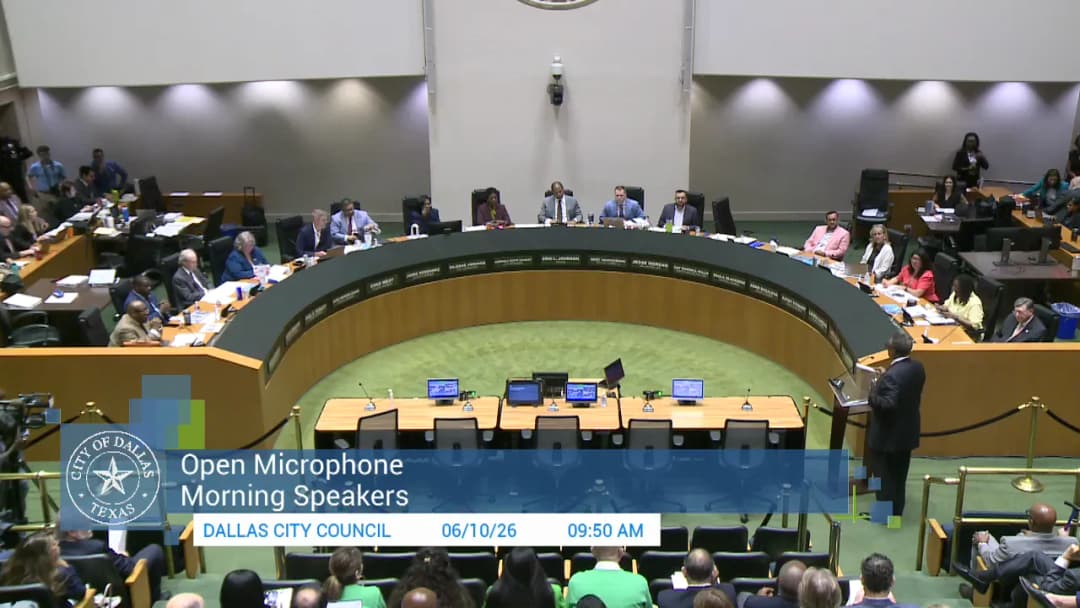
Dallas City Council Regular Meeting - June 10, 2026

The Dallas City Council convened on Wednesday, June 10, 2026, at 9:32 a.m. and recessed multiple times for a special called meeting and closed session, reconvening at 7:54 p.m. The meeting included public testimony on the future of City Hall, approval of a major zoning update for South Dallas, election of officers, and routine business. Consent Calendar - Agenda items 2–3, 6–17 (as revised) were approved unanimously, including routine contracts, grants, and minutes from May 27, 2026. Items 4, 5, 9, and 14 were pulled for individual consideration, with item 14 later returned to consent by Councilmember Roth. Item 4 (supplemental contract for convention center) was approved after discussion; item 5 was deferred; item 9 (zoning) was pulled; item 10 (corrected) remained on consent. Public Comments & Testimony - City Hall Redevelopment (Morning Session): Former Mayors Ron Kirk and Tom Leppard urged the council to pursue redevelopment of the City Hall site rather than spend an estimated $500–600 million to bring the current building to code. Brad Cheeves (Dallas Regional Chamber) expressed business community support for redevelopment. DuPree Scovell (Woodbine Development) argued the site's highest and best use is not a government office. Duane Caraway (resident) advocated seizing the opportunity. Jamie Schultz criticized the lack of transparency, urgency, and public information. State Representative Benton Jones cited a consultant's report indicating restoration costs could exceed $1 billion over two decades. Roland Parrish and other speakers also addressed the issue. Some speakers, including Mark Scholkoff, urged saving the building. - Evening Open Microphone Speakers: John Putnam (El Movimiento/DSA) demanded termination of Love Field lease with Atlantic Aviation, investigation of ICE deportation flights (citing 293 flights on pace for 2026), and regular public meetings on aviation. Other speakers addressed horse-drawn carriage bans (Gloria Carbajall, Nicole Micah), police academy funding (Jessica Delaspor, Black Police Association), and general calls for transparency (Abigail Clausen). - Zoning Public Hearings: On item Z1 (South Dallas Fair Park PD595 amendments), multiple community leaders (Tabitha Wheeler Reagan, Diane Ragsdale, Scotty Smith) spoke in favor, highlighting the community-driven process and need for implementation resources. No opposition speakers appeared. Discussion Items - Convention Center Budget (Item 4): Councilmember Mendelson pulled the item to protest lack of transparency on convention center costs. CFO Jack Ireland noted a response was provided in a March 24 Finance Committee presentation. Director Rosa Fleming confirmed the total budget is $3.08 billion (construction) plus $262 million soft costs. The supplemental agreement (up to $8.75M) was approved for job order contracting to maintain the existing convention center during the transition. - Software Contract (Item 22): Councilmember Mendelson expressed concern over numerous expensive software purchases with insufficient oversight. Councilmember West supported a motion requiring the city manager to provide a comprehensive software plan with license counts and purposes. The motion passed. - Vehicle Maintenance Facility (Item 23): Councilmember Mendelson moved to reject the contract after Kimley Horn withdrew its proposal. Councilmember Mendelson described deplorable conditions at the Southeast Service Center (sewage, no air conditioning, peeling paint) and argued a better plan is needed. The rejection was approved. - Zoning Update – South Dallas Fair Park PD595 (Item Z1): Councilmember Basaldua presented the massive rezoning for approximately 3,335.8 acres, the result of over six years of community engagement. The updated planned development district includes design standards for single-family and duplex homes, mixed-use corridors, and a historic destination. The motion to approve included amendments (e.g., deleting liquor store from CMU, permitting agricultural uses by right, allowing hotels with 60+ rooms by right). Councilmember Mendelson questioned the three-year, seven-month processing time; staff defended it as necessary for thoroughness. The item was approved unanimously. - Election of Officers (Item 26): Councilmembers elected Jesse Moreno as Mayor Pro Tem (10 votes) and Maxie Johnson as Deputy Mayor Pro Tem (11 votes) for a one-year term beginning June 15, 2026. - Other Items: Items 20 (archery grant), 21 (pool mechanical system), 27 (waterworks bonds) were approved. Item PH1 (alcohol variance) was approved; PH2 (HUD budget) public hearing closed. Zoning item Z7 (handicap group dwelling SUP) was deferred to August 12, 2026, for more community input. Key Outcomes - No Formal Vote on City Hall Redevelopment: The council heard extensive public testimony on the future of City Hall but did not take a vote on redevelopment or demolition during this meeting. The special called meeting (briefing item A and closed session items 5 & 6) may have addressed related matters, but no action was reported in open session. - South Dallas Fair Park Zoning Approved: The largest PD in Dallas (Z1) was approved with amendments, setting new design standards and mixed-use allowances after years of community input. - Council Officers Elected: Mayor Pro Tem (Jesse Moreno) and Deputy Mayor Pro Tem (Maxie Johnson) were elected for 2026–2027. - Convention Center Contract Expanded: Supplemental agreement for job order contracting increased by $1.75 million to maintain facilities through 2028–2029. - Vehicle Maintenance Facility Contract Rejected: Due to withdrawn bid and facility condition concerns, the council rejected the contract for a new vehicle maintenance building. - Deferrals: Zoning items Z2 and Z6 were deferred; Z7 was deferred for community outreach.

PROCEDURAL 28% · MISCELLANEOUS 19% · COMMUNITY ENGAGEMENT 15% · ENGINEERING AND INFRASTRUCTURE 10%
24
JUN 3, 2026 · DALLAS, TEXAS · CITY COUNCIL
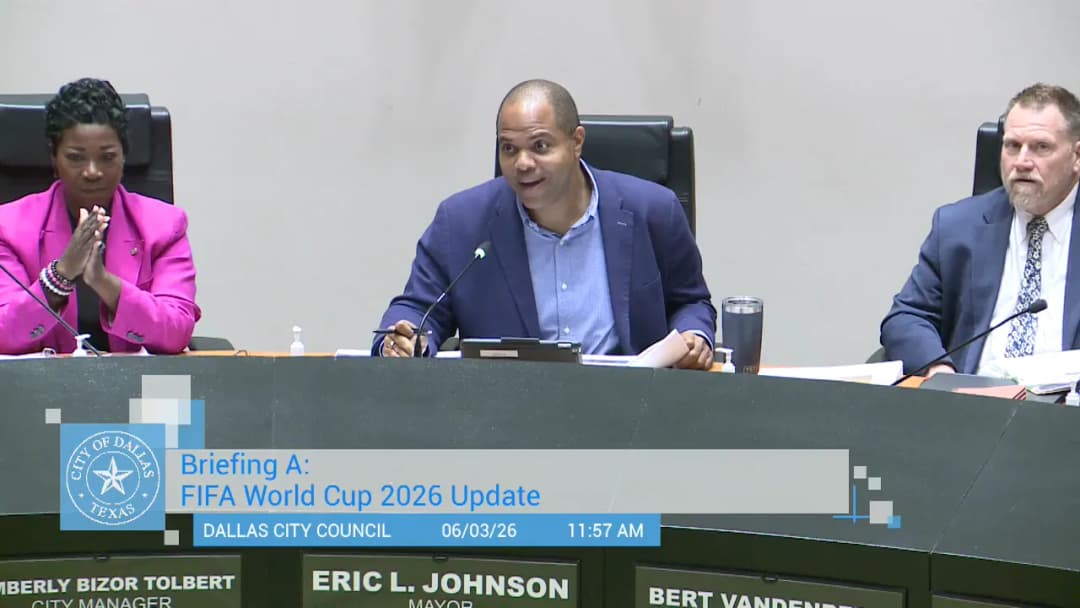
Dallas City Council Meeting - June 3, 2026: FIFA World Cup Preparations and City Hall Repair Cost Briefings

The Dallas City Council met on Wednesday, June 3, 2026, from 9:27 a.m. to 7:59 p.m., with a lunch recess from approximately 11:30 a.m. to 1:17 p.m. The meeting included public comments, a detailed briefing on FIFA World Cup 2026 preparations, and a comprehensive briefing on the costs and phasing options for repairing City Hall. No binding votes were taken on the repair options; the council heard expert testimony and will consider next steps. Public Comments & Testimony - Carol Bell Walton expressed support for the Valley View development but criticized the city council for losing the Dallas Stars and the lack of transparency, and opposed bypassing required RFPs. She also voiced concerns about the environmental impact of debris trucks on pavement and air quality. - Sana Saeed (President, Farmers Market Stakeholders Association) decried the departures of the Mavericks, Stars, Neiman Marcus, Fox 4, and AT&T under this council's watch. She urged the council to connect downtown to Southern Dallas for economic opportunity and to act quickly to save the Mavericks downtown. - John Wiley Price (Dallas County Commissioner) provided historical context on downtown growth, stating that the West End grew from $1 billion to $5 billion in value over 25 years, and compared downtown Dallas (1.4 sq mi, 15,000-16,000 residents) to Fort Worth (0.8 sq mi, 3,000-5,000) and San Diego (5 sq mi, 35,000-40,000). He argued the council has done well in fostering downtown growth. - Joanna Hampton urged the council to focus on critical repairs at City Hall rather than a luxury renovation, and called for a downtown planning effort that includes Southern Dallas, leveraging the I-30 reconfiguration and Valley View/Redbird TIFF. - Kenny Brown (Kinesha) supported Lala Johnson and Tina Fest, requesting the city designate July 3rd as Tina Turner Day and provide production support for a free event, citing Tina Turner's historic reinvention in Dallas. - Sidney Walker expressed anger that the Mavericks are leaving downtown and demanded that the 20% of the HOT tax voted in November 2022 (up to $325 million) be directed to Fair Park as promised, not diverted. He warned against selling City Hall to fund Fair Park. - Sam Williams (District 9) supported preserving City Hall, arguing that a lease line item would strain the budget, and urged investment in surrounding vacant lots rather than bailing out development interests. - Jim Anderson (former city planner, 26 years) urged the council to focus on critical repairs (water infiltration, generators, roof) rather than upgrades, and stated that civic architecture should symbolize democratic transparency. - Stephanie Drinka (Executive Director, Dallas Asian American Historical Society) spoke about architect I.M. Pei's vision for City Hall as a 'people's city hall' and urged the council to preserve it. - Miriam Sharma (mother, nurse, community safety advocate) invited recognition of Gun Violence Awareness Day on June 5, 2026, noting that firearm injuries are the leading cause of death for children and teens in Texas and that 58% of gun deaths are suicides. - Emir Pepik complained about inadequate police response to his stolen vehicle (3 months ago) and accused the city of protecting criminals and human trafficking. - Jedidiah Ulrich opposed selling City Hall, arguing it is an anchor for the city and should not be turned into an amusement park, and opposed sports franchises leaching from the city. - Sean Buckley (downtown resident, equity partner at a law firm) urged the council to take action to prevent downtown collapse, citing the loss of the Mavericks and Stars as a once-in-a-generation opportunity to relocate City Hall to a modern tower. - Ariana Smith (downtown resident) expressed disappointment that promised businesses never opened and many have closed, and asked the council to create a revitalization plan for downtown now that the Mavs and Stars are leaving. - Ifani Umeiji (entrepreneur, downtown resident) expressed disappointment that the Mavericks are leaving downtown, calling it a missed opportunity to drive economic growth and connect downtown to Southern Dallas. - Brenda Gurumorthy (high school math teacher, co-chair DSA) argued that City Hall should be preserved for its historic value and as a site for First Amendment rights, and that surface parking lots and the I-30 gash offer redevelopment opportunities without tearing down City Hall. - Mohammed Abdullah (Imam, oldest mosque in North Texas) criticized the lack of transparency and the city's approach to homelessness, calling for unity and a bigger vision beyond politics. - Ronnie Mestis (West Dallas resident) urged reconsideration of plans to leave City Hall, warned about unintended consequences from redevelopment, and noted a lack of transparency. - Alexander Stein (Alex Stein) criticized the mayor personally, blaming him for losing the Stars and Mavericks, and accused him of poor judgment. - Cookie Pedon empathized with call center staff working conditions (citing her experience after a 1994 American Airlines crash) and noted the austere conditions in the City Hall call center. - Cynthia Michaels (speaking for herself and Heritage Oak Cliff) thanked the six council members who paused the City Hall move process, questioned why repair costs doubled compared to earlier quotes, and noted that Zayetta Rosario's independent repair estimate was under $100 million over 10 years, contrasting with the $600 million phase 2 report. She also noted six major companies leaving downtown in the last 8 months. Discussion Items FIFA World Cup 2026 Briefing - City Manager Kimberly Tolbert opened the briefing, noting it covers the city's ongoing planning and coordination for the World Cup, which involves multiple city departments and regional partners. - Rosa Fleming (Director, Convention and Event Services) recognized staff contributions and introduced the team. - Monica Paul (Sports Commission/Visit Dallas) provided an overview: - Match schedule: June 14 to July 14 (9 matches, including a semifinal). Ticket sales are strong; international ticket purchasers range from 45% to 56% for group stage matches. - Transportation: TRE from Victory Station to Centerport, then free shuttle buses to AT&T Stadium. DART will provide backup direct buses. - Fan Festival at Fair Park: June 11 – July 19 (34 of 39 days), free but requires ticket registration; capacity 35,000 at one time. Three concerts with $26 tickets. - Hotel and air travel data: Hotel bookings in Dallas city limits pacing 24% ahead for June, 56% for July. Short-term rentals up 40% (June), 28% (July). International flight bookings into DFW and Love Field up 78% over last year. - International Broadcast Center (IBC) at convention center: already 2,000 broadcasters present, total expected 2,000-3,000. - Legacy: Four mini-pitches in underserved Dallas areas; North Texas Business Connect program registered over 2,300 businesses (683 in Dallas). - Travis Houston (Deputy Director, Emergency Management) outlined the regional public safety organization, including four standing objectives: protect life, sustain situational awareness, preserve continuity of city services, enable rapid consequence management. - Assistant Chief Paco (Dallas Fire Rescue) described enhanced heat safety protocols, CBRN detection capabilities, proactive venue inspections since July 2025, and strengthened mass casualty response. - Arnold (Department of Aviation) reported that Dallas Love Field expects sustained FIFA-related aviation pressure with three high-risk windows. Dallas Executive Airport will serve as overflow. - Charlie Salazar (Deputy Director, Transportation and Public Works): Since April 2026, the 'Dallas Ready' program closed nearly 1,700 service requests, including 395 code compliance cleanings, 87 encampment cleanings, 71 graffiti removals, 23 pothole repairs, and 22 traffic sign repairs. Enhanced pavement, sidewalks, traffic signals, and wayfinding. - Jacqueline Justice (Assistant Director, Special Events) listed planned fan and pedestrian activations: Croatia parade (June 16), Japan event at Harwood Park (June 24), Open Streets on Main Street (June 20, 27, July 4, 11), America's Block Party (July 4), and nightly light shows on the UNT Law Building (July 4-24). - Councilmember questions focused on wayfinding, volunteer hospitality, public safety staffing levels, and inclusivity for residents who cannot afford tickets. City staff confirmed that all relevant costs are being tracked for state reimbursement. City Hall Repair Program Briefing - City Manager Tolbert introduced the second phase of the process directed by council on March 4, 2026 (Resolution 26-0499), which required a repair and replacement program prioritizing critical needs with at least two phased repair options over 10 years. - Gresham Smith (Jen Murphy, Chris Kuhn, Dustin Yates, Tanyan Farley) presented two scenarios: - Scenario A (construction efficiency): 3 phases over 6.4 years, prioritizing highest-risk items (generators, roof, expansion joints). Peak swing space needed: 193,000 sq ft. Planning-level estimate: $531.6 million (corrective repairs with code triggers). - Scenario B (operational flexibility): 5 phases over 10 years, smaller disruptions. Peak swing space: 132,000 sq ft. Estimate: $556.8 million. - Both estimates include 4.5% annual escalation from 2029, ADA/TAS upgrades, fire and life safety upgrades (sprinklers, smoke evacuation, stair pressurization), asbestos abatement, and triggered items. Excluded: modernization, furniture, technology. - Risk-based prioritization framework placed emergency generators, roofing, expansion joints, and water intrusion as highest priority. - WM2 Co. (Will Mundinger, Don Powell, Mike Percell) presented an independent peer review with different methodology but similar conclusions: - 10-year plan: $610.8 million - 5-year compressed plan (same scope): $591.2 million - Key cost driver: electrical system replacement (Federal Pacific panels, switchgear, generators) at $120 million (vs. others at $60 million). They argued the entire system must be replaced, not repaired. - Life safety deficiencies: No automatic sprinklers on floors 2-7, no smoke evacuation in the atrium, and no stairwell pressurization (stairs act as chimneys in a fire). - CBRE (Peter Jansen) provided total occupancy cost estimates over 20 years, including corrective repairs, modernization ($213 million), temporary leasing, financing (5% cost of capital), and operating expenses. Total under any scenario ranges from $1.3 billion to $1.5 billion. - Council discussion was extensive and divided. Key points: - Councilmember Mendelson argued the March resolution specified 'repairs,' not 'renovation,' and questioned costs triggered by code upgrades. She sought a minimal repair-only estimate, but consultants explained that code compliance (51% threshold) is mandated by the 2022 Dallas Existing Building Code for high-rise buildings. - Councilmember Gracie noted that all estimates have increased from staff's $152-345 million to over $600 million, and questioned whether the council should accept that the building requires major investment. He stated the numbers are not faulty but reflect reality. - Councilmember West emphasized that code compliance is mandatory—the city cannot exempt itself—and asked about financing mechanisms (bond vs. cash). City Manager Tolbert stated no financial plan is ready yet. - Councilmember Ridley focused on phasing and cost breakdowns, questioning whether certain items (e.g., facade sealing, roof) might be overestimated. He noted WM2's own admission that some numbers need further validation. - Councilmember Roth urged proceeding with a phased repair plan, arguing the numbers are reliable for planning and the council can manage costs. - Councilmember Stewart emphasized that the numbers are reliable and the council must make a tough decision. - Councilmember Johnson (Maxie) stated the numbers are truthful and the council must stop 'kicking the can.' He noted the water leakage problem dates back to 1976. - Councilmember Blair asked about stair pressurization and life safety; experts confirmed that current stairwells are not safe for firefighters. - Councilmember Blackman noted that either staying or leaving will have a budget impact. - Councilmember Cadena asked about demolition costs (not yet estimated) and urged caution without full information. - Councilmember Ricendez thanked the team and said the numbers should be accepted as a basis for decision. Key Outcomes - No votes were taken on the City Hall repair options. The briefing was informational only. - The council will continue to consider the data and expects future briefings on financing, side-by-side comparison with leasing/new building options, and additional work on demolition costs and historic preservation implications. - The city manager noted that current budget capacity cannot cover these costs, and any path forward will require either new revenue cuts or debt issuance. - The meeting recessed into closed session at 5:33 p.m. to discuss legal and real estate matters (agenda items 3, 4, 5), and reconvened at 7:59 p.m. to adjourn without further action.

ENGINEERING AND INFRASTRUCTURE 57% · PUBLIC SAFETY 9% · FISCAL SUSTAINABILITY 8% · MISCELLANEOUS 7%
25
JUN 1, 2026 · DALLAS, TEXAS · CITY COUNCIL
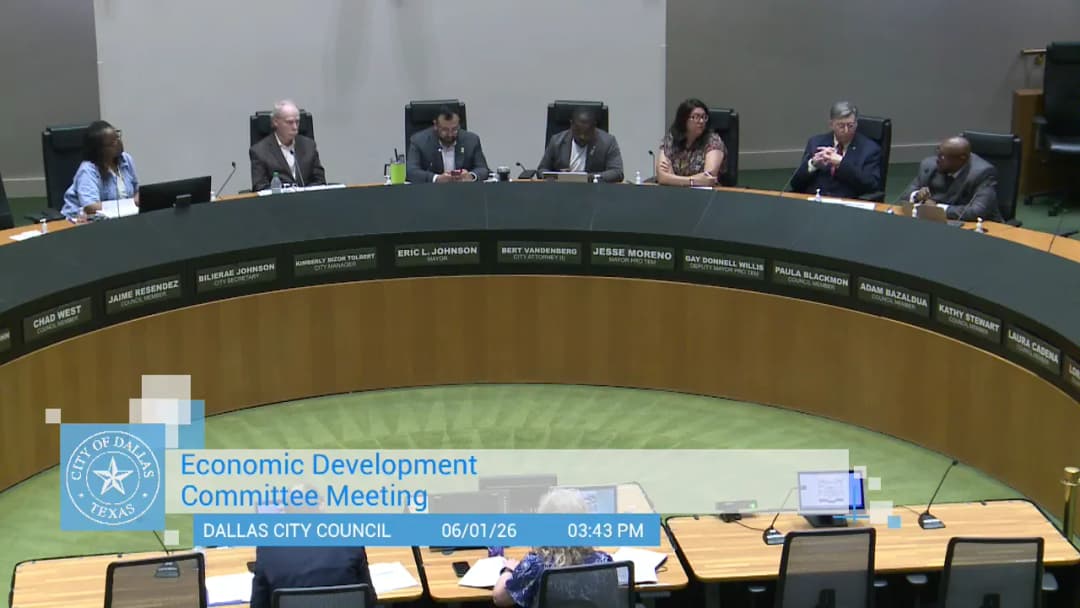
Economic Development Committee Meeting - June 1, 2026

Meeting Date: June 1, 2026 (convened at 1:00 p.m., recessed, reconvened at 2:48 p.m., adjourned at 4:43 p.m.) The Economic Development Committee met to discuss several key items, including the final list of recommended Opportunity Zones (OZ 2.0), an update on the Dallas Now permitting system, informational briefings on the New Markets Tax Credit program, and a proposed tax abatement for a light manufacturing project in District 8. Opportunity Zones 2.0 (Briefing Item A) Staff presented a final list of 42 recommended census tracts for nomination to the governor's office for the federal Opportunity Zone program (OZ 2.0). The tracts were selected from an initial 175 eligible tracts in Dallas, refined through public comment (27 tracts received comments) and staff analysis. Estimated potential investment in these tracts is approximately $9 billion. The governor's office will score nominations on a 10-point scale (4 points project viability, 4 points local support, 2 points geographic balance/disaster area; Dallas can maximize 9 points). Submission deadline to the state is June 26, 2026. Discussion: - Councilmember Kadena asked about the purpose and tracking of OZ investments. Staff noted that under OZ 2.0, new reporting requirements will provide outcome data, unlike the original program. - Councilmember Blair sought clarification on how zones attract development and whether they could bring undesirable projects. Staff acknowledged that the city cannot control all investments under the program. - Councilmember Johnson expressed strong concern about lack of community engagement in District 4, specifically regarding tract 211 (Cedacrest area). She stated the community was not consulted and opposed the designation without proper dialogue. She characterized existing “opportunity zones” in her district as bringing gas stations, laundry, crime, and blight, not real economic development. - Councilmember Blair echoed concerns about lack of communication with her district (District 8) regarding tracts at Redbird Mall, UNT, and Paul Quinn. - Councilmember Gracie and others discussed the process for withdrawing tracts and adding new ones. Chair Ridley proposed a motion to approve the 42 tracts but allow council members to withdraw tracts in their district by June 15, 2026, via memo to staff. Staff indicated additions would be difficult to vet in time. - After further debate, the motion passed with that amendment. Councilmember Johnson requested a community meeting to discuss which tracts might benefit District 4 before any withdrawal. Key Outcome: Motion approved (vote not recorded, but no opposition stated) to forward the 42 recommended census tracts to the governor's office, with the allowance for any council member to remove tracts within their district by June 15, 2026. No additions to the list are permitted. Dallas Now Update (Briefing Item B) Jason Poole, Assistant Director for Planning and Development, provided a one-year update on the Dallas Now digital permit and development management platform, launched May 5, 2025. Key statistics: over 126,000 records, 35,000 customer accounts, 14,000 contractor registrations, and 213,000 inspections managed. The system integrates 15 city and external systems and connects multiple departments (Dallas Water Utilities, Parks, Transportation, Fire, etc.). Performance Trends: - Residential permits: Median issue days declined from 20 days post-launch to 6 days (a 70% reduction). - Commercial permits (new construction): Median issue days (including Q-team) were 95 days as of June 1, down from 117 in mid-May. Goal is under 100 days. - Zoning cases: Median time from application to council consideration fell from 184 days to 128 days. Discussion: - Councilmember Blair asked for training to help residents and developers navigate the system, noting it is not intuitive. Staff committed to providing assistance and noted a new public portal is forthcoming. - Councilmember Ridley emphasized the need for continued improvement to remain competitive with other cities. - Councilmember Roth stressed the importance of both high-tech and high-touch customer service, including a case manager for large projects. Director Liu confirmed recent improvements: a dedicated intake specialist for new projects and cross-departmental coordination teams. - Councilmember Kadena raised fee collection issues—under Dallas Now, full payment is required upfront for large projects, which can be a burden. Staff explained that the previous system also required full upfront payment, and partial payments are impractical for 50,000 annual permits, but exceptions may be made for very large projects. - Director Liu noted that staffing cuts last year (58 positions) were too deep, and the department will request restoration of about 15-16 positions to handle upcoming major projects (convention center, hospitals, school bond). Fee collection corrections have increased revenue by 10% over projections. Key Outcome: Informational only; no vote needed. New Markets Tax Credit (Briefing Items C, D, E) Staff provided a brief overview of the New Markets Tax Credit (NMTC) program, administered through the Dallas Development Fund (a city-controlled 501c3). The program provides federal tax credits (39%) to investors in low-income census tracts. The city has $55 million in allocation (netting approximately $20 million in subsidies). Projects are vetted by a board and require council approval. No questions were raised on items D and E. Item F – Tax Abatement for Light Manufacturing Project Staff presented a proposed 50% tax abatement (Chapter 381 Economic Development Agreement) for a light manufacturing company locating in an existing vacant building in the inland port (District 8). The project is expected to create 166 jobs (150 required) with an average wage of $55,000 plus benefits. The abatement would reduce the city’s tax revenue by approximately $1.38 million over 10 years, but net fiscal impact is $1.52 million over the same period (benefits exceeding abatement). The project also aligns with the New Markets Tax Credit program (forthcoming). Discussion: - Councilmember Ridley questioned the low payback ratio, but staff noted net benefit is real and the building is currently vacant. - Councilmember Blair expressed support after verification, emphasizing job quality, partnership with educational institutions, and only a 50% abatement (vs. full abatements). The project will also create a clawback provision if the company leaves within 10 years. - Councilmember Roth praised the deal as aligning with city goals. Key Outcome: Motion to forward this item to the full City Council with a favorable recommendation for the June 10, 2026 agenda was made by Councilmember Blair, seconded, and passed (no opposition). Other Items - Items G and H were postponed to the next Economic Development Committee meeting. - Items D and E were informational only; no action taken. Meeting Adjourned at 4:43 p.m.

ECONOMIC DEVELOPMENT 62% · TECHNOLOGY AND INNOVATION 20% · COMMUNITY ENGAGEMENT 11% · PROCEDURAL 3%
OPENPUBLICA · PUBLIC MEETING INDEXUPDATED DAILY · openpublica.com