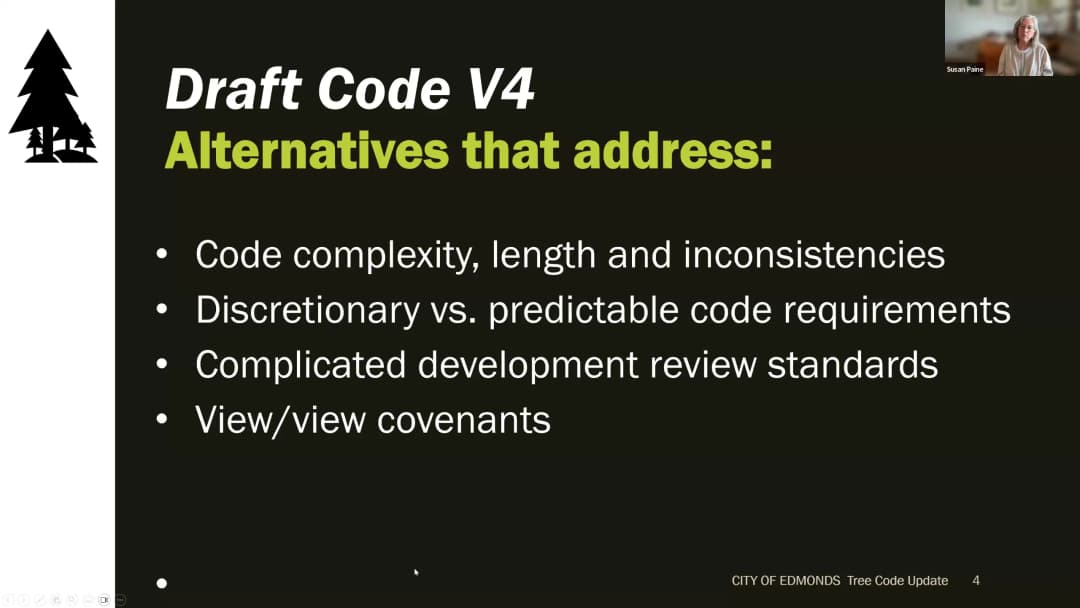
The Edmonds City Council met in study session to continue work on the tree code amendments (AMD2026-0001, Fifth Reading and Beyond), focusing on public feedback from the previous night's public hearing and possible further code changes. The meeting opened with an executive session on litigation; no formal action was taken. Note: the agenda packet lists the meeting as September 9, 2026 at 3:00 PM, while the meeting record timestamp is 2026-09-10 17:30:00+00:00; this summary uses the latter date. Executive Session - Council moved into executive session pursuant to RCW 42.30.110(1)(i) to discuss litigation or potential litigation with legal counsel representing the city. - The session was expected to last 16 minutes; Council reconvened at 4:15 PM, and no action was taken. Public Comments & Testimony - At the previous evening's public hearing, approximately 20 people spoke in person, and multiple additional comments were submitted via email. - Staff and council summarized the themes of that public feedback: the code's complexity, length, and inconsistencies; discretionary versus more predictable code requirements; and view and view covenant concerns. Discussion Items - Tree Code Amendments (AMD2026-0001) – Fifth Reading and Beyond: - Deb, the project manager, explained that the study session was intended for staff to hear council feedback on the prior night's public hearing and to determine what further code changes staff should consider. Staff will seek direction from council at the September 22, 2026 meeting. - Delays: the tree board and planning board each took additional time, pushing the schedule later in the year than anticipated; October 6, 2026 was identified as a potential date to extend the interim ordinance. - Version 3 vs. Version 4: several council members observed that some planning board recommendations in Version 3 did not carry into Version 4 and requested better communication on why changes were made. Staff and Jeff Charity explained that Version 4 was developed from council's August 11th discussion, because the same Version 3 shown at the planning board public hearing could not be shown again at the council public hearing; any revisions intended for adoption had to appear in the public hearing packet. The schedule was extended from July 22 to August 12, shortening the time between the planning board recommendation and the first public hearing. - Council members' positions and suggestions included: - Support for incentives, especially for public owners who voluntarily retain mature trees, using tree fund and fee-in-lieu dollars (for example, a stormwater fee reduction) to encourage retention. - Caution that monetary incentives are 'ripe for unscrupulous activity' and that financial incentives are harder to administer than development-based incentives. - Retention of the tree risk assessment requirement, performed by an ISA-certified professional. - Concern that the code's 2,000 square foot threshold is treated as non-development, which is not how the development code treats it. - View easements should remain a civil matter between property owners, not enforced by city staff; the code should allow flexibility where an easement is in effect without exempting properties from the code or from tree replacement requirements. - A question about how fee-in-lieu dollars are ensured to translate back into tree canopy, referencing the city attorney's statement. - A suggestion to adopt a more strategic framework with tree retention as the first priority, followed by the activities the city will undertake to retain trees. - A council member relayed that Friends of the Edmonds Trees reported three people independently using two different AI models to find inconsistencies within the code and between the code and the Urban Forest Management Plan, with all three converging on similar refinements; the group offered to share their prompts with staff. - Staff described two enforcement tracks: clear violations, especially involving critical areas or tree protection plans, versus inadvertent removal where a permitted path exists; the city is generally not punitive when property owners self-report. For dead tree removals, staff historically accepted photos showing a tree that was clearly brown, leafless, and dead. - Process note: one council member expressed concern that the informal format was being monopolized and that all council members should receive equitable time to share perspectives, stating that continuing to abuse the process was not a fair or good use of taxpayer time and money. Items for Future Consent - Addendum No. 1 to the 2026 Summer Market Event Agreement, adding Winter Market dates (Parks and Recreation). First reading; listed for a future consent agenda. Key Outcomes - No formal action was taken; the meeting was a study session. - Staff will prepare draft code changes and seek council direction at the September 22, 2026 meeting. - Two more public hearings are anticipated before adoption. - October 6, 2026 was penciled in as a potential date for extending the interim ordinance. - Council members requested clearer communication on the differences between planning board recommendations (Version 3) and staff's Version 4. - The study session adjourned at 4:50 PM.
Public Meetings - Edmonds, Washington
Public Meetings - Edmonds, WashingtonThe City Council of Edmonds held a regular meeting on September 8, 2026, at 6:00 PM in the Council Chambers. The meeting included a proclamation, a finance update, audience comments, a public hearing on tree code amendments, and two council business items: unlicensed food vendors and the Deer Creek Critical Aquifer Recharge Area (CARA) PFAS study. All council members and the mayor were present. Consent Calendar - Approved unanimously: minutes from previous meetings, resolutions recognizing the 136th anniversary of Edmonds and commending student representative Vivian Liao, payroll and benefit checks (Aug 1-15 and Aug 16-31), appointment of 15 members to the Fiscal Sustainability Task Force, revisions to the WWTP Senior Laboratory Technician job description, award of the Yost & Seaview Reservoirs Repairs and Upgrades construction contract, acceptance of a National Fish and Wildlife Foundation grant agreement for the Edmonds Marsh preliminary design, authorization to advertise a Request for Qualifications for the same project, claim checks and wire payments, and renewal of the UW event contract. Public Comments & Testimony - Margie Fields (Edmonds resident) expressed concern about the Deer Creek Aquifer and urged caution regarding stormwater infiltration into drinking water, noting that existing data are insufficient to determine safety. - Joe Scordino (Edmonds resident) called for improved council process and transparency, stating that the tree code is a “mess” and that residents feel unheard. - Bob Danson (General Manager, Olympic View Water and Sewer District) acknowledged the Deer Creek PFAS study and said the district is reviewing the report, particularly regarding stormwater infiltration and aquifer protection. Presentations - Proclamation for Puget Sound Starts Here Month – Mayor Mike Rosen proclaimed September 2026 as Puget Sound Starts Here Month in Edmonds. Stormwater Engineer Ryan Hogue emphasized the importance of local actions (e.g., restoring habitats, cleaning catch basins) to protect Puget Sound. - Mayor’s Finance Update – Mayor Rosen reported that Finance Director Gould has returned, the city is deep into budget work while implementing new software (Tyler), and the June financial report is in the packet. A budget retreat is scheduled for September 11. Public Hearing – Tree Code Amendments (AMD2026-0001) The public hearing was opened to receive comments on the proposed tree code update, which has been under development since 2021. Planning Manager Brad Shipley and Urban Forest Planner Deb Powers presented two versions of the draft code and noted that over 75 council member questions had been addressed. Many residents spoke in favor of strengthening tree protections. Key points from speakers: - Georgina (Edmonds resident) questioned the accuracy of canopy data (32% figure) and urged emphasis on retaining landmark trees, especially in multifamily developments to mitigate heat impacts for underserved communities. - John Merske (Friends of Edmonds Trees) argued that regulating trees on private property is standard land use practice and necessary to meet the city's 35% canopy goal, since most canopy sits on single-family residential land. - Lou Larie (Edmonds resident) used the removal of “Big Red” (a 100-year-old Coast Redwood) as an example of the code’s failure, requesting clear language to prevent removal via landscape plans and requiring arborist assessment and analysis of alternatives before removal. - Barb Steller (Edmonds resident) supported retention over replanting and fee-in-lieu, urging high fees to discourage clear-cutting and establishment of minimum retention requirements. - Dennis Weaver (Boardwalk Condominiums) supported Friends of Edmonds Trees and recommended requiring HOAs to prove authority to apply for tree removal permits. - Deborah Ashland (Edmonds resident) criticized Version 4 of the code for reducing tree density credit (TDC) requirements, arguing that it incentivizes replanting over retention and will not achieve the 35% canopy goal. She noted that a 2,000 sq ft threshold for development activity is too high. - Laura Hine (Edmonds resident) urged protection of landmark and significant trees, linking the tree code to honoring the land acknowledgement. - Arlene Williams (Edmonds resident) raised concerns about arbitrary director discretion over fines, use of photographs instead of arborist reports for hazard tree permits, the increase in development threshold from 500 to 2,000 sq ft, and legal agreements exempting replanting in critical areas. - Royal Walls (Edmonds resident, park steward) emphasized the loss of Big Red and called for protection of heritage trees, as well as planting of appropriate native species that won’t obstruct views. - Cameronack (longtime Edmonds resident, scientist) presented preliminary research showing a possible 0.5% to 3% canopy loss from 2016-2024, but cautioned that the science is not settled and called for more transparent data. - Gayla Schumach (Edmonds resident) urged that the code protect landmark trees on private property, as the current draft does not. - Pam Cower (Edmonds resident) criticized the 2,000 sq ft threshold and the reduced TDC, stating the code will not achieve the 35% canopy goal. She called for return to 500 sq ft threshold and minimum retention requirements. - Kyle McIntyre (Edmonds homeowner) argued that the fee-in-lieu amount must be high enough ($2,615/credit for a 5-credit scale) to deter removal, or the code will go backwards from current fees. - Natalie Rever (Master Builders Association) asked for predictable code, less director discretion, and meaningful incentives for preservation. She noted that public works is exempt from many requirements. - Joe Scordino (second comment) challenged the city to commit to increasing its own canopy and stop cutting trees. - Janelle (Edmonds resident, tree board member) suggested incentives (tax credits, stormwater credits) instead of punitive measures, and argued that tree loss is not happening in single-family zones. - Gabriel (Lynnwood resident) supported incentives and noted that climate change is already killing shallow-rooted trees. - Gary Nelson (60-year Edmonds resident) commended Deborah Powers, supported the direction on nuisance trees, and asked that parks and public works be explicitly exempt from permit requirements (as in earlier versions) since “utility agencies” is undefined. Councilmember Olson suggested that another public hearing may be needed before final action, and noted inconsistencies between the Urban Forest Management Plan and the draft code, particularly regarding views and landmark trees. Council Business – Unlicensed Food Vendors (Third Reading) The council discussed amendments to Chapter 4.12 of the Edmonds City Code regarding mobile food vendors. Senior Planner Dwayne Walcott presented research on other cities’ approaches, including a mobile food incubator program in Bothell. After several motions and amendments: - Councilmember Nand moved to direct planning staff to conduct further research on the possibility of creating a pilot program for mobile food vendors. The motion passed 4-3. - Councilmember Barnett proposed a replacement motion to create two separate policy tracks (licensing/enforcement and location/standards including a pilot program). That motion failed 1-6. - Council President Dodge moved to direct the pilot project to be only on private property. That motion failed 3-4. Direction was given to staff to return with a simplified approach, including a pilot program, with the public hearing scheduled for October 13. Council Business – Deer Creek CARA PFAS Source Identification Study Jeff Teraday (legal) and Brad Shipley introduced the study conducted by EA Engineering. Garrett Lee and Pavan Chala presented findings: - PFAS in the Deer Creek CARA should be addressed as both a source control and stormwater pathway issue. - Major sources include weather-exposed materials (coatings, roofing, artificial turf, compost) and atmospheric deposition. - Stormwater infiltration facilities are pathways, not sources; redirecting stormwater may not eliminate PFAS from the watershed. - Recommendations: prioritize source control, use a tiered risk-based approach to infiltration, and implement phased monitoring. Councilmembers asked about regulatory approaches, fairness, and whether the data supports a tiered code. Staff indicated more work is needed before bringing regulations forward. Councilmember Payne suggested public education based on the study. The study will be posted on the city website. Key Outcomes - Consent agenda adopted unanimously. - Tree code public hearing held; further deliberation scheduled for council study session on September 9. - Mobile food vendors: Council directed staff to research a pilot program and return with a simplified approach (motion passed 4-3; subsequent motions on scope failed). The public hearing on the ordinance is set for October 13. - Deer Creek PFAS study: Discussed; no immediate action taken. Staff will develop regulatory recommendations for future consideration.
Note: The agenda listed this meeting as August 18, 2026, at 3:00 PM, but the provided date is August 19, 2026; this discrepancy is noted. The Parks and Public Works Committee, chaired by Vivian Olson, reviewed five items related to infrastructure and environmental projects. All items were forwarded to the consent agenda for full City Council consideration at a future meeting. Questions focused on costs, scope, and interagency coordination. Consent Calendar - Preliminary Bid Results – Yost & Seaview Reservoirs Repairs and Upgrades: The sole bid from Combined Construction ($7.73 million) was 2.25% above the engineer's estimate ($7.56 million). Councilmember Michelle Dodge thanked staff for proactive work and inquired about ADA upgrades at the pickup court. City Engineer Mike DeLilla explained that ADA improvements are limited to the project's disturbance area and utility fund restrictions. Discussion also included park-wide ADA accessibility challenges. - National Fish and Wildlife Foundation Grant Agreement – Edmonds Marsh Preliminary Design: A $667,400 grant with matching funds (city portion $98,240, plus citizen and volunteer hours) to begin preliminary design. Council members expressed strong support. - Approval to Prepare and Advertise a Request for Qualifications – Edmonds Marsh Preliminary Design: Authorized staff to solicit consultants for the design, which will include 30% design and consider the Unical property using aerial data. - Interlocal Agreement with WSDOT for Highway 99 Revitalization Project - Stage 4: WSDOT will fund 100% of the roadway overlay and bike lane, and partially fund regrading, driveway work, and wall improvements. Bertrand from Engineering presented cross-sections with bike lanes and noted that WSDOT will cover any cost increases after bid opening. - Supplemental Agreement for Hwy 99 Revitalization Project - Stage 4: Adds complete streets elements, additional stormwater work, a shared-use path on 220th, hazardous material studies, and right-of-way negotiations for up to 33 parcels. Funded by federal grants and traffic impact fees. Bertrand noted potential delay of Stage 3 (shifting from 2028 to 2029) could affect Stage 4 but also raised the possibility of combining Stage 4 with the 76th and 220th project for cost savings. Discussion Items - Reservoir Repairs: Councilmember Chris Eck asked about project delays; DeLilla confirmed it is about a year behind schedule due to additional engineering for fiberglass reinforced plating. Dodge raised concerns about ADA investment versus return; DeLilla and Director Faster explained legal limits and recommended separate capital project discussions. - Edmonds Marsh Grants: Dodge clarified that the marsh project was removed from the CIP/CFP to avoid impacting stormwater rates, not due to lack of interest. She expressed gratitude for citizen donations. - Highway 99 Stage 4 ILA and Supplemental: Eck asked whether WSDOT would cover cost overruns—Bertrand confirmed yes, through a supplemental agreement. Dodge suggested sidewalk width could be reduced near Doug's Mazda to accommodate new bike lanes, and Bertrand noted that is being evaluated. Dodge also asked about Stage 3 delays affecting Stage 4; Bertrand said they are independent but Stage 4 may slip by 6–12 months, with potential cost impacts from inflation. Key Outcomes - All five agenda items were forwarded to the consent agenda for City Council action at a September meeting (date not specified). - No formal votes taken; unanimous consensus among committee members (Olson, Eck, Dodge) to recommend approval. - Future actions: Staff will complete due diligence on the reservoir bid, finalize cost-sharing documents with WSDOT, and initiate the RFQ process for the marsh design.
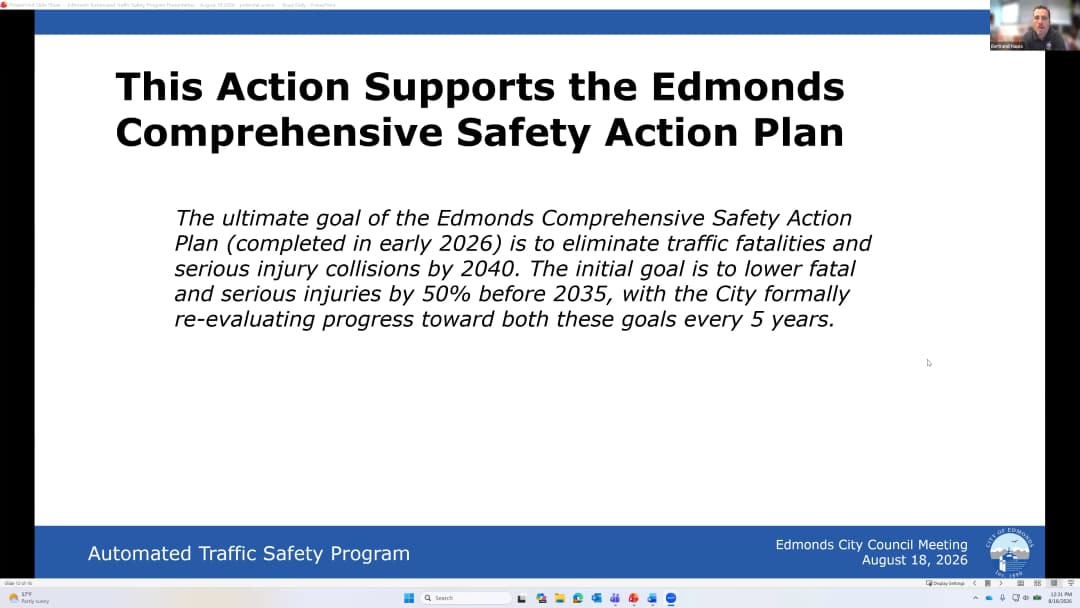
The Edmonds City Council held a special meeting on August 18, 2026, at 11:00 AM to address a public hearing on extending a development moratorium in the Deer Creek Critical Aquifer Recharge Area (CARA), and three council business items: an ordinance to extend the moratorium, a resolution of intent to annex part of the Esperance area, and an ordinance to expand automated traffic safety cameras to 24-hour operation in school zones. The meeting concluded at 12:57 PM. Public Comments & Testimony - Ken Reedy (Edmonds resident): Urged the council to establish a clear due diligence framework with specific questions to be answered before declaring intent to annex Esperance Area 1, noting that the resolution does not bind the city but may create expectations. - Jack Malik (Shoreline resident, realtor): Requested expedited consideration for a traffic impact fee of approximately $85,000–$110,000 on a lease at 471 Admiral Way (Port of Edmonds), arguing it would exclude small businesses. He stated he had already incurred $60,000–$90,000 in soft costs. - Joe Scordino (Edmonds resident): Asked the council to return to publishing complete meeting minutes and to allow public comments at committee meetings for transparency. Public Hearing: Extension of Deer Creek CARA Moratorium Public testimony was taken on Ordinance 4430, which would extend the moratorium on permit applications requiring stormwater management in the Deer Creek CARA for an additional six months. - Florim Booker: Expressed confusion about his permit (BLD 2026-0185), submitted before the moratorium, now blocked not by the moratorium but by the critical area code. He asked the city to identify the exact code provisions supporting the denial. - John Brock (Woodway council member, EEC board): Proposed a CARA-specific materials management standard based on best available science, focusing on source control for materials with a credible pathway to groundwater, rather than a general building material regulation. He asked the council to direct staff to evaluate this approach. - Ken Reedy: Raised questions about the PFAS study scope, additional analysis since the moratorium began, consideration of a range of protection approaches, a gap between current and proposed moratorium effective dates, and the drafting of the ordinance findings. He requested public access to the completed study. - Joe Scordino: Argued the moratorium is unnecessary because the updated critical area ordinance adopted in January provides a two-step review process to evaluate and mitigate impacts, and that applicants can use PFAS-free materials. He questioned the purpose of the study. Discussion Items Ordinance Extending the Moratorium (Deer Creek CARA) Staff (Mr. Teraday) explained the moratorium avoids processing applications that would ultimately be denied under current code. The PFAS study is expected in September 2026, and the six-month extension provides cushion; the council could repeal the moratorium early if an interim ordinance is adopted sooner. Councilmember Nand expressed concern about litigation risk from burden on property owners and requested updates on Mr. Booker's application. Councilmember Barnett suggested a targeted interim pathway after the study is published. Councilmember Olson noted a scrivener's correction replacing "regular meeting" with "special meeting." The motion to adopt the six-month extension passed unanimously. Resolution of Intent to Annex Esperance Annexation Area 1 Staff presented a resolution to declare intent to annex Area 1 (south of the bridge on 84th Ave W) via an interlocal agreement, deferring Area 2 pending infrastructure and cost analysis of the bridge. The resolution is not a legal prerequisite but a check on council interest. Key points: - The two-phase approach allows time to assess bridge repair costs and potential funding via a second 0.1% sales tax credit (available only for separate annexations of 2,000–10,000 population). - Councilmember Chen abstained due to a conflict of interest (office in the annexation area). - Concerns from Area 2 residents about holding pattern were addressed: the city has incentive to complete both phases before July 1, 2028, to qualify for the tax credit. - Council President Dash proposed an amendment to request Snohomish County not to change zoning in Area 2 before July 1, 2028, within the ILA. Councilmember Nand opposed, stating city zoning would preempt after annexation. The amendment passed 5-1-1 (Councilmember Chen abstained). The main motion, as amended, passed 6-0-1 (Chen abstained). Automated Traffic Safety Program (24/7 School Zone Cameras) Staff (City Administrator Lukash, Chief Dawkins, Engineer House) presented data from a June–July 2026 study showing thousands of speeding violations, including significant numbers of vehicles traveling 12+ mph over the limit in school zones. Collision data (one-year period) showed numerous accidents, including one fatality. Proposed operation: cameras would enforce posted speed limits 24/7, with fines of $200 for 6–10 mph over and $290 for 10 mph over during school zone hours; $144 for 6 mph over during school walk zone hours. A warning period would precede enforcement, expected to reduce violations by over 50%. Councilmember Barnett asked for monitoring of nearby residential streets for cut-through traffic. Key Outcomes - Moratorium Extension (Ordinance 4430 extension): Passed unanimously. The moratorium on permit applications requiring stormwater management in the Deer Creek CARA is extended six months, expected to be lifted earlier if an interim ordinance is adopted after the PFAS study is received. - Annexation Intent (Resolution for Esperance Area 1): Passed 6-0-1 (Councilmember Chen abstained). The resolution declares intent to annex Area 1, directs staff to collaborate with Snohomish County on an interlocal agreement, and defers Area 2 pending bridge investigation. An amendment requesting a county commitment not to rezone Area 2 before July 1, 2028, was added and passed 5-1-1. - Automated Traffic Safety Program (Ordinance amending Chapter 8.10 ECC): Passed 5-2. The ordinance authorizes 24-hour operation of existing school zone and school walk zone cameras, revises fine schedules, and updates statutory references. A proposed amendment to raise the walk zone threshold from 6 to 8 mph failed 3-4.
The Public Safety, Planning, Human Services, and Personnel (PSPHSP) Committee of the Edmonds City Council met on August 19, 2026, at 4:30 PM (agenda date August 18; meeting date per instruction). Council President Pro Tem Jen called the meeting to order. Committee members present included Councilmember Susan Payne, and city administration staff Rihanna Duarte and Joe Carter. The committee considered two items: revisions to the Wastewater Treatment Plant (WWTP) Senior Laboratory Technician job description and an introduction to Comprehensive Plan Future Land Use Map and Zoning Map updates for the Westgate Neighborhood Center. Consent Calendar - The committee reached consensus to schedule the WWTP Senior Laboratory Technician job description revisions on the consent agenda for approval at the September 8, 2026 council meeting. There were no objections. Public Comments & Testimony - No members of the public provided testimony. Discussion Items - WWTP Senior Laboratory Technician Job Description Revisions: Joe Carter (Public Works and Utilities) presented the proposed revisions, noting that the changes align with a recent reorganization (maintenance supervisor and regulatory supervisor changes). The position title changed from 'Water Quality Analyst' to 'Senior Laboratory Technician' to better reflect the role's certifications and duties. Joe indicated that an internal candidate is already qualified and passionate about the lab side, and the position will first be offered internally under the Teamsters contract. Rihanna Duarte confirmed the internal recruitment process. Councilmember Payne asked about safety requirements (confined space, CPR, first aid, bloodborne pathogens) and whether such elements are clustered or spread throughout the description. Joe explained that safety requirements are included in all wastewater job descriptions due to the harsh environment, and that embedding them ensures staff cannot refuse training or duties. Councilmember Michelle (participating) asked whether 'Senior' implies a future 'Junior' position. Joe clarified that the title reflects a consolidation of previous roles (Lab Quality Analyst, Senior Lab Quality Analyst, Water Quality Analyst) after creating a Regulatory Supervisor position, and that retaining 'Senior' helps with recruitment flexibility. - Introduction to Comprehensive Plan Future Land Use Map and Zoning Map Updates for Westgate Neighborhood Center: Stephanie (Planning and Development Services) presented in place of Brad Shipley and Director Cluxton, who were both ill. Stephanie noted that four parcels in the Westgate neighborhood hub were inadvertently 'orphaned' due to a scrivener's error that left them without a zoning designation after the previous designation was removed. The item was a first reading with no formal action requested; the next steps were outlined in Brad Shipley's agenda memo. Councilmember Payne expressed that the next steps are clear but noted the presentation will need to be more robust when it returns to council. President Pro Tem Jen summarized the schedule: August 18 (introduction), September 9 and September 23 planning board consideration and public hearing, followed by a formal recommendation to city council. Key Outcomes - The committee gave consensus to move the WWTP Senior Laboratory Technician job description revisions to the September 8, 2026 consent agenda for council approval. No dissent was recorded. - The committee directed the administration to proceed with the next steps for the Westgate Comprehensive Plan updates as outlined in Brad Shipley's agenda memo, including planning board review, a public hearing, and a formal recommendation back to council by the end of 2026. - The meeting was adjourned at 4:45 PM.
The Finance Committee met at 1:00 PM to receive the first reading of the June 2026 Monthly Financial Report. Staff presented a detailed review of revenues and expenditures, highlighting favorable trends and areas requiring attention. Council members asked clarifying questions and requested follow-up on several items. Discussion Items - June 2026 Monthly Financial Report: Kisha from Finance presented the report. Key highlights: sales tax revenues up $200,000 year-to-date and 4.8% over the same period last year; salaries and benefits $1.2 million below budget due to approximately 25 vacant funded positions; overall citywide revenues at 53% of budget. Construction permits and building plan reviews significantly exceeded expectations. The city's cash balance is projected to end the year at $2.44 million. Concerns noted: real estate excise taxes down (18.29% year-to-date), street construction fund delays due to Highway 99 project permitting, and municipal arts fund revenues down. - Councilmember Ronette requested subcategorization of non-departmental expenditures for better transparency, noting it acts as a "junk drawer." - A council member pointed out a discrepancy in the May cash balance figure: originally reported as $2,943,269 in the May report, but revised to $3,344,644 in the June report. Staff will investigate the cause. - Questions were raised about the building maintenance fund (016) plan following the departure of manager Tom Sullivan. The Mayor confirmed that six people are now working on the plan and that all buildings will be addressed. - Council President asked about unplanned election fees of $13,000 and Highway 99 stage three permit delays from WSDOT. Staff will follow up on both. - A council member inquired about the public financial dashboard website. The Mayor indicated it is targeted for 2027 and mentioned parallel efforts for a public works project dashboard and an enhanced GIS infrastructure dashboard. - Clarification was provided on arbitrage: it represents the differential between interest earned and interest paid on bond proceeds; the city is not allowed to profit from bond funds. Key Outcomes - The committee received the June 2026 Monthly Financial Report as a first reading. No formal vote was taken; the item will proceed to the full City Council. - Staff will provide follow-up reports on: detailed breakdown of non-departmental expenditures, explanation of the May cash balance discrepancy, details on election fees and Highway 99 delays, and an update on the financial dashboard implementation timeline.
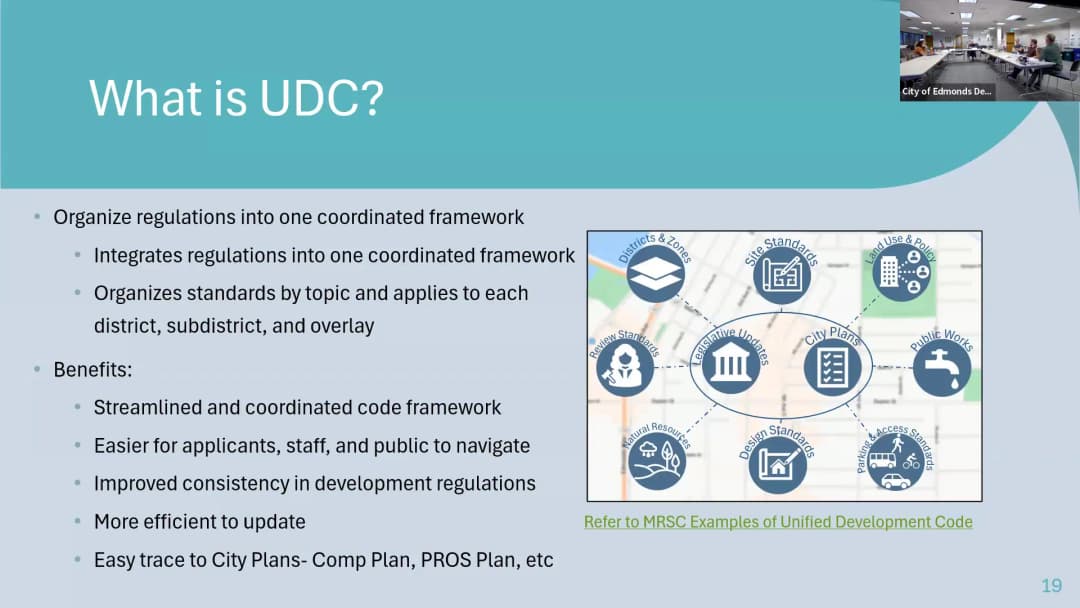
The Edmonds Planning Board held a regular hybrid meeting on August 13, 2026, at 7:00 PM in the Brackett Room of City Hall. The board addressed unfinished business regarding zoning for the Westgate Neighborhood Center, received an informational update on state legislative changes and the Unified Development Code (UDC) program, and considered permanent regulations for family burial grounds. The meeting adjourned at 9:01 PM. Consent Calendar - Approval of Minutes: The draft minutes from the August 5, 2026 special meeting were approved with a friendly amendment to include more discussion detail. The motion passed with Stephen Lee and John Milton abstaining. Public Comments & Testimony - No members of the public attended in person or online to provide testimony. One online attendee (John Milton) joined late and did not speak; he later announced his abstention on the minutes vote. Discussion Items - Westgate Neighborhood Center Zoning Map (Second Reading): Staff presented four parcels (including Taco Bell and other businesses) that were temporarily zoned BP after a discrepancy between the comprehensive plan map and previous WMU zoning. Staff recommended designating them as NCH (Neighborhood Center High) to maintain consistent streetscape and design standards. Key differences: NCH allows 30-foot building heights (vs. 25 feet for BP), includes better public realm standards, and limits height near LDR zones. Board members expressed support for NCH, citing better urban design and compatibility with adjacent NCH areas. A motion by Nick Maxwell, seconded by Stephen Lee, to designate the four parcels as NCH passed unanimously. A subsequent motion by John Milke, seconded by Lee Hankins, to extend the ground floor commercial requirement along Edmonds Way for the newly designated NCH zone (from the existing limit to near 102nd Place West) passed 5–1, with Nick Maxwell voting no. - 2025–2026 Washington State Legislative Updates and UDC Program: Senior Planner Andy Arts presented an overview of 13 new RCWs and bills requiring code updates by 2027–2028. Key topics included lot splits (HB 1096), housing accountability (SB 5148), transit-oriented development (HB 1491), step housing, religious affordable housing (HB 1859), child care center siting, parking minimum reductions (SB 1626), and side modulation/setback updates. Staff proposed packaging most updates into an omnibus ordinance in early 2027, with separate work on middle housing and parking later. The board also discussed the UDC framework, which aims to restructure the city’s use-based zoning code into a more unified, form-based system. No action was taken; the presentation was informational. - Family Burial Grounds Permanent Regulations (First Reading): Staff reviewed Substitute House Bill 2239, which allows family burial grounds on private property subject to specific standards (≤10% of parcel, ≥25 ft from boundaries, ≥150 ft from critical areas, etc.). Council previously adopted an interim ordinance prohibiting such burials. The policy question before the board was whether to recommend a permanent prohibition or allow regulated burial grounds. Board members expressed strong opposition, citing conflicts with urban development, property turnover issues, groundwater contamination risks, and the “creepy” nature of tombs in residential backyards. A motion by Lee Hankins, seconded by Nick Maxwell, to recommend a permanent prohibition on family burial grounds passed unanimously. Key Outcomes - Minutes: Approved with amendments (5 ayes, 2 abstentions). - Westgate Zoning: Board recommended designating four parcels from temporary BP to permanent NCH (unanimous). - Ground Floor Commercial: Board recommended extending the ground floor commercial requirement along Edmonds Way for the newly rezoned NCH area (5–1). - Family Burial Grounds: Board recommended a permanent prohibition (unanimous). - Next Steps: The Westgate zoning recommendation will be packaged with the upcoming CIP/CFP docket for a public hearing in September. Staff will bring forward a formal ordinance for family burial grounds prohibition to council. The board will begin detailed work on lot splits and UDC framework later this year. Planning Board Chair Comments - Chair noted the tree code presentation to council the previous evening was not accompanied by planning board members, which may have caused confusion. The city administrator and clerk are developing a policy for future joint meetings between council and planning board.
The Edmonds City Council held a study session on August 13, 2026, to review the final fiscal analysis of the potential annexation of the Esperance area. Planning and Development staff presented the findings from consultant Burke Consulting, indicating a generally positive impact on the city's general fund under certain assumptions. Council members discussed key issues including phased annexation, a potential 0.2% sales tax credit, infrastructure costs (especially the 84th Street Bridge), staffing needs, and public engagement. No formal votes were taken, but consensus emerged to advance a resolution of intent to pursue annexation at the next regular meeting. The council also entered an executive session on litigation matters. Discussion Items - Final Fiscal Analysis of Potential Esperance Annexation: Mike Cluxton (Planning and Development) introduced the study and recommended a resolution to pursue annexation. Josh Linden of Burke Consulting answered questions on the financial model. The report assumed new revenues from a 20% utility tax and sales tax (including online sales attributed to the address), and estimated a very slight increase of about $0.004 per $1,000 of assessed value for existing Edmonds property taxes. - Phased Annexation: Several council members supported a phased approach to annex Esperance in two pieces, partly to allow more time to assess the 84th Street Bridge and to potentially qualify for the 0.1% sales tax credit twice (0.2% total). Jeff (legal) noted that the resolution must specify the annexation area, and that a phased approach preserves options. The state Department of Revenue had not yet given a definitive answer on the double credit. - Infrastructure and Bridge: Councilmember Andy highlighted that Esperance's roads and stormwater systems are substandard and will require significant capital investment over time, though operating costs may be partially offset. He stressed the need for an independent engineering assessment of the 84th Street Bridge. Councilmember Vivian endorsed that recommendation and noted the county had no projects planned for that bridge. - Staffing and Service Levels: Josh Linden explained that the report assumed all staffing costs under the general fund, and did not fully model service-level maintenance. Councilmember Chris asked about lifecycle costs and maintenance; Josh replied that street overlay costs were included but stormwater facility conditions were unknown. Andy cautioned that adding 4,000 residents will strain an already reduced staffing level. - Public Engagement and Voting: Councilmember Jenna raised concern about bypassing a popular vote and urged robust public outreach, including possible zoning exemptions for semi-rural uses (e.g., keeping horses). Staff noted that Esperance is in an urban growth area, limiting zoning flexibility, but that the interlocal agreement (ILA) process includes public hearings. The mayor reminded the council that all terms are negotiable with the county. - Executive Session: The council moved into executive session from 3:45 PM to 4:25 PM to discuss potential litigation under RCW 42.30.110(1)(i). No action was taken. Key Outcomes - Direction to Bring Resolution: Council indicated general support for adopting a resolution of intent to begin the annexation process at the next regular meeting (week of August 19, 2026). - Phased Approach Preferred: Council members broadly favored a phased annexation to manage risk and explore the 0.2% sales tax credit, with first phase covering the area excluding the 84th Street Bridge corridor. - Independent Bridge Assessment: Council requested an independent engineering assessment of the 84th Street Bridge before committing to that portion of the annexation. - Public Engagement Plan: Staff will launch a public information campaign, including a dedicated webpage and town halls for Esperance residents. The ILA process will include official negotiations with Snohomish County and additional council touch points. - Executive Session Held: The council met in executive session for litigation discussion and then adjourned the study session at 4:26 PM.
The Edmonds City Council met on August 11, 2026, starting at 6:00 PM. The meeting included presentations, public comments, approval of consent items, and two major council business items: the 2026 Tree Code Amendments (fifth reading) and a first reading of an ordinance to expand the automated traffic safety program to 24/7 school zone enforcement. No formal action was taken on either item; the tree code discussion was for information and direction, while a motion to place the traffic ordinance on the next consent agenda failed. Presentations - Resolution Recognizing the 136th Anniversary of Edmonds: The council unanimously adopted a resolution celebrating the city's founding on August 11, 1890. Members of the Edmonds Historical Society accepted the resolution, noting that 2026 also marks the 50th anniversary of the Historical Society. - Resolution Commending Student Representative Vivian Liao: The council adopted a resolution commending Vivian Liao for her service as student representative during the 2025–2026 term. Liao thanked the council and stated the experience strengthened her passion for public service. - Mayor’s Finance Update: The mayor reported that departments are building budgets and that sales tax revenue is $1.6 million ahead of forecast, even after a conservative upward revision of $500,000. A significant leap in June revenue is being analyzed. Public Comments & Testimony - Georgina Armstrong (Edmonds): Urged the council to consider the impact of the new tree code on heat-vulnerable populations, citing that Edmonds’ 2022 canopy assessment shows single-family residential accounts for 58% of tree canopy while multifamily residential has only 5%. She noted that frontline communities along the Highway 99 corridor have low canopy and high heat, and argued for best practices such as tree equity scores to direct planting incentives. - Kathleen Sears (Edmonds, representing Friends of Edmonds Trees): Supported the Planning Board’s recommended draft code, highlighting a citywide canopy goal of 35%, a tiered tree density credit system, fee-in-lieu of $1,600 per credit, fines at least double the fee to deter illegal removal, landmark trees defined at 24 inches, and a tree species list. She requested additional changes including applying TDC to multifamily and mixed-use zones. - Deborah Ashland (Edmonds, representing Friends of Edmonds Trees): Supported the Planning Board’s TDC system but noted the staff alternative of 50 credits per acre is at the bottom of the range compared to other cities (e.g., Kirkland saw canopy reduction with 50 credits, while Bellevue increased with higher credits). She urged adding TDC requirements for zones other than low-density residential and a minimum retention requirement (e.g., one landmark or three significant trees per lot). - Margie Field (Edmonds): Continued the previous speaker’s remarks, reiterating support for applying TDC to multifamily and mixed-use, minimum retention, removal of vague language, and climate-related recommendations. - Roger Pence (Edmonds): Associated himself with tree advocates’ goals but expressed concern that the proposed code is overly complex—22 pages—and would require a lawyer or arborist for homeowners to understand. He recommended sending the draft back to the Planning Board for simplification. Consent Calendar - Approved consent agenda (minutes, payroll and benefit checks, claim checks). Approved unanimously. Council Business - Confirmation of Becky Peterson as Liaison to South County Fire Authority: Council confirmed Becky Peterson as the non-voting liaison, following the resignation of Officer William Morris. Councilmembers thanked Morris and praised Peterson’s expertise. Unanimous approval. - 2026 Tree Code Amendments, File AMD2026-0001 (Fifth Reading): This was a discussion-only item. Planning Director Mike Clugson and Urban Forest Planner Deb Powers presented the draft code. Key points: - The draft addresses legal challenges, clarifies definitions (landmark tree at 24 inches DBH for all trees, plus species-specific thresholds), and reorganizes code. - Introduces a tiered Tree Density Credit (TDC) system for low-density residential: 110 credits/acre for 1 unit, 88 for 2-3 units, 66 for 4 units. Site improvements over 500 sq ft are now regulated. - Fee-in-lieu is $1,600 per credit. For an average 8,500 sq ft lot with no existing trees, the required TDC for 1 unit would be 21 credits, leading to a fee-in-lieu of $33,600. The presenters and council debated whether this effectively defaults to fees rather than retention. - For multifamily and commercial zones, no TDC is proposed; instead, existing landscaping requirements and “if feasible” language apply. Several councilmembers questioned this approach, urging retention requirements for all zones. - Planning Board Chair Lauren (attending) explained that the one-tree-per-year removal allowance (without permit) was chosen over a graduated lot-size approach to balance flexibility and oversight. - Councilmembers raised concerns about complexity, equity across lot sizes, view covenants, staff discretion, and balance between housing needs and tree canopy. - Councilmember Barnett suggested a simpler canopy-based approach rather than proxy math for homeowners. Staff indicated that regulating by canopy on a lot-by-lot basis is not currently feasible due to lack of aerial imagery. - Next steps: Council will provide specific feedback via email or one-on-one meetings; a revised draft will be brought back. No motion was made. - Edmonds Automated Traffic Safety Program and Draft Ordinance (First Reading): Police Chief Dawkins, Transportation Engineer Bertrand, and Court Administrator Stephanie Lukash presented. Current program has five school zone cameras operating during drop-off and pickup times (45 minutes each). Proposed expansion to 24/7 operation with revised fine structure. Data from a two-week summer study showed: - Over 302,000 total vehicles passed the five cameras in two weeks. - Approximately 9% of vehicles exceeded 6 mph over the posted speed limit (25 or 30 mph). - Chase Lake Elementary had a 15.4% violation rate during school zones; 24-hour data showed 8% of all vehicles going 7+ mph over. - 76% of speeders were non-Edmonds residents. - Proposed fines: $145 for 1-10 mph over, $290 for 11+ mph over (consistent with state schedule, maximum $290). Council discussed tiered approaches (like Redmond’s) and equity concerns. - Court administrator noted current staffing may be adequate initially but warned of auditing burden from high citation volume. - Councilmember Nand opposed expansion as regressive and harmful to local businesses; Councilmember Eck, Olson, Chan, Barnett, and Payne supported expansion for safety. Council President Dutch and Olson preferred a second reading for further refinement. - Motion: Councilmember Payne moved to place the ordinance on the next consent agenda (August 18 special meeting). The motion failed 5-2 (majority opposed). Item will return for further discussion. Key Outcomes - Tree Code Amendments: No vote taken. Staff will incorporate council feedback (simplification, TDC for all zones, clearer feasibility language) and return with a revised draft. - Automated Traffic Safety Ordinance: Motion to advance to consent agenda failed. The council is scheduled to revisit the item at the special meeting on August 18, 2026, for potential action. - Liaison Appointment: Becky Peterson confirmed unanimously. - Consent Agenda: Approved. - Resolutions: Both anniversary and student representative resolutions adopted. - Councilmember Nand: Shared personal health update—completed treatment for stage 1 breast cancer, expressing gratitude.
The Edmonds Planning Board held a special meeting on August 10, 2026 (agenda date noted as August 5, 2026) to hold a public hearing and continue discussions on the 2026 Tree Code Amendments. The meeting included public testimony, board deliberation on remaining code updates, and votes on key provisions. Consent Calendar - Unanimous approval of the July 22, 2026 meeting minutes. Public Comments & Testimony - Kathleen Sears (Friends of Edmonds Trees, FOET) recognized board efforts but noted the draft code would not have saved 'Big Red', a 71-inch, 100+ year-old tree removed via a Type I permit. She proposed five amendments: strengthen permit language, define significant trees as 6-24 inches, exclude landmark trees from removal allowances, add development/non-development definitions, and extend TDC requirements to multifamily. - Pam Tower identified three gaps: landmark trees removable as nuisance via Type I; landscape modifications exempt; ambiguous permit language including landmark trees. Recommended Type II permits for landmark trees, clarify landscape modifications, and separate landmark from significant trees. - Kyle McIntyre (FOET) proposed a joint city-applicant early design review process for development projects to maximize retention, with fee-in-lieu as last resort, and incentives like expedited permits. - Travis Hyde requested that fee-in-lieu funds be used for tree replacement, noting $300k collected but only $67k spent, with 60% on removal not replacement. Asked for timely spending. - Gala Shumake supported preserving canopy and opposed removal of landmark trees for landscaping. - Georgina Armstrong (Climate Advisory Board) highlighted heat vulnerability in Gateway and international districts, emphasizing need for strong tree requirements in multifamily developments to combat urban heat islands. - Margie Fields urged no removal of landmark trees without stronger review and minimum retention. - John Merske raised four concerns: removal of prohibition on landmark tree removal in §50; lack of TDC values for landmark tree species list; allow covering tree protection zones with plywood for up to 12 months; and no protection for trees from off-site work. - Barbara Stellard encouraged revision to retain viable trees and suggested pursuing Tree City USA status. - Frank Caruso expressed disappointment at delay since 2019, urging completion. - Deborah Ashland (FOET) recommended adopting 50% retention of TDC via retained trees, conservation subdivision TDC requirements (e.g., 132, 110, 88 per unit categories), and extending TDC to multifamily zones at minimum 44 credits/acre. - Era (last name not given) supported increased fines but noted staff discretion undermines enforcement; cited only one fine in five years. - Kathleen Lester supported expanding landmark tree definition to include species like Alpine fir and excluding invasives. - Laura Hine reiterated keeping 'Big Red' in mind, supporting joint design reviews, timely tree fund use, heat island mitigation, and minimum tree retention. - Janelle Cass (Tree Board member, speaking personally) warned that strict prohibition on 24-inch trees may cause unintended removal of 22-inch trees; called for multifamily inclusion, community support for maintenance, and using funds for ivy removal in parks. Discussion Items - Forest Stewardship Plan (Permit Option): Staff explained it as a custom plan for large properties needing stand management beyond the 3-tree/36-month limit. Board debated inclusion; voted 3-1 to recommend inclusion in code but with clearer definable eligibility criteria and explicit intent to promote forest health. - Conservation Subdivision TDC Thresholds: Board adopted FOET's proposed graduated TDC requirements (132, 110, 88 credits/acre for 1, 2-3, 4 units respectively) unanimously. - Maintenance Agreements: Board voted unanimously to require 5-year maintenance agreements for all low-density residential development projects that trigger TDCs, replacing bonds to ensure long-term tree care. - Striking 50% Fee Waiver: Unanimous votes to strike the obsolete 50% retention fee waiver for conservation subdivisions and from the tree code, as TDC system makes it moot. - Tree Density Credits for Multifamily/Commercial: Motion to adopt 44 credits/acre for multifamily, mixed-use, and commercial failed (2-2 tie). Board noted insufficient analysis and complexity; will not include in recommendation. - Landmark Tree Language Clarification: Board agreed by consensus to strengthen language to explicitly prohibit removal of landmark trees (except for hazard/nuisance) and to clarify that annual removal allowances for significant trees exclude landmark trees. Key Outcomes - Motions Passed: - Approval of July 22 minutes (unanimous). - Recommend forest stewardship plan with conditions (3-1). - Adopt conservation subdivision TDC thresholds (unanimous). - Require 5-year maintenance agreements for low-density residential development (unanimous). - Strike 50% fee waiver from conservation subdivision and tree code (unanimous). - Motion Failed: TDC of 44 credits/acre for multifamily/commercial (2-2). - Consensus Decisions: Strengthen landmark tree removal prohibition and clarify allowance limits. - Final Approval: Board voted to recommend the draft Findings, Conclusions, and Recommendations (with tonight's revisions) to City Council (unanimous). - Next Steps: Staff will incorporate changes into Version 3 and prepare a cover letter summarizing key decisions for Council review. Board chair will circulate draft letter for comment before submission.