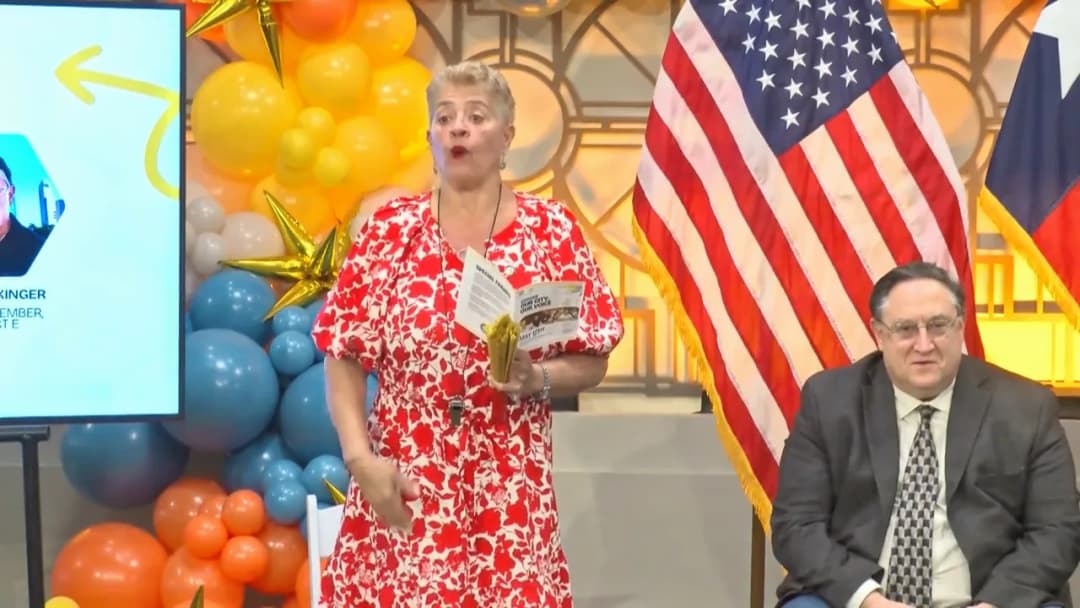
On May 12, 2026, the Mayor's Youth Council and City of Houston Youth Ambassadors hosted the second annual youth town hall, titled "Our City, Our Voice," at Houston City Hall. The event aimed to increase Houston youth's understanding of local government, foster meaningful conversations with decision-makers, and empower young people to make an impact in their communities. Councilmembers from Districts D, E, and I participated in a panel discussion followed by a Q&A session with youth both in person and online. Public Comments & Testimony - Mariam Kahn (9th grader, Youth Ambassador) asked what easy ways youth outside the inner city can help Houston. Councilmember Martinez suggested engaging with nearby civic associations, churches, or starting initiatives; Councilmember Flickinger added volunteering at church social ministries; Dr. Shabazz emphasized joining team sports to build teamwork skills. - Andrew (8th grader) asked Dr. Shabazz how hard it is to be a city council member. She responded that it is not easy—requiring a heart for service and sacrifice—but love for the work makes it worthwhile. - Denzel (11th grader) asked Councilmember Flickinger how the city will address educational funding concerns for students. He clarified that education funding is a state function, not a city responsibility. - Michael asked Councilmember Flickinger what challenge the next generation will inherit that current leaders haven't fully solved. Flickinger cited financial challenges, infrastructure (especially water/sewer under a consent decree), and long-term pension obligations. Michael also asked how to prepare students for evolving energy and job markets. Responses highlighted that fossil fuels will remain significant but that Houston should also invest in clean energy, technology, logistics, and the medical sector. Panelists emphasized diversification and the importance of trade skills and community colleges. - Andrew Miras (9th grader) asked how to enhance academics in elementary schools. Councilmember Martinez noted limited city role but mentioned Harris County Department of Education's after-school programs; Dr. Shabazz stressed early interest inventories and relevant curricula; Flickinger cited personal contributions via scholarships and highlighted community college opportunities, including port-related trades with free training. - Eric Pace (11th grader) asked how to make political discussion less taboo and more accessible among youth. Dr. Shabazz recommended joining school political organizations and youth branches of groups like the NAACP. Flickinger urged removing vitriol and recognizing that disagreement does not make someone a bad person, criticizing gerrymandering for polarizing politics. Martinez advocated meeting youth where they are (e.g., bike rides, mock city council sessions) and announced plans for a young adult civics 101 program. Discussion Items - Youth Engagement Round: Dr. Shabazz described offering paid internships in her office and funding after-school programs. Councilmember Flickinger said young people can play a role in community safety by doing the right things and influencing peers. Councilmember Martinez outlined steps for youth to propose solutions: research the issue, connect with his office, use public session, and follow through. - Youth Initiatives & Public Service Round: Dr. Shabazz shared her path from educator to councilmember, including a 16-candidate race against the rapper Scarface, and urged youth to work on campaigns. Flickinger emphasized making District E a better place to live and work, noting Houston's strong financial management relative to other big cities. Martinez credited his middle school basketball coach and mentor Johnny Soto for teaching him that "one clown doesn't make the circus" and that his time in office is finite, motivating him to pour into young people. - Quality of Life Round: Dr. Shabazz encouraged youth to organize community cleanups to build pride and reduce litter and crime. Flickinger described median cleanups in Kingwood where youth work alongside him, building relationships. Martinez reframed "at-risk" as a lack of exposure and urged youth to mentor younger students, especially in elementary schools, to provide experiences they might not otherwise have. Key Outcomes - Councilmembers repeatedly encouraged youth to get involved in civic activities such as internships (paid, per Dr. Shabazz), volunteering on campaigns, joining civic associations, and participating in community cleanups. - Several concrete initiatives were highlighted: paid internships in Dr. Shabazz's office; median madness cleanups in District E; and a planned civics 101 program by Councilmember Martinez. - Youth were directed to connect with the Mayor's Youth Council and Youth Ambassadors for ongoing involvement. - The event concluded with remarks from program leaders Ebony Jones and Johara Jackson, who thanked participants and emphasized that youth voices are vital to Houston today. - Notably, no formal votes or policy decisions were made; the town hall was purely informational and engagement-focused.
Public Meetings - Houston, Texas
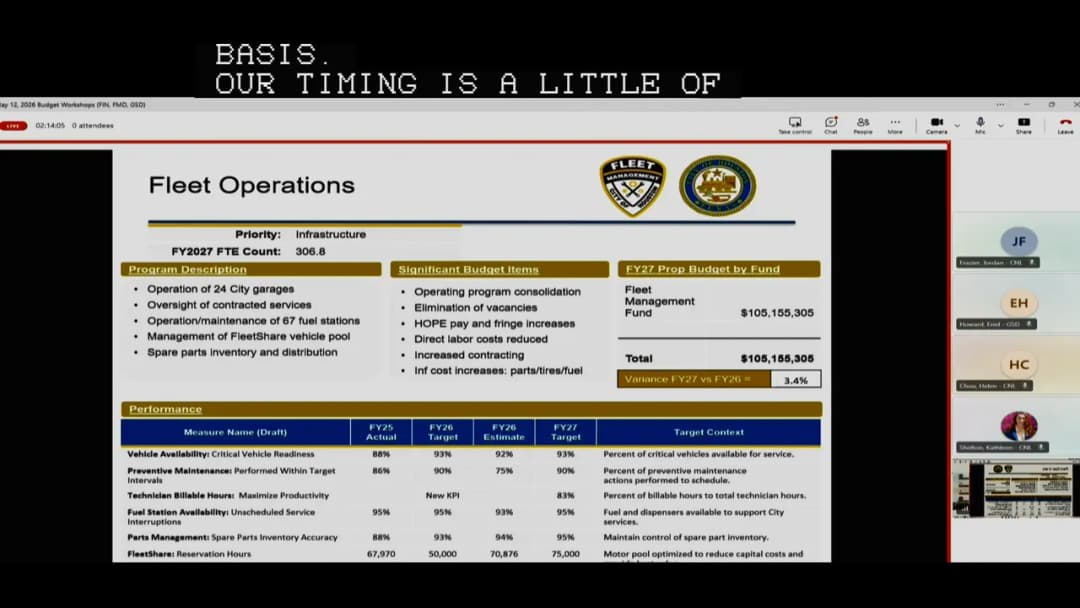
Public Meetings - Houston, TexasThe meeting focused on the Fleet Management Department's proposed operating budget for fiscal year 2027. Director and Assistant Director Lisa Jefferson presented cost-cutting initiatives, planned expenses and revenues, and addressed challenges including a severe mechanic shortage and fuel card audit findings. Councilmembers asked questions about staffing, contracting, and audit remedies. Public Comments & Testimony - Azul McSwain (speaker): Commented that Houston has developers who could fix system issues for unified dashboards and transaction overviews, and suggested that the city could train up entry-level mechanics to address the shortage rather than relying solely on external hiring. Discussion Items - FY2027 Operating Budget Overview: The department presented a $113.7 million budget request (2.8% increase over current year). The budget is fully funded by the Fleet Management Revolving Fund. Revenue sources: 76% general fund, 22% enterprise funds, 2% grants/special revenue. Post-solid waste transition, enterprise revenue expected to rise to 48% and general fund to 50%. - Cost-Cutting Initiatives: Elimination of 26 positions (mostly vacant), yielding $2.4 million savings. Reorganization reduced programs from eight to two, cutting 18 administrative/supervisory positions. Overtime expenses held flat despite wage increases. Training programs accelerated for entry-level mechanics; transition to paperless garages with tablet PCs. Contracting strategy: shift in-house labor to high-cost outsourced work (e.g., specialized crane repair at $700/hour) and outsource lower-cost work (e.g., mower repair at $45/hour). Plans to contract total operation of all airport garages and several public works garages, reallocating mechanics to general fund garages. - Mechanic Shortage: Nationwide issue; city advanced mechanics top rate $35/hour. Survey showed only Metro (Houston) and Austin pay more. Lost 43 positions to retirement, including 27 mechanics. Currently 80 vehicles per mechanic vs. industry standard of 37 sedans per mechanic. Efforts to recruit from HISD, HCC, veterans centers, but advanced-level hiring remains difficult. - Fuel Card Audit (Controller’s Office FY22-24): Discussion of 11 findings, three critical. Director stated most findings were closed before report issued. New measures: GPS integration with fuel cards to verify vehicle location; departmental fuel coordinator monthly reconciliations and checklists; planned employee ID swipe at fueling stations. Councilmembers expressed concern about sharing of fuel cards and lack of proper review; director noted no fraud found but acknowledged limitations. Councilmember Maris requested a formal report on status of all audit findings. - Other KPIs: Target 93% vehicle availability; 90% on-time preventive maintenance; 83% technician billable hours (industry standard 70%); fuel station availability; 95% parts inventory accuracy; 75,000 fleet share reservation hours; client satisfaction surveys; safety program formalization. Key Outcomes - No formal votes were taken. The committee acknowledged the presentation and thanked staff. - Councilmember Maris requested that Fleet Management provide a written update on the status of all 11 fuel card audit findings to council. - Director committed to continuing recruitment for the 10 remaining mechanic vacancies and adjusting contract spending if more mechanics are hired. - The department will proceed with plans to contract out airport and some public works garages, redeploying mechanics to general fund operations. - A short break was taken before the next agenda item (General Services Department).
The Budget and Fiscal Affairs Committee held its first FY27 budget workshop on May 12, 2026, focusing on the Finance Department. The workshop also previewed the budget calendar, including town halls and a revised public hearing date. Finance Director Alyssa presented the department's proposed budget, performance metrics, and revenue projections. Councilmembers asked questions about energy costs, procurement consolidation savings, property tax rates, and the budget process for LGCs and TIRZs. Discussion Items - Finance Department Budget Overview: The proposed FY27 budget for the Finance Department is $2.5 billion in revenue (primarily property and sales tax) and expenditures increase 15% over FY26, driven by consolidation of 30 additional FTEs (from 267 to 296) and HOPE contractual increases. The department's programs include accounting, procurement, debt management, disaster recovery, energy management, treasury, and grants management. - Energy Management: The Chair (Councilmember Alcorn) asked about the $640 million electricity contract. Director Alyssa confirmed that due to higher market rates, the city may need to return to Council before the end of FY27 to increase the maximum contract amount, though the FY27 budget fully covers expected costs. A longer-term procurement is underway. - Procurement Consolidation: Councilmember Martinez asked about when savings from category management would be realized. The Director stated that the budget includes a conservative projection and that focus areas include portable restroom rentals, ground maintenance, janitorial, security, IT contracts, and vehicle replacement parts. - Property Tax Rate: Councilmember Martinez asked about the margin below the tax cap. The Director noted that for every penny of property tax rate, the city generates about $26–28 million. The budget is below both the state and local caps. - Performance Metrics: The Chair praised the improved performance measures, noting the work of Jesse Bounds and EY on "Turn the Curve" indicators. Several metrics were updated or discontinued. - Budget Process: Councilmember Ramirez inquired about the timeline for departments. The Director explained that the budget kickoff occurs in January, with ongoing communication and allowances. LGC budgets are submitted to Finance, while TIRZ budgets are handled by the Economic Development group. - Revised Budget Calendar: The Chair announced changes to the budget adoption timeline: the public hearing moved from May 20 to June 3, amendments due June 3, and the vote on the budget on June 10. A BFA meeting on the CIP will be on June 8. Key Outcomes - No votes were taken during this workshop. The Finance Department presentation concluded with a break before the Fleet Department session. - The committee will continue budget workshops through May 19, with town halls on May 16 (Fondy Rec Center) and May 20 (6 p.m.), and a public hearing on June 3. Note: No public speakers spoke during the Finance Department portion.
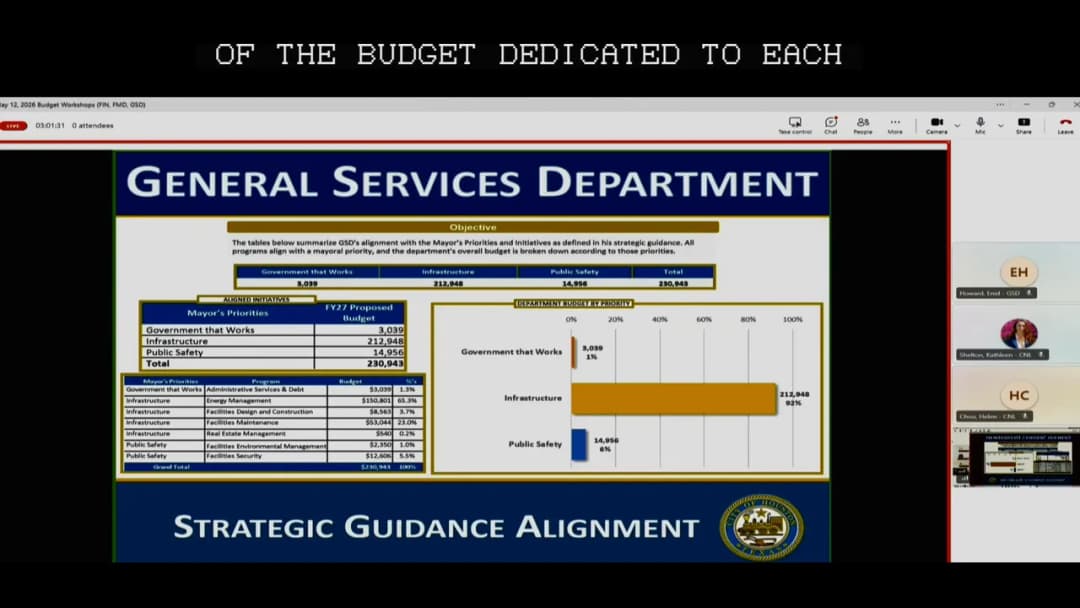
On May 12, 2026, the Houston City Council held a budget hearing for the General Services Department (GSD) for Fiscal Year 2027. GSD Director CJ Messiah and senior staff presented the proposed budget, which included reductions under shared sacrifice, updated KPIs, and overviews of core programs. Councilmembers discussed deferred maintenance, real estate holdings, energy pricing, and solar projects. Public Comments & Testimony - Laura Gallier asked about solar energy projects in the budget, noting six projects budgeted for solar to create 150 megawatts. She inquired whether these projects are meant to mitigate rising energy prices. GSD staff responded that the 150 megawatt-hours figure refers to solar work already completed, including photovoltaic systems at the Annex and Houston Permitting Center, and a resilience hub pilot at Cashmere MSC. Additional grant-funded projects are planned, targeting multi-service centers and community centers used as warming/cooling centers during disasters. Discussion Items - Budget Presentation: GSD Director CJ Messiah and Andy Quee presented the FY27 budget. GSD reduced its budget by $268,000, including $219,000 in contract services and $67,000 in personnel savings. The proposed program expenditure budgets include $47.4 million from the general fund, $7.9 million from project cost recovery, $135.3 million from the Central Service Revolving Fund, and $39.7 million from the maintenance repair and replacement fund. Proposed revenue is $191.1 million, a 5% decrease from FY26. - Deferred Maintenance: Vice Mayor Pro Tem Amy Peck asked about deferred maintenance for all city facilities. GSD reported approximately $864 million, which includes 1200 Travis but excludes 611 Walker (not under GSD). The figure will change once buildings are removed from the portfolio. - City Real Estate: Councilmember Flickinger asked about vacant land owned by the city. GSD did not have the number but promised to provide it. He noted that selling vacant land could generate revenue and add property tax generators. GSD mentioned an ongoing engagement with Page, a consulting firm, to review all real estate and buildings for consolidation opportunities. The status and timeline of that engagement were not immediately available. - Energy Pricing: Councilmember Flickinger questioned the apparent contradiction between a reported increase in electricity contract prices (handled by finance) and GSD's presentation showing a decrease in energy management costs. GSD staff clarified that the budget numbers are based on the old contract rates; the new contract (expected soon) will have higher rates. The $8 million decrease in energy management revenue is tied to electricity pricing changes and chargeback methods. - Facilities Assessment: GSD noted that a facilities assessment for parks is planned, separate from the Page work. A previous assessment covered the entire portfolio except parks and HAS. Key Outcomes - No votes were taken. Councilmembers requested additional information: (1) the amount of vacant land owned by the city, (2) the status and timeline of the Page real estate engagement, and (3) updates on the parks facilities assessment. GSD committed to providing these answers. - The meeting adjourned early, with the next budget hearing scheduled for May 13, 2026, at 1:30 p.m., featuring the Planning, Housing, and Airports departments.
City budget director Stephen David presented the proposed FY27 budget to the Super Neighborhood Alliance, outlining structural deficits, revenue caps, and two major fiscal reforms: declaring solid waste a utility with a $5 monthly administrative fee, and implementing a 5% gross revenue right‑of‑way fee from the combined utility system. Residents voiced concerns about fee regressivity, efficiency, and service impacts, while city officials committed to continued public engagement and a phased approach. Public Comments & Testimony - Tamara (Super Neighborhood representative): Questioned why the city’s revenue diversity slide omitted franchise fees from Comcast/AT&T, and suggested sunsetting Tax Increment Reinvestment Zones (TIRZs) in wealthier areas to increase general fund resources. - Jack (East Houston, Super Neighborhood 49/50): Asked for a department‑by‑department budget chart and challenged the claim that a $104 million annual transfer from the water/sewer utility would not affect water rates or consent decree projects. He argued the $5 fee was a “fear‑and‑relief” tactic and proposed enforcing existing littering fines instead. - Beverly A. J. (Super Neighborhood 68): Expressed frustration over repeated fee increases (drainage fee, water rate hikes, now solid waste) without noticeable service improvements, citing a neighbor’s $600 water bill and lack of responsive repair. - Lindsay Williams (Super Neighborhood 64/88): Asked why none of the $5 fee would go toward solid‐worker safety equipment or pay, given that workers had recently petitioned City Hall. Stephen David replied that the fee creates a dedicated revenue stream for capital purchases (trucks, transfer stations) that will directly improve conditions. - Lisa Hines (VP, Super Neighborhood 64/88): Described a neighbor on fixed income with reduced food stamps and argued the $5 fee is a regressive “political ploy.” She advocated for immediately charging the full $25/month cost to avoid prolonged burden and offered to subsidize lower‑income neighbors. - Ken Rogers (Super Neighborhood 67): Noted that Houston’s once‑a‑week pickup is less frequent than many cities that charge higher fees, implying the $5 is insufficient. - Andrew Mickelson (Super Neighborhood 30): Asked whether the $6/month sponsorship credit for private‑trash customers would be eliminated. David stated that by law the city cannot charge a fee for a service it does not provide, and the program will continue. - Ms. Rainwater (Super Neighborhood 41): Pointed out that businesses like halfway houses generate large amounts of trash but are only charged the same $5 residential fee, calling for a separate commercial rate. David responded that commercial establishments should not be receiving city service, and asked them to report violations. - Sylvia Rivas (Super Neighborhood 36): Representing a community with private trash service, asked how the city would identify those homes to avoid charging them. David said the city maintains a comprehensive customer database. Discussion Items - Revenue constraints: Stephen David explained that Houston faces the nation’s most restrictive property tax cap (lesser of 4.5% growth or inflation plus population growth, with population data lagging two years). This has forced the tax rate from $0.63 in 2011 to $0.51 today, creating a structural deficit projected at $209 million in FY27, growing to $446 million by FY30. - Proposal 1 – Solid waste utility and $5 fee: Declaring solid waste a utility under Chapter 1502 moves its $117 million overhead from the general fund into a dedicated utility fund. The $5/month fee (for 383,000 residential customers) covers only administrative costs and will be held flat for two years, then increase to $10 (FY29) and ultimately to $25/month (the full cost per household per month). The fee will support a revenue bond for new trucks, transfer station repairs, and modernization. The city plans to create a hardship assistance fund similar to existing water assistance programs. - Proposal 2 – Right‑of‑way fee (5% gross revenue): The combined utility system (water, sewer, solid waste) will pay a 5% gross revenue fee to the general fund, generating $104 million annually. David argued this is standard practice across Texas cities (e.g., Austin, Dallas) and will come from operational efficiencies already achieved, without increasing water/sewer rates or delaying consent decree projects. He cited excess debt service coverage (215% vs. 135% required) and cash reserves (550 days vs. 300‑day policy) as evidence of available headroom. - Efficiency measures: Past savings include a voluntary retirement program (1,056 employees, $100 million/year) and the merger of 311 and water billing call centers. David acknowledged solid waste department inefficiencies (aging fleet, non‑functional transfer stations, lack of GPS routing) that will be addressed with the new dedicated revenue. - Council Member Sally Alcorn announcements: She encouraged attendance at budget town halls (May 12 at Fondy Rec Center, 10 a.m.; May 20 virtual, 6 p.m.) and promoted the “Your Two Cents” survey. She also flagged a proposed update to the Open Space Ordinance that would redirect 30% of park‑dedication fees citywide and urged residents to attend a public hearing at the Planning Commission on May 14 at 2:30 p.m. - Public safety concern: Attendee Rachel reported a drive‑by shooting victim who waited 12 hours for police, who allegedly said they do not work weekends. She requested the Mayor be notified. Key Outcomes - No formal vote was taken; the presentation was informational. - Next steps: Budget town halls (May 12 in person, May 20 virtual) and continuation of city council hearings. The solid waste utility declaration and right‑of‑way fee will require council legislation in the coming weeks. - Council Member Alcorn committed to revisiting a potential increase to the park‑dedication fee (currently $700 per unit) after the budget cycle, pending stakeholder feedback. - Public engagement: Residents were encouraged to sign attendance sheets and follow online budget documents. Additional Announcements - Illegal dumping: Stephen David noted increased funding for HPD’s environmental unit and camera enforcement, with a shift from compliance‑based to enforcement‑based approach. The solid waste utility will also fund abatement equipment. - Transfer station conditions: David described severe disrepair in three of five stations (northeast, northwest, central), with a 25‑foot hole in one roof, exposed wiring, and standing water. The new revenue bonds will prioritize repairs and reopen these stations. - Private‑trash sponsorship: The existing $6/month reimbursement program (covering 50,000 homes) will continue; David stated absorbing those homes would overwhelm the current system.
Chair Fred Flickinger called the meeting to order with council members present including Councilwoman Amy Peck, Councilwoman Tiffany Thomas, Councilman Mario Castillo, Mayor Pro Tem Martha Castix Tatum, and Councilman Julian Junior Mares. Later joined by representatives from council offices of Carter, Cayman, Huffman, Alcorn, and Salinas. Three presentations were given covering solid waste tire permitting, parking program updates, and the water bill improvement plan. Discussion Items 1. Solid Waste Management: Tire Permitting Program Assistant Director Shiva Singh presented an overview of the tire permitting program initially effective in 2016. The ordinance requires all tire generators and transporters within city limits to be permitted and inspected annually, with fees of $114 for generators and $295 for transporters (plus $52.50 per additional vehicle). Key metrics: 1,800+ permits in system, only 1,100 active, 800 expired; 2,800 inspections performed annually; two-thirds of locations require reinspection; year-to-date 5 citations issued; 612 ordinance violations found. In FY25, solid waste conducted 9,500 inspections (80% responsive, 20% proactive), with 2,600 illegal dumping incidents involving tires. Calendar year through April 2026, an estimated 14,722 tires were disposed of by solid waste. Tires can be taken to all six neighborhood depositories (residential drop-off centers), environmental service centers, and consumer recycling centers. The city has a contract with Liberty Tire Recycling for collection. Councilman Ramirez asked about enforcement, noting that many small businesses may be unaware of the permit requirement due to TCEQ's 500-tire threshold. Singh confirmed that inspectors often find new locations and that most businesses comply when informed. Ramirez also inquired about the disincentive of permit fees versus illegal dumping, and whether the environmental fee charged at tire purchase covers proper disposal—noting that retailers pocketing that fee while illegally dumping. Singh acknowledged the cost of compliance. Councilwoman Peck asked about hot team collections, which are included in solid waste numbers. Singh stated no changes to the ordinance are proposed. 2. Administration and Regulatory Affairs: Parking Program Updates Deputy Director Maria Urshad presented updates on four programs: - Mobile Payment Program: Since 2011, mobile payment adoption reached 50% of 3 million meter transactions. A 2025 RFP selected up to three vendors plus a data aggregator. Benefits include customer choice and accommodating out-of-town visitors. Contracts will be presented to City Council in June 2026 with no cost to the city; go-live anticipated winter 2026. - Smart Loading Zone Pilot: 19 zones in downtown and midtown using cameras and license plate recognition to charge by the minute for delivery vehicles. Dynamic rates Monday–Saturday, 7 a.m. to 6 p.m. Existing commercial loading zone permittees will receive their allotted time (e.g., 2 hours) without per-minute charges. Go-live planned for June 2, 2026. Privacy assurances: license plate data stored only for payment and compliance; other data de-identified. After 18 months, if successful, a longer-term agreement will be sought. - Ride Share Zones: Four zones primarily on Travis Street and Commerce to address nighttime congestion, especially after 2 a.m. Active Monday–Sunday, 6 p.m. to 3 a.m. Geofencing will direct ride shares to designated zones, avoiding main street corridor. Go-live by end of May 2026 in advance of FIFA activities. - Chapter 26 and 16 Updates: Ordinance amendments addressing Controller's audit findings on the Washington Parking Benefit District, clarifying that the $100,000 project hurdle is a one-time threshold (not per project) and that citation revenue is not shared with the district. Other housekeeping updates. These amendments will be shared for public feedback and are anticipated to go to City Council in June 2026. Councilman Ramirez asked for clarification on the Washington Parking Benefit District audit findings, which Urshad explained in detail. 3. Houston Public Works: Water Bill Improvement Plan Chief Operations Officer Chris Butler (joined by Deputy Director Gina Gillary) presented an update on the Mayor's Water Bill Improvement Plan, initiated in 2024 to address billing inconsistencies from aging infrastructure. Over 20-year-old meters caused failed remote reads, estimated bills, and customer confusion. The plan focuses on replacing aging meters. FY24 actual device installations: 30,826 of a planned 51,000 (60% achieved). Average monthly manual reads: over 128,000. FY25 installations exceeded plan: 101,000 actual vs. 80,000 planned. FY26 plan: 60,000; to date 40,000 installed (as of the meeting). The presentation was cut off before completion. Key Outcomes - No formal votes were taken; the committee received presentations and discussed items. - The mobile payment contracts and Chapter 26/16 ordinance amendments are scheduled for City Council approval in June 2026. - The Smart Loading Zone pilot will launch June 2, 2026, and the Ride Share zones by end of May 2026. - The Water Bill Improvement Plan continues with accelerated meter replacements; further updates expected.
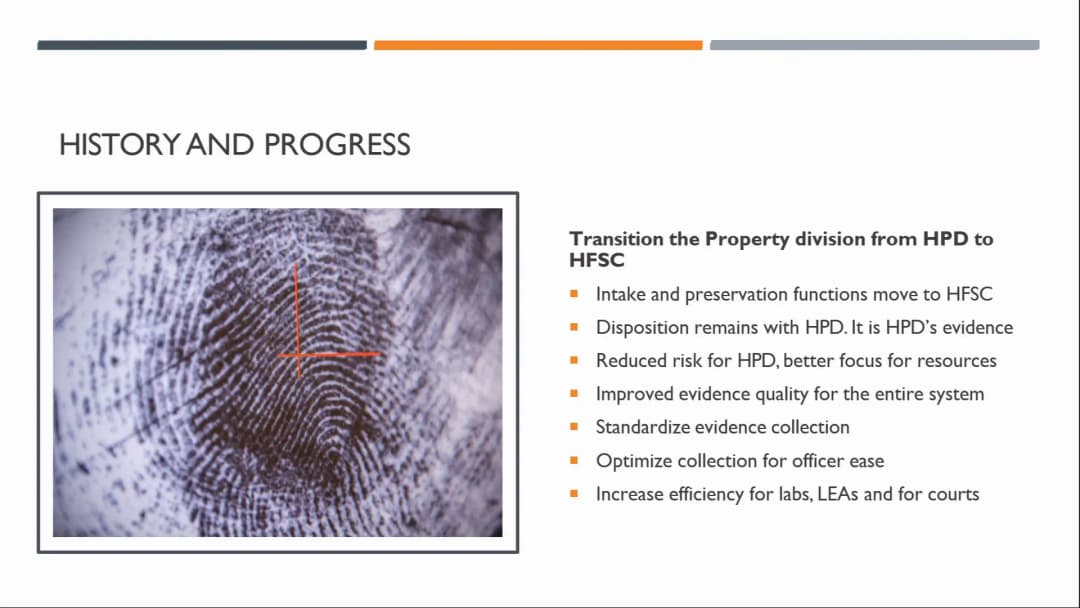
The board convened with a quorum, Vice Chair Joni Baird presiding in Chairwoman Cohen's absence. The meeting covered operational updates, technology expansions, and administrative approvals. Key discussions included the multi-year transition of property and evidence storage from HPD to HFSC, lab backlog reductions, and the upcoming accreditation of rapid DNA technology. The board unanimously approved several consent items and a contract renewal, and after a closed session, voted to provide written notice of intent to renew President Dr. Peter Stout's contract. Consent Calendar - Approval of Minutes: The minutes from the previous meeting were approved by unanimous voice vote. - Reappointment of Corporate Officers: Dr. Peter Stout (President), Dr. Amy Castillo (Vice President), Mr. David Leach (Treasurer), and Ms. Natalie Visi Haley (Secretary) were reappointed for one year, through May 2027, by unanimous voice vote. - Selection of Vice Chair: Director Joni Baird was reappointed Vice Chair for a term concluding at the May 2027 board meeting, by unanimous voice vote. Public Comments & Testimony - No members of the public signed up to speak; the public comment period was closed without testimony. Discussion Items - Property and Evidence Transition: Dr. Amy Castillo, COO, presented the phased plan for HFSC to assume evidence intake and preservation from HPD (disposition remains with HPD). Highlights: over 8,000 sexual assault kits and test fires have been moved to the Jefferson facility; a new freezer room has been built; the giant walk-in freezer at Washington will be decommissioned, freeing space for gun storage. The transition is expected to fully execute in FY28, with nine HPD positions transferring to HFSC in FY27. Board members asked about the auditing function (checking shelves against inventory) and legal ownership (HPD retains ownership). Staff tours of the facility were offered. - Lab Operations and Backlogs: Dr. Castillo reported on current backlogs: forensic biology backlog is down to 5 sexual assault kits over 90 days; seized drugs backlog is under 800; firearms backlog is approximately 453 but expected to improve with two experienced examiners starting in August (reducing training from two years to six months). Three new drug analysts are in training. New technologies: 3D crime scene mapping (Matterport) is live; rapid DNA is being brought online for reference samples (cost $250/sample vs. $30 for traditional); YSTR testing will return in September; LCQ-TOF systems for toxicology and seized drugs are undergoing validation. - Rapid DNA Quality Report: Jackie Morale, Quality Manager, detailed the scope extension audit scheduled for May 11–12, 2026, to accredit rapid DNA under ISO 17025. She explained the technology (hands-free, single-source profile in 109 minutes), limitations (cannot process mixtures), and the extensive preparation: 142-page validation, standard operating procedures, training, mock casework, and two satisfactory proficiency tests. The FBI's 2025 rule update allows crime scene sample uploads into CODIS, but the sample cartridge is not yet approved. The Texas Rapid DNA Working Group, including prosecutors, defense attorneys, law enforcement, and labs, is developing guidelines. Board members discussed demand (likely fewer than once a month for urgent cases), admissibility (will be admissible once accredited and approved by Texas Forensic Science Commission), and the importance of maintaining proficiency. Key Outcomes - Unanimous approval of all consent calendar items (minutes, officers, vice chair). - Unanimous approval of the VersaTerm/Justice Track subscription renewal for $337,128.28, authorizing Dr. Stout to execute the agreement. - After a closed executive session, the board reconvened and unanimously voted to provide written notice to Dr. Stout of the board's intent to renew his contract, as required six months before expiration. - The meeting adjourned at approximately 10:15 AM.
On Thursday, May 7, 2026, the Houston City Council Resilience Committee, chaired by Councilmember Twyla Carter, held a meeting focused on recycling contamination and solid waste management. The committee heard a presentation from FCC Environmental Services, the city's recycling processor, regarding the high contamination rate in Houston's recycling stream. Public speakers addressed the airport master plan, a university resilience course, and solid waste funding. No formal votes were taken, but committee members committed to follow up with the Solid Waste Department on contract amendments and public education efforts. Public Comments & Testimony - Rich Herwick, Vice President of Strategy at H21000, presented a conceptual master plan for Bush Intercontinental Airport, emphasizing the need for infrastructure improvements to accommodate projected passenger growth. He noted that a meeting with airport leadership was scheduled for May 22, 2026. - Alex Landon, Professor of Practice at the University of Houston's Cullen College of Engineering, invited committee members to attend final presentations on May 29, 2026, from students in a course on coastal resilience, comparing Houston and the Netherlands. - Bill Kelly, on behalf of Environment Texas, expressed support for the proposed administrative fee for solid waste in the mayor's budget. He highlighted the need for increased public education and outreach, citing a 42% contamination rate and a 16% diversion rate (less than half the national average). He advocated for reliable service, transfer stations, and proper funding to reduce contamination and worker burnout. - William Martinez submitted a letter regarding personal experiences with gang stalking and gaslighting at a facility in Deer Park, requesting assistance. Discussion Items - Presentation by FCC Environmental Services: Cesar Garcia (General Manager) and Andrea Rodriguez (VP of Engineering) presented on the contamination crisis. They reported that Houston's contamination rate is 42% (based on an April 13, 2026 audit), well above the national average of 30% and the 25% threshold in the contract. Common contaminants include electronics, styrofoam, tanglers (e.g., straps, wires), batteries, and propane tanks, which cause fires, equipment damage, and downtime. The financial impact in 2025 was approximately $2.5 million due to higher processing, maintenance, and disposal costs, plus lost revenue. FCC has been seeking a contract amendment with the Solid Waste Department to recoup some losses, but only one meeting (in January 2026) has been held, with no follow-up. - Councilmember Questions and Discussion: - Councilmember Martinez asked about the impact of the proposed solid waste administrative fee; FCC noted that fees often reduce contamination. - Councilmember Castex Tatum's office inquired about the status of contract amendment discussions; FCC stated they have been unable to get a second meeting despite attempts. - Councilmember Ramirez's office asked about contamination trends, education efforts, and which contaminants are most dangerous. FCC identified propane tanks and batteries as top hazards. - Councilmember Alcorn's office asked about the RFP information on contamination rates; FCC confirmed the city provided lower rates during bidding. - Councilmember Peck's office asked if FCC could participate in community events; FCC agreed to consider setting up booths. - Chair Carter requested FCC send educational materials in multiple languages for council offices to distribute. Key Outcomes - No formal votes were taken. - Committee members committed to follow up with the Solid Waste Department regarding the contract amendment and communication issues raised by FCC. - The committee agreed to distribute FCC's educational materials to help reduce contamination. - The next Resilience Committee meeting was scheduled for June 4, 2026, at 10 a.m.
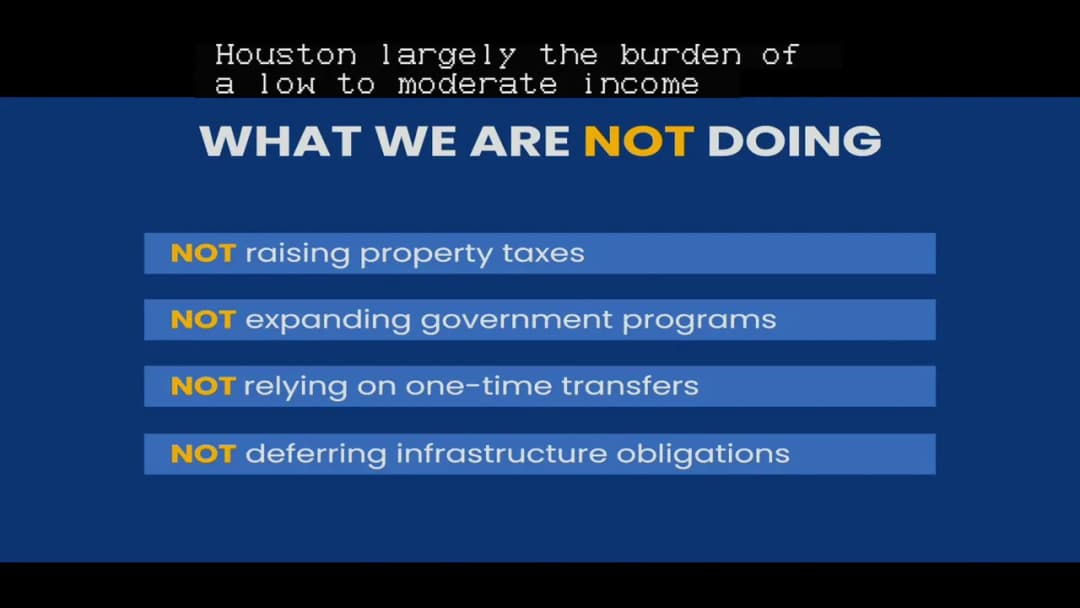
The Budget and Fiscal Affairs Committee, chaired by Vice Chair Mario Castillo, met on May 6, 2026, to receive the proposed FY2027 budget and five-year forecast from Finance Director Melissa Dubowski. The meeting covered the city's financial outlook, including two major structural reforms: moving the Solid Waste Department into the combined utility system (CUS) with a $5/month administrative fee, and implementing a 5% right-of-way rental fee from the CUS to the general fund. The proposed budget reduces the projected $209 million gap to $25 million through these changes, efficiency savings, and conservative revenue estimates. Council members posed detailed questions on fee structures, property tax cap usage, overtime budgeting, and the impact on water and wastewater infrastructure. Public speakers offered additional perspectives. Public Comments & Testimony - Jack Valinski questioned the wisdom of using excess water fund reserves for solid waste when infrastructure needs remained, and expressed skepticism about overtime projections. - Ruben Garza (Strong Towns Houston) applauded the right-of-way fee but advocated for a transportation utility fee based on development density to better align costs with infrastructure consumption. - Felix Kapoor requested clearer explanations of the CUS fee structure, noted that the $5 administrative fee would not directly improve worker safety or equipment, and flagged a 16% reduction in the "quality of life" category (parks, libraries, health) in the mayor's budget. - Dominic Mazok suggested starting budget processes earlier, contracting out services in outlying areas, and raised concerns about the city's role in hospitality ventures and potential World Cup shortfalls. Discussion Items - Structural Budget Reforms: Director Dubowski presented the plan to reorganize Solid Waste as a division of Houston Public Works within the CUS, funded by a $5/month administrative fee (rising to $25 over time). The fee covers only the administrative portion ($7.57 per household per month per the Burns & McDonald study) and will not directly fund new trucks or salary increases. The right-of-way rental fee of 5% of CUS gross revenues ($104M in FY27) is common among Texas cities and uses the CUS's excess fund balance. - Property Tax and Revenue Cap: The budget assumes no tax rate increase, keeping it at $0.51919 per $100 valuation, with property tax revenue of $1.5 billion—$20 million below the state and local cap. Councilmember Pollard criticized this choice, arguing it undermines arguments for future cap relief. The administration responded that raising the cap would require a tax rate increase not desired at this time. - Overtime Budgeting: The FY27 budget includes $6.6 million more for police overtime and $9.1 million more for fire overtime compared to FY26 adopted, based on a new methodology using five-year averages. Actuals are expected to be higher, but offset by savings elsewhere. Councilmember Ramirez pressed for details on fire overtime (projected $82.6M in FY26 actuals vs. $53M budgeted for FY27). - CUS Fund Balance and Infrastructure: Multiple council members questioned the use of CUS reserves for solid waste rather than water/wastewater projects. Director Dubowski and Chief Operating Officer Randy explained that the CUS has excess reserves (debt service coverage ratio 2.15 vs. required 1.2, cash reserves 550 days vs. policy 300 days) due to efficient operations and front-loaded capital appropriations. The East Plant replacement ($4 billion) will be financed via low-cost Texas Water Development Board loans, not cash reserves. - Five-Year Forecast: The structural changes reduce the projected gap from $523 million in FY31 to $172 million. The out-year gaps remain and will require continued efficiency measures, potential new revenue, and legislative monitoring. - Fee Implementation and Guardrails: The $5 administrative fee will be established via the budget ordinance, with future increases requiring a cost-of-service study and council ordinance. The right-of-way fee is set at 5% for FY27, with future increases potentially capped by master bond ordinance amendments. The administration committed that the $25 maximum fee will not be exceeded without a rate study, but Mayor Whitmire stated he would not go above $25. - Managed Competition: Councilmember Davis raised the idea of private sector competition for solid waste. The administration noted that major vendors require 10-15 year contracts, 50-60,000 customer maximums, and the ability to select favorable neighborhoods, making managed competition challenging. Key Outcomes - No formal votes were taken; the committee received the presentation and will continue with budget workshops (May 12-19), a public hearing (May 20), and a virtual town hall (May 20 evening). Council members are to submit questions via SharePoint. The budget will be considered as amended on June 3. - The administration confirmed that the $6 rebate for private trash pickup will remain in FY27. - The recycling and container lease special revenue funds will be closed and their balances transferred to the CUS upon budget adoption. - The administration will develop a discounted rate structure for seniors and low-income residents for future fee increases, but not for the $5 fee in FY27. - The committee directed that detailed questions on the CUS, solid waste, and other departments be addressed in upcoming workshops.
The City Council of Houston convened on May 5, 2026, for a regular session that included multiple proclamations, public testimony on the proposed budget and a street renaming, and votes on several ordinances including a high-risk apartment inspection program and updates to the BARC Foundation. The meeting featured extensive public comment on the proposed $5 monthly trash fee and the diversion of $104 million from water and sewer funds to the general fund, as well as strong support for renaming Cesar Chavez Boulevard after longtime activist Maria Jimenez. Consent Calendar - Routine approvals and unanimous actions included adoption of minutes from April 21st-22nd and April 28th-29th, and procedural motions to add speakers to the non-agenda list. - Consent items under the categories of Accept Work (items 2-5), Property (item 6), and most Purchasing and Tabulation of Bids (items 7-9, 12-13, 15, 17) were approved en bloc. - Resolutions for public hearing on the FY2027 budget and a TWDB drinking water loan application (items 18-19) passed without discussion. - Several ordinances were approved on consent including items 25 (FY26 CIP projects), 30 (HPD records management amendment), 32 (contract amendment with Air Products and Chemicals), 34 (rescheduling council meetings), 36 (alley vacation), and 41 (Salvation Army sub-recipient agreement). Public Comments & Testimony - Trash fee and budget (multiple speakers): Audrey Nath requested a progressive trash fee and ending the subsidy for private trash pickup. Alice Liu criticized the proposed budget for taking $104 million from water infrastructure to fund police raises and called the $5 fee regressive. Danny Hernandez, Cesar Espinosa, Francisco Arguelles, Rhonda Sepulveda, Jessica Campos, and others spoke in favor of renaming Cesar Chavez Boulevard after Maria Jimenez, noting her decades of civil rights and immigrant advocacy. Yulin Shu, David Espinosa, Beth Lumillo, Rita Robles, Becky Sell, Josiah Rector, and others opposed cuts to drainage and water infrastructure, citing flood risks and lead contamination. Rain Eatman and Jacobed Henley proposed alternatives such as a one-cent property tax increase and expiring tax abatements. - Street renaming (Maria Jimenez): Multiple speakers (Danny Hernandez, Cesar Espinosa, Francisco Arguelles, Rhonda Sepulveda, Jessica Campos) urged the council to rename Cesar Chavez Boulevard after Maria Jimenez, a lifelong East End activist. Councilmember Martinez publicly supported the change. - Other public comments: Anthony Henderson (Joseph Amari) alleged police misconduct and FOIA denial. Jacob Clementich spoke on election reform. Dominique President commented on the Eisenhower Park pipeline public hearing location. Clay Kane and Jeff Dustin requested a pilot program for BMX bikes at Lee and Joe Jamail Skate Park. Carlos Miranda advocated for approval voting for city elections. Carolyn Rivera opposed the trash fee, citing high water bills. Ruben Garza urged a focus on infill development and traffic calming. Discussion Items - Item 10 & 11 (SAP B2G optimization): Councilmember Castillo highlighted that the assessment will eliminate manual data entry for time cards in police and fire, improving efficiency. Mayor Pro Tem Casteel-Tatum noted the disparity study showed extensive manual inputting. Approved. - Item 16 (Heavy trash supplemental for District J): Councilmember Pollard explained the need for an additional $50,000 for heavy trash and tree waste collection due to city service challenges, noting the contractor is an MBE/SBE. Approved. - Item 20 (National League of Cities support): Councilmember Castillo was endorsed as representative and board candidate. Several councilmembers praised his tech and innovation leadership. Approved. - Item 21 (High-risk apartment inspection program): Mayor Pro Tem Casteel-Tatum and Councilmember Thomas presented the ordinance as a starting point to target repeat-offender properties with fines up to $2,000 per day. Councilmembers Kaman, Alcorn, Salinas, Davis, Pollard, and Evans-Shabazz commended the community engagement process and emphasized the need for mold remediation in future iterations. Approved. - Item 22 (BARC Foundation bylaws): Councilmember Alcorn described the restructured foundation will allow more aggressive fundraising with a part-time executive director. Councilmember Carter compared it to the Houston Zoo model. Approved. - Item 30 (HPD RMS amendment): Councilmember Kaman noted the add-on for the fire department's Arson Bureau and an expanded citizen portal. Approved. Key Outcomes - Approved: All consent items, items 10, 11, 14, 16, 20, 21, 22, 25, 30, 32, 34, 36, and 41. - Public hearing closed on the proposed pipeline expansion at Eisenhower Park (Energy Transfer) with no opposition testimony. - Councilmember announcements: Budget town halls announced for May 16 and May 20; Proposition A for online sign-up at council meetings to be voted on May 20; updates on District B Economic Development Academy; upcoming community engagement meetings in District K. - Exchange on budget: Councilmember Pollard asked Mayor Whitmire several questions about the proposed $5 trash fee, including whether it would improve service and why not propose the full $25 cost. Mayor Whitmire agreed to a private meeting to discuss the budget in detail.