OPENPUBLICA · PUBLIC MEETING RECORD
Record of Proceedings
Alameda County Social Services Committee Reviews Veterans, IHSS, Staffing, and Child Welfare – October 28, 2026
Board of Supervisors — Wednesday, October 28, 2026
BodyAlameda County, California
SessionBoard of Supervisors
DateWednesday, October 28, 2026
StatusNEW · FILED
Video Record
STREAMING COPY IN PREPARATION — RECORDING AVAILABLE FROM THE ORIGINAL SOURCE
Transcript — Verbatim
Speaker numbers apply only to this recording. Names come from transcript evidence. “Possibly” marks uncertain attribution.
Discussion Breakdown — Share of Meeting
Veterans Services19%
Public Assistance19%
Child Welfare Services19%
Personnel Matters17%
Healthcare Services6%
Adult Protective Services5%
Public Health Services5%
Technology and Innovation2%
Public Engagement2%
Summary of Proceedings
Alameda County Social Services Committee Meeting – October 28, 2026
The Alameda County Board of Supervisors Social Services Committee convened with Chair Lena Tam and Supervisor Nikki Fortunato Bas present, constituting a quorum. The agenda and transcript list the meeting as Monday, October 26, 2026, at 2:30 p.m., while the supplied meeting timestamp is October 28, 2026, 10:30 UTC; this summary uses the required date of October 28, 2026. No minutes were available. All four agenda items were informational, and no formal votes were taken.
Public Comments & Testimony
- County Veterans Service Office update: no public speakers.
- In-Home Supportive Services update: Velma Gaye, a 61-year-old permanently disabled tenant at Depot Community Apartments, expressed concern that people moving from street encampments, shelters, and transitional housing into new affordable housing are not connected with IHSS providers in advance. She said this operational gap has contributed to deaths, drug use, bed bug infestation, and habitability problems in her building, and she asked where IHSS workers are. Staff offered to connect her with Nicole Hayes for follow-up.
- Social Services Agency vacancies update: no public speakers.
- Department of Children and Family Services update: Melody Davis raised concerns about labor problems involving social workers and staff, referenced policy and procedure work with the sheriff’s department, and asked how many state audit recommendations have been completed and who oversees implementation. Michelle Love responded that the state’s assessment is still pending, the county believes audit items were completed, and items not fully completed or sustained are incorporated into the corrective action plan.
Discussion Items
County Veterans Service Office (CVSO) Annual Update
- Anthony Simpson, County Veterans Service Officer, reported on the CVSO’s new main office in Hayward, relocated around February 17–19, 2026; Eastmont and Fremont remain appointment-based satellite locations on Thursdays and Tuesdays, respectively. He said clients and staff respond positively to the new location, and signage on Foothill Boulevard was installed about two months ago.
- The office has focused on specialized benefits training, including total disability individual unemployability, special monthly compensation, discharge-related documents, debt management and waivers, dependency and indemnity compensation, survivor’s pension, and veterans’ readiness and employment.
- Outcomes reported: more than 254 college fee waivers processed and more than 9,200 veterans served. Visitors grew from over 5,000 in FY 2021-22 to 9,200 in FY 2025-26. Simpson attributed the growth to outreach, increased public awareness, economic need, and the PACT Act of 2022.
- He shared a case example of a Vietnam veteran whose monthly compensation rose from about $2,300 to more than $4,700 tax-free after moving from an 80% to a 100% permanent and total rating, including special monthly compensation and property tax exemption.
- Future plans include a virtual office, a countywide newsletter, targeted outreach, continued use of the VA mobile team, stronger coordination with IHSS and workforce programs, CalVet legal brief assistance, and correction of clear and unmistakable errors.
- In follow-up, speakers noted that the virtual office has been a significant tool in Contra Costa County and could increase claims once implemented in Alameda County.
In-Home Supportive Services (IHSS) Annual Update
- Nicole Hayes and Hue Giang presented the IHSS and Public Authority annual update. The Public Authority recruits and supports providers, administers provider-related programs, and is the employer of record for collective bargaining.
- A client story was shared in which a social worker helped a double-amputee, wheelchair-bound client reactivate lapsed CalFresh benefits, connect to an IHSS provider through the Public Authority, complete a reassessment, and avoid institutionalization.
- Demographics: 35,671 IHSS recipients, with 41% in Oakland, 12% in Hayward, and 10% in Fremont; 61% were seniors 65 and older, 31% adults 18–64, and 8% minors. Reported recipient demographics included 22% Chinese, 12% Hispanic, and 1% Cambodian; 55% spoke English, 16% Cantonese, and 8% Spanish.
- IHSS providers totaled 35,495; 69% were female and 31% male; 64% spoke English and 10% Cantonese. More than half of providers were family members, 6% were parents of minor children, and 6% were friends.
- The enacted FY 2026-27 state budget rejected major IHSS reductions, including elimination of the backup provider system, ending eligibility with Medicaid, and shifting IHSS growth costs to counties. The federal administration is withholding $1 billion from California, and 28 counties, including Alameda, are subject to CMS audits.
- Telehealth reassessment was implemented early in July 2025, but adoption has remained low. Alameda County is ahead of state eForms deadlines: intercounty forms and quality assurance reviews are required by July 1, 2026, and recipient/provider case files by January 1, 2027.
- Pending technology projects include a phone/voice response upgrade, self-service scheduling for about 3,000 monthly appointments, AI-assisted case narratives, and BOUNDS portal enhancements for provider enrollment.
- Audit results included 90–100% in nine areas, but initial assessment timeliness was 75% and combined CFCO/non-CFCO reassessment compliance was 42.86%. The county was removed from the CFCO QIAP in August 2026 and is currently at 99% CFCO compliance, while non-CFCO reassessments are at 70.32% and timely applications at 69.696%, below the 80% minimum target.
- Workload: IHSS applications have increased 19% over two fiscal years to nearly 800 per month. Social workers have carried caseloads in the 500–600 range, versus a realistic 300. Alameda County has 92 IHSS social workers (29 intake, 63 case-carrying) and, by comparison, has the highest overdue assessments and highest average caseloads statewide; Sacramento has 171 social workers and about 30% more recipients, and San Francisco has 18 more social workers while serving fewer recipients.
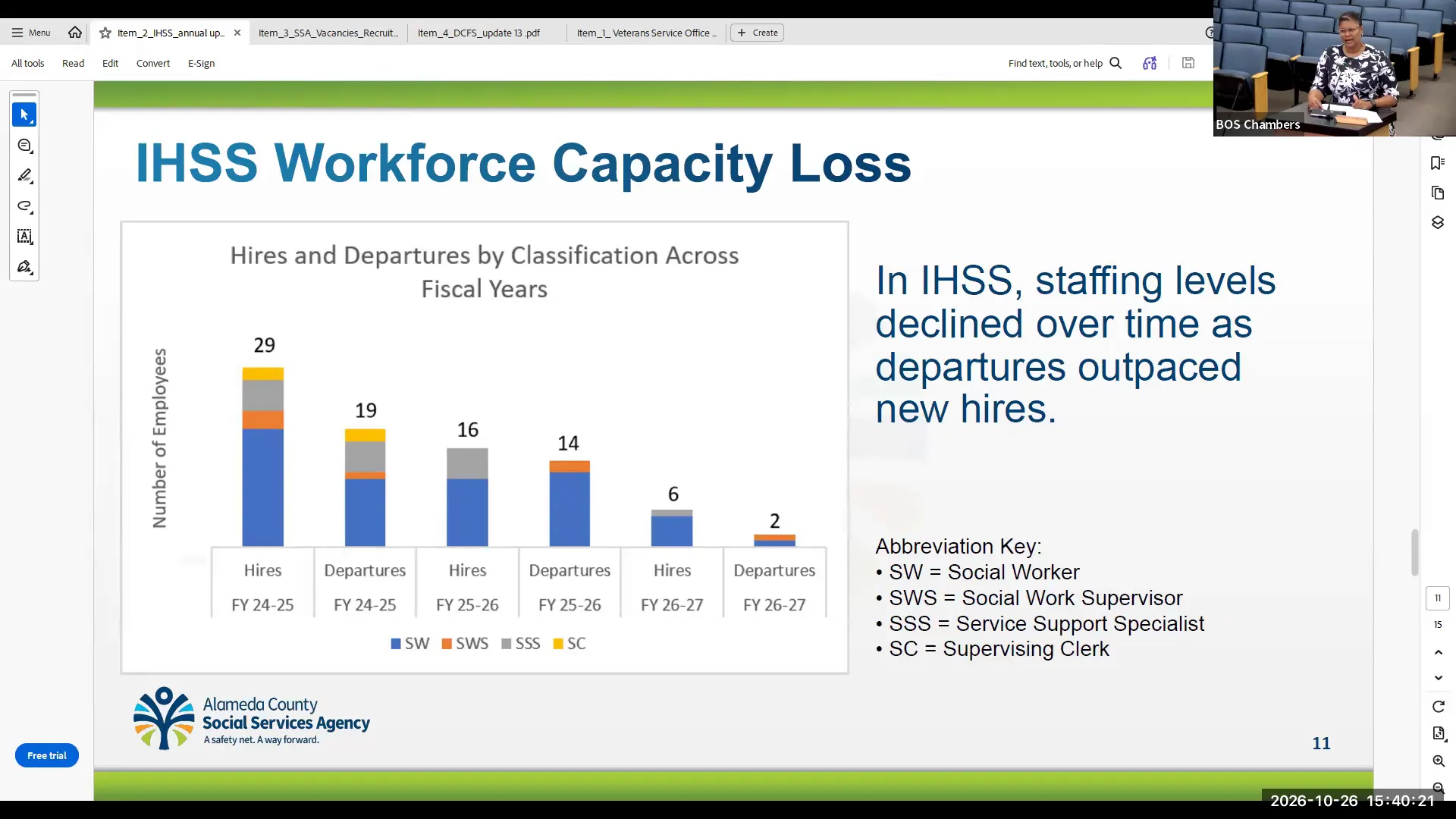
- Alameda County paid more than $2.1 million in CFCO penalties last fiscal year, described as equivalent to 10 social worker positions; counties are now 100% responsible for penalties. First-quarter FY 2026-27 penalties were $48,200. Staffing has declined from 125 to 92 social workers and from 75 to 57 service support specialists, with departures outpacing hiring.
- A phased staffing plan was presented: Phase 1 would restore 10 funded and 23 unfunded social worker positions and 3 funded and 15 unfunded service support specialists plus supervisors; Phase 2 would add about 25 more social workers and additional support staff to reach roughly 150 social workers.
- In discussion, overdue assessments were defined as exceeding 12 months. Director Andrea Ford said the county administrator’s office has been engaged about funding additional IHSS social workers; a training joint-powers agreement with Los Angeles and Santa Clara counties has signed articles of incorporation, with a funding decision still pending.
Social Services Agency Vacancies, Recruitment, and Retention
- Sharon Moore, Chief Departmental Human Resources Administrator, reported that the agency has 109 classifications (59 unique to Social Services), 2,151 budgeted positions, 208 vacant full-time-equivalent positions, and a vacancy rate of 8.8%, excluding TAP employees.
- Hiring totals: 346 employees hired in FY 2025-26 and 137 hired from July through October 2026. Child welfare worker vacancies were reduced to 4.4%. In October 2026, 196 eligibility service technician candidates were interviewed, producing an eligibility list of about 180 people, with about 80 expected to start in January.
- Separations continued across FY 2025-26 and FY 2026-27. Workforce demographics for the largest classifications: 259 child welfare workers with attrition near 8%, and 92 social workers with attrition slightly above 8%.
- Hard-to-fill classifications are identified by vacancy rates over 10%, lengthy recruitment, and limited eligibility lists. Child welfare workers and social workers are on the employee referral incentive program; eligibility service technicians and adult protective services workers also warrant focused recruitment, although eligibility technician recruitments draw many applicants.
- Recruitment and retention challenges include applicant pool limitations, competition from neighboring counties and the private sector, Alameda County’s cost of living, and retention after training, with eligibility technician roles sometimes used as a stepping stone.
- In discussion, Moore did not have a comparison of vacancy rates with peer counties and agreed to provide one. Ford noted recent SEIU negotiations included comparative salary work with counties such as Santa Clara and that some hard-to-recruit positions are now above the median.
Department of Children and Family Services Status Update #13
- Michelle Love provided the 13th update on the department. The county submitted its Corrective Action Plan (CAP) to the California Department of Social Services on October 1, 2026; implementation is anticipated to begin January 7, 2027, with completion projected by December 31, 2028. A new statewide child welfare database begins December 7, 2026.
- Love explained the CAP is a targeted, two-year plan addressing front-end referral investigation timeliness and documentation, while the System Improvement Plan (SIP) is a broader five-year process that is board-approved and rolled up into the state’s federal performance plan. The CAP includes 10 action steps and six longer-term steps to be folded into the next SIP.
- Key CAP work includes front-end emergency response practices, structured decision-making reviews using case readings with Evident Change, relative engagement, and a communications plan to be developed over the next six weeks. A continuous quality improvement process is built into the CAP.
- SIP accomplishments since 2024 include a permanency guide, permanency-related policies and referrals, an FFE provider, internal process mapping, increased staffing, and improved court report documentation, including for siblings placed apart.
- Foster care data as of October 11, 2026: approximately 620 children ages 0–17 in care, with the majority placed with relatives; about 118 in foster family agencies, 113 in county resource family homes, 39 in short-term residential therapeutic programs, 24 in small family homes, and 15 in group homes. Non-minor dependents ages 18–21 average about 275–290.
- Emergency placement capacity: the transitional shelter care facility can currently serve up to six children, with eventual capacity for 10. Emergency STRTP placements and RFA emergency beds are being used to maintain compliance, including the state’s 72-hour limit for transitional shelter care.
- In discussion, Love said the dashboard’s roughly 24% increase in open referral investigations since January reflects pending closures, including about 600 cases affected by a recent union agreement; she expects the number to fall as new staff close cases. New child welfare workers complete the required 10-week state training plus an 8-week on-the-job training, and first immediate referrals are assigned after about 2.5 to 4 months, consistent with peer counties.
- The board sought monthly CAP updates to monitor progress. Love said the CAP is still a working document and CDSS edits are expected before January. Baker Tilly’s root-cause analysis feedback is expected mid-January 2027.
Key Outcomes
- No formal motions or votes were taken; the committee received all four informational updates.
- The committee requested that SSA provide a peer-county vacancy rate comparison and continue working with the county administrator’s office on funding for additional IHSS social workers; board involvement may be considered if funding is not otherwise secured.
- DCFS will continue monthly/ongoing status updates during CAP implementation, with the next milestones including the new database on December 7, 2026, CAP implementation on January 7, 2027, and Baker Tilly feedback in mid-January 2027.
- Staff will follow up with the IHSS public commenter, Velma Gaye, regarding conditions at Depot Community Apartments.
- Informational milestones to track: IHSS eForms statewide deadlines (July 1, 2026 and January 1, 2027), the IHSS phased staffing request, and the CAP completion target of December 31, 2028.
Meeting Transcript
Good afternoon and welcome to the Alameda County Board of Supervisors Social Service Committee meeting for Monday, October the 26th, 2026. May I roll call, please. Supervisor Fortunato Bass. Present. Supervisor Tamp. Present. We have a quorum. Thank you. Please go through instructions for participation. Detailed instructions are provided in the teleconferencing guidelines. A link to the document is included in today's agenda. If you are joining the meeting using a computer, use the button at the bottom of your screen to raise your hand to request to speak. When called to speak, please unmute your microphone and state your name. If you are calling in, dial star nine to raise your hand to speak when you are called to speak. The host will enable you. If you decide not to speak, notify the clerk when your call is unmuted, or you may simply hang up and dial back into the meeting. When called, you will have two minutes to speak. Please limit your remarks to the time allocated. Public comment will generally alternate between in-person and online speakers as determined by the chair and subject to all overall time limits. Thank you. Thank you. We will start with the first information item, the County Veterans Services Office annual update. Good afternoon. My name is Pamela Pala, executive program coordinator for the Alameda County Social Services Agency. I'm speaking on behalf of Andrea Ford Director. I would like to introduce Anthony Simpson, our County Veteran Services Officer with the Department of Adult and Aging Services to give his annual updates on the County Veteran Services Office. Good afternoon once again. Oh watch it, Kern Green. Okay. Is that better? All right. I tried again. Good afternoon to the board members. Also I like to thank Mrs. Ford as well as Faith, my supervisor, for giving me the opportunity to present what we have accomplished as a veteran service officer office for Alameda County. Again, my name is Anthony Simpson. Next slide. First of all, I like to start this off by saying look of our wonderful new building and our location. I'd like to give thanks to the VAC, the Veteran Affairs Commission, and all of their efforts for putting this in place. With this new location, we have been able to entertain as well as service our clients. Most of the input from our clients have been, they love the location, and so do the employees as well. I can't proceed without the presentation to prevent any further delay. May I? Oh, here we go. Thank you.
SUMMARIZED BY OPENPUBLICA AI
TRANSCRIPT VIA PUBLIC VIDEO
openpublica.com
openpublica.com