Albuquerque City Council Meeting - June 2, 2025
STREAMING COPY IN PREPARATION — RECORDING AVAILABLE FROM THE ORIGINAL SOURCE
Albuquerque City Council Meeting - June 2, 2025
The Albuquerque City Council held its 33rd meeting of the 26th Council on June 2, 2025, at 5:00 PM (local time). The meeting began with a moment of silence and the Pledge of Allegiance. All nine councilors were present, with Councilor Grout joining via Zoom. The agenda included presentations on APD's language access program and the 2024 Public Art Census, a consent calendar, public comments, discussion and final action on several items, and administrative Q&A.
Consent Calendar
- The council approved the May 19th journal unanimously.
- The letter of introduction was approved, including referral of R163 (adjusting FY2026 operating appropriations for planning department efficiency) to the Finance and Government Operations Committee (FGO) on a unanimous vote.
- The consent agenda was approved unanimously, with items EC353 (voucher task force implementation plan) and EC400 (ABQ Ride quarterly security report) pulled for separate discussion.
Public Comments & Testimony
- Melissa Kaminsky and Kathy Sotello (Heading Home): Requested continued funding for the Job Connect program, which has enrolled 474 individuals and secured employment for 279 (59% success rate) since January 2023.
- Sonia Smith (Delta Sigma Theta Sorority): Highlighted the chapter's 50+ years of service and called for collaboration on affordable housing, economic stability, health, and education.
- Anami Das: Expressed concern about AI training using police body cam footage and urged the city to adopt responsible data use policies similar to Denver.
- Teresa Garcia and Dr. Lisa Christofferson: Urged advocacy for 200 Job Corps students facing sudden closure and displacement, warning of potential homelessness.
- David McKibben: Criticized National Guard militarization and drone surveillance, and called for support for Job Corps youth.
- Denise Mouniz Archiback (CABQ transit driver): Described escalating safety issues including verbal abuse, physical assaults, unsanitary conditions, drug activity, and lack of security on buses. She requested increased law enforcement presence, stricter passenger conduct enforcement, and a review of the free fare policy.
- Ilsa Beal: Raised concerns about the city's process for storing valuable items found during solid waste operations, asking for a clear SOP and better communication with owners.
- Multiple speakers (on hemp ordinance): A range of positions were expressed. Some urged a ban to protect children, while others argued the ordinance would hurt small businesses, create a black market, and cited pending federal regulation. Public comment on the hemp ordinance was divided.
- Alexandra Paisano (NM Coalition to End Homelessness): Urged support for maintaining funding for the 768 Help Homelessness Resource Line, calling it a critical access point for thousands in crisis.
- Don Greenby Hill (ACS violence intervention program): Reported discrimination, retaliation, and a toxic work environment, requesting council investigation.
- Other public comments addressed topics including the National Guard, city-owned property, transit issues, and personal appreciation for council actions.
Discussion Items
- APD Language Access Program Presentation: Deputy Chief JJ Griego and Language Access Coordinator Jocelyn Segovia presented data on the program. In 2024, APD identified 671 police reports with communication barriers (89% spoken language, 10% deaf/hard of hearing). Emergency Communications Center calls requiring interpretation rose from 10,007 in 2023 to 12,556 in 2024. Efforts include an ASL station at the Northeast substation, multilingual traffic tickets, and ongoing training. Councilors thanked the presenters and stressed the importance of continued resources.
- 2024 Public Art Census Presentation: Mandelin Sanchez (Public Art Outreach Coordinator) presented the census results, conducted in partnership with Bernalillo County and Rook. The census canvassed 20,000 linear miles and identified 11,364 works of art in public rights-of-way across Bernalillo County. The city's 1.5% for art program contributed 342 works valued at over $11 million over 46 years. The report identifies public art deserts and aims to inform future placement. Councilors requested additional data on property values and spending over the past four years.
- Item EC353 (Voucher Task Force Implementation Plan): Councilor Grout and Rogers praised the task force's progress and data-driven approach. Approved unanimously.
- Item EC400 (ABQ Ride Quarterly Security Report): Councilor Rogers asked about data gaps for APD, ACS, and Metro Security on specific routes, and noted that not all buses had automatic passenger counters at the time of the equity study. Deputy Director Davis confirmed counters are now on all buses. The report was received and noted unanimously.
- O78 (Intoxicating Hemp Products Ordinance): Councilor Lewis introduced the ordinance to ban the sale of synthetic/semi-synthetic intoxicating hemp products (like delta-8 THC) in retail establishments, targeting products marketed to children. Council debate focused on enforcement capacity, lab testing requirements, and the potential for preemption by state/federal action. The bill passed 7-2, with Councilors Feblecorn and Bassan voting no. Councilors noted that the ordinance does not affect state-regulated cannabis dispensaries or THC beverages in liquor stores.
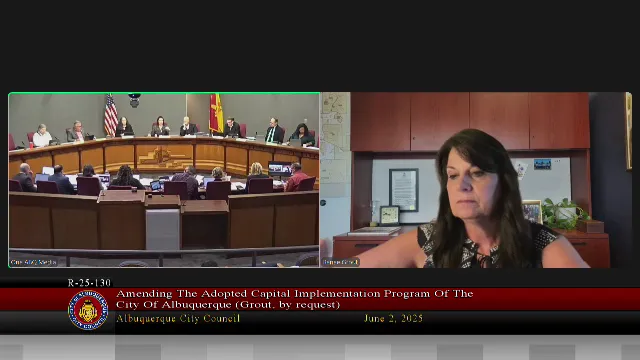
- R130 (Capital Improvement Program Amendments): Councilor Grout presented the resolution to appropriate state funds and donations. Two technical amendments were approved unanimously: one added $525,000 from Bernalillo County and $5.5 million from Explora for the Briante Early Learning Center and STEM Learning Campus; the other corrected a total to $4,516,567. The resolution passed unanimously.
- R145 (Support Local Performing Arts): Councilor Baca moved to withdraw the bill, noting that the administration is now aligned on the issue. Withdrawal was approved unanimously.
Key Outcomes
- O78 (Hemp ban): Passed 7-2 (Councilors Feblecorn and Bassan opposed).
- R130 (Capital amendments): Passed unanimously as amended.
- R145 (Performing arts): Withdrawn unanimously.
- Consent agenda items: All approved unanimously, including the journal and letter of introduction.
- Administrative Q&A:
- Code Enforcement provided details on the closure of six hotels, including the Barcelona Suites, citing extensive code violations, mold, and unsafe conditions. All residents were offered motel vouchers and services; six veterans were connected to the Veterans Integration Center.
- The administration discussed the process for establishing Safe Outdoor Spaces on city-owned land, emphasizing that applications would go through the planning department and that liability, security, and consideration (potential rent) would be determined on a case-by-case basis.
- National Guard deployment: Commander Vierz explained that guardsmen have completed training equivalent to a reduced version of Police Service Aids (PSAs), including radio procedures, traffic control, and perimeter security. They will carry only OC spray and will not be issued handcuffs or involved in use of force. They will assist at the Real-Time Crime Center, prisoner transport, and field perimeters. Councilors expressed concerns about community engagement, lack of translated materials, and the need for citywide town halls. The administration agreed to provide contact information for the National Guard and to improve future engagement.
- Housing and Homelessness Department: Joseph Montoya answered questions about the RFI for affordable housing on city-owned lots, defining affordable as 80% AMI (e.g., $73,000 for a family of four), with a 30-year affordability period for rentals. The RFI primarily targets single-family homeownership, with no rental component. A soft second mortgage structure will be used to ensure long-term affordability.
- Parks Department: Director Simon reported that parks are on a weekly mowing schedule, but staffing shortages (only 20 temporary hires vs. a typical 40-60) have led to delays. Weed control relies on pre-emergent applications and healthy turf. Councilor Rogers suggested exploring cross-program opportunities with the Better Way Forward program to fill vacancies.
The meeting was adjourned at approximately 8:30 PM.
Meeting Transcript
Good evening, everyone. It's June 2nd, 2025, the 33rd meeting of the 26th Council will come to order. All counselors are present this evening with Councilor Grout joining us via Zoom. We're gonna start tonight with a moment of silence, followed by the Pledge of Allegiance in English and in Spanish. Civic Plaza parking passes are provided for members of the public. You can obtain a parking pass from the council staff at the table near the chamber's entrance. Members of the public, city staff, and the media have the ability to view this meeting in person and on live streams through four different platforms GovTV on Comcast Channel 16, the Gov TV website, YouTube, and Zoom webinar. The live streams can be accessed from most smartphones, tablets, or computers. Also, this meeting is closed captioned, and you may be enabled, you may enable your closed captioning services on your television or device at this time. The video recording of this and all past council meetings will remain available for viewing at any time on the city council's website. Council staff is available via telephone if members of the public need assistance finding the videos online. Please call 505 768 3100 for assistance during business hours Monday through Friday, 8 a.m. to 5 p.m. The council will take a break at approximately 7 p.m. this evening if needed. With regard to decorum in the chambers, we want tonight's proceedings to be as civil and respectful as possible. Please do not make any personal attacks and please no applause or snapping at one another or any outbursts during the meeting. The meeting will go a lot smoother if we are respectful of one another. We're going to start with proclamations and presentations. Tonight we do not have any proclamations, but our first presentation will be introduced by Councilor Rogers. Thank you, Madam President. We have a presentation from Deputy Chief JJ Griego with Albuquerque Police Department who will provide an update on APD's language access program. This is one of the programs I had the privilege of working on in equity and inclusion when I worked for the administration, and really just excited. I know this JJ Griego's gonna be leaving us soon for retirement. And so I just really wanted to push up his work within APD because him being an advocate for language access really helped us push this work forward in APD. It's something that's really important to me, and so I just really wanted to give him some time to share his work and the progress that we've made. Thank you. You know, I just want to say expositionally that um language access is uh not a political issue. This is a human rights issue. Um we uh have worked very hard to establish the program that we are currently working off of. Um in uh my naiveness when I first took over this program uh to implement what City Council mandated. Uh I thought I could be the language access coordinator for the City of Albuquerque's police department. I quickly realized that that was not the case, um, and it was a full-time job in and of itself for at least one person. Uh so we did hire Jocelyn Segovia to be our language access coordinator. Um, when we first started this project, you can go to the next slide. Um, right there. Okay, my apologies. Um, when we first started this project, we really didn't have an idea of the need uh for the program. Um we knew there was a need, but we didn't know how much of a need. Um so when we embarked on this mission to develop a policy and procedure, we met with the community groups to determine what's gonna work best for not just the police department but also the community at large. Um we uh gathered all the information. Um we agreed on some things and we agreed to disagree on a couple of things, but for the most part, uh this is a community-driven policy. Um when we started, uh, we were a little bit slow on starting to collect data to determine you know how much or how great that need was, but as we progressed, um, you can do the next slide. Um we quickly saw that this was uh something that the Albuquerque Police Department needed. Um we can't say that we're community policing if we are leaving out a segment of that community. Um, and what Jocelyn is going to talk about next is some of the data that we've uh been accumulating and how we're responding to that data. Jocelyn. Hello, good evening. Thank you so much for having us. Thank you.
openpublica.com