Community Meeting on Substandard Lot Regulations – September 3, 2026
STREAMING COPY IN PREPARATION — RECORDING AVAILABLE FROM THE ORIGINAL SOURCE
Community Meeting on Substandard Lot Regulations – September 3, 2026
This was the second community meeting hosted by city planning staff (Sam and Katie) to present findings from a citywide inventory of substandard lots and to gather public feedback on draft recommendations to modify the special use permit (SUP) process for these lots. The meeting took place virtually via Zoom, with a Q&A format.
Public Comments & Testimony
- Phoebe: Asked whether staff planned to review lot size requirements as part of zoning for housing part two. Staff responded that it would require consensus from planning leadership and City Council endorsement.
- Catherine: Asked whether height and size on substandard lots are the same as on regular lots, and how many approved SUP cases requested FAR variances. Staff clarified that no FAR modifications were granted; only setback modifications occurred on very substantially substandard lots.
- Sunny: Asked whether variances that allow taller/larger buildings obviate requirements. Staff explained that variances require demonstrating unique property conditions, with a very high hurdle.
- Brett: Asked if the draft recommendation would set a threshold percentage of buy-right lot size (e.g., 75% or 90%) for by-right development. Staff confirmed they are considering 75% or 90% of lot requirements.
- Hans: Asked if substandard lots would be held to the same canopy coverage requirements as other zones. Staff confirmed 25% canopy coverage applies on redevelopment.
- Catherine: Asked how “surrounding lots” would be defined, citing a past inconsistency in her neighborhood. Staff responded that the definition would be tightened to only adjoining lots in the same zone.
- Annie: Asked what the impact numbers would look like using the 75% criteria instead of 90%. Staff committed to posting that analysis on the website.
- Catherine: Asked whether the public could get a list of addresses so neighbors could provide feedback, given 1,600 lots would be removed from SUP. Staff said they cannot release addresses due to privacy concerns but will post a high-resolution interactive map and may provide block-level information.
- Andrew: Asked whether “development” includes only full teardowns and reconstruction, or also remodeling. Staff clarified that development means building a new house on a vacant lot or teardown/rebuild on an occupied lot; rules for additions would also be simplified.
- Brett: Asked about the distinction between developed and non-developed lots. Staff explained: vacant lots currently have limited SUP eligibility; developed lots have a separate process. Both would be treated similarly under the new rules.
- Han: Asked about concerns about unintended impacts. Staff responded that they have conducted thorough research and believe the measured approach minimizes surprises.
- Annie: Asked if lots currently in the SUP process would be affected by a November rule change. Staff said only applications submitted after final passage would be affected; existing docketed cases would proceed unless applicants defer.
Discussion Items
- Presentation of Inventory Findings: Staff presented that approximately 33% of the city’s single-unit detached lots (about 2,900 lots) are substandard, primarily in the R8 zone (tree streets, Northridge, Beverly Hills), with pockets in R5 and R25 (Rosemont, Delray). Most substandard lots fall modestly short of minimum requirements: 71% meet at least 75% of lot size, width, and frontage. Nearly all are clustered with similar lots on the same block. House sizes and widths on substandard lots are proportionally smaller due to FAR and setback requirements.
- SUP Case History: Since the 1970s, 32 vacant substandard lot SUPs were processed (26 approved, 6 denied). Since 2008 rules for teardowns on occupied substandard lots, 35 cases have all been approved. Approved SUP houses have similar FAR and height to by-right teardowns.
- Draft Recommendations:
- Expand SUP eligibility to all vacant substandard lots (remove the current strict threshold).
- Allow by-right development for substandard lots that either (a) have similar size and shape to surrounding lots (block face compatibility test) or (b) meet 75% or 90% of the zone’s minimum requirements (staff seeking feedback to decide).
- Retain SUP requirement for “outlier” lots that are significantly smaller than surroundings and not close to meeting requirements, and for lots without frontage.
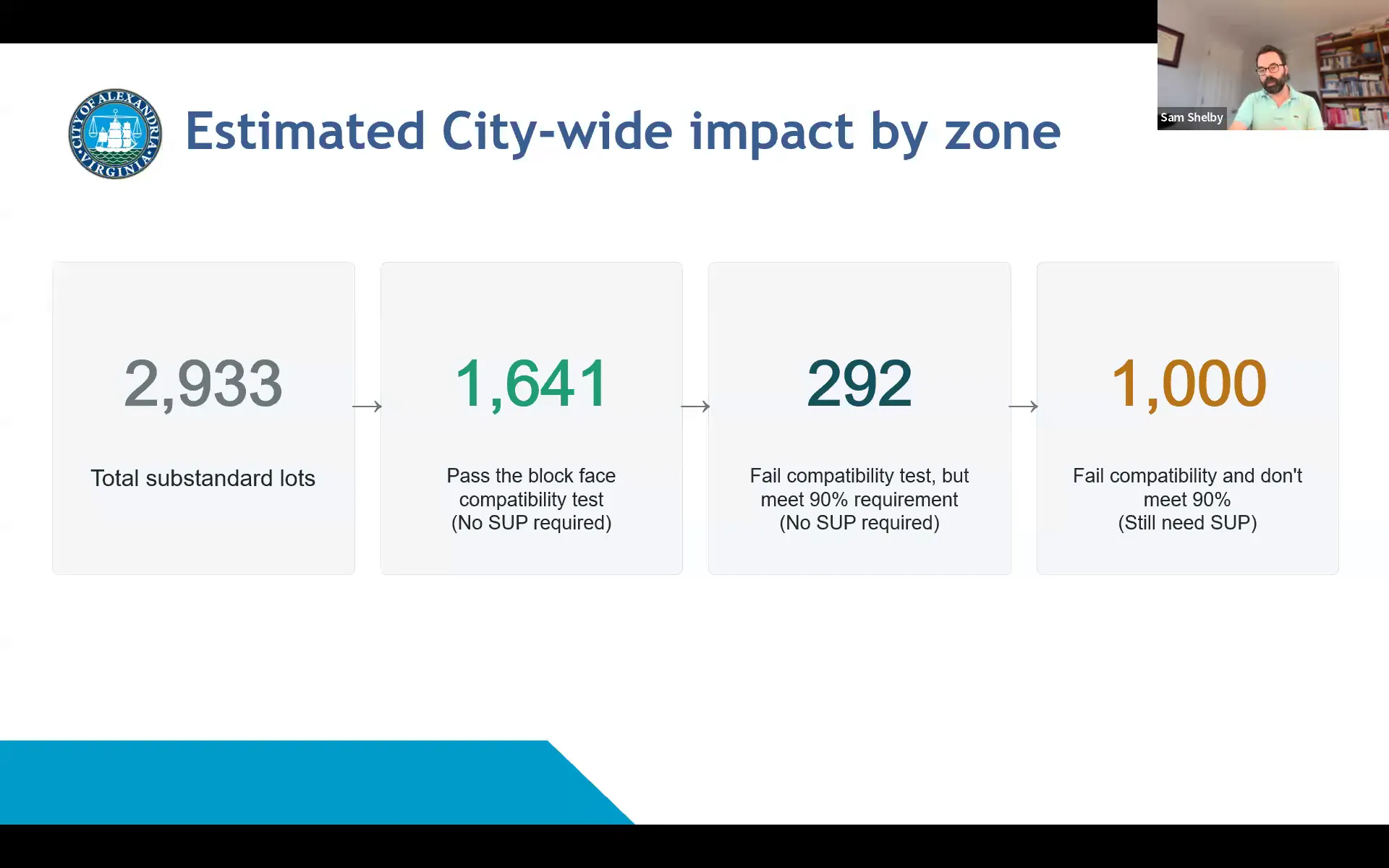
- Analysis of How Rules Would Apply: Of 2,900 total substandard lots, about 1,600 would pass the block face compatibility test (by-right). About 292 would fail compatibility but meet 90% of requirements (by-right). The remainder (outliers) would still need SUP.
- Next Steps: Staff will finalize recommendations based on feedback, release a staff report on September 25, 2026. Planning Commission public hearing on October 6, 2026. City Council hearing and final vote on October 17, 2026. If approved, rules take effect in November 2026.
Key Outcomes
- Draft recommendations presented with two key thresholds (75% or 90%) still under consideration pending public feedback.
- Staff committed to posting additional analysis (e.g., impact of using 75% vs. 90%), a high-resolution interactive map, and block-level lot counts on the project website.
- Staff offered to attend civic association meetings in September and hold virtual office hours for one-on-one discussion.
- Timeline confirmed: Staff report September 25, Planning Commission October 6, City Council October 17, with November effective date if approved.
Meeting Transcript
All right. Good evening, everybody. We want to thank you very much for signing on tonight. I know you probably have you had to eat dinner early or do something else or cancel something else to be here. So we're really pleased that you're you're able to join us for this presentation and this discussion tonight. Um in the participants tonight. And I'm joined here by my colleague as well, who can introduce herself. So yeah, we're going to talk to you guys a little bit tonight about um substandard lots. This is our second community meeting in the process. So uh tonight we're going to go over, you know, kind of what led to uh uh where we are now. Um we're going to go over the results of the substandard lot inventory that um that Katie really led, but that we uh have put a lot of of work into to determine where these are and what they're like. Um we're gonna bring up some uh uh you know, hear questions from you and discussion um uh you know, then go into our draft recommendations and more discussion and then kind of go over the timeline in the next steps. So um we're gonna for this meeting, we're gonna utilize the QA function in in Zoom. Um you can type in your questions at any time during the presentation, but we um and we'll we'll answer them if they're sort of uh questions that we can answer sort of quickly, um, you know, that don't require lengthy responses, and we're gonna try to answer them um typing them out while the other person is um kind of tag teaming to answer questions during the presentation. Um for some reason you're having trouble typing in the QA, um, you can raise your hand, use the raise hand function, and we can unmute you. So again, you can you can use the QA function during the presentation. Um there's a there'll be two uh points during the presentation where we're gonna just dedicate fully for discussion. Um if you again if you have trouble using the QA function, then you just raise your hand during those designated times during the presentation, and we can we're happy to answer your questions. So um diving in, um, this is just kind of a quick overview of uh it's a little bit of a spoiler um for the presentation, but it's an overview of of what we're gonna talk about tonight and why we're here. And so basically our our uh our inventory, our research found that about 33% of the city's single unit detached lots or substandard. Um and nearly all of them are developed and fall only like just short of the zoning requirements. So they're they almost meet all the required um lot requirements. And despite these, the fact that there's so many of them and that they're only a little bit short of the zoning requirements, all of them have to go through the SCP process. And some actually aren't even allowed to apply for an SUP before they can be developed. And so again, that's regardless of how minor, how minorly substandard they are or how similar they are to their surrounding lots. So we we are again that this is a little bit of a spoiler, but one of our draft recommendations is to allow substandard lots that come close to meeting the zoning requirements or that are similar in size and shape to their neighbors to develop by right and reserve the SCP process for genuine outliers, lots that are much smaller than their surroundings or significantly smaller than their after surroundings and are not surrounded by lots of similar sizes and shapes. So the purpose of tonight is just to share what we've learned about the you know, through the citywide inventory process, walk through our recommendations and and most importantly, really get your feedback before finalizing these recommendations before we take them to planning commission and council in um October. So with that, I'm oh I still have a little bit more. Just to recap kind of how we got here. This uh this project was endorsed by city council um back in June 2025. So it's a little bit over a year ago. Um that was when uh planning and planning staff indicated they wanted to study this a little bit and council endorsed that effort. Um we we initially held a community open house in September 25 to um to sort of initiate this project, and then um Katie and our team really got derailed with a number of other projects, and so we really didn't um get a website going and have our first community meeting until April of this year. Um and since since that meeting, we've had a discussion with the planning commission. Um, obviously, today is August 6th, and we're talking with you all tonight with a second community meeting, and then again, the October will be when we have the Planning Commission City Council hearings. And with that, I am going to pass this off to Katie. All right. Um, as Sam mentioned, we did a substandard lot inventory. Um, and what we found were was that there was about 2900 lots in the city that are substandard. Um, and this is approximately 33% of the 9,000 single unit detached housing, detached residential lots. Um, it's in all the residential zones, uh, but mainly R8. That's the the highest concentration, as you can see by the graph here. Um, and then next would be R25. Next slide, Sam. And here we have just a map to kind of show you where these areas are. They're very concentrated in pockets of the city. You can see a lot of the R8 is in sort of that like north central area of the city. Um, with the we call them the sort of tree streets over there. Um, but a lot of those are there, and then you have some pockets over on the west end and in Delray as well. So um a lot of the lots are substandard in more than one uh lot requirement.
openpublica.com