Arlington City Council Special Meeting – October 8, 2024
STREAMING COPY IN PREPARATION — RECORDING AVAILABLE FROM THE ORIGINAL SOURCE
Arlington City Council Special Meeting – October 8, 2024
The Arlington City Council convened in a special meeting on October 8, 2024, at 1:30 p.m. in the Council Briefing Room. Mayor Pro Tempore Barbara Odom-Wesley called the meeting to order at 1:36 p.m. and immediately adjourned into Executive Session, which lasted until 3:12 p.m. The open session resumed at 3:23 p.m. and included presentations on the HUD 2025–2029 Housing Needs Assessment and the Handitran/On-Demand Services Update, followed by informal staff reports, committee reports, and discussion of future agenda items. The meeting adjourned at 5:35 p.m.
Discussion Items
HUD 2025–2029 Consolidated Plan Component: Housing Needs Assessment
- Nikki Lewis (Grants Manager) introduced Karen Dash (President, Karen Dash Consulting, LLC), who presented the preliminary findings of the city’s housing needs assessment. Key data points: Arlington’s typical resident is a 33.1-year-old woman of non-Hispanic white background with an annual household income of $71,736. The population is 37% white, 30% Hispanic or Latino, and 22% Black or African American. The fastest-growing age cohort is 65 and older. Over half of renters and 22% of owners face at least one housing problem, primarily cost burden. The median home was built in 1984; nearly two-thirds of housing was built before 1980. Home prices have shifted dramatically: from 2009 to 2022, the share of homes priced $100,000–$149,999 dropped from 37.3% to 8.8%, while homes in the $300,000–$499,999 range rose from 3.5% to 27.4%. The median sales price peaked at $347,000 in June 2023. Rents have also increased; the share of units under $1,000 fell from 35% to 17.4% between 2013–2017 and 2018–2022. Currently, 6,000 multifamily and 2,500 single-family units are permitted but not built due to high construction costs. The consultant recommended considering project-based vouchers, gentle density via zoning, a community land bank, a below-market financing fund, and continued efforts to build residents’ wealth and purchasing power. Councilmember Boxall requested a finer breakdown of multi-unit projects and a comparison of condo affordability to other cities. Councilmember González asked for a definition of executive housing and noted that Viridian may not qualify as true executive housing; he also asked about corporate housing opportunities for transient workers. The final report is expected at the end of October 2024.
Handitran and On-Demand Services Update
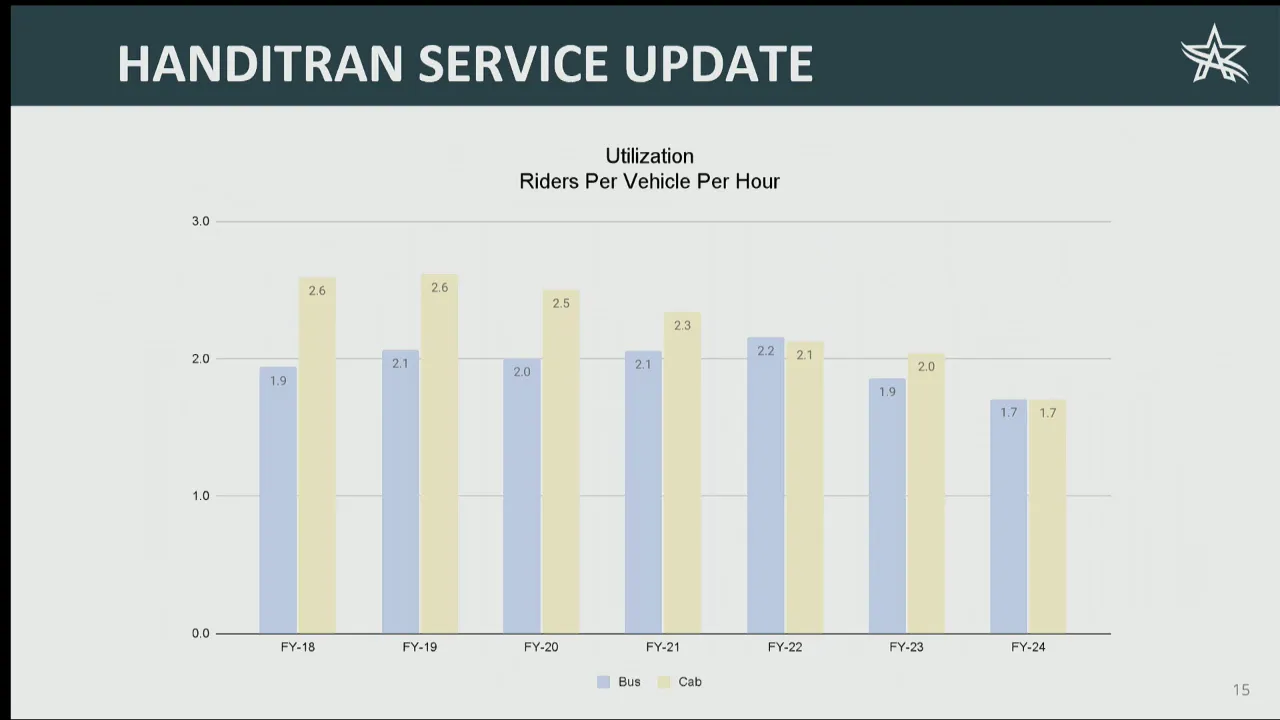
- Alicia Winkelblech (Transportation Director) and Ann Foss (Planning Manager) presented an update. Handitran serves elderly and disabled residents with a fleet of 34 vehicles (mix of city buses and cabs). The service area covers the entire city plus 1.5 miles outside, effectively doubling the geographic area. Ridership is growing: active riders increased from about 5,000 in FY2018 to over 6,000 in FY2024; new registrations are up. Resources are flat, leading to unmet demand – about 60% of ride requests are met. On-time performance dropped after a software change (from near-100% to lower levels) because the new system does not adjust trip windows retroactively. No-shows are declining after policy changes. The on-demand service (VIA) provides citywide rides for $3–$5 per trip, with shared vans and a fleet of up to 65 vehicles (including electric/hybrid and wheelchair-accessible). Since its launch in December 2017, over 2.75 million rides have been taken. Current ridership is about 10,000 rides per week, with 120,000 unique riders total. Rider satisfaction averages 4.7 out of 5. Average wait times are 13–17 minutes. The service is highly efficient, with utilization near 4 riders per vehicle hour. The city’s annual contribution is about $5.3 million (out of a total contract cost of $10–$11 million, with 40% federal funding and about 15% farebox recovery). Councilmember Boxall asked about overlap between Handitran and on-demand riders, and about potential cost-sharing with AISD. Councilmember Galante asked about the ideal fleet size to meet all Handitran demand. Councilmember Hogg suggested exploring variable pricing based on need. Councilmember Piel asked about the cost of reducing wait times to 15 minutes, and noted that joining DART would cost roughly $100 million in sales tax revenue. Councilmember Pham shared personal experience using the on-demand service and recommended advanced planning. Councilmember González inquired about the Handitran seat-unavailable rate; staff acknowledged constraints and said a new transit manager will start soon.
Informal Staff Reports
- FY24 Repetitive Loss Area Analysis Plan (RLAA) and Floodplain Program for Public Information Plan (PPI) Annual Reports – No discussion.
- Micromobility Pilot Program and License Agreement – Councilmember González expressed safety concerns about scooters on Cooper Street and enforcement issues. Staff noted that if the city withdrew from the license agreement, scooters and bikes would only operate on the UTA campus.
- Boarding Home Facilities for Elderly and Disabled Persons – Council directed staff to take the item to the Municipal Policy Committee (MPC) for potential regulation and standards.
- City of Arlington/Arlington Independent School District Program for Student ID Library Services – No discussion.
Committee Reports
- Municipal Policy Committee (Chair Odom-Wesley): Discussed a possible charter amendment election in May 2025. Proposed cleanup changes include aligning language on runoff election dates, council officer titles, polling places, and time warrants with state law. Other topics for discussion: authority to issue general obligation debt for economic development, council compensation, professionalizing the council, term limits, and a “rotate off” provision. The committee supports calling an election; the first reading ordinance would be January 28, 2025. Councilmember Pham noted that term limits and compensation changes require voter approval. Councilmember Hogg encouraged colleagues to review the charter.
- Transportation and Municipal Infrastructure Committee (Chair González): Reviewed the Safe Streets Arlington Plan update. The plan focuses on roadway safety, with community concerns about speeding, red-light running, and distracted driving. The draft plan will be finalized after an online survey (open through October 18) and one-on-one council meetings. A work session is scheduled for October 22, Planning and Zoning consideration on November 13, and a public hearing and adoption on December 10.
- Economic Development Committee (Chair Piel): All matters were discussed in Executive Session.
- Arlington Housing Finance Corporation (Chair Hunter): The board received an application from Ken Rose for 145 units of affordable senior housing on 287 between Sublett and Eden roads. The board deferred action pending additional information.
Appointments and Nominations
- Appointments to Boards and Commissions: None on the evening agenda.
- Nominations for Tarrant Appraisal District Board of Directors: Ethan Klos (Treasurer) presented the current list of nominees from other entities. Council members may nominate up to five individuals; no additional nominations were made, so the existing list will proceed to the December vote.
Key Outcomes
- Boarding home regulations referred to the Municipal Policy Committee for further study.
- Charter amendment election for May 2025 supported; staff directed to prepare an ordinance for first reading on January 28, 2025.
- Item 6.2 on the evening agenda (consideration of executive session matters) was tabled per Councilmember González’s recommendation.
- Future agenda item: Councilmember Boxall requested staff to research creating an Office of Energy Efficiency and/or Sustainability, including a director and staff, and to report on potential cost savings from such an office. The request was approved as a future agenda item.
- No other future agenda items were proposed.
Meeting Transcript
Estrella del espectáculo es el señor Héctor Patiño. Yo me siento aquí cruzado de manos esperando a ver quién se arriba a comprarme, nadie me va a comprar. Entonces, la forma de él es como llamando la atención. Y sí, y si lo logra porque llama la atención de toda la gente. Y prácticamente vende Michelada y vende baile. Creo que los retos más difíciles han sido ser la como primera generación en todo. La doctora María Yareli Delgado es una inmigrante de un rancho que se llama Los Tanques Valparaíso Zacatecas in Mexico. Nos movemos para acá para Texas, llegué a Irvine. Fue un, digamos, un cambio drástico, tanto culturalmente, con el idioma, visualmente un lugar muy pequeño a una ciudad. Fue difícil, pero también tenía, estábamos muy positivos porque la razón por la que yo había venido acá en Estados Unidos es era para ir a la universidad. Soy primera generación latina que tiene un doctorado. Yo creo que para mí el sueño americano es vivir una vida plena, donde todo lo que hago, ya sea como mi vida personal, mi vida profesional, que mis papás estén orgullosos. Tener un empleo que yo disfrute, que yo adore y que diga mañana voy muy feliz a trabajar, entiendes. Soy la directora ejecutiva de las iniciativas hispanas acá en UTA. So HSI es una es una designación federal que se le da a instituciones como UTA porque tenemos un porcentaje como de 25% o más de estudiantes que son que son Latinos, que son que es la primera vez que han venido a una institución. Pero también el sueño americano es para mí ayudar a la siguiente generation de ya sea de studiantes, de membros of the community, a ten a obtener sus metas, a que sean también exitosos, que todos que todos sepan que el sueño americano sí existe y que si trabajamos duro in este país, nosotros podemos alcanzar grandes metas. Y hay que apoyarnos uno a otro. Soy la doctora María Yareli Delgado y vivo el sueño americano. Hard worker. Okay, I think we got everybody, right? I'm calling the meeting to order at uh one thirty six pm on Tuesday, October the eighth. Okay, let's all get ready to resume. We will continue with our afternoon session for the Arlington City Council. These are work session items and our first presentation. Let's see, Nicky Lewis. I think you want to introduce our item. Thank you very much. We have Miss Karen Dash. She is the consultant who's been hired to complete the city's housing needs assessment. She had an opportunity to meet with you all as council members earlier today, and now she'll give you an update on the work that she's been doing to complete the housing needs assessment. Karen? Turn your mic, Karen, so we can hear you. Several closer to the thank you for the opportunity to be here today and to share with you where we are in our housing needs assessment. I will get started, I guess. Um do I click or right on the top of there? Oh, okay, great. Okay. Okay, great. So we're going to take you through where we've gone thus far with our housing needs assessment process. We'll talk a little bit about the success stories that we've seen already here in Arlington. Um, we'll talk about the the national context because what's happening here in Arlington is happening around the country. And so we'll just give a little bit of insight regarding that. We'll look at the city's demographics and housing markets. We'll get into some detail on that. We'll also look at some preliminary stakeholder feedback. About a month ago, we were here and we had meetings, five different focus groups and met with a lot of different folks. We also interviewed 24 different stakeholders. Um we've been gathering that feedback. We'll talk a little bit about the Arlington Housing Authority, and then we'll we'll go through an exercise that shows some of the housing choices that are available for different income groups. Lastly, we'll we'll talk about a couple of preliminary recommendations that we have thus far.
openpublica.com