Arlington City Council Special Meeting - December 10, 2024: Work Session on Tree Preservation, World Cup, Energy Efficiency, and Appointments
STREAMING COPY IN PREPARATION — RECORDING AVAILABLE FROM THE ORIGINAL SOURCE
Arlington City Council Special Meeting - December 10, 2024
The Arlington City Council held a special meeting on December 10, 2024, starting at 12:45 PM. The meeting began with an executive session for legal and real estate matters, then reconvened at 2:38 PM for presentations and discussions on tree preservation, FIFA World Cup 2026, energy efficiency, and various policy items. The council reached consensus on the Tarrant Appraisal District Board of Directors appointment for 2025.
Executive Session (12:45 PM - 2:22 PM)
- The council met in closed session under Texas Government Code Sections 551.071 (consultation with attorney), 551.072 (deliberation regarding real property), and 551.087 (economic development negotiations).
- Items discussed included:
- Discussion regarding acquisition or exchange of property relative to Oncor Substation.
- Discussion regarding the lease of city-owned property at 1200 Ballpark Way.
- Resolution authorizing settlement for fee simple ownership of 553 sq. ft. at 519 West Division Street for the Division Street TxDOT Sidewalk Project.
- Resolution authorizing settlement for fee simple ownership of 631 sq. ft. at 708 East Division Street for the same project.
- Resolution authorizing termination of a pipeline license agreement with Texas Midstream Gas Services, L.L.C.
- Offers of incentives to business prospects.
Work Session Items
3.1 Tree Preservation and Mitigation
John Chapman, Long Range Planning Manager, presented proposed changes to the Unified Development Code (UDC) to enhance tree preservation. The changes were developed after a year of meetings with the Municipal Policy Committee and external stakeholders (Landmark Preservation Commission, Impact-Arbor, Developers Round Table). Key proposals included:
- Revising the point system for bonus trees: reducing values for cross timbers and bonus trees, but increasing the value for significant tree stands.
- Redefining a significant tree stand: raising the minimum number of trees from 3 to 5, increasing the minimum caliper size from 2.5 inches to 8 inches, and increasing spacing requirements. No double dipping of bonus points.
- Introducing a Heritage Tree category: cross timbers trees 40 inches or larger receive a 2x bonus point to incentivize preservation, with a penalty for removal.
- Development incentives: single-family (exceeding 35% preservation up to 50% gets reductions in lot area, lot size, and dwelling size); multifamily (new 10% preservation requirement, incentive of up to 25% reduction in garage parking); non-residential/mixed-use (reduction in required parking for exceeding 10% preservation).
- Increasing the penalty fee for unauthorized removal of protected trees from $200 to $600 per caliper inch.
- Adding a purpose statement and defining caliper measurement at 4.5 feet.
- Exempting Arlington Municipal Airport from tree preservation requirements due to FAA regulations.
- External stakeholder suggestions (no action required by council at this time): education materials, allowing parking reduction for surface and garage parking (up to 50%), administrative waiver for sites with minimal trees, and decreasing the caliper size for significant stands. Councilmember Odom-Wesley and Councilmember Hogg expressed support for moving forward with staff proposals and not adopting the stakeholder suggestions that would weaken the policy. Councilmember Hogg emphasized the importance of education materials. The public hearing before Planning and Zoning Commission is scheduled for January 8, 2025, with a council return in February/March.
3.2 FIFA World Cup 2026 Update
Jennifer Wichmann, Deputy City Manager, and Monica Paul, Executive Director of the Dallas Sports Commission, presented an update. Key points:
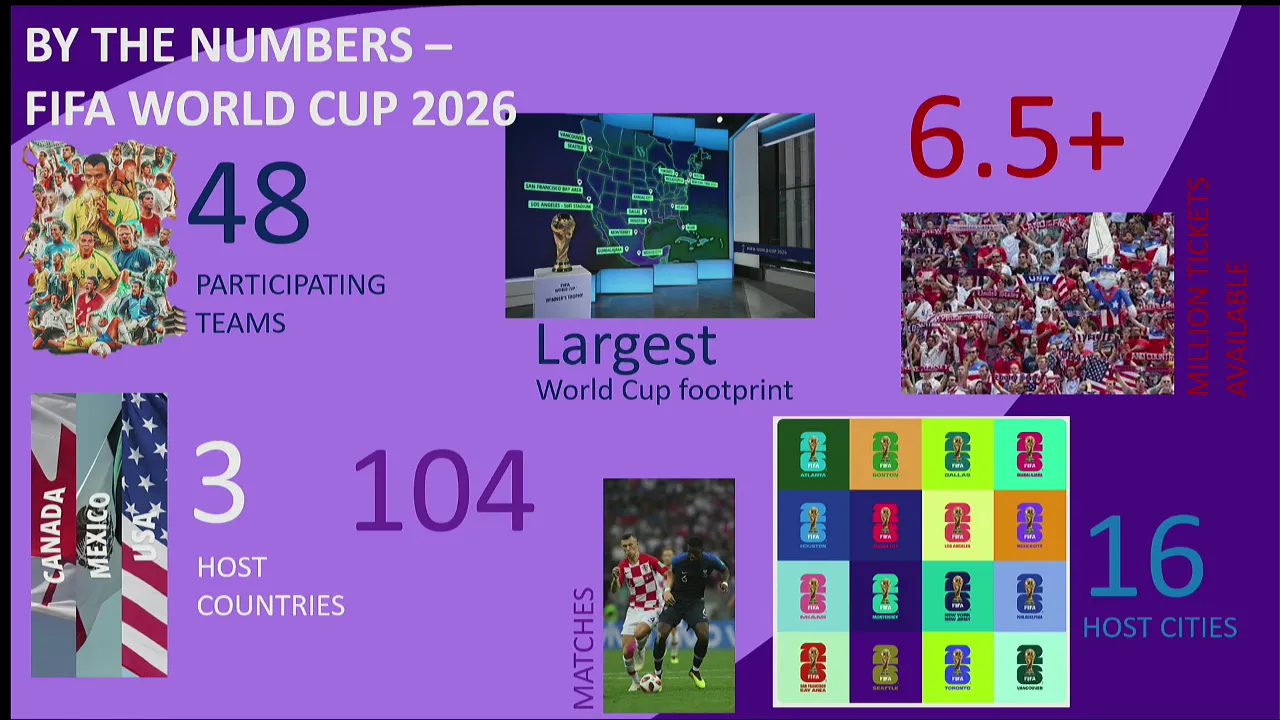
- Nine matches will be played at AT&T Stadium in Arlington (June 14 to July 14, 2026), including a semifinal. The stadium name is expected to be updated to reflect Arlington (Arlington-Dallas Stadium) in early 2025.
- Five base camps have been identified (Toyota Stadium, University of Dallas, Dallas Baptist, TCU, and UNT Denton), with a possible sixth. Teams will be assigned after the December 2025 draw.
- A FIFA Fan Festival will run for 39 days, with potential for additional watch parties in the Arlington Entertainment District and other locations.
- Economic impact estimated at $2 billion for the region, with a state Major Event Reimbursement Program and local fundraising covering costs.
- Transportation planning includes a bus bridge from CenterPort to AT&T Stadium. Councilmember Boxall raised concerns about local transportation for residents and trash removal. Councilmember Odom-Wesley inquired about allowing short-term rentals during the event; City Manager Trey Yelverton advised against temporary changes to the ordinance.
- Arlington planning efforts include business outreach beginning in 2025, communication to residents starting April 2025, and staff preparation for nine events in 31 days. Volunteer opportunities will be available via DallasFWC26.com.
3.3 Energy Efficiency
Nora Coronado, Director of Asset Management, presented an overview of the city's energy efficiency initiatives. Highlights:
- The city has embedded energy efficiency policies and practices for over a decade, without a separate sustainability office.
- Past projects: 2008 energy conservation CIP (paid off early), 2015 LED streetlight retrofit (10,500 lights, 45% energy reduction), and performance contracting for building upgrades (HVAC, controls, lighting) leveraging streetlight savings.
- Received $369,000 in federal formula grants for further LED retrofits and one EV charging station.
- New construction complies with updated energy codes, achieving LEED Silver certification for several buildings (Downtown Library, Fire Stations 5 and 9, Airport Terminal).
- City electricity is purchased from TXU with no renewable contract provisions, but Texas grid relies heavily on wind and solar.
- State mandates (SB5, SB241) require a 5% annual reduction in energy consumption; the city is tracking data and exploring ways to meet goals, including solar opportunities on buildings and parking lots.
- Councilmember Gonzalez suggested internal behavioral changes (e.g., turning off lights) to save energy, similar to successful programs in MISD.
Issues Session Items
4.1 FY2025 City Council Priority - Enhance Regional Mobility
- No discussion; written report provided.
4.2 Municipal Policy - Proposed Boarding Home Ordinance
Councilmember Odom-Wesley reported that the Municipal Policy Committee met and discussed a proposed ordinance to regulate boarding home facilities. The ordinance would require annual operating licenses, criminal background checks, property owner consent, initial and annual inspections, and enforcement tools (citations, license suspension/revocation). The impetus came from a case in Arlington where a group home owner was indicted for murder due to substandard care. The committee agreed to move forward with drafting a comprehensive ordinance expeditiously, as surrounding cities already have such ordinances. Councilmember Gonzalez suggested adding a requirement for proof of property tax payment as part of the licensing process. City Attorney Shortall noted that could be explored. The ordinance will be brought to the full council.
4.3 Appointments to Boards and Commissions
- No appointments for the evening agenda.
4.4 Charter Amendments
City Attorney Molly Shortall provided an update. The council is working toward five charter amendments to be placed on the January election ballot. No new items were added.
4.5 Tarrant Appraisal District Board of Directors Appointment for 2025
Treasurer Ethan Klos presented the current vote totals from taxing entities across Tarrant County. As of the meeting, the top contenders were Blaylock (who already has enough votes to be appointed), Burgess, Campos, Pena, and Puente. After extensive discussion, the council agreed on a voting allocation to maximize Arlington's influence and ensure representation. The final consensus (with Councilmember Pham dissenting on some allocations) was:
- 124 votes for Gloria Pena (Arlington resident, incumbent, current vice chair)
- 83 votes for Rolando Campos (HEB ISD trustee, new candidate)
- 1 vote each for Alfred, Blaylock, Burgess, and Puente (to ensure eligibility in case of recall) A resolution reflecting these numbers will be presented at the evening meeting.
4.6, 4.7, 4.8 Evening Agenda Items, City and TxDOT Projects, Future Agenda Items
- No discussion on evening agenda items or city/TxDOT projects.
- Councilmember Hogg requested a future agenda item regarding illegal garage sales (repeat sales of building materials, etc.). He will meet with staff to discuss enforcement.
- Councilmember Hunter requested a future agenda item allowing council members to give reports from entities where they represent the city (e.g., RTC, COG). The mayor confirmed this will be added at the beginning of the new year.
Key Outcomes
- Council directed staff to draft a comprehensive boarding home ordinance for expedited consideration.
- Council agreed on the Tarrant Appraisal District Board appointment votes: 124 for Pena, 83 for Campos, and 1 each for Alfred, Blaylock, Burgess, and Puente.
- Staff will continue work on the tree preservation ordinance, with public hearings scheduled for January 2025 (Planning and Zoning Commission work session Jan. 8, public hearing Jan. 27, return to council Feb/Mar).
- World Cup 2026 planning continues regionally; Arlington will begin business outreach in early 2025 and resident communication in April 2025.
- Energy efficiency efforts will continue, including exploration of solar opportunities and potential internal behavioral changes.
- The meeting adjourned at 4:47 PM.
Meeting Transcript
Okay, we'll go ahead and call the afternoon session back to order. We're gonna move on down to 3.1. John. How are you? Good afternoon. Let's see here. There we go. Good afternoon, Mayor and Council. John Chapman, long range planning manager for the record. I will be talking to y'all about the tree preservation and mitigation item as part of the today's work session. As many of you are familiar with, we have gone uh to extensive amounts over this past year, meeting with the municipal policy committee, and then also meeting with many of our external stakeholder groups that have also talked about trees over this past year and some previous years before. Um some of those additional stakeholders' groups include the landmark preservation commission as well as uh uh impact, uh Arbor, which is a realtor association, and then uh DRT, the developers round table. Uh all of these groups uh gave us the green light, uh which is why we are here today. Um so to go over today's agenda, we'll be reviewing the 2019 amendment and kind of what spurred the conversation that led into this UDC amendment, changes to the point system based on the results of that um uh question about the 2019 UDC amendment, some significant stand updates, heritage tree, which would be a new addition to our UDC, uh development incentives for tree preservation, um, some other miscellaneous revisions brought up by staff as well as some suggestions from our external stakeholders. So back in 2019 we had a UDC amendment that went forward that amended a lot of our tree preservation and mitigation requirements. Um it was then brought up to uh a question was brought into staff regarding that amendment and its implementation uh success. Uh after some analysis, it was determined that even though we uh the objective was to protect more trees as part of that 2019 UDC amendment, uh we found that uh we were in fact allowing developers to remove a greater number of trees or the tree canopy from Arlington as part of that UDC amendment back in 2019. So that then spurred the uh review of a lot of our point systems as well as including new criteria for the heritage tree. So uh just a broad overview of how the point structure for our bonus points have changed. You see the buckets of trees uh that are related to bonus points, our cross timbers, the bonus trees, as well as significant stand. In the middle there is how the point systems are currently calculated when developers propose new development, and then on the right hand side is the proposed changes. Cross timbers and bonus trees are looking at a reduced uh value in the point system. Significant tree stand, however, is looking at an increase, and that is also due to an increase in the definition and requirements to uh meet a significant tree stand. So moving into that, what we're looking at is our existing conditions for a significant tree stand would be two and a half caliper inches uh minimum for each of those trees with three trees uh and then no more than 10 feet apart from each other. Um and that would be a 1.5 bonus point. What we're looking at doing is really beefing up the standard for uh trees to be meeting the significant tree stand requirement. Um, because what we've heard during this conversation is that we really want to make sure that as uh people are visiting Arlington or residents are walking down their sidewalks, visiting businesses that we're can uh keeping and incentivizing the much much more mature trees that are in stands uh to keep those as part of new developments. So we've increased the number of trees uh that would need to be uh part of a tree stand from three to five, increased the maximum caliper size for each tree to be identified within the tree stand from two and a half up to eight inches, um eight inches being a a much more mature size for many of our tree species that would be protected or cross timbers uh to really show uh characteristics of mature trees, and then uh also increasing the maximum spacing. So the objective here is to really refocus what a significant stand is by increasing those standards. And then we will also ensure that it will be explicitly stated that there is no double dipping of our bonus point structures. So if a significant tree stand included cross timbers, the developer would need to determine based on their development and what they're proposing which point system would behoove them the best, whether that be significant stands or through the cross timbers. So no double dipping. Heritage tree would be a new addition to our point system. These would be defined as cross timbers trees that are more than 40 or at least 40 inches or greater. They would receive a times two bonus point as part of the preservation calculation. And this goal, the goal here is to deincentivize any proposed removal of these truly significant and mature cross timbers trees in Arlington that honestly you can't replace. So by making it more bonus points, we're really incentivizing these types of cross timbers trees. And then this would be the only type of tree that you would actually have a penalty for removing. So it really becomes a part of the conversation when developers are laying out their site and likely you know trying to figure out how to maneuver around these types of trees. So moving into some development incentives as part of tree preservation. Each category is receiving a proposed incentive for single family, multifamily, and then mixed use and non-residential. For single family, the current requirement that is not being amended at all is that there needs to be 35% preservation on total caliper of inches on the site. The incentive that would be related to single family would be that if a developer was to exceed that 35% preservation requirement up to 50%, they would get an equal decrease or reduction in the lot area and lot size requirements. And then after some feedback from council, we've also added in here and underlined it the dwelling size requirement. So that would be that's part of y'all's consideration is to also include a reduction in dwelling size. So that would be a reduction limited to no more than 50%. So that's where I got that 50 overall was 35 plus 50. So for each additional percentage over that 35% up to a total of 15%, you would receive that reduction. For multifamily, the first bullet point of 10 preservation as a requirement would be new to our multifamily category. So the incentive that we're looking for or proposing on that is a reduction in the garage parking requirement, which is something frequently cited as part of many of the multifamily plan development applications seeking relief from that standard.
openpublica.com