Arlington City Council Special Meeting – February 25, 2025
STREAMING COPY IN PREPARATION — RECORDING AVAILABLE FROM THE ORIGINAL SOURCE
Arlington City Council Special Meeting Summary – February 25, 2025
The Arlington City Council held a special meeting on February 25, 2025, starting at 12:30 p.m. in the Council Briefing Room. The meeting began with an executive session covering legal, personnel, and economic development matters, followed by public work sessions on public health, downtown farmers market, racial profiling, and neighborhood priorities. The council also received updates from committees and staff on various issues, with several items slated for upcoming formal votes.
Executive Session
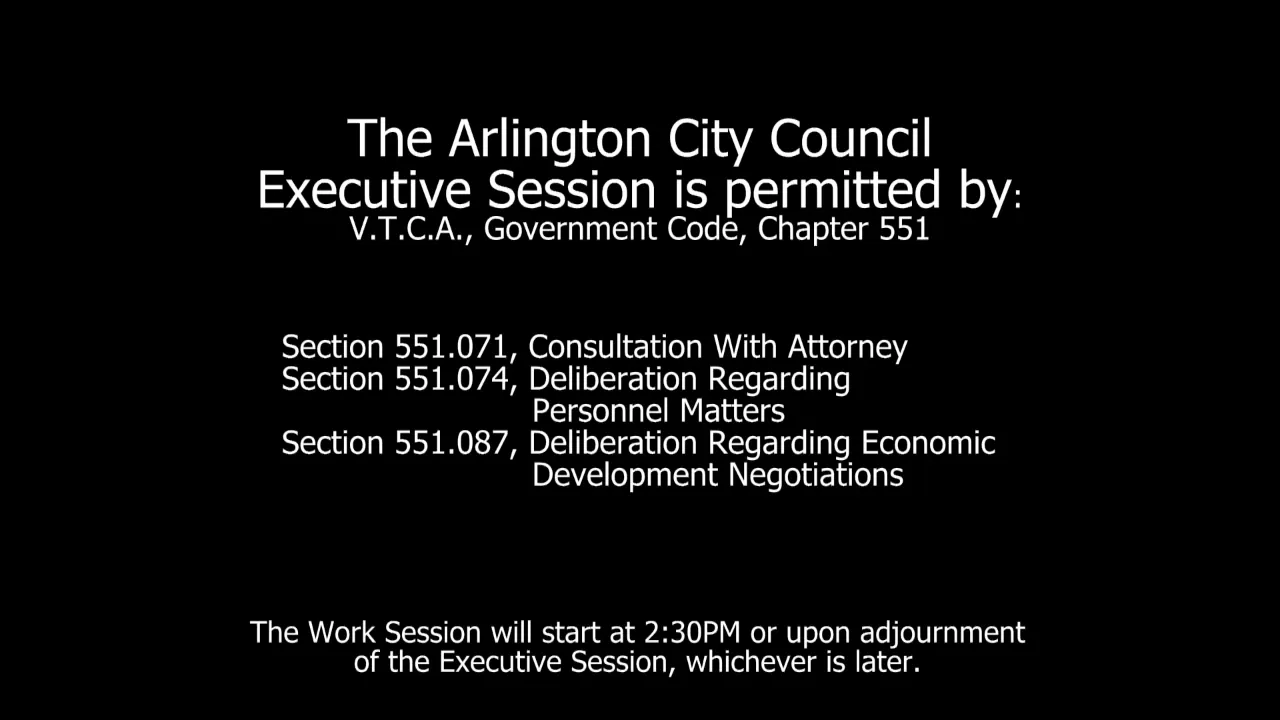
- The council convened in executive session at 12:30 p.m. to discuss: litigation (City of Arlington vs. Aiman Investments, Zoning Board appeal, AFFF litigation), employment of the Presiding Municipal Court Judge, performance reviews of council appointees, and economic development incentive offers.
- Executive session adjourned at 2:15 p.m.; open session reconvened at 2:32 p.m.
Work Session Items
- Tarrant County Public Health Update – Dr. Brian Byrd (Director) and Russ Jones (Chief Epidemiologist) presented on flu, bird flu (H5N1), and measles. They noted flu was the worst in over a decade, H5N1 risk to the public remains low but with moderate pandemic potential (70 human cases nationally, 1 death), and a measles outbreak in West Texas (124 cases, mostly children). They emphasized vaccination and mentioned a new initiative to increase childhood vaccinations to 10,000 in 2025.
- Downtown Farmers Market – John Chapman presented a one-year license agreement (with two two-year extensions) for Four Seasons Markets to operate a Saturday market north of the downtown library, starting March 29, 2025. The agreement includes a $500 annual fee, $1,000 escrow, and a $1 million insurance policy. Councilmembers expressed excitement and asked about marketing, vendor availability, and feedback mechanisms.
- Arlington Police Department Racial Profiling Report – Chief Al Jones and Deputy Chief Steve Williams presented the annual report, showing 83,335 traffic stops in 2024 (a ~30% increase from 2023). Key findings: 98% of stops were made without prior knowledge of race; search outcomes were consistent across racial groups; contraband was found in nearly half of searches, with arrests following in 85% of those cases. The report will be posted on the city website.
- Council Priority – Champion Great Neighborhoods – Jennifer Wichmann presented an update on the priority, including progress on commercial corridor initiatives, the comprehensive plan (adoption expected October 2026), a homeless encampment coordinator (348 inspections in Q1), a form-based code (RFP delayed but on track), goat grazing for invasive plants, and improved animal reunification (from 16% to 27%). Staff also highlighted challenges with volunteer hours.
Discussion of Issues Session Items
- Used Auto Sales Certificate of Occupancy Update – No discussion; Councilmember Caso praised progress.
- Universal Design Standards – John Chapman presented survey results (11 respondents) showing developer familiarity but low demand. Councilmembers debated voluntary incentives vs. mandates; staff recommended educational materials rather than requirements. Councilmember Odom-Wesley noted a 121% increase in senior population since 2000 and advocated for some requirements for city-assisted housing.
- Fire Protection Fees – Alex Whiteway explained proposed fee adjustments to distribute costs more evenly and avoid higher water rate increases. Councilmember Pham raised concerns about impacts on small churches; Whiteway said staff are working with the fire department to reduce fire line sizes where possible and will explore adjustments for nonprofits/churches.
Committee Reports
- Community and Neighborhood Development – Councilmember Boxall reported on PY2025 CDBG planning. Estimated PY25 allocation is $3,191,069; 20 funding requests totaled $901,957 (exceeding the $474,660 public service cap). Recommendations include funding prior-year organizations (except those returning funds, scoring below 70, or not meeting guidelines), funding two new organizations (C5 Youth Foundation and Texas Family Pathfinders), and $2,014,337 for city projects. Further review will incorporate ESG and HOME funds.
- Municipal Policy – Councilmember Odom-Wesley reported on the Unified Development Code (UDC) annual update, which includes six clarifications, three corrections, two new/modified definitions, and eight substantive changes (setbacks, fencing, platting). Next steps: P&Z meeting March 5, Developer Roundtable March 13, full council briefing March 25.
External Committee and Training Reports
- Regional Transportation Council – Councilmember Gonzalez reported on the February 13 meeting: approved $380,000 for work zone data exchange; removed wording about protecting dedicated transportation funding from the legislative agenda.
- U.S. Conference of Mayors Winter Leadership Meeting – Mayor Ross reported on recent meetings in D.C. and Phoenix, highlighting discussions on federal funding uncertainty and ICE operations.
- Arlington Convention and Visitors Bureau – Councilmember Hogg had no report (item was inadvertently skipped).
- Workforce Solutions Governing Board – Mayor Ross announced the hiring of Robert Stearns as new executive director.
- North Texas Commission Executive Committee – Mayor Ross was unable to attend.
- NLC Human Development Federal Advocacy Committee – Councilmember Odom-Wesley reported on February 18 call, noting concerns about ICE raids and frozen homelessness funding.
- NLC Finance, Administration, and Intergovernmental Relations Advocacy Committee – Councilmember Gonzalez reported on February 20 meeting, covering municipal bonds, tax reform, blockchain bonds (Quincy, MA example), and the use of PayPal conversion services.
Miscellaneous Reports
- Appointments to Boards and Commissions – No appointments on the evening agenda.
- Legislative Update – Natalie Raulston and Jay Warren provided updates on state and federal legislation. State: five HFC-related bills filed; ADU and lot size bills (HB 878, SB 673) expected to move quickly; Representative Turner chairs property tax subcommittee. Federal: city receives about $230 million annually; $165 million already received; funding freeze uncertainty persists.
- Evening Agenda Items – Council discussed several items: fire department interlocal agreement (7.25) to address frequent 911 callers; Atmos and Encore steering committee fees (7.30 and 7.31); Watson housing resolution (7.33) noting potential name change; and zoning case PD 24-30 Wandaway (10.2) where Councilmember Gonzalez reported on opposition and clarified homes will start at $450,000.
- Future Agenda Items – Councilmember Boxall requested a study on allowing single-car garages on infill lots of 6,000 sq ft or less, to be referred to the Developers Roundtable.
Key Outcomes
- No formal votes were taken during this work session; most items are set for action at the March 4, 2025 regular meeting (e.g., farmers market license agreement) or future meetings.
- Staff will explore adjustments to fire protection fees for churches and nonprofits.
- Staff will consider universal design standards outreach materials and potential requirements for city-assisted senior housing.
- The municipal policy and community development committees will continue their respective reviews.
- The meeting adjourned at 4:33 p.m., with the evening session scheduled for 6:30 p.m.
Meeting Transcript
Okay, we're gonna go ahead and call the afternoon session of the city council meeting to order it is. Okay, folks. We're gonna go ahead and see call the afternoon session back to order. We're gonna move on down to our agenda to 3.1. Dr. Byrd, don't run away too far because you're the first up first back. So Dr. Brian Byrd, Terrant County Health Director. Welcome, sir. Thank you, Mayor and Council. As the mayor just said, uh I'm Brian Byrd, Terran County Public Health Director. I'm joined by the person who really knows what they're talking about, our chief epidemiologist, Russ Jones. We're going to give a basic uh infectious disease overview. There are a number of things circulating that we're seeing in the in the news. We'll talk a little bit very briefly about our current flu outbreak. We'll talk about bird flu. We're keeping an eye on bird, yeah, that is my last name. So you know, double entendre. Uh so far, bird flu has stayed mostly in cows and birds. It hasn't yet attained the ability to jump human to human, but if it does, we've got a real booger bear on our hands. And then we'll talk briefly about the measles outbreak that we're seeing in the South Plains area and what we need to know about it, particularly what you as leaders need to know about it, and then we'll be happy to take questions after that. I like to hear from experts, and that's why I'm more than happy to turn it over to Russ Jones, the chief epidemiologist for Terran County Public Health. Russ, please take it away. And thank you all for having us. Umacted. That's what we're going to talk a little bit about. We're just real quick about regular flu. It's been high this winter, it's probably the worst we've had in over 10 years. Huge amounts of flu. It is coming down, it's still high. Probably will be for a couple more weeks. It's rapidly coming down because so many people were infected. I want to talk about bird flu and how it affects us, what's going on there. Um influenza's been around for a long time. It periodically causes pandemics. We'll get to that in just a few minutes. But um, well, we'll just do it now. In H 1918, so it's been over 100 years, you had the Spanish flu. It caused uh an estimated 50 million deaths in the year and a half, two years that it circulated. Now that's compared to 16 to 19 million through the COVID epidemic pandemic we just went through. So it was bad. Um it was occurring at about the time of World War One. Um apparently may have started in the United States, went to Europe, came back as a as a terrible flu. And we've had other pandemics in 19 um 57, about 116,000 deaths from um Asian flu. And then H3N2, the Hong Kong flu is the first time I had flu. I think it was eight years old. Um and that caused approximately 100,000 deaths here in the United States. And then in 2009, if you remember, it was H1N1 made a reappearance. It's a cousin one that was in uh from 1918. We called it swine flu, because it was a remix that was uh come out of pigs out of Mexico in particular.
openpublica.com